Opinion | Why China Is Producing More, Selling Cheaper - And Still Not Getting Anywhere
More capital, more capacity, more elaborate technology, and steadily less profit to show for any of it. That's what's happening to China now.
In 1963, anthropologist Clifford Geertz, in his study of Javanese rice farming, gave an old word a second life. The word was 'involution'. Geertz used it for a system that absorbed ever more labour onto the same wet paddies, growing more intricate and more crowded, yet never breaking through to higher productivity. More hands, more elaborate arrangements, the same output per head. A treadmill dressed as progress.
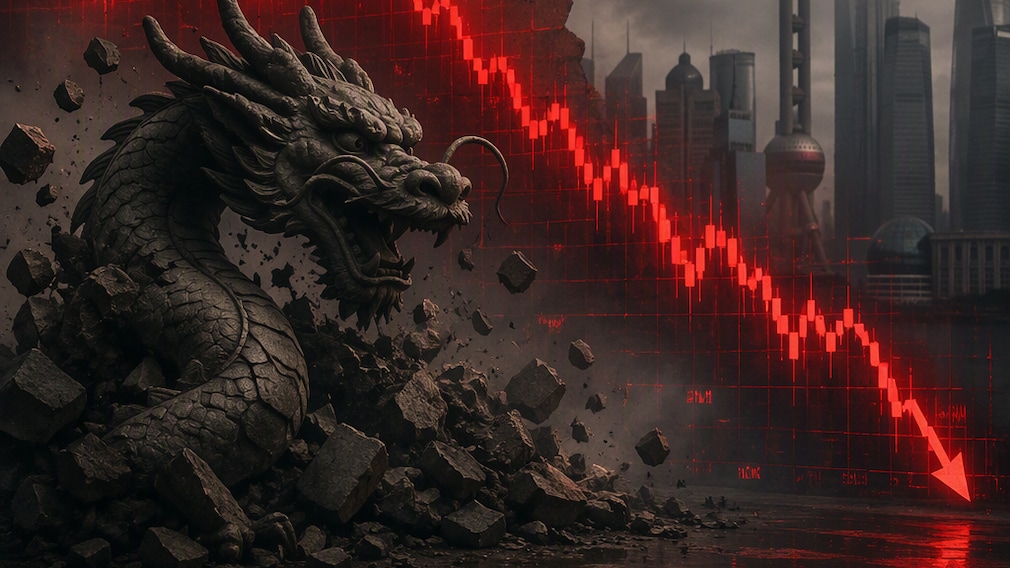
Six decades on, the word has migrated to a country Geertz never wrote about. Young Chinese call it 'neijuan'. Officials in Beijing have adopted involution as a term of policy. This is used for the self-defeating price wars in which makers of electric vehicles, solar panels, and food delivery undercut one another until no one earns a margin. The market that fell into a bear this week is the financial expression of the same treadmill. More capital, more capacity, more elaborate technology, and steadily less profit to show for any of it.
The Big Crash
The numbers are these. Chinese equities lost about 2.4 trillion dollars in market value between a peak in May and October 22 this year. The China Securities Index (CSI) 300, the benchmark of the 300 largest mainland firms, closed 1.8% lower on Thursday, taking its fall from a June high to 20%. It has now declined for ten straight weeks. Shanghai's technology board, the STAR 50, is down close to 40% from its late June peak, which erases its entire gain for the year.
Begin with the trigger. The rally that started in late 2024 ran first on stimulus, then on artificial intelligence (AI). Optimism around the startup DeepSeek and heavy state support drove technology valuations to levels that earnings never justified. What has turned is the question of whether the enormous capital spending of the AI hyperscalers will earn a return. The doubt is global. Softbank's shares have halved from a June high. In Hong Kong, the Hang Seng Tech index is down 31% for the year. Alibaba fell 6.1% in one session after regulators summoned e-commerce firms over product quality. Contemporary Amperex Technology Limited (CATL), the battery maker, dropped 12% on a profit miss. Valuations built on a narrative are the first to fall when the narrative is questioned.
Beneath the trigger sits the reason. Home prices have fallen about 30% from their 2021 peak. Property investment contracted 20.6% in the first nine months of 2026, and fixed asset investment fell 7.2%. Retail sales rose 1.1% in September, against 3% a year earlier. Falling house prices erode the one asset in which Chinese households stored their savings, and a household that feels poorer saves rather than spends.
Here, precision matters. On the headline, China left three years of falling prices earlier in 2026, and producer prices rose 5% in September. Shorn of the import effect, the recovery dissolves. That jump came from oil after the war with Iran and from chips amid the AI boom, not from domestic demand. Core consumer inflation was 1%. Underneath this is demography. Births fell to 7.93 million in 2025, the lowest since 1949. The working-age share of the population has slipped to about 61% from more than 70% a decade earlier. The buyer base is shrinking.
Add the flight of capital. Foreign investment inflows fell 4.3% in the first three quarters to 548.8 billion yuan, while Chinese outbound direct investment reached 101 billion dollars. Margin financing has dropped to a level last seen in late 2025. The state can place a floor under the index, as its "national team" did by trading some 52 billion yuan of exchange-traded funds in a session. It cannot manufacture confidence. Beneath the market lies the older problem of local government financing vehicles, whose hidden debt the International Monetary Fund puts at about 60 trillion renminbi, roughly 48% of GDP.
When Too Much Happens At Once
What, then, becomes of the Chinese economy? Officially, it is steadying. The GDP grew 4.5% in the third quarter, within the target band of 4.5 to 5%, itself the least ambitious goal since 1991. Capital Economics estimates true growth nearer 2%. The steadying is entirely external. The monthly trade surplus hit a record 134 billion dollars in September, and the year will pass last year's record of 1.19 trillion dollars. Yet integrated-circuit export volumes rose only about 1% once price gains are removed. This is a K-shaped economy, a thriving export summit, and a sinking base of consumption, with no policy yet bold enough to join them. A genre has appeared on Chinese social media of the "fake commute", the laid-off worker who leaves home each morning to sit in a library so relatives do not learn the truth. Gig employment is expected to reach 320 million people in 2026. The rally never reached them.
Now the global implications. Deflation is an export. A producer with idle capacity and no buyer at home sells abroad below cost. September shipments rose 40% to the United States, 25% to the European Union, and 52% to Southeast Asia. The European Union has negotiated quotas on hybrid cars and is drafting a tool to shut China out if tensions escalate. History counsels caution about the panic that follows. The 2013 paper by David Autor, David Dorn, and Gordon Hanson attributed about a quarter of American manufacturing job losses from 1990 to 2007 to Chinese competition. Lorenzo Caliendo and co-authors put the national figure at 16% in 2019, and a 2022 correction for automation halved the effect again.
For India, the account is mixed. Cheaper oil, coal, and iron ore are a terms of trade gain for a net importer. Against that, imports from China reached 79.41 billion dollars in the first half of 2026-27, and the annual deficit is running above last year's 116 billion dollars. India has opened anti-dumping cases on steel and chemicals. A duty is a defensible shield. It is also a tax on the Indian firm that buys the input.
Geertz's farmers never starved. They simply worked harder each year to stand still. China's market has now priced what its shopkeepers, selling sweaters at a loss in a Beijing wholesale market, already knew. Involution is not a crisis. It is the absence of one, indefinitely prolonged.
(The author was with the Economic Advisory Council to the Prime Minister)
Disclaimer: These are the personal opinions of the author
-
Opinion | Jamnagar, Rubio, And Why The US Wants India To 'Obey', Not Negotiate

Marco Rubio's dash to Jamnagar was driven by Trump's hope that India could do something about the shortage of diesel that the world is experiencing and thereby help his mid-term performance. But why the punishing policies then?
-
Opinion | A Jolt For Trump? How The US May Be Staring At A 'Blue' Wave
Evidence now points firmly to a Democratic majority in the House. The only real surprise is the Senate
-
Opinion | Why The Saudi-Pak-Turkey Defence Pact May Actually Be An 'Intel' Network
Rather than a NATO-like construct, the Mecca pact may evolve to become something like the West's Five Eyes alliance.
-
The Real Story Of France's Unrest Is Getting Lost In A Storm Of Online Lies
A man cosplaying Napoleon on the streets, looting at luxury fashion stores like Dior, France is currently confronting one of its most serious episodes of civil unrest in years.
-
Opinion | The Last Bet? What Trump's 'Mother Of All Bombs' Could Actually Do To Iran
Can an MOAB deliver a decisive blow to Iran that may force it to surrender immediately, as Japan did after Hiroshima and Nagasaki in World War 2?
-
Hit Songs, Empty Pockets: The Hidden Math Behind India's Viral Music Boom
Over 80,000 brands and five lakh creators in India make branded content. The opportunity is worth around Rs 1,500 crore.
-
Opinion | Great 'Exceptions': How The Oil India Was Attacked For Is The Oil Trump Now Seeks
A law written to punish the buyers of Russian oil was suspended by the US to protect a purchase of Russian oil. India spent fourteen months being lectured for less.
-
Opinion | Louis Vuitton Loot, Torched Cars: France Protests Have An Unlikely Beneficiary
It's an unbelievable moment. Crowds looting the most exclusive stores in Paris, including the famed Luis Vuitton. But what's behind this meltdown?
-
Blog: Kolkata Didn't Learn From 2015. Eleven Years Later, It Proved To Be Fatal
The City of Joy isn't a stranger to crowd control. Be it during Pujo or Christmas at Park Street, Eden Gardens cricket matches, or Derbies between Mohun Bagan and East Bengal. But during Pujo, the entire city is on alert.