Opinion | Britain Seems To Have A New National Hobby: Firing Its Prime Ministers
Britain's Prime Ministers are dropping like mayflies, and nobody seems to be able to stop the mayhem.
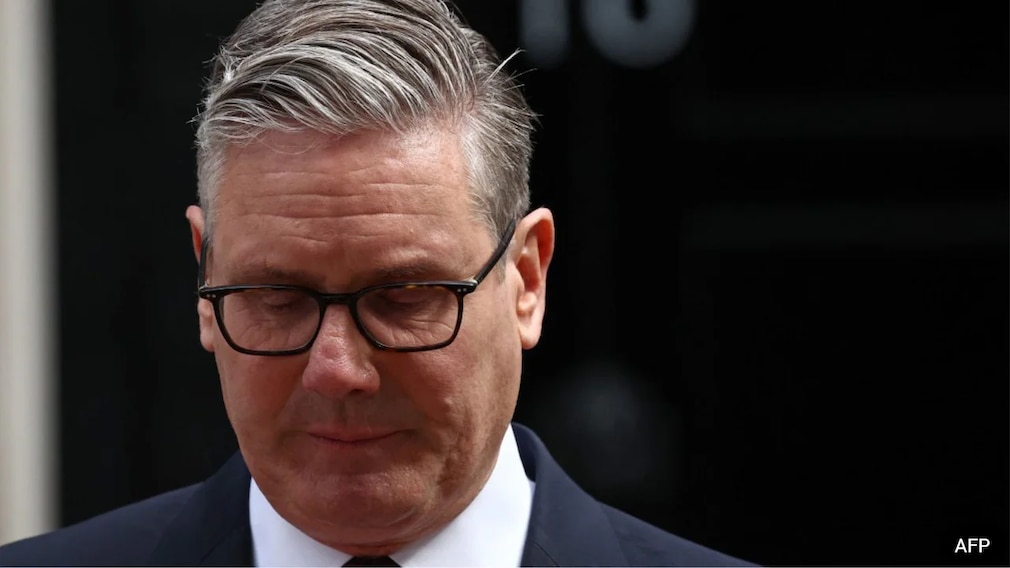
The tale of Britain's revolving-door prime ministers has become an embarrassment, if not the outright butt of social media jokes and memes.The churning at alarming regularity in Downing Street looks less like democratic renewal and more like political musical chairs. The country once prided itself on political stability. Not long ago, Margaret Thatcher spent more than a decade in Downing Street. Tony Blair lasted 10 years. Even David Cameron survived six. Today, however, the world's one of the oldest democracies suffers from an unbelievable inability to keep a prime minister in office.
If Andy Burnham eventually succeeds Keir Starmer, Britain will have had seven prime ministers in roughly a decade: David Cameron, Theresa May, Boris Johnson, Liz Truss, Rishi Sunak, Keir Starmer and now Burnham or someone else. For a country that likes to lecture others on stable democratic governance, it is an astonishing but quite worrying record.
The most obvious question is why. Why has British democracy become so politically restless? Why do prime ministers now seem to have shorter shelf lives and are found easily disposable?
Some here believe that the easy answer is Brexit. The referendum simply divided Britain. It also shattered the political consensus that had ruled the country for decades. It exposed deep tensions between London and the rest of the country, between younger and older voters, between those who felt globalisation had benefited them and those who felt abandoned by it.
No British prime minister since Brexit has truly escaped those divisions. Theresa May was consumed by trying to implement Brexit. Boris Johnson won power by promising to "Get Brexit Done" but discovered that slogans are easier than governing. Liz Truss destroyed her own premiership in a matter of weeks. One saw Rishi Sunak coming as a breath of fresh air. He inherited a broken Conservative Party but carried on bravely until he was undone by the weight of his own promises.
Keir Starmer, who also inherited a broken country, must be credited for getting a handsome win at the election in 2024, temporarily uniting the people in opposite camps. But in many ways, Starmer's fall is the most fascinating of them all. Future historians will struggle to identify his great political crime. He did not crash the economy. He felt the pressure of Trump who pushed him hard to join him in the war against Iran, But he did not lead Britain into war. He was not involved in any corruption or scandal
Yet he still fell. His mistake appears to have been more subtle. He offered just about enough competence at a time when voters were demanding transformation. Britain today is a country where economic growth has stagnated, public services are struggling, housing is increasingly unaffordable and living standards have barely improved for many households in years.
Voters did not merely want a more efficient prime minister. They wanted someone who could persuade them that the future would be better than the present. Starmer never managed to tell that story. He could never win the war of narratives against the Reform Party or other opponents. Ironically, it's quite shocking to see that the former chief prosecutor struggled to make his case. He was seen as a ruler who believed that seriousness alone would eventually be rewarded. But he should have known that vVoters often forgive mistakes. What they rarely forgive is a sense that nothing is changing. Stagnation is a politician's biggest adversary
The other thing that slowly crept against his premiership was the rise of Reform UK and the wider populist right. Nigel Farage has achieved something remarkable. He has convinced millions of voters that he is an anti-establishment outsider despite spending decades in politics. The more mainstream politicians attacked him, the stronger he appeared to have become. Labour responded by shifting to the right on migration and border controls, hoping to win back voters tempted by Reform.
The strategy failed. And it failed miserably. The public wanted the original, they did not want the imitation. The result was predictable. Labour lost support both to Reform on one side and to the Greens on the other.
To be fair Starmer came to power at a time when the move to the right had become a force globally. Across Europe, centre-left parties faced the same dilemma. Do they move closer to the populist right or offer a clear alternative?
Starmer chose convergence. His critics now argue that Burnham is being chosen because he represents contrast. Whether that proves true remains to be seen. But Burnham's appeal is easy to understand. He comes from northern England. He talks about jobs, transport, housing and public services.
He defeated the Reform Party candidate a few days ago in a bypoll. Most importantly, he still looks vaguely connected to ordinary life, which in modern politics has become a rare skill. That does not mean his path will be easy. Many Labour MPs privately admit they know surprisingly little about how Burnham would handle foreign policy, defence spending or relations with Donald Trump.
Another increasingly important factor in British politics and its gross instability is the US. For decades Britain influenced America. Increasingly it feels as though the reverse is true. British political debates and those being at play in Europe are now heavily shaped by American culture wars. Immigration, identity politics, gay rights, diversity, free speech, social media and even policing controversies increasingly arrive through an American lens. The influence extends beyond ideas. Leaders, such as Donald Trump, JD Vance and Elon Musk comment regularly on British politics. Right-wing American influencers amplify British controversies. British political stories often go viral in the US before they do in Britain.
Trump recently diagnosed Britain's problems in classic Trump fashion. "Energy and immigration," he said. "He's really hurt himself very badly." He was reacting to Starmer's resignation. And it is simple, direct and instantly understandable. Whether accurate or not is almost irrelevant. Many voters increasingly prefer simple explanations to complicated ones. That is something Britain's mainstream politicians still struggle to understand. There is also a growing sense that parts of the American right would be perfectly happy to see Reform UK form the next government. Mind you Britain doesn't matter to them in practical terms. They focus on Britain because the countryn has become a symbolic battlefield.
The American far right may want a mid-term parliamentary election. If Reform wins power, it would be seen as further evidence that the populist revolt sweeping parts of Europe remains alive and growing. A Reform victory would be celebrated in many of the same circles that celebrated the victories of Giorgia Meloni in Italy, Geert Wilders in the Netherlands and Donald Trump in the US.
That simply doesn't mean that there is some grand American conspiracy to install Farage in Downing Street? An emphatic no. British voters will decide Britain's future. But there is little doubt that sections of the American right view Britain as an important front in a broader ideological struggle. Social media has made national politics increasingly international.
Arguments that once stayed within national borders now travel instantly across continents. A speech in Washington can influence voters in Manchester. A riot in Britain can become ammunition in an American election campaign. A controversial arrest in London can become a talking point on Fox News within hours.
The old boundaries have disappeared. This creates a final challenge for whoever succeeds Starmer. The next prime minister will not merely be governing Britain. He will be governing Britain in an age when politics has become globalised, polarised and permanently online.
Every mistake will be amplified. Every controversy will be internationalised. Every policy will be judged not only by voters at home but by ideological tribes abroad.
Perhaps that explains why modern British prime ministers seem unable to survive. The pressures are greater than ever. The electorate is more fragmented than ever. Trust in institutions is weaker than ever. The irony is that Britain still looks stable from a distance. Elections remain free. Governments change peacefully. Parliament still functions. But beneath the surface lies a profound uncertainty about where the country is heading. I speak to people in cafes, at stations, in trains and planes. Their uncertainty has now consumed Conservative and Labour leaders alike.
Andy Burnham may yet prove different. But recent history suggests caution.The next occupant of Downing Street may discover that winning power is no longer the difficult part.
Keeping it is.
(Syed Zubair Ahmed is a London-based senior Indian journalist with three decades of experience with the Western media)
Disclaimer: These are the personal opinions of the author
-
Gyanesh Kumar Has An Immunity Pin. Why A Petition Says He Can't Use It

The Opposition wants the Chief Election Commissioner prosecuted for alleged manipulation of voter rolls, but a 2023 law stands in the way. A petition in the Supreme Court now says the law has a gap.
-
Opinion | Is The World Staring At A Big Stock Market Crash - And Recession? 5 Uneasy Signs
On Wednesday, the US bond market recorded its worst day since Trump's "Liberation Day" tariffs rattled markets in April 2025. The 30-year US Treasury yield topped 5.43%, putting it on track for its highest close since 2004.
-
Form 6 For New Voters: When A Small Change Triggered A Big Row
In July 2026, the online version of Form 6 on the ECI's ECINet portal was modified to include a new declaration.
-
Opinion | Saudi Arabia's China Turn Has Begun - After Learning Much The Hard Way
Leaning on China just makes sense for the Saudis right now. The question is, can its other great 'ally' stomach it?
-
Opinion | Bihar Assault, Hisar Marriage Ban: Who'll Stop The Guardians Of Indian 'Culture'?
Why exactly does the sight of a young couple seeking a bit of alone time somewhere tend to particularly provoke a certain kind of Indian men?
-
Opinion | The Trump-Xi Summit, And India's Many Worries Of Its Own
Washington and Beijing may have chosen coexistence over confrontation. For India, that could be both a relief and a warning.
-
Opinion | China Claims It Has Cut Troops At The Indian Border. But The Math Doesn't Add Up
The reduction likely has more to do with the deployment along the LAC than the total strength active in the region
-
Opinion | China Is No Longer Waiting For Trump To Set The Rules. And He Knows It
America's old diplomatic tricks with China won't work any longer. Because China has changed, and so has its ambitions.
-
Opinion | As UN Interviews Its Next Chief, The Interviewers Have Some Explaining To Do
On the panel sit governments whose wars, vetoes, and unpaid dues have helped make the organisation ineffective.