Opinion | The Quiet 'Upheaval' Within US Military Over The Iran War
General Randy George's ouster carries echoes of a similar episode in 2003, in the run-up to the Iraq war. But much more is happening within the US military, courtesy Hegseth.
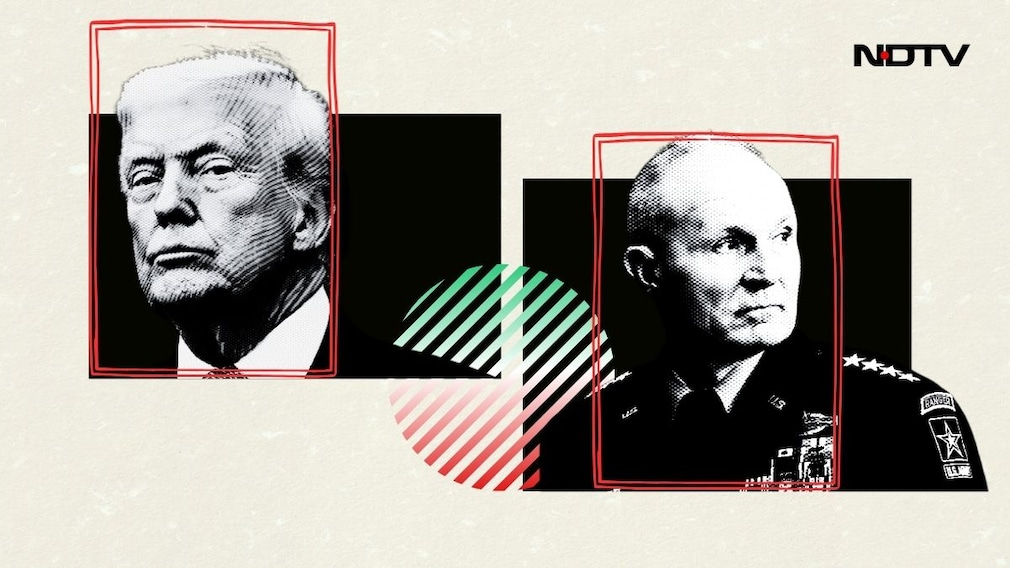
A series of developments inside the United States military has brought a deeper issue into focus: what happens when visible disagreement emerges between the military and political leadership during an ongoing war?
The sequence of events in the Iran campaign is now reasonably clear.
General Randy George, the US Army's chief and a highly decorated infantry officer who served in the Gulf War, Iraq, and Afghanistan, was removed while American forces remained engaged in operations against Iran. His tenure had not run its course. George's firing stemmed in part from Hegseth's long-running grievance with the Army and his troubled relationship with Army Secretary Dan Driscoll, with whom George had been an ally. Driscoll is widely seen as aligned with Vice President JD Vance, adding a dimension of internal political rivalry to what was formally presented as a routine leadership change.
The Rumsfeld-Shinseki Episode
The parallel with an earlier chapter of American civil-military history has not gone unnoticed. George's ouster carries echoes of Defence Secretary Donald Rumsfeld sidelining General Eric Shinseki after disagreements over troop requirements for the Iraq war. Shinseki paid professionally for his candour. The pattern, a serving chief removed mid-conflict amid reported differences over operational direction, is recognisable. Reporting suggests George opposed Hegseth's push for a land war in Iran, though whether Trump fully backs such a plan remains unclear.
Additional developments reinforce the picture. Hegseth has been linked to interventions in promotion processes, including instances where Black officers and women were removed from consideration at senior levels. He intervened to remove multiple Army officers from a promotion list after Driscoll refused to do so, an unusual step that drew White House attention. A close associate from the Secretary's own office has reportedly been positioned as the leading candidate for the next Army chief, suggesting that the basis for top appointments is shifting.
Institutional safeguards have been adjusted as well. Senior military legal officers, responsible for advising on the legality of operations, have been removed. These positions have traditionally served as an internal check within the chain of command, particularly during active operations.
A further strand concerns the framing of the Iran campaign itself. Throughout the month of attacks, service members reported rhetoric from commanders invoking the idea of a "holy war", and the Military Religious Freedom Foundation received over 200 complaints from active-duty personnel. One non-commissioned officer described being told the conflict is part of "God's plan" and that the President was "anointed by Jesus to light the signal fire in Iran". Hegseth has used Christianity to justify the US-Israeli war against a Muslim-majority country, telling Americans to take a knee and pray for victory "in the name of Jesus Christ". More than two dozen members of Congress have formally requested an Inspector-General-level investigation into whether such a war framing contravenes constitutional protections and professional military norms.
Taken together, these developments describe a moment in which the military and executive are not fully aligned on a major conflict, and where that gap is being managed through changes in leadership, process, and internal structure, simultaneously, and under operational pressure.
The Balance That Matters Most
Civil-military systems are designed to accommodate disagreement. Professional militaries are expected to offer candid advice; political leaders are expected to decide. The strength of the system lies in its capacity to absorb that tension without fracturing institutional coherence.
During wartime, that balance becomes especially consequential. An armed force engaged externally depends on internal stability, clarity of purpose, and continuity of command. When senior leadership changes frequently, when promotion processes attract scrutiny, and when advisory mechanisms are restructured, the institution is required to adapt at multiple levels simultaneously while managing an active conflict. These conditions place heavier demands on the system precisely when those demands are already high.
Lessons Closer Home
Pakistan offers the starkest regional lesson: decades of military-sponsored religious nationalism did not strengthen the state. It hollowed it out, producing institutional decay, democratic erosion, and a security apparatus that ultimately became ungovernable.
India is not immune to these pressures either, though it faces them on a far smaller scale; of late, veterans have flagged public displays of religious affiliations by some uniformed officers.
The American situation in the Iran campaign is still developing. Its long-term impact will become clearer with time. What it has already demonstrated is that the management of internal military coherence is a wartime requirement, not a peacetime luxury. Because when an armed force is asked to look inward while engaged outward, how it manages that adjustment shapes outcomes well beyond the battlefield.
(The author is a Former Visiting Fellow of the U.S. National Defense University and alumnus of the University of Wyoming. His current research interests include US domestic politics and foreign policy)
Disclaimer: These are the personal opinions of the author
-
Opinion | The Last Bet? What Trump's 'Mother Of All Bombs' Could Actually Do To Iran

Can an MOAB deliver a decisive blow to Iran that may force it to surrender immediately, as Japan did after Hiroshima and Nagasaki in World War 2?
-
Hit Songs, Empty Pockets: The Hidden Math Behind India's Viral Music Boom
Over 80,000 brands and five lakh creators in India make branded content. The opportunity is worth around Rs 1,500 crore.
-
Opinion | Great 'Exceptions': How The Oil India Was Attacked For Is The Oil Trump Now Seeks
A law written to punish the buyers of Russian oil was suspended by the US to protect a purchase of Russian oil. India spent fourteen months being lectured for less.
-
Opinion | Louis Vuitton Loot, Torched Cars: France Protests Have An Unlikely Beneficiary
It's an unbelievable moment. Crowds looting the most exclusive stores in Paris, including the famed Luis Vuitton. But what's behind this meltdown?
-
Blog: Kolkata Didn't Learn From 2015. Eleven Years Later, It Proved To Be Fatal
The City of Joy isn't a stranger to crowd control. Be it during Pujo or Christmas at Park Street, Eden Gardens cricket matches, or Derbies between Mohun Bagan and East Bengal. But during Pujo, the entire city is on alert.
-
Opinion | Slurs, Threats, Now A Temple Attack Plot: When Did America Become So Hostile To Indians?
The rising tide of anti-India, anti-Hindu, and racist attacks serves as a stark reminder that economic prosperity does not automatically guarantee social immunity from bigotry.
-
A Step Behind Neha Bora: What Rahul Gandhi's Gesture Says About Congress' Gen-Z Pitch
At INDIA bloc's march to Supreme Court, Rahul Gandhi placed himself a step behind two women, hands resting on their shoulders. One was his sister Priyanka. The one on his right was Neha Bora. Here's what the image means for the protest wave now, and for Rahul's politics in general.
-
Opinion | Imran Khan, And The Perils Of Having An 'Opinion' In Bollywood
The reality of the industry is quite grimy. More often than not, its inhabitants have been fairweather friends, happy to sing the praises of whoever is in a position of authority.
-
Exclusive: India's Food Safety Problem Goes Beyond Just Dirty Kitchens - By Tukaram Mundhe
On World Food Day, Maharashtra's Commissioner of Food Safety explains why instead of taking stopgap measures, the entire supply chain in India needs to be held accountable and made transparent.
-
Opinion | India Has Enough Coal. So Why Are Power Plants Running Short? A 76 Million 'Crunch'
As of October 5, as many as 82 of the 191 thermal plants monitored by the Central Electricity Authority were in the 'critical' category