Opinion | US Attack On Chabahar, And Why It's Time India Stopped Playing By Others' Whims
As the US destroys Chabahar in Iran, one thing is clear: India cannot wait eternally for the whims of others to do what is vital for its own interests.
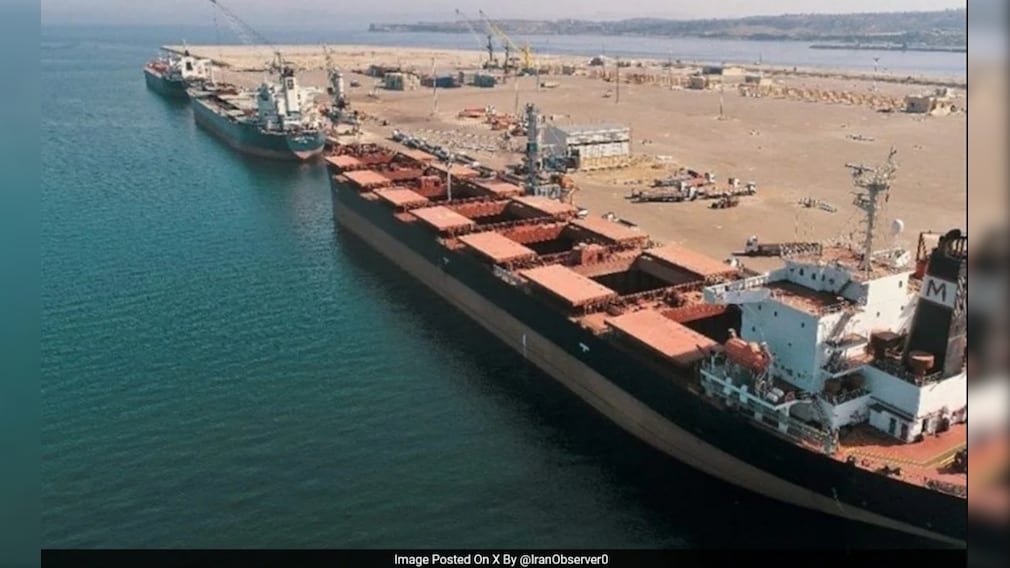
The US Central Command on Friday confirmed on a post on X that "on July 16, US forces successfully destroyed the Chah Bahar Shahid Kalantari Port surveillance tower, part of a maritime surveillance network along Iran's Gulf of Oman coastline used for decades by the Islamic Revolutionary Guard Corps (IRGC) to track and target commercial vessels transiting the Strait of Hormuz".
The Ministry of External Affairs immediately assuaged fears about damage to India's interests at the port site. India has invested in developing the Shahid Beheshti terminal at Chabahar port. But the reignition of the conflict once again puts India's plans and ambitions under a cloud.
Ill-Fated From The Beginning
Ever since the Chabahar port project was first mooted, it had been plagued by uncertainties stemming from Western sanctions on Iran. The nuclear deal (the Joint Comprehensive Plan of Action, or the 'JCPOA') between Iran on one hand and the US, the UK, France, Russia, China, Germany, and the European Union on the other, provided a brief respite. Nonetheless, India went ahead and, in 2016, signed a trilateral agreement with Iran and Afghanistan for the port, earmarking USD 500 million for the development of the Shahid Beheshti terminal. Since 2018, the port's operations have been managed by the New Delhi-backed India Ports Global Limited (IPGL).
However, in his first term, as US President Donald Trump pulled out of the JCPOA, sanctions on Iran came back. Still, given the port's usefulness in sending supplies to Afghanistan from India, bypassing Pakistan, Trump perhaps felt incentivised to waive sanctions on it, and India could continue with its engagement and outreach to Afghanistan. In 2024, India even announced that it was signing a 10-year contract with Iran for the operation of the Chabahar port.
All this alludes to just how critical the port is to India's geo-strategic and geo-economic ambitions. Anodyne analyses, about Chabahar being crucial only because it allows India to bypass Pakistan and access Afghanistan and Central Asia, are lazy at best and ignore the larger picture. Governments change, regimes collapse, wars end, and even borders may change. Geography, however, is a constant. The Chabahar port - and by extension Iran - is important for India because much of India's Eurasian policy hinges on it.
Why Chabahar Matters So Much
Iran's Chabahar Port on the country's east coast is the nearest node for India to reach not just Afghanistan and Central Asia, but also Russia and Europe. In terms of trade and connectivity, its significance has grown exponentially over the past few years and continues to increase with each geopolitical escalation. Just a few years ago, the frailties of the traditional Suez Canal route had been exposed as a stuck megaship completely stopped all traffic in the canal for six days. In this regard, Chabahar is easily the closest and far more cost-effective alternative.
Beyond Chabahar, Iran is also important for India's access to the Russian Federation as well as to the South Caucasus, the Balkans, and West Europe through the International North-South Transport Corridor (INSTC). The INSTC is the shortest trade route between India and Russia, 30% cheaper and 40% shorter than the Suez, significantly reducing transit time for Europe-bound shipments. Iran thus becomes a gateway to India's access to the Black Sea and Mediterranean ports via a route that runs through Iran, Armenia, and Georgia.
Chabahar's role is further bolstered by the setback the India-Middle East-Europe Trade Corridor project has received due to the Iran war. Instead of going through Israel, as originally envisaged, the Saudis are re-routing the IMEC through Syria and India's rival, Turkey. Chabahar can provide an alternative route to Mediterranean and Black Sea ports for India, bypassing Turkey. The closure of the Strait of Hormuz similarly strengthens Chabahar's appeal as the port lies outside the route and can be accessed easily.
The Rise Of China
Geopolitically, too, Chabahar serves an important function. It is a counter to the China-developed Gwadar Port in Pakistan. Moreover, Pakistan's mediation role notwithstanding, Iran-Pakistan relations have always been complex and complicated, which allows Iran to act as a balancing player on Pakistan's western borders.
Operation Sindoor revealed the Pakistan-Azerbaijan-Turkiye nexus against India. This has automatically translated to India cooperating more closely with Azerbaijan's rival, Armenia. Iran borders Armenia and provides India a land route to it, which India has utilised to transport defence hardware to the country. India needs to keep this route open, given that with American intervention in the South Caucasus, an overland trade and transport Corridor, the 'Trump Route for Peace and Prosperity' (TRIPP) is being developed, which will give Turkey unfettered access to the Caspian Sea and Central Asia and, consequently, to Pakistan.
Advantage Turkey And Pak
However, Turkey and Pakistan are not the only ones benefiting from the destruction of Chabahar. For instance, the Middle Corridor, or the Trans-Caspian International Transport Route, already allows China access to Europe through Eurasia, bypassing the Suez. The China-Pakistan Economic Corridor (CPEC) allows China direct access to the Arabian Sea. And China already has a rail route to and from Iran. If India cannot access Chabahar, then she will become just a mute onlooker, unable to exercise any agency in Eurasia and dependent only on longer traditional routes. In geostrategic terms, therefore, Iran is a crucial cog in India's South Caucasian outreach.
Yet, India's options are being constrained while those of its rivals are being enabled. Even when it is not India alone that stands to benefit from Chabahar. Iranians are equally invested in engaging India. This was most recently articulated by Foreign Minister Abbas Araghchi in Delhi during the BRICS Foreign Ministers meeting, where he pitched Chabahar as a golden gateway. Last year, after the 12-day Iran-Israel war, Iranian strategic thinkers had told this author that Iran did not want to put all its eggs in the Chinese basket. China is majorly involved in Iran's infrastructure development, and Iran would wish to have India's imprint, too, in port and strategic infrastructure development there. India should not cede this strategic space to others.
A Costly Waiting Game For India
Chabahar, quite possibly, is ever more important for India's outreach to Afghanistan today, where Pakistan has declared a trade war and blockade against it. In April this year, the US withdrew the sanctions waiver on Chabahar, and India, being risk-averse, had to retreat from it for the time being, having fulfilled its payment obligations. The spokesperson of the Ministry of External Affairs, Randhir Jaiswal, explained at a briefing, "Regarding Chabahar ... there was a waiver granted by the American side, which expired some time ago. Since then, we have been in discussions with relevant stakeholders on how to take this matter forward."
It's not as if policymakers don't understand Chabahar's salience. As soon as the MoU for a peace agreement was signed between the US and Iran, reports appeared of India's plans to revive the 700-km Chabahar-Zahedan railway corridor in Iran, a project that India has committed itself to but has so far been unable to implement. Moreover, a range of Central Asian countries have also become party to the Chabahar port project as it serves their connectivity and trade with South and Southeast Asia.
The recent destruction at Chabahar marks another setback to port development and India's position there. Whatever the state of the US-Iran ceasefire now, one thing is clear: India cannot wait eternally for the whims of others to do what is vital for its own interests. It's taxpayers' money that has gone into the development of the Shahid Beheshti terminal. Sooner or later, India will have to take a call on how far it is willing to engage with the project, irrespective of sanctions, waivers, and other such constraints.
(The author is a senior journalist)
Disclaimer: These are the personal opinions of the author
-
Opinion | Kaveri To J-20, How China Overtook India In A 40-Year-Old Race To Build Fighter Jets

Both launched ambitious military jet engine programmes during the 1980s. Both depended heavily on Soviet and Russian technology. Four decades later, however, the finish line tells two dramatically different stories.
-
Beyond Low Cost: Why Foreigners Choose India's Healthcare Over The West
India's medical tourism industry is estimated to be worth $12.32 billion in 2026. It is growing much faster than the country's overall tourism sector.
-
Opinion | Is Sharad Pawar Planning To Merge NCP With NDA? Behind The Ongoing Calculations
The NCP patriarch, turning 86 this year, will have to take a decision soon - before someone else takes it for him.
-
Opinion | Maa Behen, Obsession, And The Gaze That Eats Itself
Every society has a woman it has already judged. Every man has a story about her. Cinema has long inherited both.
-
'School Fees Are Just The Beginning': The Hidden Cost Of Educating Children
Tuition classes, digital devices, transport, uniforms, extracurricular activities, and competitive exam coaching have made education a costly affair.
-
NDTV Probe: CSAM, Sexually Suggestive Content, Gun Culture On Social Media
The probe has uncovered a wider pattern of exploitative and illegal content slipping past moderation, raising questions about the consistency and effectiveness of enforcement.
-
Ice Stupas To Education Reforms: The 'Fast' Evolution Of Sonam Wangchuk
Sonam Wangchuk remains a prominent figure whose activism spans climate change, education reform, democratic rights and environment conservation.
-
Opinion | Pakistan's Iran Problem Isn't Going Anywhere
Despite its glowing successes, and for all its mediation efforts, Pakistan's toughest audience may be in Iran itself
-
Satyagraha, Pyre On River: Tribals' Unique Protest To Save Their Homes
As the Ken-Betwa river-linking project advances, thousands in Madhya Pradesh's Chattarpur say they face displacement, lost livelihoods and inadequate rehabilitation, and are mounting Gandhian-style protests.
-
Opinion | Why Britain Is Finding It So Hard To Deport A Pakistani 'Grooming Gang' Leader
Shabir Ahmed, a UK-Pakistan dual national, lost his British citizenship after his conviction more than two decades ago. Now, Pakistan is refusing to take him back.