Opinion | Unmarked Vans, 'OMR' Tricks, 'Solver-For-Hires': The Dark Underbelly Of Multi-Crore NEET Scams
Beneath the answer sheets and OMR bubbles, beneath the invigilators and sealed envelopes, lies a system so fragile and so compromised that it has become a multi-crore auction.
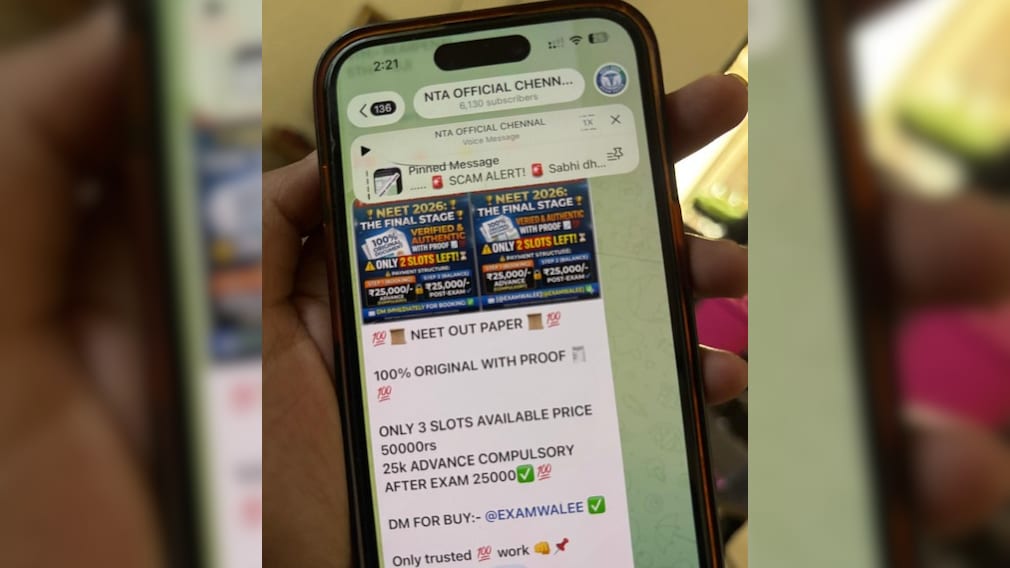
Every year, 24 lakh young Indians wake up believing the same dream: that hard work, not wealth, will earn them a white coat and a stethoscope. They believe that one exam - NEET, the National Eligibility cum Entrance Test - will judge them fairly, measure their merit purely, and open the doors to becoming a doctor.
But here's what they don't see: beneath the answer sheets and OMR bubbles, beneath the invigilators and sealed envelopes, lies a system so fragile, so vulnerable, and so compromised that it has stopped being a test of knowledge. It has become an auction. And the price? Lakhs of rupees that only some families can afford to pay.
This is not a story about a few isolated cheating incidents. This is the anatomy of a national betrayal - where outdated infrastructure meets billion-dollar desperation, and merit quietly dies in the gap between them.
Here's Part I of this operation.
When Your Future Travels In An Unmarked Van
Imagine this: your entire future-12 years of schooling, sleepless nights, sacrificed friendships, your parents' hopes-all of it compressed into a single set of question papers. Now imagine those papers moving through the country like ordinary cargo. They start at a high-security printing press. Good so far. But then they're loaded into transit vehicles - ordinary trucks driven by contract workers paid a pittance. They're stored in state bank vaults overnight. Fine. Then moved again to district strongrooms. Still manageable. But then comes the final, fatal step: distribution to thousands of local exam centres - often small-town schools, managed by underpaid staff, guarded by temporary security, located in neighbourhoods where everyone knows everyone.
This is where the system breaks.
The sophisticated vaults at the top of the chain? Nearly impossible to breach. But that suburban school on the outskirts of town, where the physics teacher doubles as the exam coordinator and the security guard is someone's cousin? That's where organised criminals don't break in - they just knock politely and negotiate.
The Single-Day Gamble
Now here's what makes it worse. NEET happens on a single day, in a single shift, across the entire country. Every candidate, from Kashmir to Kanyakumari, answers the same paper at the same time. Compare this to the engineering entrance exam, JEE. It's computer-based, runs across multiple days, with different question sets for different shifts. If there's a leak at one centre or one shift, only a small group is affected. The damage is contained. A localised re-exam can fix it.
But NEET? If even one question paper leaks in one small town in Bihar or Rajasthan or Tamil Nadu, the entire national exam is compromised. Because everyone, everywhere, is answering the same questions at the same time. It's a ticking time bomb. And when it goes off? The National Testing Agency has only two choices, both terrible: cancel the entire exam nationwide and face public fury, or deny the leak happened and let the cheaters win. Either way, 24 lakh honest students pay the price.
The OMR Trick: Changing Answers After Time's Up
Here's a detail most students never think about: while the question papers are physical, the evaluation is digital. You fill in bubbles on an OMR sheet-those optical mark recognition forms-and later, those sheets are scanned by machines that read your answers. Sounds secure, right? Except there's a gap. A window of time between when you hand in your sheet and when it actually gets scanned at a central facility. Hours. Sometimes days.
And in that gap, things can happen. Allegations have surfaced - not proven in every case, but persistent enough to worry - of blank OMR sheets being filled out after the exam, in coordination with corrupt centre staff. A student walks in, hands in a nearly blank sheet. But by the time it reaches the scanning facility? Somehow it's filled with correct answers. Magic? No. Money.
Next, Part II of this operation.
When Hope Becomes a Product You Can Buy
Let's talk about why this happens. Why would anyone risk jail, disgrace, and ruining thousands of lives just to leak a question paper? Because there's a market. And that market is worth billions. India's coaching industry - the private test-preparation economy centred in cities like Kota, Sikar, and Hyderabad - has stopped being supplementary education. It's become a parallel schooling system. A corporate machine that runs on one fuel: desperation.
Here's the math that creates that desperation: 24 lakh students take NEET every year. 55,000 seats exist in affordable government medical colleges. The rest? Private colleges, which charge anywhere from ₹50 lakh to ₹1 crore for the full course.
Let that sink in. Out of 24 lakh dreamers, only 55,000 will get an affordable shot at becoming a doctor. The rest must either abandon the dream or mortgage their family's future. This is not a test. This is a financial lottery. And in that gap - between a ₹5,000 government college seat and a ₹1 crore private college bill - an entire economy has sprung up. An economy that sells hope in instalments.
The Coaching Factory: Where Childhood Goes to Die
Step inside a coaching centre in Kota. You won't see children. You'll see production units. Students as young as 14, children who should be playing cricket, discovering literature, learning to paint or sing, are instead locked into a brutal regimen: 12-hour study marathons. Weekly ranking tests that determine their self-worth. Dummy schools where they're enrolled on paper but never actually attend. Hostels where five kids share a room and the windows have bars, not for security, but for suicide prevention. Because every year, several students in Kota take their own lives. The pressure of being ranked, re-ranked, and publicly shamed on scoreboards becomes unbearable. When your entire existence is reduced to a percentile score that updates every Sunday, and when your parents have spent ₹3-4 lakh per year betting on you, and when you see yourself slipping from rank 450 to rank 1,240, some students decide that failing the test means failing at life.
This is what desperation looks like when it's industrialised.
The Dummy School Scam
Here's how the system works: Coaching institutes partner with schools that agree to mark students "present" without them ever attending. Students get a school certificate. Schools get a cut of coaching fees. Everyone's happy. Except the student, who is robbed of an actual education. They don't study history, literature, art, civics, or philosophy. They don't learn to think, debate, question, or imagine. They learn to mechanically solve 180 multiple-choice questions in three hours. That's it. That's the sum total of their teenage years.
Biology becomes memorising 30,000 factoids. Chemistry becomes pattern recognition. Physics becomes formula substitution. This isn't education. It's training lab rats to press the right lever. And when those rats are told that their entire future - their family's honour, their financial security, their self-worth - depends on pressing levers better than 23.95 lakh other rats, well, some of them start looking for shortcuts.
Now comes Part III...
The Birth of a Black Market
The ₹10 lakh question paper. Now here's where the logistical vulnerability and the economic desperation meet - and create a monster.
Organised syndicates have figured out the formula:
- Identify the weak link in the exam's custody chain (usually a local school centre)
- Approach underpaid staff with an offer they'll struggle to refuse
- Acquire the question paper 12-24 hours before the exam
- Sell it to desperate families for ₹5-10 lakh per student
Notably, the people buying leaked papers aren't criminal masterminds. They're parents. Middle-class parents who've spent ₹4 lakh on coaching, who've watched their child's confidence crumble under weekly ranking tests, who know that without a government seat, they'll have to sell their house or take loans they can never repay. So, when someone whispers, "For ₹8 lakh, I can guarantee your daughter gets the paper 12 hours early", some parents say yes.
The "Guess Paper" Shell Game
Coaching centres have always produced "guess papers" - predictions of what might come on the exam based on pattern analysis. Legitimate coaching institutes do this through years of data analysis. But here's the trick: when a coaching centre's "guess paper" matches the actual exam with 80-90% accuracy, is it genius prediction, or is it a leaked paper disguised as a guess? And how would you ever prove the difference?
This ambiguity is a feature, not a bug. It provides plausible deniability. The coaching centre can claim expert analysis. The syndicate can sell stolen goods under the cover of legitimate preparation material. Parents want to believe it's just really good coaching. Students want to believe their centre has brilliant faculty. And everyone pretends not to notice that some "predictions" are suspiciously perfect.
The Solver-for-Hire
The leaked paper is one method. Here's another: the proxy test-taker, or "solver". For ₹3-5 lakh, a syndicate will arrange for someone else - often a medical student or graduate - to take the exam in your place. They use fake ID cards, bribed invigilators, and look-alike photographs. The student whose future is being stolen? They're sitting in a different centre, filling in random bubbles, knowing their OMR sheet doesn't matter because someone else is taking the real test under their name.
The cruellest irony? The students who can't afford ₹5 lakh for a leak or a solver are the same students who've studied the hardest, sacrificed the most, and believed most deeply in the system's fairness. They're the ones who lose.
On to Part IV, the human cost stories.
The Girl Who Studied by Streetlight
Let me tell you about someone. Her name doesn't matter because there are thousands like her. She's from a small town in Jharkhand. Her father drives an auto-rickshaw. Her mother stitches clothes. Together, they make ₹15,000 a month. They can't afford Kota. They can't afford a ₹2 lakh coaching centre. So she studies at a local library. Uses second-hand books. Watches YouTube videos on a ₹3,000 phone. Studies under streetlights when the power goes out at home, which is often.
She scores 680 out of 720 in her mock tests. She's brilliant. She's disciplined. She's everything the system claims to reward. But on examination day, she's competing against students who had the paper 12 hours early. Students whose parents paid ₹8 lakh for that advantage. Students who memorised answers, not concepts. She doesn't know this, of course. She thinks it's a fair fight.
And when the results come out and she misses the cut-off by 11 marks -11 marks that could have been hers if the exam had been clean - she'll blame herself. She'll think she didn't work hard enough. Wasn't smart enough. Wasn't good enough. The system will never tell her the truth: that she lost to money, not merit.
The Boy Who Couldn't Take It Anymore
Now let me tell you about another student. He's in Kota. Rank 847 in his coaching centre of 2,400 students. Not bad, right? Top third? But his centre only puts the top 200 ranks on the "Success Board" outside the building. Every student walking in sees those names. Everyone else - including him - is invisible. His parents call every Sunday after the test.
"What's your rank?"
Not "How are you?"
Not "Are you eating well?"
Just the rank.
Last month, he dropped from 847 to 1,053. His father's voice on the phone: "We're spending ₹4 lakh a year. What are you doing there?" He wants to say: I'm trying. I'm studying 14 hours a day. I barely sleep. I haven't spoken to a friend outside this place in eight months.
But instead, he says, "Sorry, Papa. I'll do better." Two weeks later, he's found on the bathroom floor. Sleeping pills. A note that says: "I'm sorry I couldn't make you proud." He didn't fail the test. The test failed him.
The Parents Who Thought They Had No Choice
And finally, the parents who paid for the leak. They're not villains. They're a middle-class couple from Indore. Father is a bank manager. Mother is a school teacher. One daughter. Their entire world. She's been in coaching for three years. They've spent ₹12 lakh so far - more than their combined annual salary. They've taken loans. Postponed fixing their leaking roof. Stopped attending weddings to save money.
And in her final mock test, she scored 590. Just below the expected cut-off.
Then someone - a "consultant" - approaches them. "For ₹7 lakh, your daughter gets the paper the night before. Guaranteed seat."
They say no at first. Obviously. But then they think: What if she misses by 5 marks? We've already spent ₹12 lakh. If she doesn't get a government seat, a private college will cost ₹1 crore. We'll lose our house. Our retirement. Everything. Naturally, ₹7 lakh starts to sound like insurance. Like a rational hedge. They pay.
And on results day, when their daughter gets a seat, they feel relief, not guilt. Because in their minds, they didn't cheat the system, they just refused to let the system cheat them.
This is what desperation does. It turns good people into conspirators. And they never even realise what they've become.
Part V? The way out.
What Fixing This Actually Requires
One, kill the paper trail. This is the most urgent fix. NEET must abandon the pen-and-paper model entirely. Move to computer-based testing like JEE. Run the exam across multiple days, multiple shifts, with algorithmically randomised questions. Each student gets a unique combination of questions from a massive question bank.
Two, regulate the coaching mafia. The coaching industry has become too big, too unregulated, and too intertwined with the exam ecosystem. Ban dummy schools. If a student is enrolled, they must attend. No exceptions. Audit coaching-centre finances. Track where their revenue comes from and where it goes. If ₹50 crore in "consulting fees" is moving to untraceable accounts, investigate. Prohibit centres from operating exam venues. The conflict of interest is obvious - coaching institutes should never be allowed to host the exams they prepare students for. Cap fees and mandate transparency. Publish success rates, refund policies, faculty credentials.
Three, expand the seats. Attack scarcity at its root. Here's the uncomfortable truth: as long as 25 lakh students are fighting for 55,000 affordable seats, desperation will create corruption. India needs to massively expand affordable medical education: double government medical college seats over 5 years, regulate private college fees to bring them within middle-class reach, invest in teaching hospitals in tier-2 and tier-3 cities, create scholarships for economically weaker sections
Four, enforce transparency and accountability, and end the culture of denial. Every time a leak happens, the NTA's first response is denial. Then deflection. Then, if forced, a grudging admission with no accountability. This has to end. There has to be real-time public disclosure of exam logistics, third-party audits of the custody chain, criminal prosecution of everyone involved in leaks - not just the "masterminds" but the officials who enabled them - compensation and priority re-examination for affected honest students. Make the cost of corruption higher than the profit.
NEET is more than a medical entrance exam. It has become a mirror reflecting everything broken in how India treats its young people, its dreams, and its promises. The country is running out of time to fix this. Not because the logistics are complicated - they're not. Not because the solutions are unclear - they're painfully obvious. We're running out of time because we're running out of believers. The question is: will we fix it before the last believer gives up?
Disclaimer: These are the personal opinions of the author
-
Opinion | Jamnagar, Rubio, And Why The US Wants India To 'Obey', Not Negotiate

Marco Rubio's dash to Jamnagar was driven by Trump's hope that India could do something about the shortage of diesel that the world is experiencing and thereby help his mid-term performance. But why the punishing policies then?
-
Opinion | Why China Is Producing More, Selling Cheaper - And Still Not Getting Anywhere
More capital, more capacity, more elaborate technology, and steadily less profit to show for any of it. That's what's happening to China now.
-
Opinion | A Jolt For Trump? How The US May Be Staring At A 'Blue' Wave
Evidence now points firmly to a Democratic majority in the House. The only real surprise is the Senate
-
Opinion | Why The Saudi-Pak-Turkey Defence Pact May Actually Be An 'Intel' Network
Rather than a NATO-like construct, the Mecca pact may evolve to become something like the West's Five Eyes alliance.
-
The Real Story Of France's Unrest Is Getting Lost In A Storm Of Online Lies
A man cosplaying Napoleon on the streets, looting at luxury fashion stores like Dior, France is currently confronting one of its most serious episodes of civil unrest in years.
-
Opinion | The Last Bet? What Trump's 'Mother Of All Bombs' Could Actually Do To Iran
Can an MOAB deliver a decisive blow to Iran that may force it to surrender immediately, as Japan did after Hiroshima and Nagasaki in World War 2?
-
Hit Songs, Empty Pockets: The Hidden Math Behind India's Viral Music Boom
Over 80,000 brands and five lakh creators in India make branded content. The opportunity is worth around Rs 1,500 crore.
-
Opinion | Great 'Exceptions': How The Oil India Was Attacked For Is The Oil Trump Now Seeks
A law written to punish the buyers of Russian oil was suspended by the US to protect a purchase of Russian oil. India spent fourteen months being lectured for less.
-
Opinion | Louis Vuitton Loot, Torched Cars: France Protests Have An Unlikely Beneficiary
It's an unbelievable moment. Crowds looting the most exclusive stores in Paris, including the famed Luis Vuitton. But what's behind this meltdown?