Opinion | Trump's Nuclear 'Gift' To Saudi Arabia Could Haunt Middle East For Years
Trump just signed a '123' deal with the Kingdom. For the Saudis, this could be a big win. But for the region, it can quickly become a source of uncontrolled chaos.
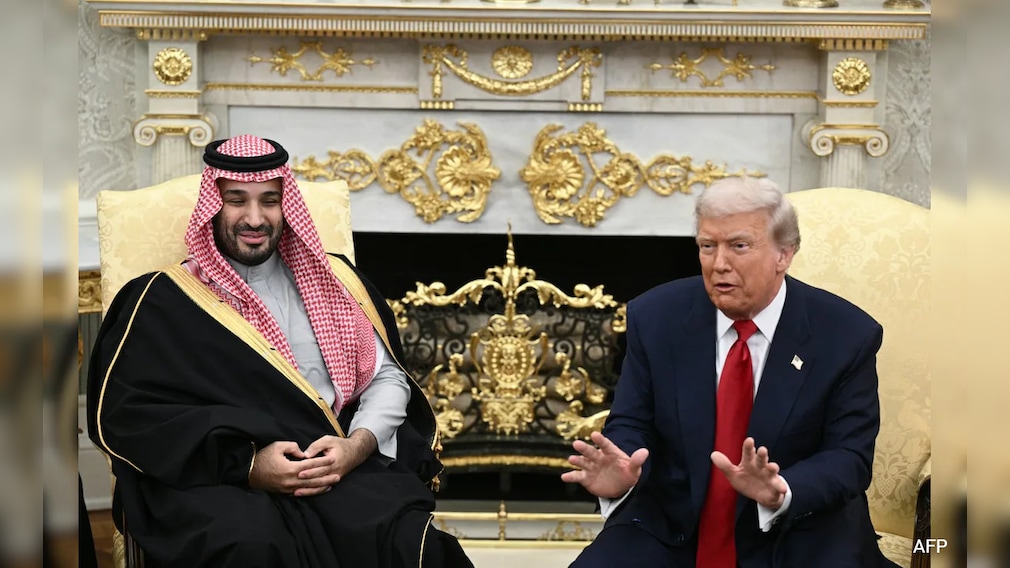
As usual, US President Donald Trump has pulled another cracker from his hat. In a surprise move, the US Department of Energy announced that the US and Saudi Arabia had reached an agreement on a thirty-year civil nuclear deal, also called the '123 Agreement', which, as is typical of this administration, lauds the "great access" given to US companies to the Saudi nuclear energy programme, the benefits for American industry and workers, President Trump's vision, and so on. All standard issues on most US government announcements now. Almost as a footnote, it also says the agreement will meet Saudi energy needs.
What would puzzle most people is the timing. After all, the proposal has been in the pipeline for years - it was there even during Trump's first term. For the Saudis, this is a big win. But it is going to lead to a lot more anxiety in the region with possible developments.
Not Just A 1-2-3
First, the '123 agreement' itself. It gets its name from a US Energy Act section that allows peaceful nuclear cooperation with other countries. The US has some 26 such agreements in force with various nations to allow the transfer of nuclear material or equipment and facilitate technical exchanges, scientific research, and safeguards discussions. These agreements are tied to the 'Treaty on the Non-Proliferation of Nuclear Weapons (NPT)' and require strong non-proliferation agreements on the ground, with safeguards agreements and oversight by the International Atomic Energy Agency (IAEA). Though, however strong the oversight, there is already strong opposition from both Republicans and Democrats towards encouraging the development of a technology that everyone agrees is dual-use.
Early reports had indicated that there might be a two-year study to assess the viability of local enrichment. But for now, it appears that there are no such plans, with some talk of a 'black-box' facility that would allow the US to enrich uranium in Saudi Arabia under its control. Though it is impossible that the deal would not have been discussed with Israel first, Tel Aviv will certainly do all it can to prevent enrichment inside Saudi Arabia.
The Directive From The President
The argument for the deal is that it is rooted in the Presidents Executive Order 14299, which declares that the US "faces a critical national security imperative to ensure a resilient, secure, and reliable energy supply for critical defense facilities", including for computing infrastructure for artificial intelligence (AI) needs and national laboratories, all of which demands "reliable, high-density power sources that cannot be disrupted by external threats or grid failures". AI facilities like data centres are to be created in 48 states, which require advanced nuclear facilities, this time with the involvement of the private sector.
All this also requires a lot of money. The last bit of the agreement then says, "The Secretary of Energy shall aggressively pursue at least 20 new 123 Agreements by the close of the 120th Congress to enable the United States nuclear industry to access new markets in partner countries."
That's where the Saudis come in. The reactor business is big money. Estimates note that the nuclear construction industry is likely to be more than $70 billion by 2030, on the back of not just AI requirements but also a marked shift towards renewables.
A Political Twist
Then again, nothing in the Trump administration is ever that simple. A day later, Trump posted on Truth Social that the deal was 'totally tied' to Saudis joining the Abraham Accords, which essentially means recognising Israel. The accords are meant to encourage "efforts to promote interfaith and intercultural dialogue to advance a culture of peace among the three Abrahamic religions and all humanity" and allow for peace in a long-troubled region.
Essentially, the whole thing revolves around not just giving Tel Aviv the legal recognition it craves but also learning to live with its nuclear capabilities. So far, only the UAE, Bahrain, and Morocco have signed on to the accords. Sudan has joined in, too, though its position is still at an uncertain stage. There is, of course, Kazakhstan, which has recognised Israel since the 1990s.
The assumption is that the Middle East's stability depends on what the Saudis do. But that argument is a bit overrated. True, its position as being the guardian of the holy sites accords the Kingdom great significance. But with countries such as Iraq - which recently criminalised contact with Israel - and Syria and the Palestinians, whose key demand for a homeland is to be set aside under the US plan, expecting Saudi Arabia to be the node for stability might be unrealistic.
Washington, however, recognises something that has long been brushed under the carpet. For Saudi Arabia, the main danger comes from Iran, not Israel. In fact, Saudi Arabia and Israel have long cooperated in clandestine intelligence-sharing activities. The Saudis have also actively encouraged allies such as Bahrain in recognising Israel and have allowed overflights as well. But the main point here is the timing. Right when Palestinians are being bombed and strafed, a Saudi recognition for Israel is politically risky. In other words, this will probably remain a 'can-do' aspect of the deal rather than a critical stumbling block - for the moment, at least.
The Real Saudi Motives
There's another aspect to timing. The nuclear deal itself provides a valuable boost to the Saudis at a time when their position vis-a-vis Iran has been shaky. True, typical of Trump, it falls well short of the Mutual Defense Treaty that the Joe Biden administration had proposed for the US and Saudi Arabia. Washington, after all, is no longer in the protection business.
Meanwhile, it is not that the Saudis haven't been looking for alternative energy options. An important aspect of 'Vision 2030' envisaged by Crown Prince Mohammed Bin Salman is ending what he called over-reliance on oil and shifting to alternative sources of energy, including wind and nuclear power. He has also solidly backed the need to find alternative sources of income as he leads the country into a modern age. Massive data centres are being planned, which, in turn, need huge energy supplies. Technically, that should not be a problem for an oil-rich country. But, as experts note, the Kingdom has recorded a deficit in all but one year in the last decade. Apparently, oil, accounting for 40% of Saudi Arabia's GDP, is simply not enough. Besides, oil saved is more oil sold. Nuclear energy for domestic use thus makes sound sense.
Even so, there are problems ahead, all of which are pertinent to India. First, even tinkering with the Pandora's box of nuclear proliferation is dangerous. It is not just that the Saudis have nuclear ambitions - after all, they were the ones who had virtually financed Pakistan's nuclear programme. The fact is that Saudi Arabia also has large reserves of uranium. On paper, at least, the Saudis, with some Pakistani help, could start their own nuclear programme. That, in turn, will set off a chain reaction across the region, with countries like Turkey, with a solid industrial base and a strong missile capability, getting emboldened to act on their long-decided wish to obtain nukes. Notably, Turkey was an important node in the infamous Abdul Qadir Khan proliferation network in the 1990s. Not to forget, it has already put in place its first Russian nuclear reactor complex. So has Egypt, again with Russia. The race for the reactor business has begun in earnest. Other countries could follow suit.
India had also signed a 123 Agreement with the US in 2008, which, after extensions, is due to expire in 2048. Under this, Delhi never actually bought any US reactors, though it did buy some uranium. The long-stalled deal for six AP1000 reactors for Andhra is now moving, with land acquisition largely completed by the Nuclear Power Corporation of India Limited. The SHANTI Act (Sustainable Harnessing and Advancement of Nuclear Energy for Transforming India) amends the earlier legislation to bring vendor liability in line with international laws. The budget for the Department of Atomic Energy has been increased substantially, and the Nuclear Energy Mission has Rs 20,000 crore specifically set aside for small modular reactors. A US company, Holtec International, is set to team up with private players like Larsen & Toubro (L&T), with plans to make at least 200 reactors across the country.
That's all for the good. But Delhi needs to look closely at the other part of Trump's directive, which directs the energy bureaucracy to "aggressively renegotiate 123 Agreements set to expire within the next decade". India has technically till 2048 before its agreement expires, but 'renegotiation' clauses seem threatening to say the least, given the US President's tendency to make unexpected moves, where one deal is held hostage to another. Plans to build more nuclear reactors with Russian assistance may come under scrutiny and pressure. This is big business.
Meanwhile, with no indication that the Iran war is coming to a close, the rapid and almost daily churn in oil-rich West Asia is concerning. Foreign policy now needs continuous review and a mechanism to respond quickly, with access to all levers available to get what the country needs. So far, the Ministry has done a great job. But time to ramp it up.
(Tara Kartha is a former Director, National Security Council Secretariat)
Disclaimer: These are the personal opinions of the author
-
BJP Leader's Singer Wife, A Kabir Bhajan, And Some 'Jantar Mantar': How 15th Century Saint Entered 2026 Row

A video of Sivasri Skandaprasad's singing performance went viral, interpreted as a dig at protests at Delhi's Jantar Mantar. What she's singing is actually attributed to the saint-poet Kabir, and he did not really mean that particular "jantar mantar". He meant something far more profound.
-
Opinion | Sardar Patel, And The Art Of Holding A Nation Together
A true Gandhian, he reminded his countrymen that gaining freedom from foreign rule was merely the first step; true internal Swaraj required much, much more.
-
Opinion | How India Is Making Its Stock Market An Expensive Place To Invest
FPIs sold Rs 1.66 lakh crore of Indian equities in 2025 and a record Rs 3.08 lakh crore in 2026 through October 12. Foreign ownership of the Indian market is at a 15-year low
-
Jail Is No Bar: How Gangsters Call The Shots From Inside Prisons
Jail can become a safe haven from enemies, a recruitment ground for fresh gang members and, in some cases, a command centre for criminal operations
-
From King Edward III To Neha Bora, A 1361 Law Lives On In 'Peace Bonds': NDTV Explains
CJP leaders Abhijeet Dipke, Saurav Das, and Ashutosh Ranka signed peace bonds; two of them even faced jail over an alleged breach, while AISA's Neha Bora questioned such a bond's very logic. Here's what a peace bond is, and what the questions are.
-
Air Force Golf Course Near PM House Closed. How This Land Has Seen Many Turns Of History
The Air Force Sports Complex, which includes the golf course, is the latest property near the Prime Minister's residence set to be taken back this year, as the land is owned by ministries.
-
Opinion | How A Poland 'Experiment' Could Change India's Defence Industry
Europe is spending billions on arms in a historic rearmament drive. Indian firms can cash in. But there's a catch
-
Opinion | The Muslim World Is Seeing An Unexpected 'Experiment' - In Kazakhstan
The country has a long history of using mediation to mitigate conflict; now, it has added another, much-wanted dimension to it.