Opinion | Trump's Claims vs Numbers: Can India Really Replace 87 Million Tonnes Of Russian Oil?
US and Venezuelan exports, even when taken together, fail to match the huge volume of crude India has been getting from Russia.
The stroke of midnight has historically been an important moment for landmark happenings in India, from gaining independence in 1947 to the recent agreement on the India-US trade deal. This comes amidst a constant state of tariff influx on India. In August 2025, Trump signed executive actions adding an extra 25% tariff on Indian imports as a punitive response to India's continued purchases of Russian oil. This was imposed on top of an existing 25% duty, bringing total US tariffs on many Indian goods to around 50%.
India has been constantly attributed by the US as having one of the highest tariffs in the world, with the country being termed the "Tariff King". This discontentment largely stems from the fact that India enjoys a trade surplus with the US. In FY25, India had a trade surplus of USD 40.82 billion with America. This is just one face of this quagmire, another being India's purchase of crude oil from Russia amidst the ongoing conflict between Russia and Ukraine. Though the final details are yet to be out, one of the things believed to be part of the agreement is India's purchase of a higher quantity of crude oil from the US.
The Math of Substitution
Let's dive deeper into the idea of India substituting Russian oil with that from the US and Venezuela. The idea looks promising theoretically, but the trade figures and overall trade scenario point to something absolutely different. This analysis is strictly based on international trade aspects, without taking into consideration political factors or the enhancement of crude oil capacity in the exporting countries.
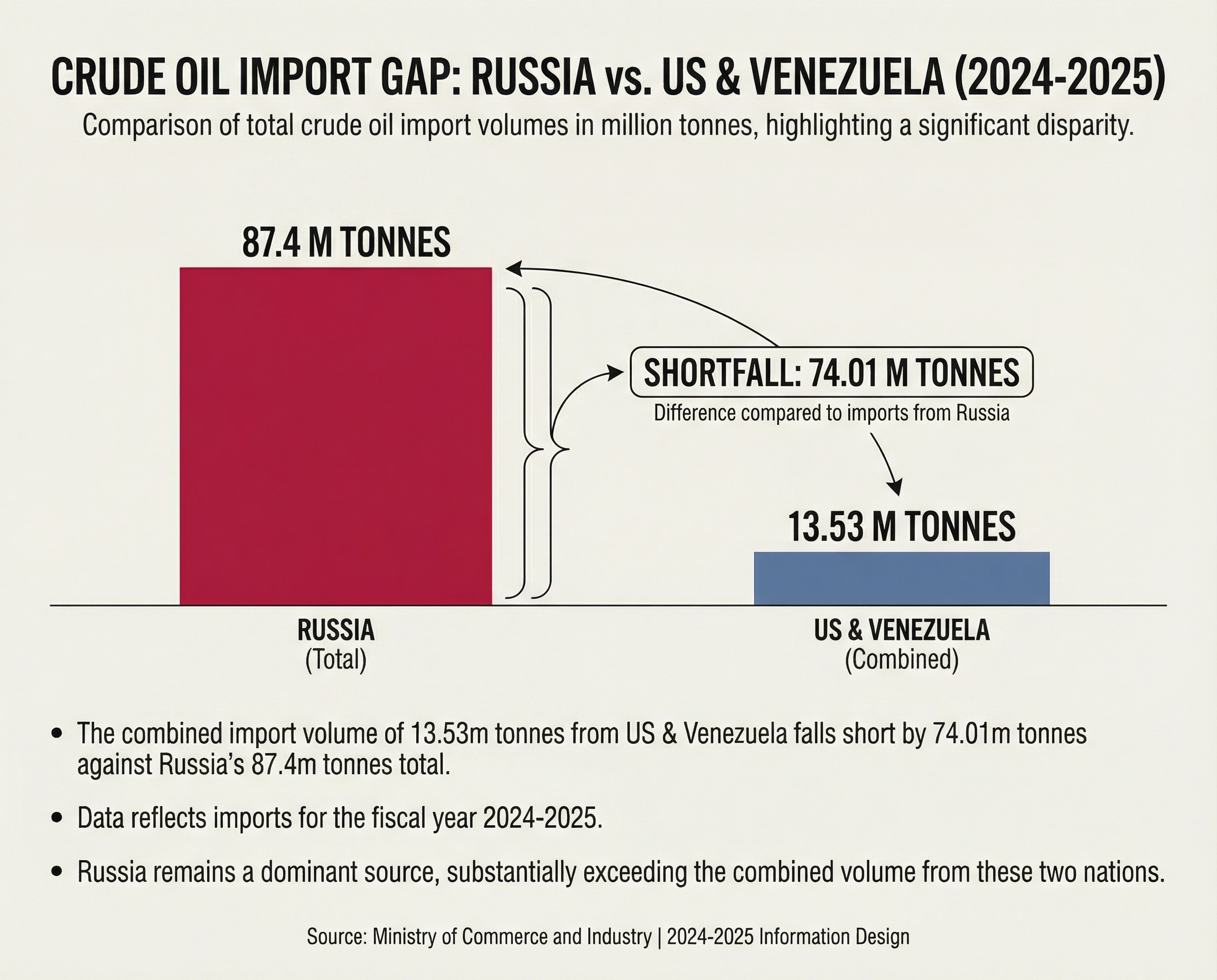
According to data from the Ministry of Commerce and Industry, India imported about 87.54 million tonnes of crude oil from Russia in the year 2024-25, registering a growth of about 72.1% from the year 2022-2023. On the other hand, India's imports of crude oil from the US were just 10.55 million tonnes in 2024-25, which in fact was a decline of about 30.4% from 15.16 million tonnes in the year 2022-2023.
In the case of Venezuela, India imported 2.98 million tonnes of crude oil in the year 2024-25. The growth in the case of Venezuela on a year-on-year basis from 2023-2024 to 2024-2025 was 74%, with zero imports in the years 2021-2022 and 2022-2023.
It's also important to note that the US exports the largest quantity of oil to Mexico (according to data from World Integrated Trade Solution), exporting about 26.50 million tonnes in the year 2024-2025, with a downward growth trajectory of about 27% from 2022-2023.
On a combined basis, India imported about 13.53 million tonnes of crude oil from the US and Venezuela in the year 2024-2025. Even this falls short by 74.01 million tonnes when compared to imports from Russia for the year 2024-2025. This pattern repeats itself for the years 2022-2023 and 2023-2024. Though oversimplistic, this analysis reveals that, keeping production capacity and political factors constant, the US and Venezuela would not be able to substitute Russia for crude oil imports.
Let's consider another ambitious scenario wherein the US diverts all its crude oil exports from Mexico to India. Even in that case, the combined capacity would only reach 40.03 million tonnes as per the 2024-25 data, again falling short by about 47 million tonnes when compared to crude oil imports from Russia.
India has registered a year-on-year growth rate of about 37% in crude oil imports from the US for the years 2023-2024 to 2024-2025. At a 32% annual growth rate, it would take approximately 4.5 to five years for American crude oil imports to reach the current level of Russia's imports. Venezuela's imports have grown at a 72% year-on-year rate. At a 72% annual growth rate, Venezuela alone would take approximately 6.2 to 6.5 years to reach the current level of India's crude oil imports from Russia.
The weighted average growth rate of US and Venezuela crude oil imports is approximately 40.8% per year for the year 2024-2025. At a 40.8% annual growth rate, it would take approximately 5.5 years to reach Russia's 87.54 million tonnes. In any case, such sustained growth seems highly improbable in the current volatile environment with conflicts raging across several parts of the world.
Divorced From Reality
The analysis clearly shows that while the idea of substituting Russian crude oil with supplies from the US and Venezuela may appear attractive at a theoretical level, it does not align with current trade realities. Venezuela has been dealing with internal political conflicts. The sheer scale of India's crude oil imports from Russia, coupled with declining or limited export capacities and unrealistic growth assumptions for alternative suppliers, makes such substitution structurally unviable in the near to medium term. Even under highly optimistic scenarios of sustained and accelerated growth, the time required to bridge this gap remains significant.
In this context, energy policy choices cannot be viewed in isolation from ground realities. For a developing economy like India, with rapidly rising energy demand, affordability, reliability, and continuity of supply remain paramount. While geopolitical pressures and trade negotiations will continue to shape discourse, India's energy security and economic stability must remain central to any strategic decision-making.
(The author is a research consultant at the Chintan Research Foundation)
Disclaimer: These are the personal opinions of the author
-
BJP Leader's Singer Wife, A Kabir Bhajan, And Some 'Jantar Mantar': How 15th Century Saint Entered 2026 Row

A video of Sivasri Skandaprasad's singing performance went viral, interpreted as a dig at protests at Delhi's Jantar Mantar. What she's singing is actually attributed to the saint-poet Kabir, and he did not really mean that particular "jantar mantar". He meant something far more profound.
-
Opinion | Sardar Patel, And The Art Of Holding A Nation Together
A true Gandhian, he reminded his countrymen that gaining freedom from foreign rule was merely the first step; true internal Swaraj required much, much more.
-
Opinion | How India Is Making Its Stock Market An Expensive Place To Invest
FPIs sold Rs 1.66 lakh crore of Indian equities in 2025 and a record Rs 3.08 lakh crore in 2026 through October 12. Foreign ownership of the Indian market is at a 15-year low
-
Jail Is No Bar: How Gangsters Call The Shots From Inside Prisons
Jail can become a safe haven from enemies, a recruitment ground for fresh gang members and, in some cases, a command centre for criminal operations
-
From King Edward III To Neha Bora, A 1361 Law Lives On In 'Peace Bonds': NDTV Explains
CJP leaders Abhijeet Dipke, Saurav Das, and Ashutosh Ranka signed peace bonds; two of them even faced jail over an alleged breach, while AISA's Neha Bora questioned such a bond's very logic. Here's what a peace bond is, and what the questions are.
-
Air Force Golf Course Near PM House Closed. How This Land Has Seen Many Turns Of History
The Air Force Sports Complex, which includes the golf course, is the latest property near the Prime Minister's residence set to be taken back this year, as the land is owned by ministries.
-
Opinion | How A Poland 'Experiment' Could Change India's Defence Industry
Europe is spending billions on arms in a historic rearmament drive. Indian firms can cash in. But there's a catch
-
Opinion | The Muslim World Is Seeing An Unexpected 'Experiment' - In Kazakhstan
The country has a long history of using mediation to mitigate conflict; now, it has added another, much-wanted dimension to it.