Opinion | There Is A 'Shadow' Route Keeping Iran Alive, And America Can't Touch It
If the Strait of Hormuz is Iran's Trump card, then the Caspian Sea in its north is the 'war machine' helping Iran play its cards well.
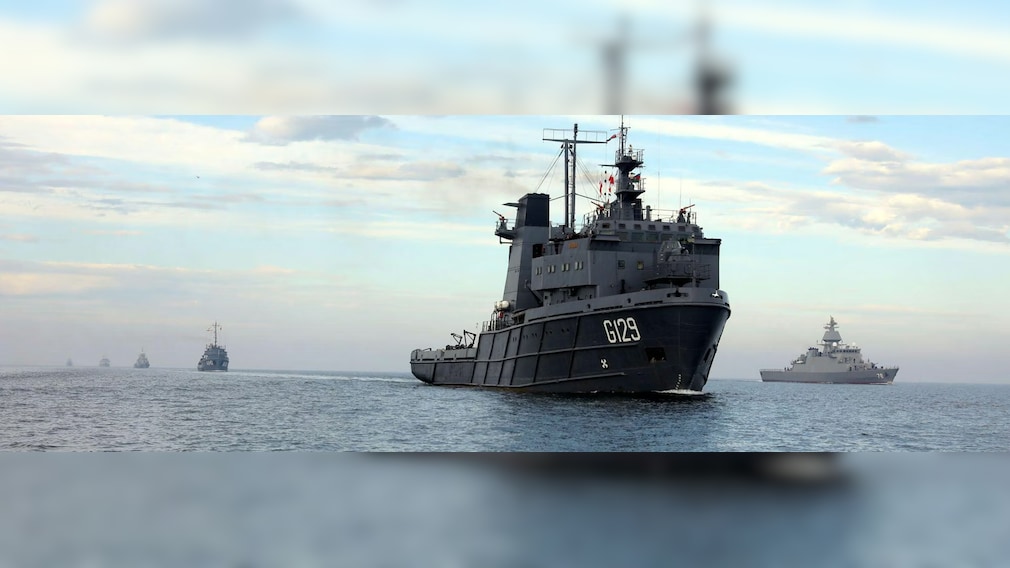
On February 28, the US and Israel struck Iran, targeting its political and military power centres, eliminating the Grand Ayatollah on the first day of the war. Washington and Tel Aviv assumed that the decapitation of the Islamic regime by killing Ayatollah Ali Khamenei would lead to political paralysis and mass uprising, like what the world saw at the start of the year - which, in turn, would result in a regime change - one of the implicit goals of the joint US-Israel operation. However, the Islamic regime and its armed forces remain intact. As Mehdi Hasan told NDTV, "Iran is winning by not losing the war."
Daniel Byman, one of the leading experts on irregular warfare and terrorism, wrote that the current standoff is no longer a match of "military capabilities, but rather a struggle for political endurance and gaining bargaining leverage". Donald Trump claimed that Iran's military is nearly finished. However, just like all of Trump's claims, a Pentagon Intelligence input claims that Iran has managed to retain key military capabilities to fight.
This begs the question: how is that possible? If the Strait of Hormuz is Iran's Trump card, then the Caspian Sea in its north is the 'war machine' helping Iran play its cards well.
Caspian Sea - A Brief Introduction
The Caspian Sea is the world's largest inland body of water and is called the world's largest lake, sometimes referred to as a sea. Five countries have territorial control over the waters of the Caspian Sea: Azerbaijan, Russia, Iran, Turkmenistan and Kazakhstan. The sea is strategically located in Central Asia, connecting Europe and Asia, and it is rich in natural resources, with 48 billion barrels of oil and 292 trillion cubic feet of natural gas in proven and probable reserves.
The discussions over the significance of the Caspian Sea are not new, and Israel and the US are aware of the arms trade between Russia and Iran via the sea. Israel struck Iran's Bandar Anzali port on the Caspian Sea to disrupt arms shipping between the two countries. Iran maintains four major ports on the Caspian: Bandar Anzali, Amirabad, Neka, and Nowshahr, while Russia operates the Astrakhan, Makhachkala, and Olya ports.
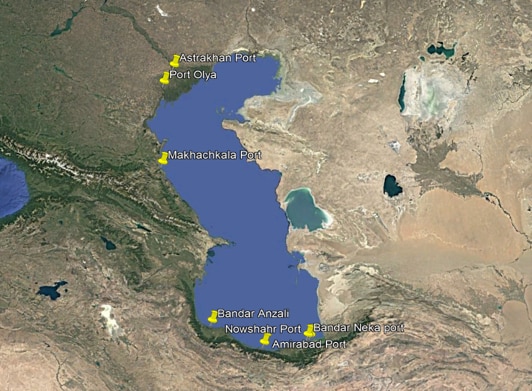
How Russia and Iran Ship Arms
Trade between Iran and Russia in the Caspian region is shrouded in secrecy and often referred to as the dark web of sea trade due to irregularities. The sea route came to prominence a few months after Russia invaded Ukraine in 2022. A maritime trade analysis from Bloomberg found that Russia and Iran are investing $20 billion to expand rail, sea and river routes connecting the countries via the Caspian Sea. The logic was simple. Evade global sanctions and ship weapons to and from Iran via the Caspian Sea, which is connected to the Black Sea via the Sea of Azov and the Volga-Don Canal on the Volga and Don rivers in Russia.
The ships from Russia and Iran conduct dark port calls - a process in which vessels turn off their Automatic Identification System (AIS), which transmits signals to satellites that help determine the location of ships at sea. While turning off AIS is one method, AIS spoofing, ships operating under a different country's flag, and vessel-to-vessel transfers in international waters are other techniques used to make it virtually impossible to track the ship. Russian and Iranian ships make fake port calls to cover sanctioned maritime routes. Many companies steal IMO numbers of scrapped tankers or invent their own numbers. Mostly, the shipping trade is handled by shell companies registered in countries such as Panama, Gambia, Singapore, China and Fiji.
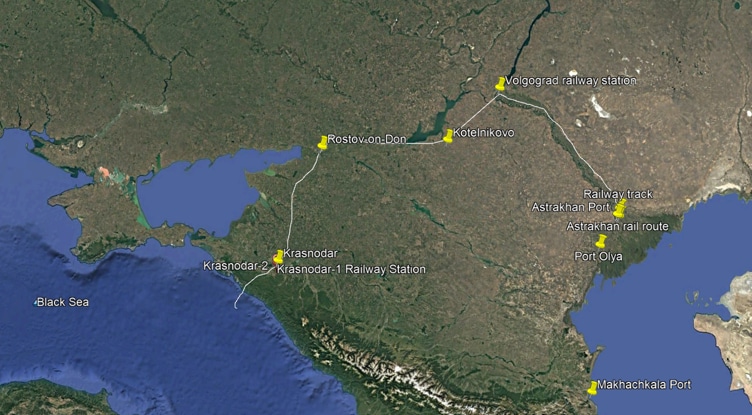
Maritime and rail routes used by Russia to transport goods from the Caspian Sea to Black Sea.
Weapons and oil are not the only commodities being shipped from the Caspian Sea. Iran imports grain from Russia, and the total trade volume in 2024 stood at 3.4 million tons, underpinning the significance of the north-south trade corridor.
According to data from Windward, an open-source platform, the number of cargo and tanker vessels increased significantly after Russia invaded Ukraine, from 23 a month in March 2022 to over 70 by the end of the year.
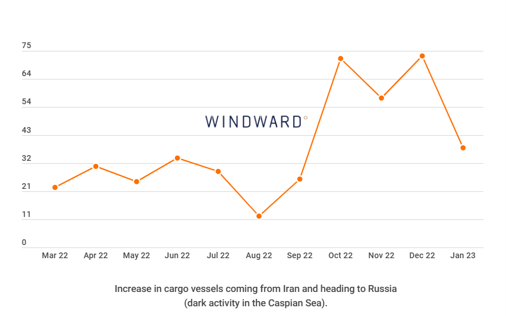
The trend was visible in the Volga and Don rivers, which saw an increase in the number of ships sailing to the Sea of Azov and then to the Black Sea. Most likely, the vessels carried weapons and oil to fund and support Russia's war machinery.
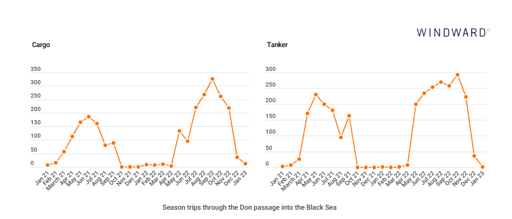
Ships with the Russian flag make it difficult for other countries to contest the trade due to a fear of inviting a military response if they take action. Moscow operates a fleet of over 20 naval ships, including minesweepers, landing craft and anti-saboteur boats, forming the Caspian Flotilla of the Russian Navy, the oldest Russian flotilla. The absence of the US to counterbalance Russian naval influence makes it nearly impossible for Caspian littoral states to stop sanctioned shipping.
Russia-Iran Arms Trade, In Numbers
From the 1990s, after the collapse of the Soviet Union, Russia has been the main supplier of arms to Iran. In 1991, Moscow lifted the barrier on the sale of conventional weapons to Iran, and in the last 35 years, Russia has supplied tanks, naval ships, surface-to-air missile defence systems such as S-300 and artillery to Iran. According to an estimate from Bloomberg, since 2021, Iran has sold $4 billion worth of weapons, including $2.7 billion worth of missiles. This includes several Fath-360 short-range ballistic missiles, 500 other types of munitions and over 200 air defence missiles. In another contract worth $1.75 billion, signed in early 2023, Iran also supplied Russia with Shahed-136 kamikaze drones and helped set up production of its domestic variant, known as the Geran-2.
In 2022 and 2023, Iran also signed contracts with Moscow to purchase Russian Su-35 fighter jets and Mi-28 attack helicopters, significantly upgrading its air fleet, which still uses early Cold War-era jets. The deal also includes 24 Yak-130 subsonic multi-role trainer/combat aircraft. In March 2026, Israel shot down one of the Yak-130 aircraft in Tehran. In February, the Financial Times reported that Iran signed a "secret deal" worth $589 million with Russia to acquire shoulder-fired missiles. Under the contract, Moscow will provide 500 "Verba" launchers and 2,500 "9M336" missiles. The agreement was signed with Russia in December 2025, around the time when Iran started witnessing massive anti-regime protests
Shadow Fleet In The Caspian Sea
Fleetleaks is an open-source platform that tracks the movement of Russian vessels sanctioned by Western nations. The platform serves as a database for identifying and examining the ships; however, it is difficult to ascertain the type of commodity being shipped, but a deep analysis of the vessel's information would explain the trade practice.
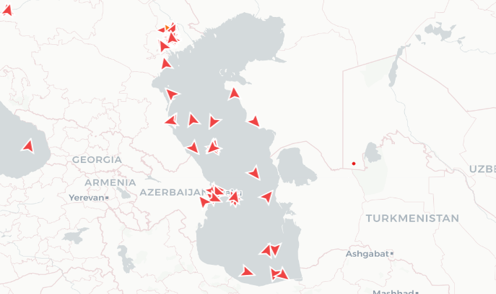
Russian ships, sanctioned by the West, are shipping in the Caspian Sea at the time of writing this article. Source: fleetleaks.com
We analysed two ships: Iran-flagged ship Zal Pars 3 (IMO Number: 9211896) and Russia-flagged Irtysh River (IMO Number: 9435375). According to Fleetleaks, the last known location of Zars Par 3 was close to Iran's Amirabad Port three months ago, and the Irtysh River was spotted near Iran's shore two months ago, speeding at 14 km/hr (8 knots). Since these vessels are designated as shadow fleets, it is impossible to determine their exact live location. The vessel information data is more compelling than the live location data, as it clarifies the link between the Russian military and Iran. However, at the time of writing this article, the vessel was found near Kazakhstan's territorial waters, sailing towards Russia.
Zal Pars 3 is managed by a company called Arya Shipping Services (Address: Apartment 31, Perooshat Alley 2, Motahari Avenue, Tehran, Iran) and managed by Tosee Bazarghani Iranian Noavai. Since 2001, the ship has switched flags between Malta and Russia twice before carrying the Iranian flag since 2013. It has been sanctioned by the European Union for trading oil with Russia, and interestingly, Arya Shipping Services, which was incorporated in 1999, runs only one vessel, a handysize oil tanker. The company and the ship have been linked to Russian company Eneya LLC, which is affiliated with Jamaldin Pashayev, a sanctioned businessman from Russia's Astrakhan. His companies have been involved in the export of Russian military hardware. He has been involved in covertly supplying material to Syria, particularly aviation fuel.
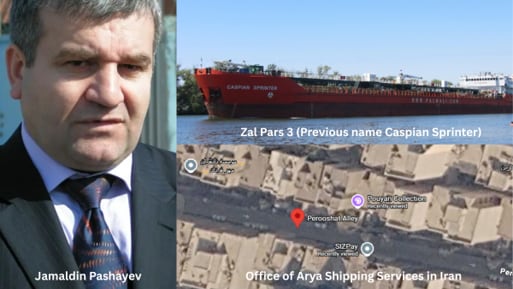
Zal Pars 3 and Irtysh River are connected. The latter is owned by Perspektiva Jsc, which is also connected to Eneya LLC and Jamaldin Pashayev. Irtysh also sailed with a Malta flag twice before switching to the Russian one. Though Perspektiva Jsc has not been sanctioned, it remains an entity of interest. Currently, the vessel is in the middle of the Caspian Sea, sailing back to Russia.
Oil trade and other cargo bring money to the economy, and military hardware helps with defence. Iran had the expertise to produce cheap kamikaze drones, and Russia has the manufacturing capacity to scale it. Since 2022, both countries have jointly produced drones to dominate in a war of attrition. The Shahed drones have helped Iran attack its neighbours on a large scale. In March, a Geran-2 drone, the Russian version of the Shahed-136 drone, was shot down in Dubai, prompting Ukraine's President Volodymyr Zelensky to say that Iranian drones were going to Russia and coming back to Iran.
In 2023, over 600 monthly incidents of AIS gaps were reported in Russia-flagged ships, compared to over 100 monthly in the first half of 2022. Both countries are operating in a shadow economy, making the Caspian Sea their best bet to evade sanctions.
Can the US Do Anything?
The two vessels are a small part of a large trade system between Russia and Iran, and for years, the US and Europe have largely failed in controlling it. After the breakup of the Soviet Union in 1991, Turkmenistan, Azerbaijan and Kazakhstan became independent, dividing the waters of the Caspian Sea, causing dispute. Since officially it is not a declared sea, the rules under the United Nations Law of Convention on the Law of the Sea (UNCLOS) are not applicable. In 2018, the littoral states signed the Caspian Sea Comprehensive Strategic Cooperation Agreement, which defined the territorial boundaries and economic zone and rejected any foreign naval presence in the sea.
What does this mean? The US maintains relations with all the countries except Moscow and Tehran, but it does not have a naval presence in the region, especially one that matches Iran and Russia's. Washington backs Azerbaijan, a secular Shia Muslim nation that tries to counterbalance Iran, but in the present war, Tehran has targeted the country with drones.
The US has several military options. One possibility is for President Trump to order strikes on Iranian rail and road links connecting the Caspian Sea ports to the interior, aiming to disrupt supply lines. Alternatively, long-range strikes could be directed at the ports themselves; however, this carries the serious risk of inadvertently striking Russian shipping fleets. A third, highly improbable option is arming Azerbaijan to involve them in the conflict.
The option of targeting transportation infrastructure appears the most likely. Nonetheless, it is risky because long-range cruise or ballistic missiles, because of their lighter payloads, pose a higher risk of collateral damage compared to aerial bombardment by fighter jets. Furthermore, for the US to conduct strikes deep within Iran, it requires complete air superiority, which current evidence suggests it lacks, as demonstrated by the earlier downing of an F-15 in southwestern Iran.
The focus of this war may remain fixed on the Strait of Hormuz, but that is only a part of the story. Away from global attention, the Caspian Sea has been fuelling trade, moving weapons, and buying Iran time for years now.
(Divyam Sharma was a journalist and is currently studying Terrorism, Security and Society at King's College London, with a specialisation in wargaming and OSINT)
Disclaimer: These are the personal opinions of the author
-
Opinion | Slurs, Threats, Now A Temple Attack Plot: When Did America Become So Hostile To Indians?

The rising tide of anti-India, anti-Hindu, and racist attacks serves as a stark reminder that economic prosperity does not automatically guarantee social immunity from bigotry.
-
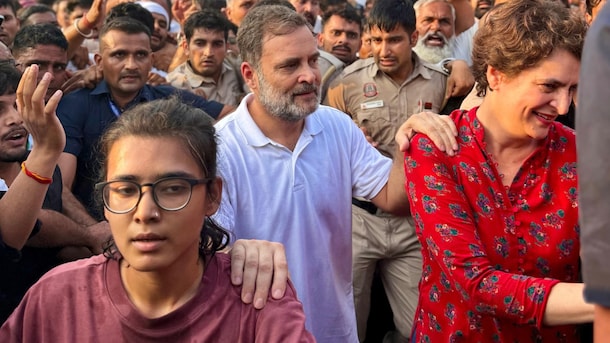
A Step Behind Neha Bora: What Rahul Gandhi's Gesture Says About Congress' Gen-Z Pitch
At INDIA bloc's march to Supreme Court, Rahul Gandhi placed himself a step behind two women, hands resting on their shoulders. One was his sister Priyanka. The one on his right was Neha Bora. Here's what the image means for the protest wave now, and for Rahul's politics in general.
-
Opinion | Imran Khan, And The Perils Of Having An 'Opinion' In Bollywood
The reality of the industry is quite grimy. More often than not, its inhabitants have been fairweather friends, happy to sing the praises of whoever is in a position of authority.
-
Exclusive: India's Food Safety Problem Goes Beyond Just Dirty Kitchens - By Tukaram Mundhe
On World Food Day, Maharashtra's Commissioner of Food Safety explains why instead of taking stopgap measures, the entire supply chain in India needs to be held accountable and made transparent.
-
Opinion | India Has Enough Coal. So Why Are Power Plants Running Short? A 76 Million 'Crunch'
As of October 5, as many as 82 of the 191 thermal plants monitored by the Central Electricity Authority were in the 'critical' category
-
Opinion | Starlink, India, And Why Elon Musk Must Know His Billionaire Tantrums Won't Work
India should neither be intimidated by Musk's global influence nor distracted by his theatrics.
-
Blog | 'Baap Da Brat': Kerala Mini Cooper Crash, And Why 'Daddy' Can't Keep Saving You
There are three things you should never underestimate in India: the power of 'jugaad', the elasticity of the law, and the confidence of a 'Baap da Brat' who believes his Papa Posh can fix absolutely anything.
-
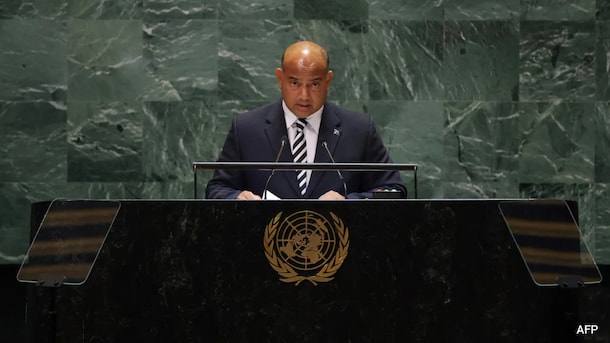
Opinion | 'Say Our Name': Why A Tiny Island Nation Wants The World To Get Its Name Right
Standing before the UN hall of nations, Naoero President David Adeang asked the world to unlearn its comfortable habits and speak a restored truth.
-
TVS Succession Row Explained: Why Venu Srinivasan's Family Is Divided Over Wealth
TVS Family Dispute: TVS Holdings is a key entity because it owns a controlling stake in TVS Motor Company. It owns 50.26% of TVS Motor.
-
Opinion | The US Is Showing India Just How Cheap Its 'Friendship' Is
Can local talent fully replace Indian contribution? Why is the US leading in setting up Global Capability Centres in India - over 60% - and pocketing the IP?