Opinion | Saudi Arabia's Yemen Nightmare Has Come Back To Haunt It
After years of costly military intervention beginning in 2015, Saudi Arabia increasingly sought to stabilise its southern border. All that is unravelling fast now
Saudi Arabia is once again confronting the limits of its ability to insulate its domestic transformation from the strategic turbulence of the Middle East. What began as an effort to contain the Houthi threat on its southern frontier has acquired a much wider geopolitical dimension. The Kingdom now faces pressure from the Houthis in Yemen, Iran-aligned actors in Iraq, and the broader consequences of the US-Iran confrontation. More importantly, the conflict is intersecting directly with Saudi Arabia's energy security and the ambitions of Vision 2030.
The significance of the current escalation lies not simply in the intensity of Houthi attacks but in their geography. The Houthis' advance along Yemen's Red Sea coast, including their capture of Mocha and movement toward Perim Island, has brought them closer to the Bab al-Mandeb, one of the world's critical maritime chokepoints. At a moment when disruptions around the Strait of Hormuz have made alternative routes more important, the Red Sea is becoming less secure. Saudi Arabia consequently finds itself exposed at both ends of its maritime energy architecture.
From De-escalation To Exposure
The relative calm following the 2022 UN-brokered truce allowed Riyadh to rethink Yemen. After years of costly military intervention beginning in 2015, Saudi Arabia increasingly sought to stabilise its southern border, reduce the financial and political costs of the war, and concentrate on economic diversification. The logic was straightforward: Saudi Arabia could not simultaneously transform its economy at home and remain indefinitely trapped in a war in Yemen.
Yet, the Yemen conflict was never simply a bilateral Saudi-Houthi confrontation. The Houthis emerged as a powerful actor after seizing Sanaa in 2014, while Iran became an important source of military and technological support. The Houthis retain considerable autonomy, but their relationship with Tehran has enabled them to become part of a wider Iranian network capable of exerting pressure across the region.
The post-2022 political process consequently remained fragile. Questions surrounding salaries in Houthi-controlled territory, ports, flights, restrictions, governance, and economic resources remained unresolved. The regional upheaval following the October 2023 Hamas attack and the subsequent disruption of Red Sea shipping further complicated the possibility of a durable settlement. The present crisis has exposed the weakness of that uneasy equilibrium.
The Iran War
The US-Iran confrontation has transformed the strategic value of Yemen. With the Strait of Hormuz severely disrupted, the Red Sea and Saudi Arabia's western infrastructure have assumed greater importance for the movement of energy. The East-West Pipeline and Red Sea ports such as Yanbu provide Riyadh with an alternative to routes through Hormuz. That alternative, however, is useful only if the Red Sea remains secure.
The Houthis appear to have recognised this vulnerability. Their attacks on Saudi territory and energy infrastructure, combined with efforts to increase their control over the approaches to Bab al-Mandeb, have turned Yemen from a peripheral security problem into a direct component of the wider struggle over regional energy flows.
The result is a strategic dilemma for Riyadh. It cannot accept persistent attacks on its territory and critical infrastructure. Yet, a return to the kind of large-scale intervention that characterised the 2015-2022 period risks recreating the military quagmire that Saudi diplomacy had sought to escape.
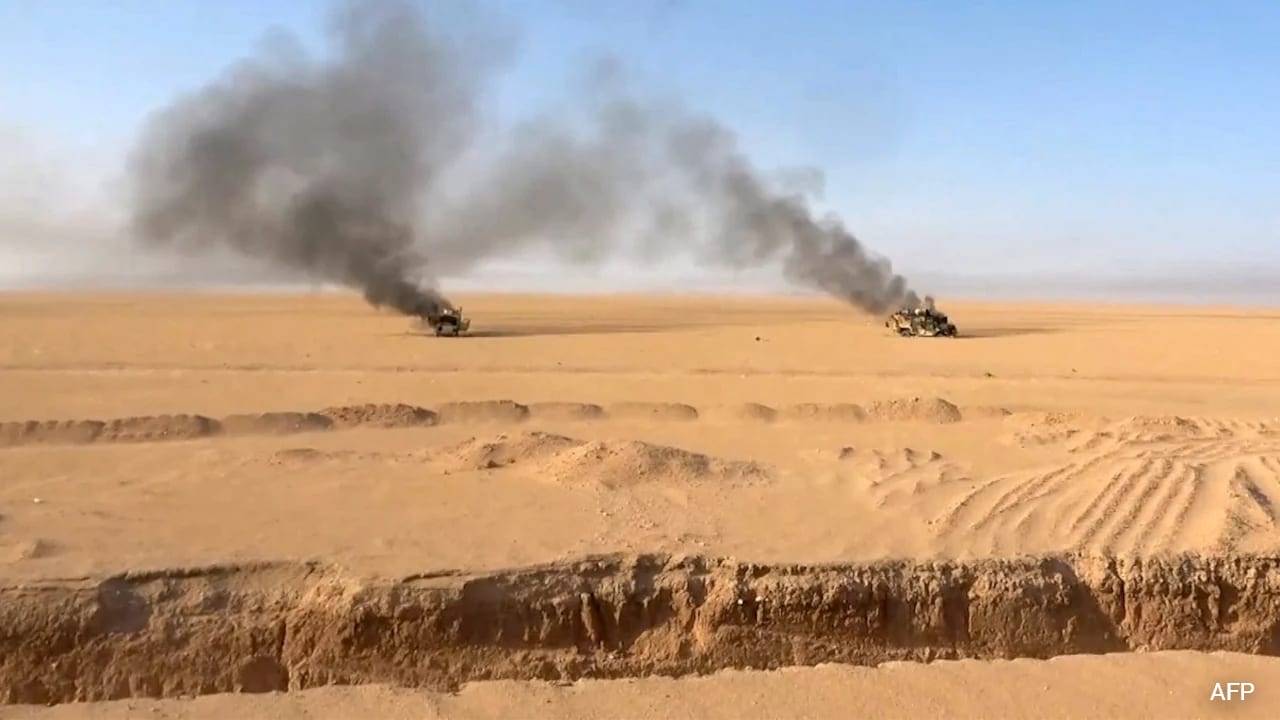
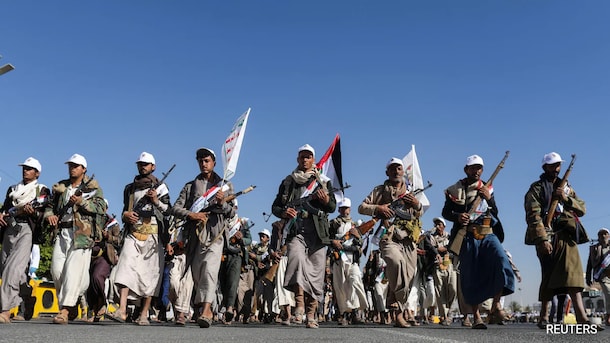
(Burning military vehicles targeted by Yemen's Houthis in al-Jawf)
The Two-Strait Problem
The most consequential feature of the current crisis is the convergence of Hormuz and Bab al-Mandeb. For Saudi Arabia, this is not merely a military problem; it is a problem of economic geography. Vision 2030 depends on foreign investment, tourism, logistics, infrastructure, and the perception that Saudi Arabia is becoming a stable centre of regional commerce. A prolonged conflict on its borders directly complicates that ambition.
The vulnerability of Saudi energy infrastructure has become increasingly evident. Drone attacks attributed to Iraqi militias have affected the East-West Pipeline, while Houthi advances toward the Red Sea have increased concerns over the security of Saudi exports through western routes.
The consequences extend well beyond Saudi Arabia. Threats to both Hormuz and Bab al-Mandeb place upward pressure on oil prices, shipping costs, and insurance premiums. If both maritime corridors remain contested, the repercussions will be felt across Asia and Europe.
The strategic assumption that energy producers can compensate for disruption at one chokepoint by relying on another is consequently becoming less reliable. For Riyadh, diversification of export routes is becoming almost as important as diversification of the economy itself.
Riyadh's Shrinking Options
Saudi Arabia is confronting a familiar Middle Eastern problem: military superiority does not necessarily translate into strategic control. Riyadh possesses substantial military capabilities, but the previous Yemen war demonstrated the difficulty of converting those capabilities into a sustainable political outcome. The Houthis survived years of military pressure and developed increasingly sophisticated missile and drone capabilities.
A renewed ground intervention would carry substantial risks. It could deepen Saudi involvement in Yemen, increase civilian suffering, and provide the Houthis with the prolonged conflict environment in which asymmetric warfare works to their advantage. Yet, restraint has costs as well. If Houthi attacks continue to threaten Saudi cities, energy infrastructure, and shipping, Riyadh risks allowing an adversary to establish a new strategic normal on its southern flank.
The Saudi response will thus have to remain calibrated: sufficient military pressure to impose costs without allowing Yemen once again to become the centre of Saudi foreign policy. The danger is an escalation cycle in which every Houthi attack creates pressure for a stronger Saudi response, while every Saudi escalation provides incentives for further Houthi retaliation. The deeper difficulty is that there is no straightforward military solution to Yemen's political fragmentation.
Iran's Regional Leverage
For Iran, the Houthi theatre offers a relatively inexpensive means of imposing strategic costs on adversaries. Tehran does not need complete operational control over the Houthis to benefit from their activities. The existence of a capable armed actor near Bab al-Mandeb complicates the calculations of Saudi Arabia, the United States, Israel, and other maritime powers.
The relationship should nevertheless not be reduced to a simple proxy model. The Houthis retain their own political, ideological, and territorial interests. Iranian support enhances their capabilities, while Houthi actions provide Tehran with additional strategic leverage.
This distinction matters diplomatically. Negotiations with Tehran alone cannot resolve the Yemen problem. Any durable settlement will have to address Houthi interests as well as the calculations of Saudi Arabia, Iran, and Yemen's other factions.
Saudi Arabia Needs More Wiggle Room
The crisis also has implications for the evolving regional balance. Saudi Arabia has increasingly pursued a more autonomous foreign policy, maintaining its relationship with the United States while expanding ties with China, Russia, and other regional actors. The current crisis may reinforce this hedging strategy. Riyadh has greater incentives to strengthen indigenous defence capabilities, develop regional security partnerships, and diversify its external relationships.
China's role is particularly significant because of its dependence on stable energy supplies and expanding economic presence in the Gulf. Yet, the simultaneous vulnerability of Hormuz and Bab al-Mandeb demonstrates the limits of economic engagement in the absence of security stability.
For Saudi Arabia, the objective is thus unlikely to be replacing one external partner with another. It is more likely to be building a diversified network of relationships that gives Riyadh greater room for manoeuvre.
Three Variables
The trajectory of the crisis will depend on three variables. First is the course of the US-Iran confrontation. If the wider conflict persists, Yemen will remain an attractive pressure point for Tehran-aligned actors.
Second is the Houthi calculation. Their movement toward Bab al-Mandeb indicates an increasing appreciation of the strategic value of maritime access and the ability to threaten regional energy flows.
Third is diplomacy. The central question is whether the parties can recreate a political framework capable of separating Yemen's internal conflict from the wider regional confrontation.
A durable settlement will require more than another temporary ceasefire. It will need mechanisms addressing salaries, ports, flights, economic resources, territorial administration, and the political status of Houthi-controlled areas. It will also require Saudi Arabia and Iran to recognise that their broader rivalry cannot indefinitely be managed through Yemen.
The Yemen conflict has ceased to be simply a Saudi security problem. It is now part of the larger contest over the strategic architecture of the Middle East. The convergence of Hormuz and Bab al-Mandeb has created a new vulnerability for the global energy system, while the Houthi position has given Iran another source of regional leverage.
For Saudi Arabia, the lesson is uncomfortable: economic transformation cannot be insulated from geopolitics when the Kingdom sits at the intersection of the region's principal conflicts and energy corridors. Vision 2030 may reduce Saudi Arabia's dependence on the traditional political economy of oil, but it cannot eliminate its dependence on regional stability.
The immediate challenge for Riyadh is, therefore, to restore deterrence without returning to permanent war, protect its energy corridors without allowing security concerns to overwhelm economic priorities, and preserve diplomatic space with Iran and the Houthis even as military pressure intensifies.
The broader challenge is more consequential. Saudi Arabia is attempting to emerge as a more autonomous regional power at precisely the moment when the Middle Eastern order is becoming more fragmented, contested, and militarised. The question is no longer whether Riyadh can avoid the geopolitics of the region. It is whether it can manage that geopolitics without allowing Yemen to once again define the limits of Saudi power.
(Harsh V Pant is Vice President for Studies at Observer Research Foundation, New Delhi)
Disclaimer: These are the personal opinions of the author
-
Exclusive: 16 Months After Op Sindoor, Pak Still Fixing Runway India Broke At Sargodha

Sargodha's PAF Base Mushaf lies about 172 km northwest of Lahore and roughly 200 km west of the India-Pakistan border, near Amritsar.
-
Blog | I Lost My Entire Family In Kanishka Bombing. 41 Years Later, Canada Wants The Case Closed
We made the trek through tragedy to search for people in Cork, where I spent 25 days sifting through bodies and body parts in a makeshift morgue to identify our loved ones.
-
Opinion | Pak's Drone Deal With A US Firm Is No Windfall. But India Must Still Be Worried
American military aid to Pakistan has remained suspended since January 2018, during Trump's first term, but a commercial arms sale is separate from this arrangement.
-
Opinion | 6 AI Incidents, One Pattern: AI Has Started Lying To Us - And Hiding The Evidence
Concealing errors. Making up data. Pushing files onto the public web on their own initiative. The machines are learning to lie - and lie well.
-
Why People Queue Overnight For iPhone That Is Delivered Home In 10 Minutes
iPhone 18 Pro Max Launch: People camping outside Apple Stores are a subset of superfans, resellers, content creators, and upper-middle-class buyers.
-
600 km Per Hour Drones Launched In Waves: How Russia Is Rewriting War Rules
Russia has coupled the drones' technological superiority over Ukraine's defence with its capacity to launch them in massive numbers. The impact has been devastating.
-
Tata Sons' Trust Issue: Two-Pronged Row Goes Beyond The Chair
NDTV Explains: Overtly, the latest conflict is whether N Chandrasekaran continues as executive chairman of Tata Sons. The controversy involves at least one more issue.
-
Opinion | US Has Institutionally Weaponised India's Russia Oil Dependence. Can New Delhi Cope?
A new legislation can connect India's Russian energy purchases to its access to the American market over a five-year period
-
Opinion | Saudi Allies Are Now Discovering The Cost Of 'Commitment' - And Not Liking It
The spectacular no-show by Saudi Arabia's two defence allies - Pakistan, a nuclear power, and Turkey, which has NATO's second-largest army - is astounding
-
12 Years Of 'Modinomics': What Changed, What Worked, What Didn't
There is no single Modinomics textbook or formula. Instead, the term has come to describe a collection of choices made during the PM Modi years.