Opinion | Why Pakistan Is Becoming Harder To Isolate - Despite India's Push
Pakistan's willingness to sell itself to the highest bidder explains its curious positioning in the world. India's only option now is to get creative as it tries to isolate it globally.
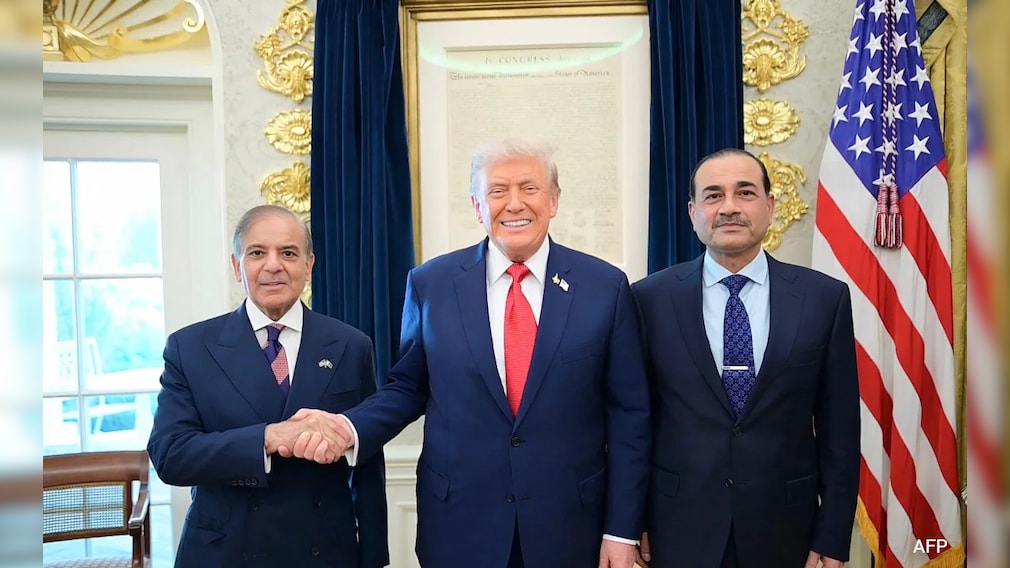
On Sunday, the world woke up to the news that Iran and the US had finally agreed to a Memorandum of Understanding "on ending the war that Israel and US had waged on Iran". The announcement was made by Pakistan's Prime Minister, Shehbaz Sharif. The document has been titled the 'Islamabad Memorandum of Understanding'. On Thursday, it was once again Sharif who announced that the deal had been electronically signed by the presidents of the United States and Iran, with his endorsement as mediator. He said the agreement takes immediate effect - Iran would reopen the Strait of Hormuz and the US would lift its naval blockade (though on Saturday, Iran closed the strait again after Israel attacked Hezbollah in Lebanon). Sharif also thanked the leaders of Qatar, Saudi Arabia, Türkiye and Egypt for their support in reaching this agreement, which has been welcomed by much of the world. Pakistan's efforts are being lauded in global capitals. Oil prices have dropped, markets have surged.
This must be the finest hour in Pakistan's diplomacy, far more significant when it brokered a breakthrough between the US and China in 1979. The Iran war had majorly and negatively affected countries around the world, and a breakthrough has caused a huge global sigh of relief. Even if, for some untoward reason, the peace deal set to be negotiated over the next two months fails, Pakistan will have put its imprint on mediating the end of this conflict and made its mark as a mediator, an important diplomatic achievement.
India has been one of the worst hit countries by the war and is understandably relieved by the detente. In France, Prime Minister Narendra Modi welcomed the MoU, without mentioning Pakistan. Coming within a year of the Pahalgam attacks and Operation Sindoor, Pakistan's elevated diplomatic position is not what India would have imagined or wished for. This clarifies a sad truth - it is impossible, at least in the current geopolitical scenario, to isolate Pakistan diplomatically. Because, Pakistan has some inherent strengths and weaknesses, both of which it leverages.
A Large Muslim Population
First, the size. Pakistan is the fifth-most populous country, with a population of over 241.5 million and the world's first modern Muslim state. Used to a secular polity, we in India often undermine the role of religion in international affairs. It is futile to ignore the fact that Islam provides Pakistan the soft power that cements its place in the larger Muslim world. Moreover, it has the second-largest Muslim population, which gives it leverage - the kind most vividly demonstrated during the Afghan jihad, when it became the frontline Muslim state fighting the communists. Such a large population also gives it visibility in states like the Gulf countries, where large expatriate Pakistani communities live and work. An overall population of 241 million also creates a large consumer market that countries do not want to forfeit.
Next is Pakistan's military. Pakistan has the world's seventh-largest standing army. The global fire power index ranks Pakistan as the 12th global military power. It has approximately 660,000 active-duty personnel, with 550,000 reserve forces and 500,000 paramilitary troops. It conducts military drills with many countries across the world. Its large military means it is also a lucrative defence market, which exporters like the US, Turkey and China and even European Union member states will not wish to lose.
Over recent years, Pakistan has bolstered its defence-industrial complex, partnering with powers like China and Turkey and exporting defence equipment. Its best-known export market is Azerbaijan, which has procured the JF-17 Thunder Fighter Jet, that Pakistan jointly co-developed with China. But there are other markets in the Middle East (Libya, Turkey), Africa (Zimbabwe, Sudan), Southeast Asia and Europe (Ukraine) where Pakistan has exported conventional small arms, drones, etc. According to reports, the country made defence exports worth $10 billion in 2024-2025.
A Rogue Nuclear State
Pakistan is a declared nuclear weapons state. It has an arsenal of 170 warheads, including tactical ones, with delivery systems ranging from short, medium, to long range. Unlike India, it does not have a No First-Use nuclear policy. While Pakistan's nuclear capabilities are primarily aimed at India, it has simultaneously provided cover of a "nuclear umbrella " to states like Saudi Arabia, further elevating its status as the only nuclear Muslim state.
Playing the role of a rentier state has also increased Pakistan's utility quotient. It has provided military and policing services to a range of countries, primarily Gulf states like Saudi Arabia, the United Arab Emirates, Qatar, as well as Jordan, helping these states to train their forces, participate in active combat during situations of conflict, and crush potential uprisings and revolts against the ruling elites. For instance, in the 1970s, Pakistan helped Jordan's King Hussein to crush a Palestinian uprising. In the current Iran war, too, even as it was playing the role of mediator, Pakistan moved aircraft and troops to Saudi Arabia under a mutual defence pact it signed with the Kingdom last year.
The Benefit Of Geography
Pakistan also has a unique geographical location bounded by the Arabian Sea on the South, the Gulf of Oman on the Southwest, and sharing land borders with India, Afghanistan, Iran, and China. It thus becomes a good listening post to monitor China, Afghanistan, Iran. Pakistan offers the most direct supply route to Afghanistan and was used as a frontline state by the US in its wars in Afghanistan, where it overrode Pakistan's sovereignty at will.
This unique location also means that Pakistan offers the shortest land transit route to the many landlocked countries of the Eurasian landmass to the warm waters of the Arabian Sea and on to south and south east Asia, and to the Middle East and Africa. Which is why it is a major node in China's Belt and Road Initiative.
At the same time the country is resource rich, sitting on a wealth of minerals and oil and gas reserves. This is why, irrespective of the internal unrest, countries like China and the US covet it, as seen in the September 2025 agreement on critical minerals between the US and Pakistan.
Offsetting these advantages, however, is what analysts call a 'schizophrenic state'. For, even as Pakistan mediates abroad, its own house is on fire, with insurgencies and uprisings from Balochistan to tensions in Pakistan-Occupied Kashmir. Even as it invests in its defence-industrial complex, its cash strapped economy depends almost entirely on IMF bailouts and grants from its patron states like Saudi Arabia. Again, this is possible in Pakistan because of its quasi-democracy.
Pakistan Is Beyond Principles
Pakistan can dispense with democracy at will, alternating between elected governments and military rule with almost no qualms, for the world cares little about the country except its utility to them as a rentier state. That is why an elected Prime Minister like Imran Khan could be easily toppled through an uprising with little international pushback and a non-elected government was installed in no time. In a country where the army calls the shots, it is perfectly normal for its Army Chief - Asim Munir in this case - to sideline the country's elected Prime Minister and seal crypto deals with the US. There are no pretences here.
All of this is unthinkable for India. In sum, Pakistan's willingness to sell itself to the highest bidder partly explains its diplomatic positioning in the world. Shehbaz Sharif's fawning over President Trump as a "peacemaker", nominating him for the Nobel Prize, had even Pakistanis cringeing. But it did the trick. Soon after Operation Sindoor ended, President Trump elevated Pakistan, especially Munir, as a friend and partner. This was what extended to Pakistan the opportunity to mediate. And that immediately resonated with America's other partners and allies (except Israel). Pakistan will continue to use such tactics and extract as much mileage as possible from its current moment in the sun.
India will thus have to get creative in managing Pakistan. India's grievances are real and pressing, but as of now, there are few takers for them. Apart from shoring up its own security, New Delhi will need to expend more effort in public relations and media engagement to put forth its own narrative firmly. The ignorance around the world on the Kashmir issue, for instance, is mind-boggling. Pakistan is a rogue neighbour that cannot be wished away. India's task is to rein it in not just in its own neighbourhood, but also on the global stage.
(The author is a senior journalist)
Disclaimer: These are the personal opinions of the author
-
Delivery Boy At 15, He's Now The Global Head Of WhatsApp: Meet Kunal Shah

Once a delivery boy and a data-entry operator, Cred founder Kunal Shah's story is right out of a movie plot. A look at his incredible journey as he takes on the role of WhatsApp's global head.
-
Opinion | The Great Surrender: Why This Is America's Worst Humiliation In Over 50 Years
There is no precedent in recent US history for an American president accepting such humiliating terms as in the Iran deal.
-
MBBS Student Sejal Pawar Dehumanised Cadavers, Internet Did The Same To Her
Sejal Pawar was rightly criticised for her dehumanising remarks. Her college sent her on a 15-day forced medical leave, and Maharashtra Cyber has registered an FIR naming her. But the faceless trolls did to Pawar what she did to the male cadavers through her words - she was stripped of her dignity.
-
Smartphones, Laptops To Get More Expensive As AI's Latest Victims
AI's latest side effect? More expensive smartphones, laptops and gaming consoles like PlayStation. Read on to know what's driving up these gadget prices.
-
Six Prime Ministers In 10 Years, 44 Days, One Lettuce: The UK's Queue
The UK has seen six prime ministers in ten years - Keir Starmer, the under-fire incumbent, preceeded by Liz Truss, Rishi Sunak, Boris Johnson, Theresa May, and David Cameron.
-
Opinion | Raped At 14, Then Hounded By Perpetrator: The Story Of Shweta And A Failing System
Rahul, 17, was produced before the Juvenile Justice Board and immediately granted bail, returning to the same neighbourhood and harassing the victim. Therein lies the blindspot in India's child justice system.
-
A $14 Billion Market Takes Off As Retirees Aren't Moving To Hometowns Anymore
India's senior living market was valued at $3.55 billion in 2025. It is projected to grow from $4.47 billion in 2026 to $14.14 billion by 2031.
-
Safe...For Now: Rohit Sharma And The Curious Art Of Delaying The Inevitable
By the time Rohit Sharma had walked out to bat in Chennai on Saturday evening, he would have known the conversations about him.
-
Delhi's Dark 'Baby Bazaar': Baby Boys Sold For Rs 8 Lakh, Girls Half The Price
Gang bought infants from underprivileged couples from Rajasthan and Gujarat, and sold them to childless couples
-
'Foreign Degree Is Rs 1 Crore Debt': Is Studying Abroad Still Worth The Price?
A weaker rupee and rising tuition fees are forcing Indian families to ask a difficult question: does an overseas degree still deliver the returns?