Opinion | Rahul Gandhi Has A 'Generation' Problem, And It May Cost Congress Dear
In his search for a new organisation, Rahul Gandhi is making the big mistake of treating the Congress he inherited as dead weight.
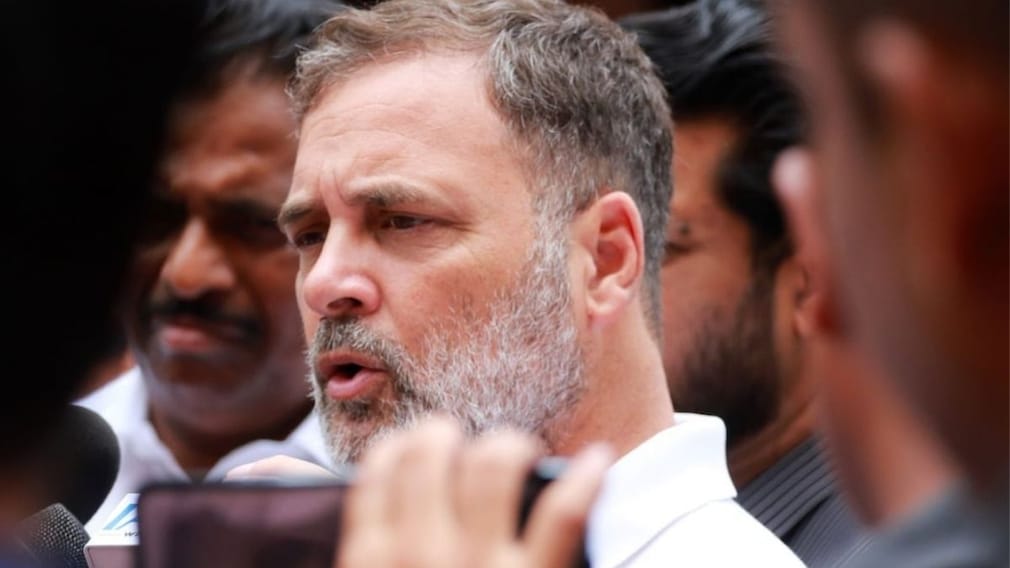
As Rahul Gandhi remakes the Congress in his image, keeping leaders with decades of patronage, favourable equations, administrative experience, and personal networks at arm's length may spell strategic doom for the party. There is a growing perception within and outside the Congress that some of Rahul's key slogans and campaigns, such as the latest 'smash the patriarchy' crusade, or his support for Gen Z and caste-based reservation, haven't been received well by many among the Congress's old guard, particularly former chief ministers. Privately, these former chief ministers are reportedly concerned that a heavy focus on Gen Z issues might overshadow broader voter priorities, such as inflation and middle-class economic struggles.
There is an old rule about the Congress that its present leadership would do well to remember: a Chief Minister never really becomes an ex-Chief Minister. The bungalow may go, the red beacon certainly does, ministers stop returning calls with quite the same urgency, but political capital accumulated through years in office does not disappear with an election defeat or a change of guard. A former Chief Minister leaves behind a web of MLAs, former MLAs, district satraps, contractors, lawyers, business leaders, journalists, bureaucrats, community leaders, religious figures, and party workers who have, at one time or another, received patronage, access, or simply a patient hearing. That is political capital. And the Congress today has an astonishing amount of it lying underutilised.
Digvijaya Singh, Kamal Nath, Ashok Gehlot, Bhupinder Singh Hooda, Bhupesh Baghel, Siddaramaiah, Prithviraj Chavan, Charanjit Singh Channi, Sushilkumar Shinde, and Rajinder Kaur Bhattal, to cite some of the most important names, have all governed major states. AK Antony and Shinde, who have now withdrawn from active politics, belong to an even older tradition of Congress elders who could be summoned when a crisis required credibility rather than decibels.
These are not identical cases, and it would be inaccurate to say each has been banished. Baghel, for instance, is the All India Congress Committee (AICC) general secretary in charge of Punjab, while Channi has been made chairman of the Punjab Congress campaign committee for the 2027 election. Hooda remains the Leader of Opposition in Haryana. Yet, collectively, these former chief ministers appear increasingly peripheral to the central political grammar being fashioned around Rahul Gandhi. This may be part of a generational transition. But a generational transition badly handled can easily become institutional amnesia.
A Congress Tradition Rahul Should Rediscover
The Congress once understood the usefulness of its former chief ministers rather well. AK Antony did not cease to matter when he left Thiruvananthapuram; he became Defence Minister, troubleshooter, and one of Sonia Gandhi's most trusted political consciences. Digvijaya Singh, after 10 years as Madhya Pradesh Chief Minister, moved into the AICC apparatus and handled difficult states. Ashok Gehlot spent years as an AICC general secretary in charge of the organisation between his innings in Jaipur. Sushilkumar Shinde went from being Maharashtra Chief Minister to being appointed Governor, Union Power Minister, and, eventually, Union Home Minister.
Former chief ministers were dispatched as observers because they understood the one language every Congress legislature party speaks fluently: ambition. In 2009, for instance, Antony and Digvijaya were among the senior observers sent to Maharashtra after the Assembly election, while Prithviraj Chavan was sent to Haryana.
There was logic to this. Someone who has himself negotiated the Chief Minister's chair knows how to recognise a rebellion before the rebel has drafted his press statement. The present Congress, by contrast, sometimes seems eager to demonstrate that nobody is indispensable. It is an understandable impulse given the many cases of regional barons often holding the organisation hostage. Rahul Gandhi wants a younger, more ideological, less transactional party. The trouble is that elections remain stubbornly transactional affairs.
The BJP understands this better than its rhetoric suggests. It may retire veterans, but it carefully harvests their networks before doing so. The Congress, on the other hand, often retires the network with the individual.
Reservoirs of Political Capital
Take Digvijaya Singh. He can be an exasperating presence for his own party, occasionally giving the BJP a quotation it could never have written as effectively itself. Yet, few Congress leaders know the political geography of Madhya Pradesh better. In the run-up to the 2023 election, he was entrusted with difficult BJP-dominated constituencies and spent months meeting cadres and placating disgruntled workers. Even in 2026, he remains politically engaged, though he has said he will not seek another Rajya Sabha term. His real asset is not a television sound bite; it is the telephone directory accumulated over five decades.
Kamal Nath represents another kind of Congress power. Nine Lok Sabha victories, decades in Union Cabinets, an extraordinary network in business and in Delhi, and the once-formidable Chhindwara organisation, which made him one of the party's great resource mobilisers and negotiators. His stock has undoubtedly fallen since the 2023 Madhya Pradesh defeat and the loss of Chhindwara in 2024. But political parties should distinguish between a leader whose best electoral years may be behind him and one whose relationships have suddenly become worthless.
Ashok Gehlot, a three-time Chief Minister, three-term Rajasthan Congress president, and a multi-term AICC general secretary, has an institutional memory. His relationship with the emerging state leadership remains complicated, and the wounds of his bizarre defiance in September 2022 have not healed. But Gehlot understands the Congress organisation and is capable of keeping both existing and potential Congress allies in good humour.
Bhupinder Singh Hooda remains Haryana Congress's most substantial mass leader. Two terms as Chief Minister created deep relationships with Jats, farmers, rural elites, and the administrative establishment. The 2024 assembly defeat has strengthened the argument for broadening the Congress beyond the Hooda family orbit; that argument is legitimate. But broadening is different from discarding. Haryana's continuing factional tensions show how difficult replacing a political centre can be without first constructing another.
Bhupesh Baghel possesses precisely the profile Congress says it wants: OBC credentials, administrative experience, an earthy campaign style, and the ability to translate welfare politics into accessible language. His assignment in Punjab shows that the high command recognises some of this value, even if his efforts there have run straight into the state's spectacularly complicated factionalism. A former Chief Minister should not merely be sent to extinguish fires. Baghel can help the Congress think about how regional identity, welfare, and OBC politics can coexist within a national message.
Then there is Siddaramaiah, newly added to this club after DK Shivakumar succeeded him as Karnataka Chief Minister in June 2026. Siddaramaiah's importance goes far beyond Varuna. He built the AHINDA social coalition, speaks the language of backward-class assertion instinctively, and can challenge the BJP on ideology without sounding like a Delhi politician reading from a briefing note. He has announced that he will not contest in 2028 but intends to remain politically active. The Congress would be foolish to confuse electoral retirement with political redundancy.
Prithviraj Chavan offers almost the opposite skill set: understated, technocratic, policy-oriented, and personally associated with the highest standards of probity in public life. His experience in the Prime Minister's Office, the Union government, and Maharashtra gives the Congress something it badly needs when confronting the BJP on governance and institutions - a politician who understands how government actually works.
In Punjab, Charanjit Singh Channi is already demonstrating why former chief ministers cannot simply be wished away. The Jalandhar MP has emerged as a significant power centre and now chairs the 2027 campaign committee. As a Dalit Sikh leader with grassroots appeal, his importance in a state where Scheduled Castes constitute an exceptionally large share of the population is obvious. The task is to accommodate that strength without allowing the Punjab Congress to become, once again, a collection of rival durbars.
Rajinder Kaur Bhattal, Punjab's first and only woman Chief Minister, belongs to another generation but carries decades of relationships in the state Congress. Her role need not be electoral command. Senior leaders can serve as conciliators, mentors, and repositories of institutional memory, particularly in a state unit that spends an alarming amount of energy quarrelling with itself.
Sushil Kumar Shinde similarly brings something difficult to manufacture. He is a Dalit leader who has been the Maharashtra Chief Minister and Union Home Minister, with decades of relationships across Maharashtra and Delhi. Even leaders withdrawing from the electoral arena can be deployed for negotiations, candidate assessment, coalition outreach, and mentoring.
Like Shinde, AK Antony, though retired from active politics, represents perhaps the most endangered commodity in today's Congress - moral authority unconnected to personal ambition. Kerala Congress has itself felt the vacuum created by Antony's withdrawal and Oommen Chandy's death. One does not send Antony to organise booths; you consult him when the institution needs perspective.
Rahul Needs Lieutenants, Not Courtiers
All this matters because 2029 will not begin in 2029.
Punjab, Uttar Pradesh, Uttarakhand, Gujarat, and other state contests will significantly test the Congress before the next Lok Sabha election, while Rajasthan, Madhya Pradesh, Chhattisgarh, and Karnataka will not be simple, either. Every defeat will shape alliances, morale, fundraising, and the perception of whether the Congress can actually convert Rahul Gandhi's national political messaging into state power.
Rahul has succeeded in giving the Congress an ideological vocabulary sharper than it possessed a few years ago - Constitution, caste census, inequality, institutional capture, and social justice.
But ideology requires transmission belts. Former chief ministers are exactly that.
The answer is not to return the Congress to a gerontocracy or restore every veteran to an office with a brass nameplate at Indira Bhawan. Nor should Rahul become hostage to satraps who believe decades of service confer hereditary rights over states. The answer is more sophisticated: create a council of political elders, use former chief ministers as permanent mentors to selected state units, involve them systematically in candidate assessment, send them on quiet reconciliation missions, make them responsible for rebuilding districts where the Congress has disappeared, use their social, business, and administrative networks, and, above all, allow younger leaders to inherit their political capital rather than forcing them to build everything again from zero.
Rahul Gandhi's great challenge is not merely to replace Narendra Modi's BJP. It is to reconstruct the Congress as a durable national institution. To do that, he needs young leaders who can run faster. But he may also need a few former Chief Ministers who remember where the road leads.
(Rasheed Kidwai is an author, columnist, and conversation curator)
Disclaimer: These are the personal opinions of the author
-
One-Day Disaster, Multi-Season Economic Shock: Nepal's Sisyphean Curse

Nepal Flash Floods: Nepal cannot prevent every earthquake, landslide or glacial collapse. But it can reduce how much each disaster costs.
-
Meta Pays Billions Over Teen Harms In US. In India, Algo Runs Unchecked
The US Surgeon General has separately warned that heavy social media use roughly doubles adolescents' risk of depression and anxiety, and that nearly half of teens surveyed said it made them feel worse about their bodies.
-
Blog | 'No Calls, People Scanning Banks For Bodies': Nepal Journalist Describes Flood Aftermath
As of Thursday evening, it was still impossible to get through to mobile phones in Dhunche, the district headquarters, or the flood-ravaged towns of Syabru Bensi or Timure.
-
Opinion | Toxic Knows Exactly What It Is Doing To Its Hero. And You May Have Missed It
Toxic's bait-and-switch goes beyond its plot. Geetu Mohandas is almost making a subtle point - for those who can see it.
-
Why Nepal Is So Vulnerable: Glacial Lakes, And A Himalaya That Moves Constantly
The August 26 inland tsunami was not an accident of weather. It sat at the intersection of processes that make Nepal one of the most hazard-exposed countries.
-
IRGC's New Boss Is No Ordinary Man. Meet Ahmad Vahidi, Iran's Ultimate Survivor
He has survived purges, sanctions, assassinations, secret deals, and Iran's most consequential wars. The IRGC's new chief, formally appointed by Khamenei this month, knows the regime - and its enemies - like few others do.
-
Analysis | BJP's Mother Of All Resets: An Overhaul To Fix Its Perception Problem
The battle this time is to regain credibility as BJP has entered a phase which is going to be the launch pad for a national face after a political force called Narendra Modi.
-
Opinion | Why Is India Cooler As The World Burns? A Heatwave 'Mystery'
Europe, which is warming at more than twice the global average, is now bracing for even worse climate impacts. But something strange and unexpected is happening in India, keeping it cooler.
-
Tukaram Mundhe: The IAS Officer Restaurants Fear Most In Maharashtra
As FDA commissioner, Tukaram Mundhe has his eyes on Maharashtra's plate. Food adulterators, storied restaurants and clubs, dark stores of quick commerce platforms, school and government canteens, surrogate advertisers of banned products - no one is out of bounds.