Opinion | Why The Congress-Samajwadi 'Merger' Fantasy Could Be Opposition's Biggest Self-Goal
Rahul Gandhi and Akhilesh Yadav do not need to become one another. They need to become better at being themselves, together.
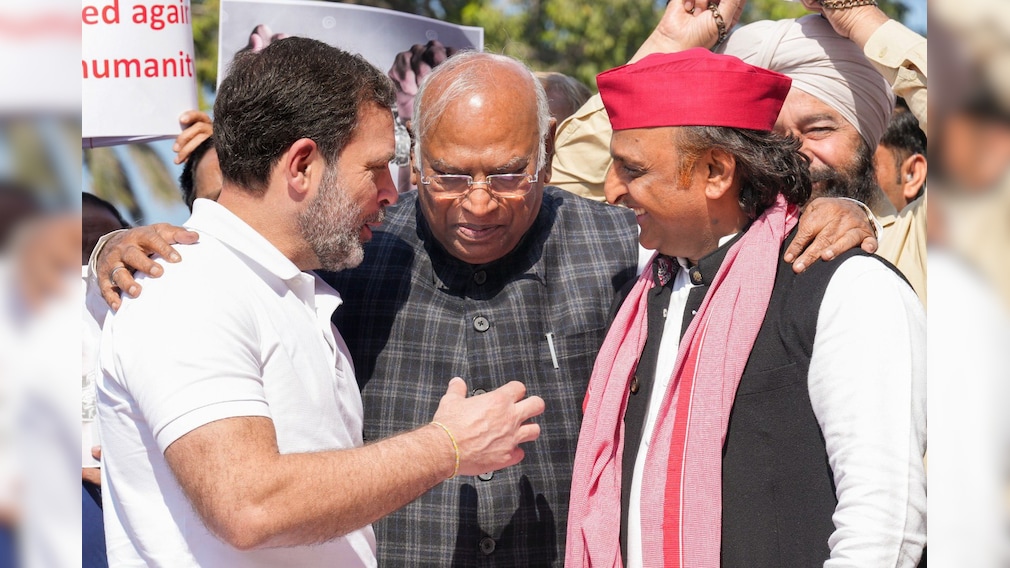
Political Delhi has a weakness for grand solutions. When alliance talks are tedious, seat-sharing becomes rancorous, and local leaders refuse to yield, a merger can appear seductively simple. Why negotiate every election if two parties can simply become one?
That is precisely why the suggestion that the Congress and the Samajwadi Party (SP) should merge deserves scrutiny. The argument is that Rahul Gandhi and Akhilesh Yadav are increasingly occupying the same terrain of caste justice, representation, and inclusive politics, and that a merger could turn this convergence into a new national political formation. It is an interesting proposition. But it also solves the wrong problem.
The challenge before Rahul Gandhi and Akhilesh Yadav is not that their parties are insufficiently alike. It is that they must cooperate without destroying the differences that make each useful. In politics, two plus two is not necessarily four. Votes carry memory, caste, class, community, local loyalties, ideological inheritance, and, importantly, the ambitions of party workers. A merger may look like a consolidation from Delhi. In Uttar Pradesh, it could become subtraction.
Parties Are Constituencies, Not Containers
The case for a merger rests substantially on the argument that the Congress and the SP are moving towards the same social terrain: caste justice, representation, minorities, Dalits, and backward classes. There is truth in the observation, but the conclusion does not follow.
Political convergence is not political sameness.
The Congress in Uttar Pradesh was historically an umbrella formation. At its strongest, it brought together a coalition of Brahmins, Dalits, and Muslims, alongside other groups, under a broad national platform. That old social compact eventually came apart under the pressures of Mandal, Mandir, and the rise of parties representing more sharply defined social constituencies.
The Samajwadi Party grew out of a very different political genealogy - the socialist tradition associated with Ram Manohar Lohia, backward-caste assertion, and a pronounced streak of political and organisational independence. The party itself describes Lohia as its "guiding light" and defines its ideological inheritance in explicitly socialist terms.
Its traditional social architecture has also been different: Yadavs, sections of other backward communities, and Muslims formed its core, even as Akhilesh now attempts to widen that coalition substantially. The fact that the Congress and the SP today seek Dalit, OBC, and minority votes does not mean that they command the same voters, or that those voters see them as interchangeable.
Even the 'Muslim vote', so casually spoken of in political shorthand, is no single transferable bloc. Ashraf and Pasmanda communities, biradari networks, class, locality, and the standing of individual candidates, all influence political preferences.
There is another constituency that political arithmetic habitually forgets: the aspirant. Every district has leaders who have spent years building a claim to a ticket, an organisational post, or a local following. Merge two organisations and one may not get twice the energy. One may get twice the number of claimants for half the available political space.
Rebellion, sabotage, and migration are not academic possibilities in Indian elections, but daily mechanics of party politics.
UP Has Tested This Already
There is no need to conduct this experiment in a laboratory. Uttar Pradesh has supplied enough evidence.
In 2017, the SP and the Congress fought the Assembly election together amid enormous publicity around the Rahul-Akhilesh partnership and the catchy promise that Uttar Pradesh liked their coming together. The electorate proved considerably less sentimental. The SP won 47 seats and the Congress seven, while the BJP swept 312.
That election demonstrated an elementary truth: leadership chemistry does not automatically produce cadre chemistry. A friendly photograph at the top does not guarantee vote transfer at the booth.
The 2019 mahagathbandhan between the SP and the Bahujan Samaj Party supplied another warning. On paper, their previous vote shares promised formidable arithmetic. In practice, those votes did not transfer mechanically; the alliance finished with 15 seats. Ironically, the argument in favour of a Congress-SP merger itself acknowledges this inconvenient fact.
Then came 2024, and that result should lead to precisely the opposite conclusion.
The Congress-SP arrangement worked because it was an alliance of recognisable political entities, not an act of political self-liquidation. The SP won 37 Lok Sabha seats, and the Congress six; together, the INDIA grouping took 43 of Uttar Pradesh's 80 seats. Both retained their symbols, leadership structures, cadres, and political personalities while preventing destructive competition across most of the State.
Why should the success of a coalition be converted into an argument for abolishing coalition partners?
The lesson of 2024 was simpler and more useful: intelligent seat-sharing, a resonant common campaign, and disciplined accommodation can make distinct social coalitions complementary. The political genius lay in addition without erasure.
The Janata Warning
Indian politics has seen a much grander merger in the name of defeating a dominant leader.
In 1977, the Congress (Organisation), Bharatiya Lok Dal, Bharatiya Jana Sangh, and socialist streams surrendered their separate identities to come together as the Janata Party after the Emergency. Anti-Indira sentiment and the extraordinary public reaction to the Emergency gave the formation a historic victory and India its first non-Congress government at the Centre.
But what was powerful enough to win an election proved inadequate to manufacture a durable political identity. Old ideological disputes resurfaced. Leadership rivalries sharpened. The tensions between the socialist and erstwhile Jana Sangh components became impossible to paper over. Morarji Desai's government collapsed in 1979, barely halfway through its mandate.
The lesson is not that Opposition unity is futile. It is considerably subtler: a negative common denominator can be a campaign instrument; it cannot, by itself, become an organisational philosophy. 'Defeat Modi' cannot be the constitution of a new political party any more than 'Defeat Indira' could hold Janata together.
A Congress-SP merger would immediately raise questions that an alliance instead can negotiate without creating an existential crisis. Who controls the Uttar Pradesh organisation? Who selects candidates? What happens when the Congress's national calculations clash with the SP's provincial imperatives? Does the Congress abandon its long-term ambition to rebuild independently in India's largest State? Does the SP trade the autonomy that gives Akhilesh Yadav his political weight for a place within a national hierarchy?
These are not minor details to be worked out after a merger. They are the merger.
Not A Political Monoculture
There is an even larger proposition in the merger thesis that deserves challenge: that bringing the Congress and the Samajwadi Party together could lay the foundation for a broad 'biparty' system more suitable for India.
India's regional parties are not merely debris left behind by the fragmentation of the old Congress system. They are expressions of federalism, caste mobility, regional aspiration, and the democratisation of political power. Groups such as the Samajwadi Party grew precisely because social groups wanted a political voice more direct than the old catch-all Congress structure could provide.
To regard regional parties as an anachronism because Indian politics is becoming increasingly 'nationalised' is to misread India. National narratives matter enormously, but elections are still fought through state societies, local leadership, caste configurations, constituency grievances, and regional political cultures. A national Opposition capable of challenging the Bharatiya Janata Party (BJP) does not need to flatten these differences. It needs to organise them.
Indeed, Akhilesh Yadav's value to a wider Opposition lies partly in the fact that he is not a Congress leader. He possesses a distinct lineage, vocabulary, cadre, and social legitimacy. The Congress, similarly, can attract voters, social groups, and local elites who may resist the Samajwadi Party but are willing to vote for a national alternative to the BJP.
Coalition politics is frequently dismissed as untidy. It is. But India is untidy in the best democratic sense - plural, argumentative, layered, and stubbornly resistant to neat political packaging.
Rahul Gandhi and Akhilesh Yadav do not need to become one another. They need to become better at being themselves together. Politics, after all, is not accountancy. Two plus two can become three, five - or sometimes zero. The skill lies not in forcing it to equal four, but in understanding what each number represents.
(Rasheed Kidwai is an author, columnist, and conversation curator)
Disclaimer: These are the personal opinions of the author
-
Opinion | Mumbai's 'Marathi' Test For Cabbies, And The Art Of Fixing The Wrong Problems

All these years, India's financial capital has worked just fine without a Marathi mandate for its taxiwallahs. Whose problem is the new language rule actually solving now?
-
Opinion | Rs 1.05 Lakh Crore Lost: Inside The Dangerous Rise Of India's Gen Z Stock Traders
Investors under 30 now account for 37.9% of the total investor base in India. But they are also losing money at a much higher rate. Why are they doing it?
-
Opinion | Why A 'Bangladesh' Proposal By Turkish Media Should Worry India
A recent article in Turkish media illustrates how Ankara is turning into a strategic threat for India and its neighbourhood
-
Opinion | 4,800 Indians Removed, 51,000 ICE Arrests: What's Happening In Trump's America?
According to Stop AAPI Hate, Indians are now one of the most targeted groups by ICE, with the highest number of arrests, detentions, and deportations out of all Asian and Pacific Islanders.
-
Opinion | Noakhali To Parliament, What Gandhi, Nehru, Jinnah And Faiz Were Doing On Aug 15, 1947
What was Gandhi doing while Nehru was making his famous midnight speech, and why was Jinnah hosting a lunch as a new nation began fasting? August 15, 1947, looked very different depending on where you stood.
-
Opinion | 79 Years On, India's Enduring Answer To Those Who Had Predicted Its Collapse
Seventy-nine years in the lifespan of an ancient civilisation is a mere heartbeat; yet, in the annals of modern nation-building, it's an audacious triumph.
-
The Coast Pays, Delhi Collects: What The Centre's Mineral Bill Takes From States
India's mineral wealth may lie with the states, but the power to tax it is increasingly travelling north.
-
Opinion | Nanded Attack: Sukhbir Badal And The Past That Still Haunts Him, 11 Years Later
Badal has now faced two serious physical attacks at Sikh religious places in less than two years. Is religious atonement enough for political forgiveness?
-
How Parents Walk Tightrope Of Sending Child To Daycare And Ensuring Safety
As dual-income households rise in India and nuclear families become the norm, daycare support is no more a want, but a need.
-
Opinion | Indian Parliament And The Perils Of Empty 'Swagger'
Indian MPs - on all sides - have found a dangerous new way to game the Parliament. And so far, they all are winning