Opinion | Prashant Kishor May Just Be Playing Two Games At Once In Bihar
The Jan Suraaj is neither a 'BJP-lite' option for disaffected upper-caste voters, nor is it an RJD alternative for Muslims. It is, in fact, both things at once, in the same seat, in the same election.
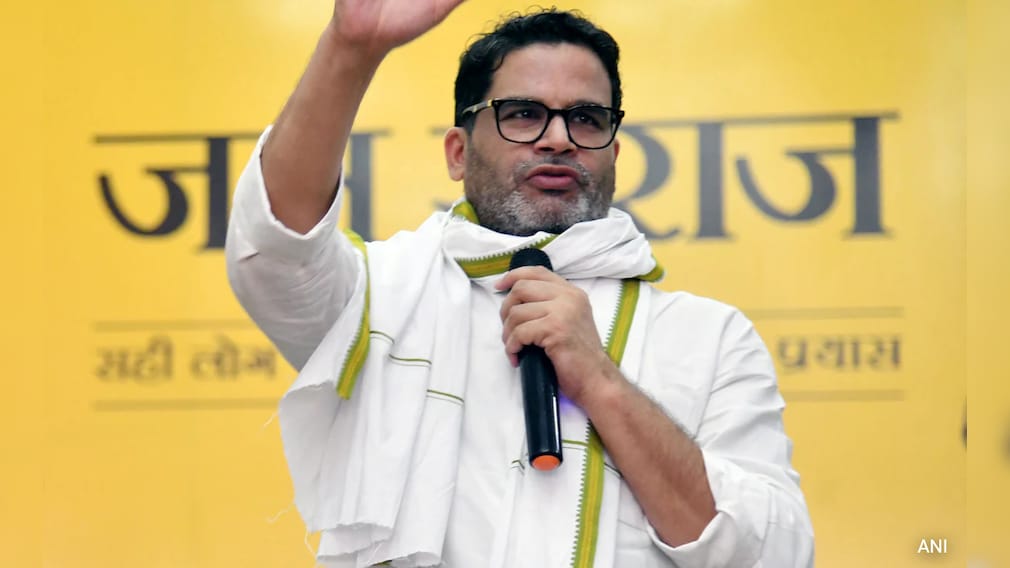
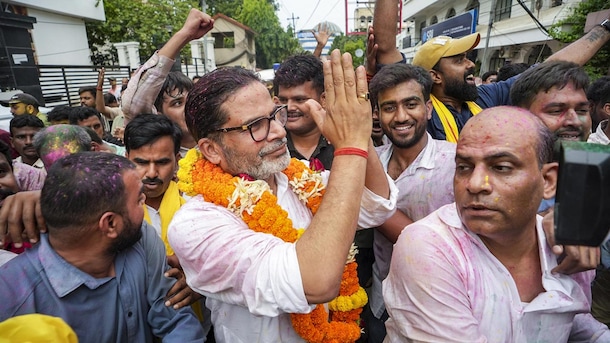
Prashant Kishor and his Jan Suraaj Party have created an upset of sorts in Bihar by wresting Bankipur from the Bharatiya Janata Party (BJP). Thus far represented by the BJP's national president, Nitin Nabin, the seat, ironically, was considered safe for the saffron party. Considering that in 80% of cases byelections are won by the incumbent government, this is a serious achievement for Kishor's Jan Suraaj Party (JSP), which last year had failed to even open its account in the Vidhan Sabha polls.
The Bankipur by-poll results have exhibited a massive swing in just eight months. In 2025, the BJP had won the seat by a massive lead of 51,936 votes. However, its loss this time is by over 19,000 votes. That's a massive swing of 71,000 against the incumbent for a seat it has held for close to three decades.
In the 2025 assembly election, Bankipur was a clean BJP vs RJD contest. The BJP polled 62.7% of the vote, the RJD 29.6%, and the Jan Suraaj Party came as an afterthought at 4.9%.
A year later, in the 2026 by-poll, that picture was inverted. The JSP has managed to bag a whopping 49.2% of the total votes, the BJP has collapsed to 34.4%, and the RJD has been reduced to a distant 11%. NOTA and other candidates barely moved.
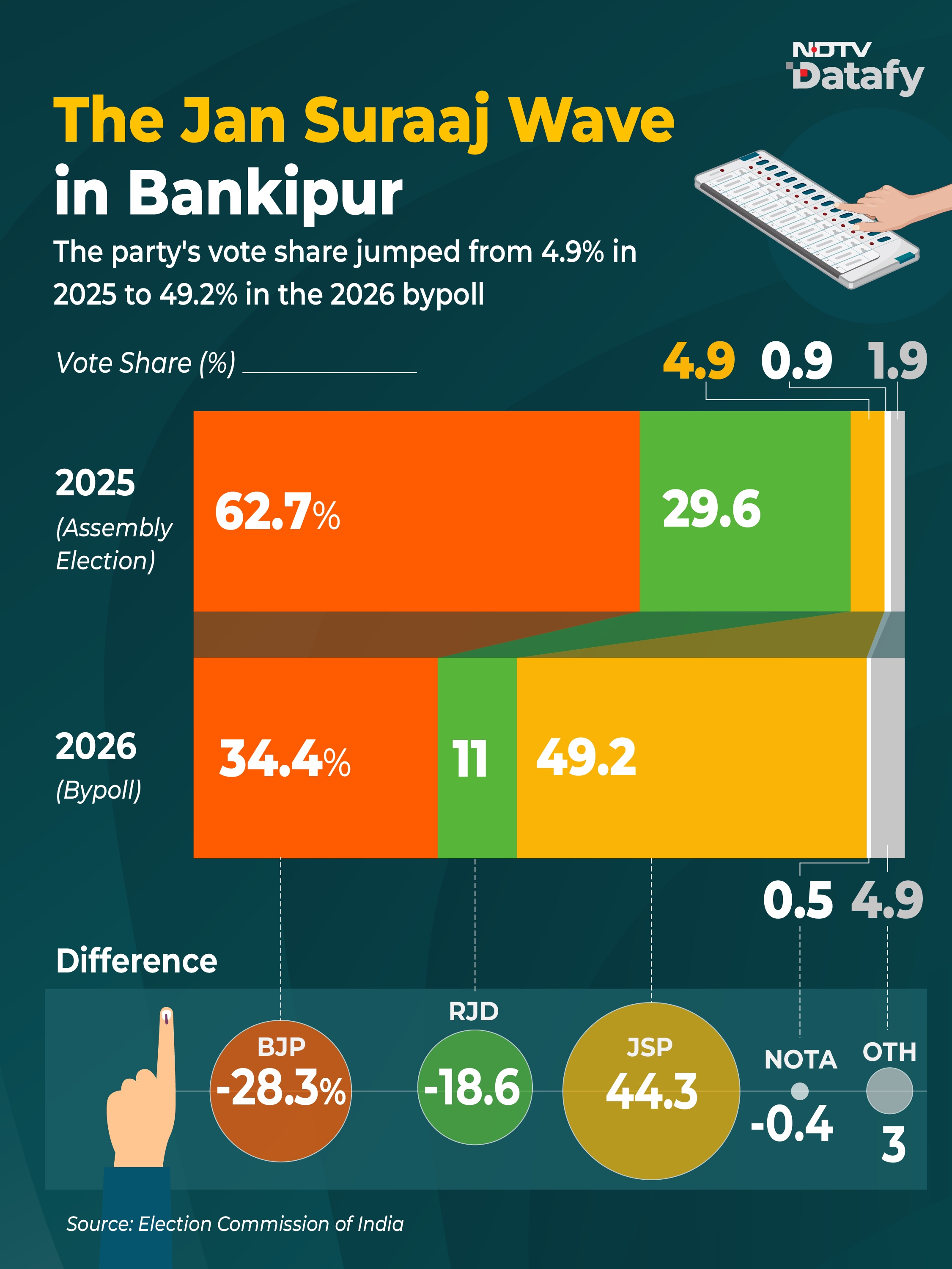
Put simply, the BJP lost 28 percentage points of votes, the RJD close to 19 points, and the JSP gained roughly 44 points. A by-poll swing of this size points to not just anti-incumbency - which the JSP effectively utilised - or mere scooping up of undecided voters. It means that the JSP has managed to eat directly into the two major parties' existing bases.
The Bigger Shock Is For BJP
That the JSP would erode the vote share of the main opposition party, the RJD, and bag a majority of the anti-BJP votes that went to it in 2025, was expected. But that it made a bigger dent in the BJP vote as well was a shock.
Working backwards from last year's vote share of the JSP (4.9%), the swing adds up almost perfectly. The party pulled about 28.3 percentage points from the BJP's vote share and 18.6 points from the RJD. These swings accounted for nearly all of the JSP's gain, with a small net loss, roughly 2.5 points, to other candidates and NOTA. In other words, the JSP's surge in Bankipur wasn't a case of one discontent community abandoning one party. It was a simultaneous raid on both flanks of the state's dominant coalition.
And that's the more interesting story here. A by-poll swing of this scale usually has one clear source - an anti-incumbency wave against the ruling party, or a consolidation of an opposition base. Bankipur shows something rarer: a third force draining support from a governing party and its principal challenger at the same time, which suggests that the JSP's appeal here wasn't ideological or anti-incumbency-driven so much as it was aspirational, pitched at voters looking for an alternative to the entrenched two-party frame itself.
A Reckoning
The category-wise breakdown makes the pattern sharper. The seat is a stronghold of the BJP as it favours it demographically. It has 65% upper caste and non-Yadav OBC voters, making it a safe den for the party.
The JSP registered gains across every social group tracked - Kayastha, Bhumihar, Brahmin, Rajput, Yadav, Vaishya/Baniya, Kurmi+Kushwah, Other OBC, Muslim, SC, and the residual "Others" category - with swings ranging from roughly 29 points among Kayasthas to a striking 67 points among Muslim voters.
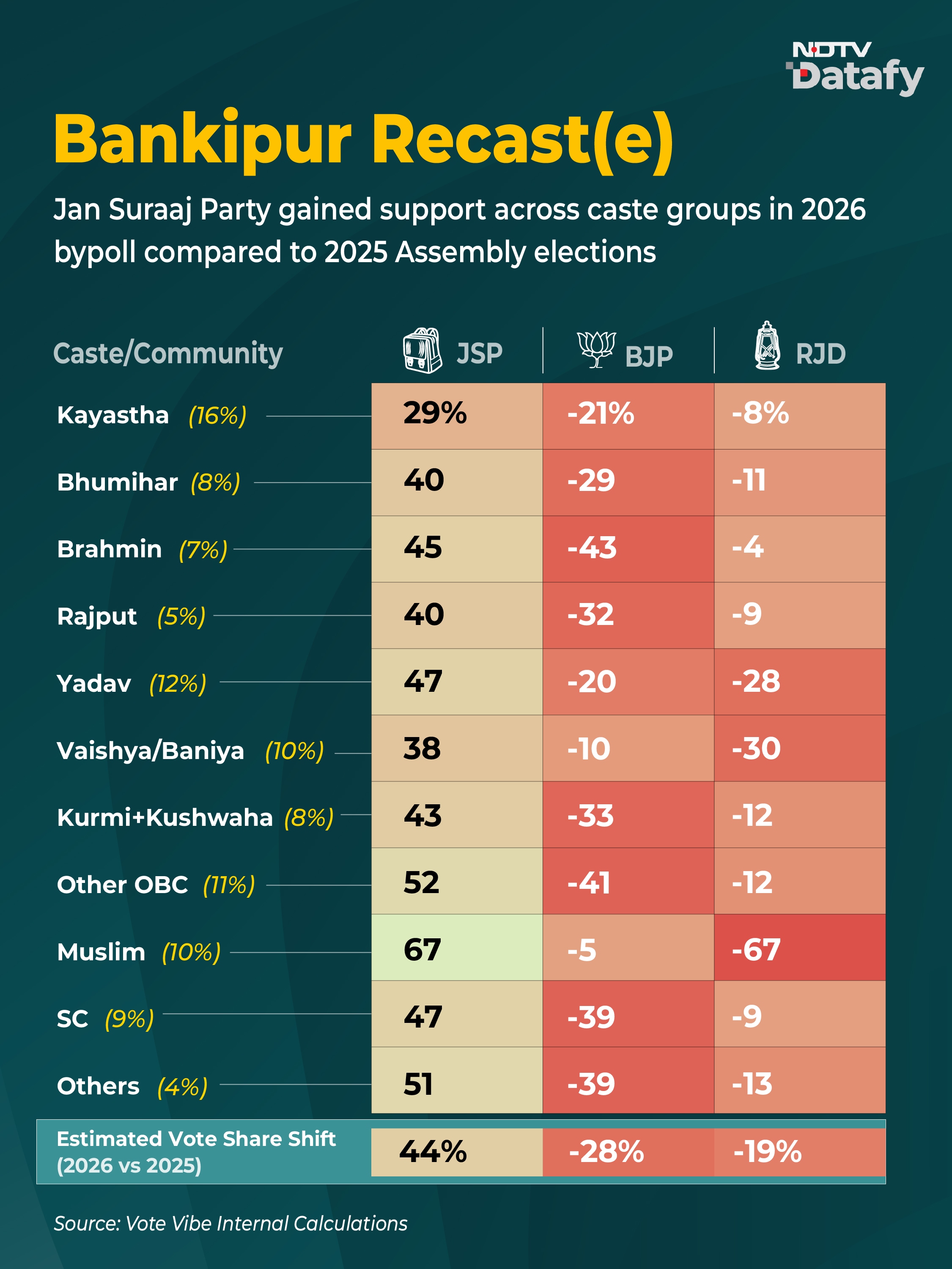
Two things stand out. First, the erosion of the BJP's support wasn't confined to any one caste bloc; upper-caste communities that have anchored the party's Bihar coalition - Bhumihar, Brahmin, Rajput, Kayastha - all contribute to the BJP's losses in the 21-43 point range, alongside comparable or larger losses among Vaishya/Baniya and OBC categories. That's a broad-based erosion of the BJP's traditional urban and upper-caste base, not a narrow one.
The upper caste voters, drawn towards the JSP both by fatigue as well as discontent over issues such as the Bharat Tiwari encounter, the UGC norms, paper leak protests, and other things, may have wished to give the BJP a warning that they can not be taken for granted. A section of Kurmi voters was also unhappy over the unceremonious exit of Nitish Kumar from the Chief Minister's office.
Second, and more dramatically, the RJD's single largest injury came from Muslim voters, where the JSP's swing of +67 points came almost entirely at the traditional opposition party's expense, alongside a meaningful, though comparatively smaller, loss among Yadav voters, of around 28 points. The RJD's Muslim-Yadav (MY) coalition, which has been the bedrock of its Bihar politics for three decades, appears to have cracked in this constituency, with Muslim voters moving toward the JSP in hordes. Perhaps they found Prashant Kishor better suited to defeat the BJP.
If this pattern holds beyond one constituency, it would represent a more consequential development than what the topline vote share numbers suggest: the JSP is neither just a "BJP-lite" option for disaffected upper-caste voters, nor is it solely an RJD alternative for Muslim voters. It is, in essence, both things at once, in the same seat, in the same election.
The paper leak protests and the brewing discontent among youth over paper leaks seem to have consolidated a significant chunk - as high as 60% per local reports - of youth voters in the 18-29 years age group in favour of the JSP. Prashant Kishor, after all, has been part of student agitations in the past and was able to woo this disgruntled segment through social media.
Not To Be Taken Lightly
A by-poll where a party goes from single digits to a near-majority, at the expense of both principal rivals across their respective core constituencies, is not statistical noise but a signal that a meaningful slice of Bihar's electorate is willing to look past the BJP-RJD binary that has defined the state's politics for a generation.
Whether Bankipur is a preview of a bigger three-cornered contest or an urban-seat outlier that evaporates once campaigns scale up state-wide is a question that this single data point can't answer on its own. However, what it does indisputably establish is that Jan Suraaj's appeal, at least here, wasn't confined to one disgruntled community. It cut across caste lines that Bihar's politics has been organised around for decades now, and points to a development-oriented voting pattern.
(Amitabh Tiwari is a political strategist and commentator. In his earlier avatar, he was a corporate and investment banker)
Disclaimer: These are the personal opinions of the author
-
Opinion | Inside The Cabinet Drama That Has Shaken The Congress In Karnataka

Siddaramaiah's decision to 'boycott' the swearing-in ceremony because of a perceived 'insult' is a story in itself.
-
Opinion | The Panic In Rawalpindi: Why Pakistani Generals Suddenly Sound So Afraid
Lectures on governance and usual accusations against India aside, the truth is that Pakistani generals are fast losing their grip on the country.
-
Opinion | Bankipur Is Prashant Kishor's Stinging Comeback. But It Is Also The End Of His 'Excuse'
Kishor's ideological flexibility helped make him a successful strategist, but it remains a political vulnerability.
-
As AI Takes Jobs, Could It Also Create A New Generation Of Entrepreneurs?
The job market has already begun feeling the impact of AI as companies automate more tasks and rethink hiring. However, India Inc and global industry captains believe the AI disruption could mean spawning a new wave of entrepreneurs.
-
Ahmedabad 2030 Isn't Just About Commonwealth Games, It's India's Olympic Audition
Ahmedabad will host the 2030 Commonwealth Games, exactly a century after the event first began in Hamilton, Canada. India hosted once before, in Delhi in 2010
-
Opinion | Kangana Ranaut Is Fast Running Out Of Enemies To Pick On
Kangana spent years cultivating the image of the 'lupa', the lone she-wolf who survived without a pack. But rebellion, once rewarded, can quickly become an addiction.
-
Opinion | 17 Dead, 166 Trapped: How Indian Seafarers Became 'Collateral' In Others' Wars
India is now the second-largest supplier of seafarers in the world, contributing 311,936 personnel. But that also means that they are among the easiest targets during war.
-
Demography Awaits Dividend: BRIC By Brick, India Built Growth But Not Jobs
Twenty-five years, five governments and several hundred investment summits later, demography is waiting for politics to propel the promise.
-
The $20 Billion Secret: How Hygiene Became India's Next Big Bet
India's annual 25 million births fuels demand for baby-care products. Meanwhile, increasing elderly population is demanding adult-care products.
-
Legendary Mountaineer's Voice Message To NDTV's Vishnu Som Hours Before He Vanished
"Hope you guys are well and it's great to be connected. Thank you guys and greetings from Camp 2 on Broad Peak. Ciao Ciao," Nirmal 'Nims' Purja told NDTV's Vishnu Som