Opinion | Prashant Kishor May Just Be Playing Two Games At Once In Bihar
The Jan Suraaj is neither a 'BJP-lite' option for disaffected upper-caste voters, nor is it an RJD alternative for Muslims. It is, in fact, both things at once, in the same seat, in the same election.
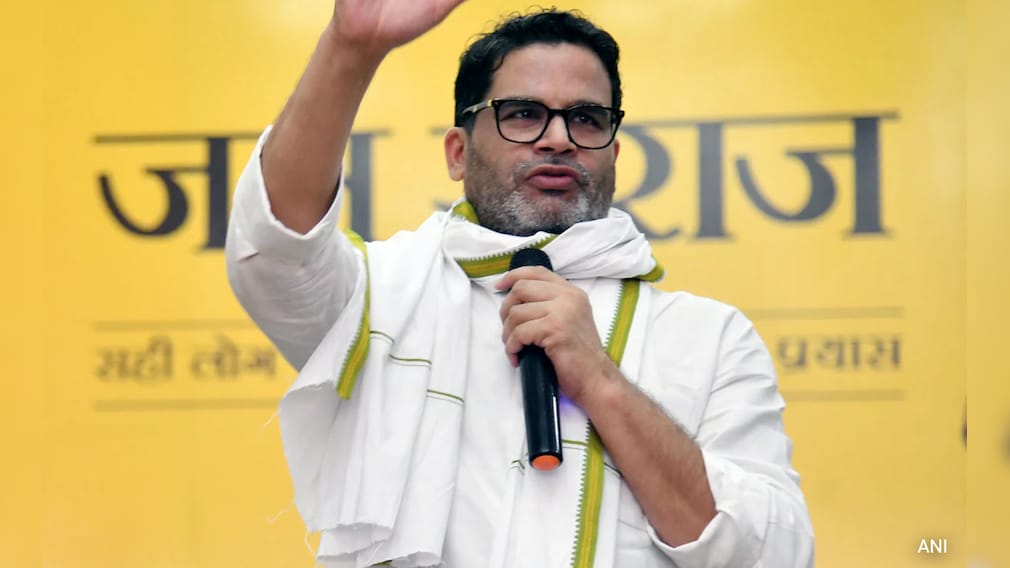
Prashant Kishor and his Jan Suraaj Party have created an upset of sorts in Bihar by wresting Bankipur from the Bharatiya Janata Party (BJP). Thus far represented by the BJP's national president, Nitin Nabin, the seat, ironically, was considered safe for the saffron party. Considering that in 80% of cases byelections are won by the incumbent government, this is a serious achievement for Kishor's Jan Suraaj Party (JSP), which last year had failed to even open its account in the Vidhan Sabha polls.
The Bankipur by-poll results have exhibited a massive swing in just eight months. In 2025, the BJP had won the seat by a massive lead of 51,936 votes. However, its loss this time is by over 19,000 votes. That's a massive swing of 71,000 against the incumbent for a seat it has held for close to three decades.
In the 2025 assembly election, Bankipur was a clean BJP vs RJD contest. The BJP polled 62.7% of the vote, the RJD 29.6%, and the Jan Suraaj Party came as an afterthought at 4.9%.
A year later, in the 2026 by-poll, that picture was inverted. The JSP has managed to bag a whopping 49.2% of the total votes, the BJP has collapsed to 34.4%, and the RJD has been reduced to a distant 11%. NOTA and other candidates barely moved.
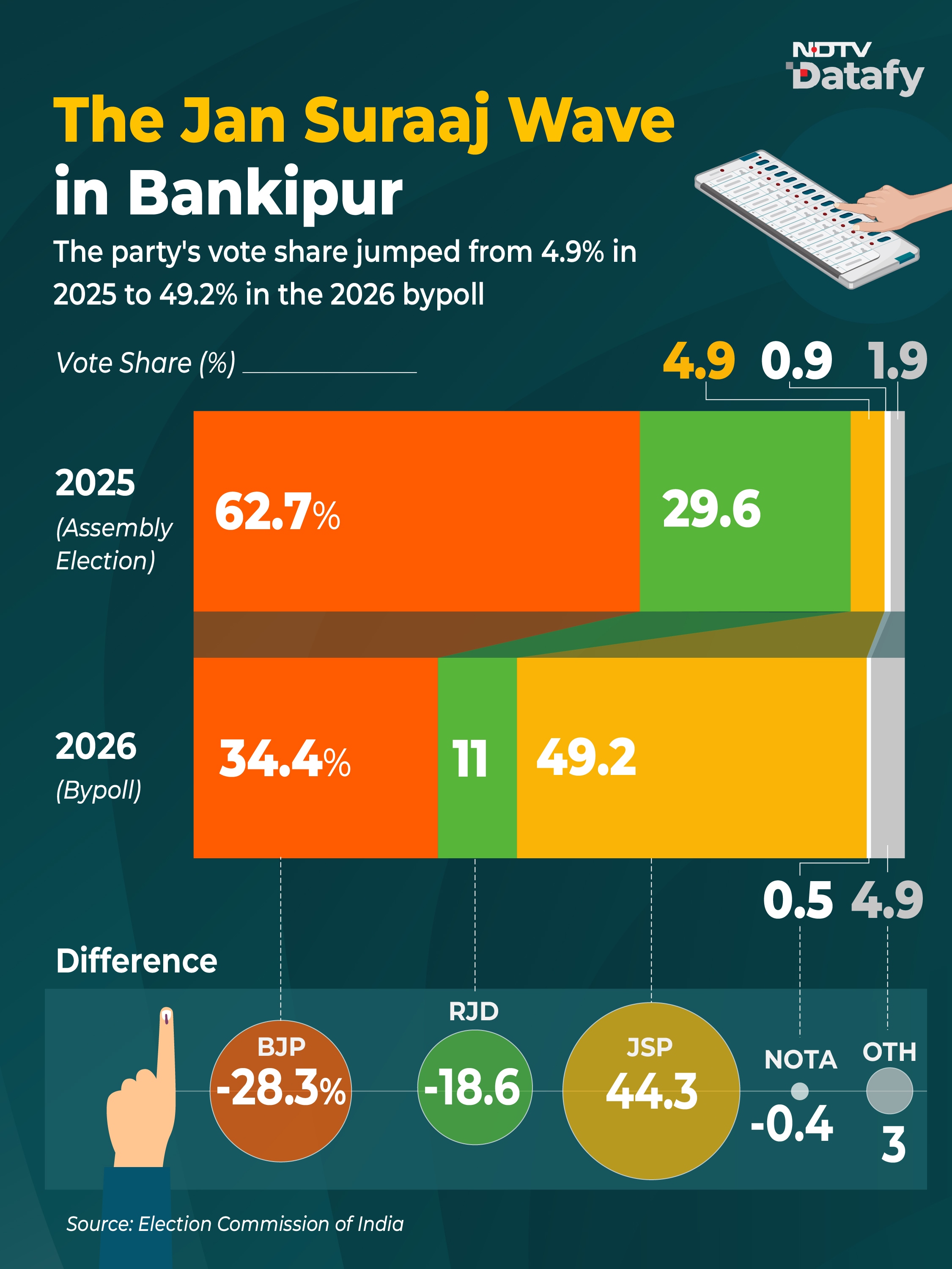
Put simply, the BJP lost 28 percentage points of votes, the RJD close to 19 points, and the JSP gained roughly 44 points. A by-poll swing of this size points to not just anti-incumbency - which the JSP effectively utilised - or mere scooping up of undecided voters. It means that the JSP has managed to eat directly into the two major parties' existing bases.
The Bigger Shock Is For BJP
That the JSP would erode the vote share of the main opposition party, the RJD, and bag a majority of the anti-BJP votes that went to it in 2025, was expected. But that it made a bigger dent in the BJP vote as well was a shock.
Working backwards from last year's vote share of the JSP (4.9%), the swing adds up almost perfectly. The party pulled about 28.3 percentage points from the BJP's vote share and 18.6 points from the RJD. These swings accounted for nearly all of the JSP's gain, with a small net loss, roughly 2.5 points, to other candidates and NOTA. In other words, the JSP's surge in Bankipur wasn't a case of one discontent community abandoning one party. It was a simultaneous raid on both flanks of the state's dominant coalition.
And that's the more interesting story here. A by-poll swing of this scale usually has one clear source - an anti-incumbency wave against the ruling party, or a consolidation of an opposition base. Bankipur shows something rarer: a third force draining support from a governing party and its principal challenger at the same time, which suggests that the JSP's appeal here wasn't ideological or anti-incumbency-driven so much as it was aspirational, pitched at voters looking for an alternative to the entrenched two-party frame itself.
A Reckoning
The category-wise breakdown makes the pattern sharper. The seat is a stronghold of the BJP as it favours it demographically. It has 65% upper caste and non-Yadav OBC voters, making it a safe den for the party.
The JSP registered gains across every social group tracked - Kayastha, Bhumihar, Brahmin, Rajput, Yadav, Vaishya/Baniya, Kurmi+Kushwah, Other OBC, Muslim, SC, and the residual "Others" category - with swings ranging from roughly 29 points among Kayasthas to a striking 67 points among Muslim voters.
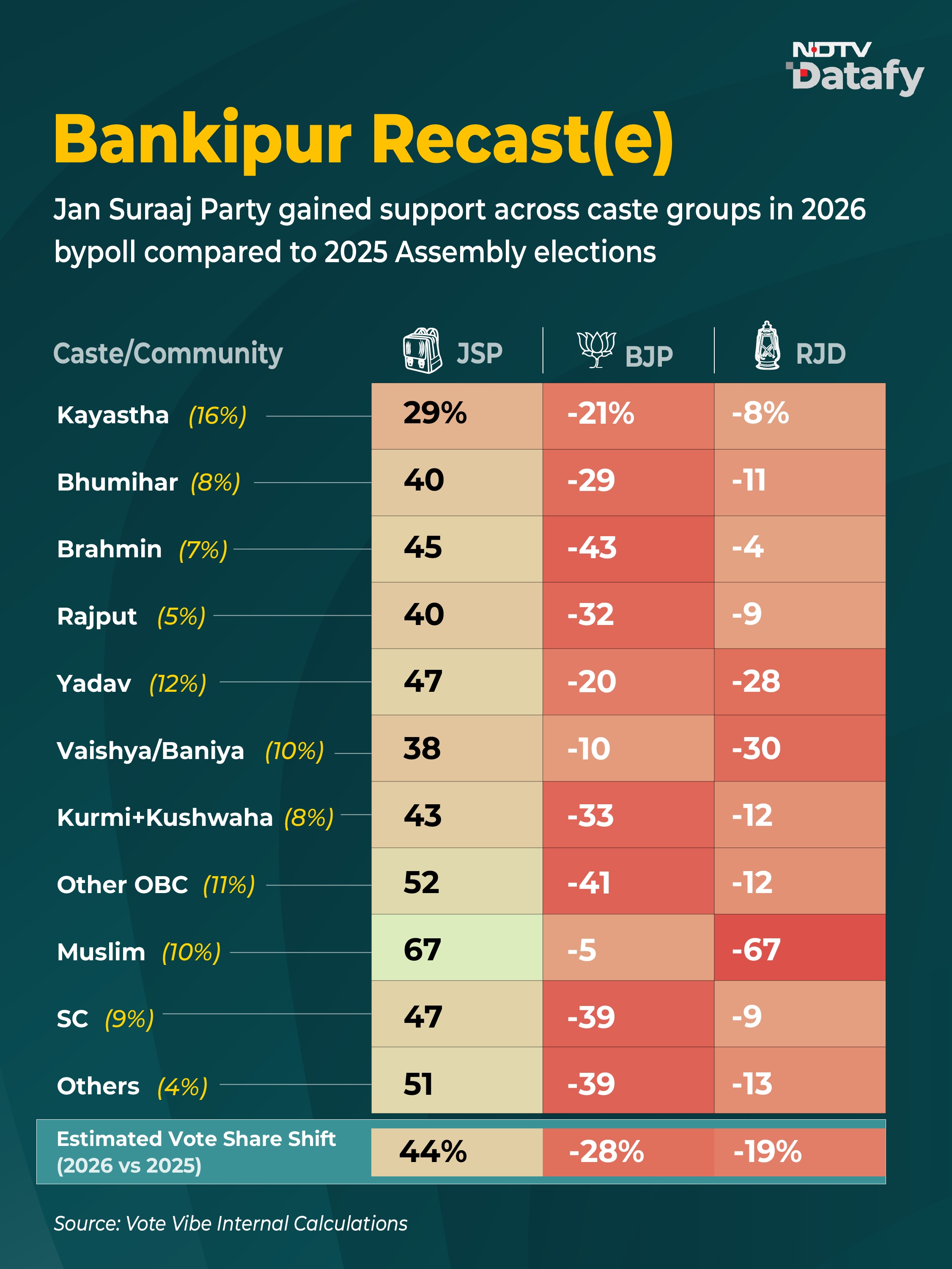
Two things stand out. First, the erosion of the BJP's support wasn't confined to any one caste bloc; upper-caste communities that have anchored the party's Bihar coalition - Bhumihar, Brahmin, Rajput, Kayastha - all contribute to the BJP's losses in the 21-43 point range, alongside comparable or larger losses among Vaishya/Baniya and OBC categories. That's a broad-based erosion of the BJP's traditional urban and upper-caste base, not a narrow one.
The upper caste voters, drawn towards the JSP both by fatigue as well as discontent over issues such as the Bharat Tiwari encounter, the UGC norms, paper leak protests, and other things, may have wished to give the BJP a warning that they can not be taken for granted. A section of Kurmi voters was also unhappy over the unceremonious exit of Nitish Kumar from the Chief Minister's office.
Second, and more dramatically, the RJD's single largest injury came from Muslim voters, where the JSP's swing of +67 points came almost entirely at the traditional opposition party's expense, alongside a meaningful, though comparatively smaller, loss among Yadav voters, of around 28 points. The RJD's Muslim-Yadav (MY) coalition, which has been the bedrock of its Bihar politics for three decades, appears to have cracked in this constituency, with Muslim voters moving toward the JSP in hordes. Perhaps they found Prashant Kishor better suited to defeat the BJP.
If this pattern holds beyond one constituency, it would represent a more consequential development than what the topline vote share numbers suggest: the JSP is neither just a "BJP-lite" option for disaffected upper-caste voters, nor is it solely an RJD alternative for Muslim voters. It is, in essence, both things at once, in the same seat, in the same election.
The paper leak protests and the brewing discontent among youth over paper leaks seem to have consolidated a significant chunk - as high as 60% per local reports - of youth voters in the 18-29 years age group in favour of the JSP. Prashant Kishor, after all, has been part of student agitations in the past and was able to woo this disgruntled segment through social media.
Not To Be Taken Lightly
A by-poll where a party goes from single digits to a near-majority, at the expense of both principal rivals across their respective core constituencies, is not statistical noise but a signal that a meaningful slice of Bihar's electorate is willing to look past the BJP-RJD binary that has defined the state's politics for a generation.
Whether Bankipur is a preview of a bigger three-cornered contest or an urban-seat outlier that evaporates once campaigns scale up state-wide is a question that this single data point can't answer on its own. However, what it does indisputably establish is that Jan Suraaj's appeal, at least here, wasn't confined to one disgruntled community. It cut across caste lines that Bihar's politics has been organised around for decades now, and points to a development-oriented voting pattern.
(Amitabh Tiwari is a political strategist and commentator. In his earlier avatar, he was a corporate and investment banker)
Disclaimer: These are the personal opinions of the author
-
BJP Hunts For A Crack. Rahul Gandhi's Allies Could Be His Weak Spot

The government suffers a handicap in the sense that there is little to beat the opponents who have been out of power for long. But this is where the Congress and Rahul Gandhi need to use caution
-
Opinion | A Wounded Trump Could Soon Make The World Pay For His Defeat
The US and the rest of the world should worry more about what Trump might do next to redeem himself.
-
Opinion | Trump's Midterm Rout Eases India's Worries. But It Doesn't End Them
The midterm outcome offers immediate psychological relief for India. But it may not change much when it comes to thorny issues such as tariffs or regulatory frameworks. There, Trump still holds the gavel.
-
Blog | Virat Kohli At 38: The Man Who Gave Cricket His 100%, Every Single Time
From revolutionising fitness standards in Indian cricket to wearing his emotions, spirituality and love for the game with pride, Kohli's legacy extends far beyond runs and records, making him one of the most influential athletes of his generation.
-
Opinion | Classroom Violence: Cinema, Society And The Crisis Of Responsibility
There has been a combined outrage against violent movies such as 'Dhurandhar' and 'Animal', which have been blamed for such widespread behaviour.
-
Opinion | Trump's Midterm Rout Has One More Victim: JD Vance
Vance campaigned as hard as the President, served as the Republican National Committee's finance chair. He watched his home state of Ohio elect a Democratic governor and send a Democrat to the Senate seat he gave up to become Vice President.
-
Opinion | China May Be Turning Pak Into A Military Nightmare For India
Beijing has steadily become Islamabad's principal defence supplier. But the emerging nexus goes beyond weapons
-
Opinion | The Great AI Rift: Why Meta, Palantir Are Fighting Against OpenAI, Anthropic, Google
On July 24, 25 companies, among them Nvidia, Microsoft, Meta, IBM, and Palantir, signed an open letter to Washington. Google, OpenAI, and Anthropic weren't part of it.
-
Rs 200-Crore Wedding That Unravelled Rs 90,000-Crore Mahadev Betting Empire
Saurabh Chandrakar was taken into custody by the Royal Oman Police after Interpol issued a 'Red Corner Notice'.