Opinion | Pakistan's Kashmir 'Story' Is Now Collapsing Under The Weight Of Its Own Contradictions
Pakistan spent decades internationalising the Kashmir issue. With the PoK uprising, that has come back not only to bite it, but to expose its false narratives
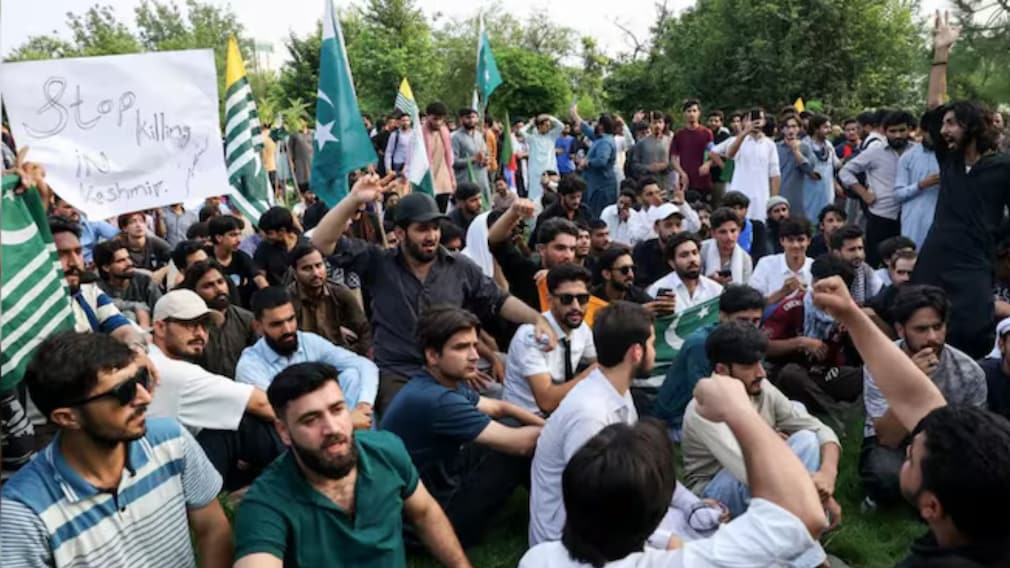
Pakistan's central narrative framed the Kashmir dispute with India essentially through the language of self-determination, making a case for international attention. The ongoing protests in Pakistan-occupied Kashmir (PoK) over the last two months, however, inform an uncomfortable contradiction. What began as an anti-government civil society mobilisation in early July over inflated prices and political representation has, by early August, resulted in weeks of internet blackout, dozens of state-led killings, the proscription of a political coalition, and a flawed election process. The escalation rapidly turned deadly with clashes between security forces and protesters. The violence coincided with local polls being conducted in three phases between late July and early August. In fact, on June 9, a British national who was not even participating in the demonstrations was struck by a stray bullet and died, though his death has been reported only now.
The 1974 Interim Constitution provided a blueprint for PoK's political framework, while concurrently institutionalising Islamabad's control. The 2018 constitutional reforms devolved some of the financial and legislative authority to the elected representation in the region; Islamabad continued to retain substantial influence through the Ministry of Kashmir Affairs, fiscal dependence, and oversight.
The JAAC and the Reserved-Seats Dispute
At the center of the current movement is the Jammu Kashmir Joint Awami Action Committee (JAAC), a coalition body of traders, lawyers, students, and transporters. The coalition first consolidated in 2023 over bread-and-butter grievances involving flour subsidies, electricity tariffs, and the high cost of living. These campaigns gained concessions in 2024 and 2025. However, the JAAC broadened its demands into a 38-point charter, with the central issue of 12 reserved seats in PoK's 45-seat Legislative Assembly for refugees from Jammu and Kashmir (J&K); these refugees, however, are based in mainland Pakistan. The JAAC has long argued that this arrangement has enabled Islamabad, with no local stake in the region, to divert funds from the region.
For the Pakistani government, the dispute is tied to the state's broader diplomatic position on Kashmir. Mirroring its own constitutional claims, India reserves 24 seats out of 114 for the territories across the Line of Control (LoC), under the legal provision of Section 14(4) of the Jammu and Kashmir Reorganisation Act, 2019. Therefore, an alteration in this arrangement will likely open a Pandora's box, potentially suggesting a shift in Pakistan's constitutional understanding of Kashmir's status.
Negotiations between JAAC and the Pakistani government collapsed in May. Subsequently, Islamabad banned the group under anti-terrorism laws on June 5 and arrested several leaders. Dozens of protesters have been killed since then.
Under the 1974 interim constitution, PoK has a semi-autonomous system, which includes its own Legislative Assembly, Prime Minister, President, and Supreme Court. However, the candidates holding these offices must remain loyal to the Pakistani state, thereby narrowing the field of permissible politics. In July, JAAC reportedly wrote directly to Pakistan's Army Chief, Field Marshal Asim Munir, potentially with the knowledge that Rawalpindi holds the real authority in the state rather than any civilian institution. The state's response was securitised. A tough-handed approach towards protesters and a harsh crackdown deepened these pre-existing anti-government grievances.
While the rhetoric around Kashmir has been that of separatism, the movement has remained devoid of any secessionist sentiments and emphasised the lack of governance, violation of constitutional rights, fiscal transparency, political representation, and accountability within the administration. The greatest burden on Pakistan's narrative of Kashmir, therefore, is emerging not from New Delhi but from its own governance failures at home. This information remains crucial in the reading of the recent developments.
Information Control
The government's restrictions on foreign media further reflect Pakistan's approach to its peripheral provinces and occupied regions - Balochistan, Khyber Pakhtunkhwa, and PoK - where careful management of information is paramount to its administration. In early August, Pakistan's Ministry of Information and Broadcasting issued the Foreign Media Facilitation Guidelines, 2026, obligating all journalists to obtain a No Objection Certificate (NOC) with the ministry's External Publicity Wing to operate outside Islamabad, Lahore, and Karachi. The rules extend to freelancers, translators, fixers, and local collaborators. The government further warned of suspending accreditation on grounds of national security, public order, and sovereignty.
Foreign correspondents have always faced bureaucratic hiccups in reporting from sensitive regions, with NOCs being delayed or withheld. International publications thus rely on local journalists for work. However, locals also now fall under the new regulatory framework. Media censorship was also imposed on an international platform on accusations of engaging in "yellow journalism" through reporting from polling stations in Muzaffarabad. The media environment is so dire that journalists across Pakistan live under the threat of being "picked up", also known as enforced disappearances, for crossing 'red-lines' against the military establishment.
Pakistan's Kashmir case has been grounded on a moral claim that Kashmiris have been denied the right of self-determination. The claim has often been directed to India's conduct in Jammu & Kashmir, especially after the abrogation of Article 370 from the Indian Constitution in 2019. The unfolding environment in PoK represents the ghosts of those very allegations - a banned coalition, prolonged internal shutdowns, a securitised approach, in a part of Kashmir that is administered by Pakistan, against a movement that is not even contesting the region's status.
The reputational costs will not remain confined to the subcontinent. Unfortunate for Pakistan, they arrive at a moment when it is eager to reconstruct its image as a responsible diplomatic actor, mediating a conflict between the US and Iran in West Asia. The sporadic airstrikes in Afghanistan first, and the visuals of unrest in the territory now, will likely taint Islamabad's carefully manicured narrative of its Kashmir policy. Already, the realisation seems to be dawning on Pakistan's powerbrokers that they have been caught on the back foot: last week, the Prime Minister's adviser, Rana Sanaullah, said that 99% of the protesters in the region are "patriotic" people - a curious pivot from just days ago, when they were being termed "enemies" or "terrorists".
For New Delhi, the episode presents a ripe opportunity to question the coherence of Pakistan's international advocacy on Kashmir and the realities in the occupied territories. For Pakistan, which is already struggling with its strained economy, the insurgency in Balochistan and the deteriorating security situation in Khyber Pakhtunkhwa, the civil society movement in PoK now adds yet another layer of pressure to an already overstretched state.
(Aishwaria Sonavane is a research analyst at the Takshashila Institution)
Disclaimer: These are the personal opinions of the author
-
Opinion | 86 Votes, 1 Warning: Is India Turning Into Collateral Damage In US' War On Russia?

Washington wants to sever Russian energy income, but India could end up paying the price for it
-
Opinion | Saudi Arabia Has Money, Missiles, And America. Why Is It Still So Scared?
What the NATO-like pact essentially points to, under its modest packaging of 'Islamic brotherhood', are growing fears of the Saudi Kingdom.
-
Learning Is Free Online, So Why Are Parents Paying Lakhs For Education?
Homeschooling is likely to grow in urban India, particularly among families frustrated with rote learning, school pressure and the race for marks.
-
Opinion | Age Of The Pink Slip: India's Brutal IT Layoffs Are No Longer About Cost-Cutting
The four biggest IT firms, TCS, Infosys, HCLTech, and Wipro, removed a net 9,100 people in the April-June quarter this year. A year earlier, in the same quarter, they had added 22,622.
-
Opinion | From Punjab To Karnataka, Congress Just Can't Stop Hitting Self-Goals
Congress leaders often speak as though anti-incumbency is a natural resource that will eventually flow towards them. But it doesn't.
-
NDTV Exclusive - Inside Meta's Child Safety: Current Systems Miss Nuance, New AI Under Test
The tech giant disclosed that it is developing a new generation of AI models to strengthen enforcement against child sexual exploitation on Facebook and Instagram.
-
Opinion | The Story Of 'SH-15', Pakistan's New Chinese Guns, Now Along India's Borders
Pakistan has reportedly deployed nearly 250 Chinese-made SH-15 wheeled self-propelled howitzers along sectors facing India.
-
Explained: Why Meta Is Under Fire Over Child Sexual Abuse Content
Meta chief Mark Zuckerberg apologised to the Indian government over child sexual abuse material, deepfake content and operational lapses. Here's what triggered the controversy and why it could reshape the debate over platform accountability and 'safe harbour' protections in India.
-
Opinion | Bankipur, And Why The Most Dangerous Voter Is The One Who Thinks Again
Bankipur is like the NOIDA of Uttar Pradesh. Its voter list isn't like the rest of Bihar. Which is why one must be careful in declaring Kishor's win a phenomenon - yet. But then, there's the power of the voter...