Opinion | One Resignation, 3 Headaches: The Bigger Politics Behind Dharmendra Pradhan's Exit
The minister's exit revives an old Congress-era tradition and hands the BJP a very contemporary problem to solve on the road to Uttar Pradesh.
There is a particular theatre to an Indian resignation. It is rarely just about the minister who walks out; it is about the message the walking out is designed to send, to whom, and why now.
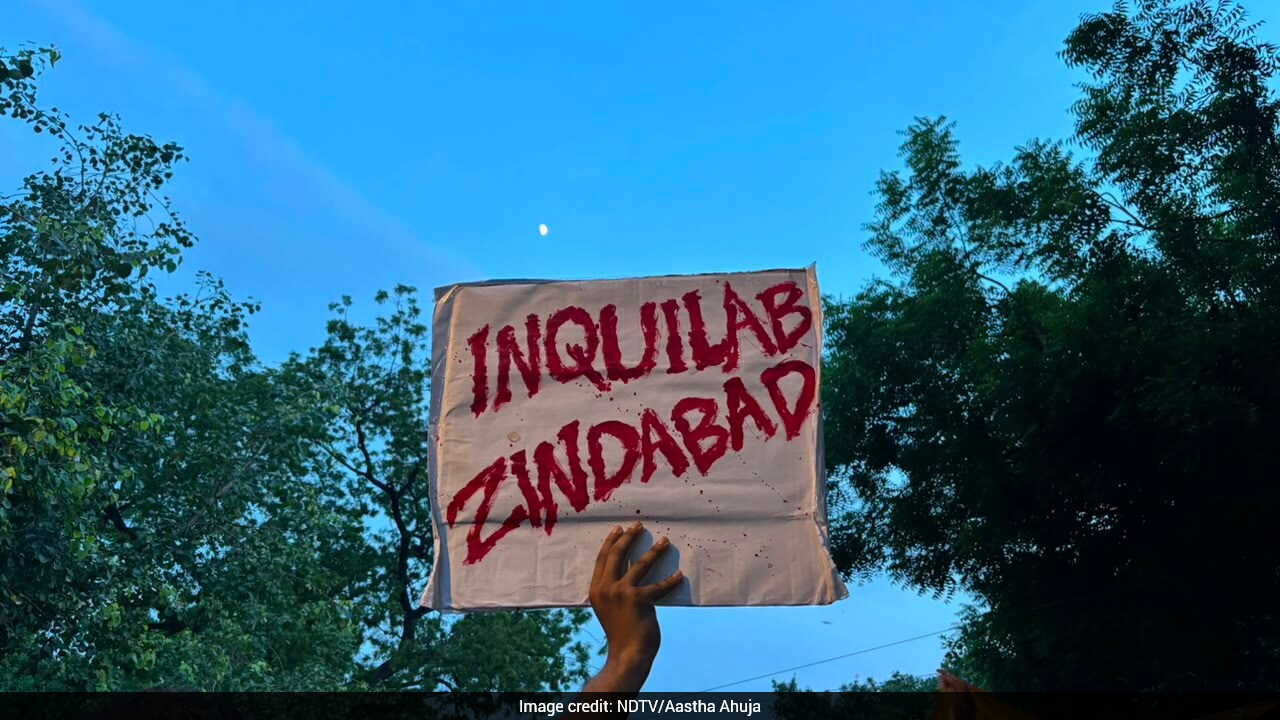
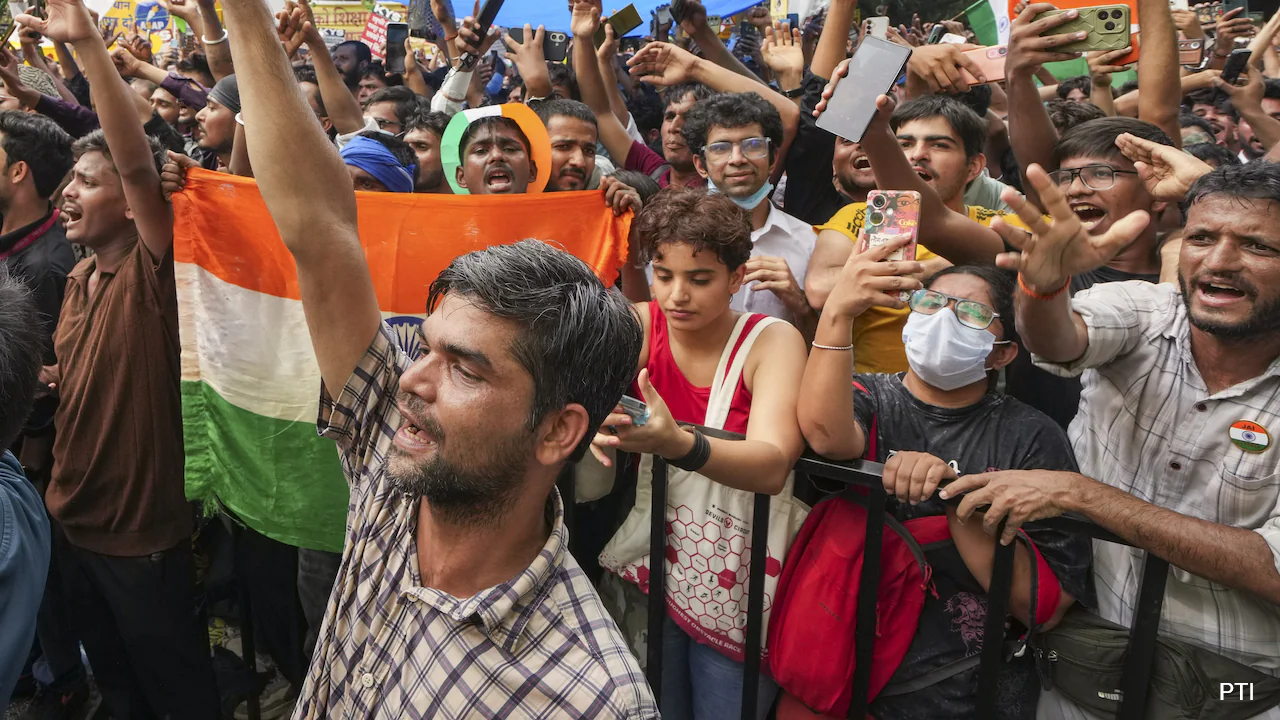
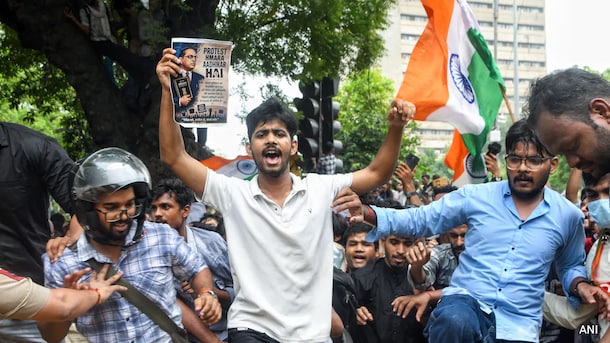
Dharmendra Pradhan's decision to send his resignation to Prime Minister Narendra Modi on July 25, amid the Cockroach Janta Party (CJP)-led protests over the NEET-UG paper leak and Sonam Wangchuk's fast at Jantar Mantar, belongs to that theatre. It is a gesture with a long lineage in Indian public life - and, like most such gestures, it is being read far more closely for its politics than for its penance.
The Shastri Standard
Indian ministers have periodically reached for the moral high ground of resignation, and the templates are instructive. Lal Bahadur Shastri set the gold standard in December 1956, quitting as Railway Minister after 144 people died in an accident near Ariyalur. "I must do penance for this. Let me go," he told Jawaharlal Nehru - a line that has echoed through every subsequent debate on ministerial accountability. Nehru accepted the resignation not because Shastri was culpable, he said, but to set an example in Constitutional propriety. Shastri was back in government within months, given transport and communications in 1957.
The pattern repeated itself with Madhavrao Scindia, who resigned as Civil Aviation Minister in 1993 after a leased TU-154 crashed in Delhi fog, saying he had decided within 30 seconds because his conscience would not permit otherwise. He returned to the Rao ministry in 1995. Shivraj Patil quit as Home Minister after the 2008 Mumbai attacks and was compensated with a Raj Bhavan posting soon after. TT Krishnamachari resigned as Finance Minister after the Mundhra scandal in 1958, only to be reinducted in 1962 and again as Finance Minister in 1964.
The lesson of this history is uncomfortable but consistent: the Indian resignation is rarely terminal. It is a pause, a punctuation mark, often a prelude to rehabilitation. Pradhan, a four-term Parliamentarian, a Rajya Sabha veteran-turned-Lok Sabha MP from Sambalpur, and one of the RSS's most trusted interlocutors within the government, is unlikely to be an exception to this pattern. His resignation letter - addressed pointedly to the country's youth rather than merely to the Prime Minister - reads less like an admission of failure and more like a carefully constructed exit designed to preserve every option for a return.
He listed the government's response step by step: the CBI probe, the cancelled examination, the shift to a computer-based NEET format from next year, the successful conduct of a fresh test for over 20 lakh students on June 21. He said he had accepted responsibility "from the very first day". And he reserved his sharpest, if unnamed, criticism for those in positions of responsibility who, he said, tried to mislead students rather than help them.
Repercussions For The NDA
The more immediate and less discussed consequence of this resignation lies within the NDA's own house. Pradhan has been among the more consequential Odia faces in the Modi cabinet, a bridge figure between the BJP's central leadership and its expansion ambitions in Odisha, where the party finally dislodged Naveen Patnaik's BJD only in 2024. His removal from the Education portfolio at a moment of visible student anger reshuffles equations of trust and turf within the wider Sangh Parivar ecosystem, where the education portfolio has always carried outsized ideological weight.
Whoever inherits the ministry inherits both a policy in mid-implementation and a movement that has shown it can mobilise without Congress, without the Samajwadi Party, without any of the conventional student-wing machinery of Indian politics.
The Uttar Pradesh Puzzle
This is where the resignation stops being a story about one minister and becomes a story about the battleground state. Uttar Pradesh, of all Indian states, has the largest stake in any question involving competitive examinations, government jobs, and the credibility of testing agencies - from Vyapam-style anxieties to the perennial anger over paper leaks that has animated the state's youth politics for a decade. The Samajwadi Party and the Congress have both, at various points, tried to own this anger and convert it into electoral capital, with limited and inconsistent success.
The Cockroach Janta Party's (CJP) emergence complicates that project considerably. It did not arise from any established political organisation; it arose from outrage at a remark by the Chief Justice of India and has since drawn hundreds of thousands of young Indians who are, by and large, contemptuous of all organised parties, the BJP as much as the Congress and the SP. For Akhilesh Yadav and Rahul Gandhi, that is a genuine strategic problem. A youth movement that refuses to be absorbed by the Opposition is, paradoxically, almost as inconvenient for the SP-Congress combine as it is threatening for the ruling party - because it denies them the ready-made cadre of student anger that has historically fuelled Uttar Pradesh's opposition politics, from the Chandra Shekhar-era JP movement onward.
The Wedge Strategy
Every resignation in the Shastri-Scindia-Patil lineage was extracted by an accident, a scandal, or the settled machinery of parliamentary opposition: a leader of the House, a censure motion, an inquiry commission, an editorial page. Pradhan was brought down by none of these. He was brought down by a movement that has no party symbol, no membership register the Election Commission recognises, and no leader who can be summoned to an all-party meeting. That is a genuinely new fact in the Indian political system, and it should worry every established party, not only the one in office. A government used to negotiating with the Congress or managing a Lok Sabha debate knows the choreography for it; it does not yet know how to negotiate with a hashtag and a hunger strike. Nor, for that matter, does the SP or the Congress, which is precisely the government's opening. Which brings us to what will likely be the government's actual playbook in the coming weeks: an attempt to drive a wedge between the CJP's amorphous, party-agnostic youth energy and the organised Opposition's efforts to attach itself to that energy. The strategic logic is straightforward. A leaderless movement is, by definition, a movement without a succession plan; it can force an exit, but it cannot easily convert that exit into durable political capital of its own, which leaves a vacuum that both the ruling party and the Opposition will race to fill on their own terms.
The government's preferred outcome may be to let the CJP's anger burn itself out on the single, now-resolved question of the NEET leak. Pradhan's own resignation functions as the pressure valve, while making sure that anger never formally merges with the SP's or Congress's student wings, the NSUI or the Samajwadi Chhatra Sabha, whose organisational reach in Uttar Pradesh would give it electoral teeth for the first time.
Pradhan's own letter did some of this spadework already, appealing to students not to let "anti-national forces" exploit the situation and urging them to return focus to their studies and careers - language calibrated to separate the movement's genuine grievance from any opposition attempt to claim its leadership.
If the government succeeds in that separation, treating Pradhan's exit as closure on the NEET question while denying the SP and Congress any credible claim to have forced it, Uttar Pradesh's Opposition will have lost an opportunity it did not create and could not fully control. If it fails, and the CJP's energy finds its way, however loosely, into existing Opposition networks ahead of the state's next electoral cycle, Pradhan's resignation will be remembered as the moment the government conceded ground it could not immediately win back.
Either way, one thing is certain from the long record of Indian ministerial resignations: this is unlikely to be the last India hears of Dharmendra Pradhan.
(Rasheed Kidwai is an author, columnist and conversation curator)
Disclaimer: These are the personal opinions of the author
-
An Evening At Student-Led Protest That Pushed Education Minister To Resign: In Pics

We spent the day at Jantar Mantar, located in the heart of New Delhi's Connaught Place area, where the youth-led movement was born and grew into a national call for accountability.
-
Dharmendra Pradhan Resigns: Gen Z's 'Online Habits' Became Protest Strengths
CJP Protests: The movement's most effective tool was not a manifesto. It was Gen Z's instinct to document, joke, post and share with Instagram as its amplifier.
-
Tear Gas Containers And Hope For A Better Future: The Duality Of Protest
The government today assured CJP that police cases filed against students would be withdrawn and no action would be taken against them in future.
-
Opinion | 7 Big Problems That Have Turned NEET Into A Trauma Machine For 22 Lakh Students
For every paper leak that makes headlines, there are seven deeper failures of NEET that decide who gets to become a doctor and who gets trapped in the system for years.
-
Opinion | CJP Protest And Opposition's Never-Ending Search For 'Readymade' Revolts
The Opposition cannot simply saunter in after anger has been created, and ask to become its beneficiary
-
Opinion | A Rs 5,000 Fine Can't Fix India's 'Babu' Raj. But It's A Start
A new bill in Delhi imposes a fine of Rs 250 a day on bureaucrats, with a Rs 5,000 ceiling, if their service for citizens is delayed without a valid justification. Can this fix India's great 'Babu' bottleneck?
-
Opinion | Kaveri To J-20, How China Overtook India In A 40-Year-Old Race To Build Fighter Jets
Both launched ambitious military jet engine programmes during the 1980s. Both depended heavily on Soviet and Russian technology. Four decades later, however, the finish line tells two dramatically different stories.
-
Opinion | US Attack On Chabahar, And Why It's Time India Stopped Playing By Others' Whims
As the US destroys Chabahar in Iran, one thing is clear: India cannot wait eternally for the whims of others to do what is vital for its own interests.
-
Beyond Low Cost: Why Foreigners Choose India's Healthcare Over The West
India's medical tourism industry is estimated to be worth $12.32 billion in 2026. It is growing much faster than the country's overall tourism sector.