Opinion | Maa Behen, Obsession, And The Gaze That Eats Itself
Every society has a woman it has already judged. Every man has a story about her. Cinema has long inherited both.

In a certain colony, a woman lives alone. Stories about her, however, are everywhere. She lures men, scans them like QR codes, and some even lie buried in her garden. Widowed early, she has a daughter with her late husband. But in a tryst shrouded in mystery, she birthed another with a man no one knows about. Her tainted character is further infected by the recurring visuals of her waist peeking out from the cotton saris and the sleeveless blouses she continues to wear, and by the place she chooses to work at: an alcohol shop. Therefore, when the self-appointed moral guardian of the neighbourhood is found dead in her house, the implication is clear as day. Rekha, the eternal seductress, has committed the murder.
A premise such as this can largely go two ways. It can either confirm the rumours and craft a narrative of a woman doubling down on her reputation, or it could dispel hearsay and culminate as a tale of a woman killing a moral custodian to vindicate her disrepute. Suresh Triveni's latest film, Maa Behen, playfully smart, does neither. Instead, the outing finds a near-impossible middle ground where the social prejudice is replicated only to be critiqued.
The filmmaking, too, responds through heightened tonality and camp. A male journalist, trained in sensationalisation, is the narrator. He briefs the viewer about the notoriety of Rekha (Madhuri Dixit) as flashbacks of her massaging her husband on the terrace as a newly-wed and men gathering to see splash on the screen. More incriminating images follow: Rekha flirting with the neighbour, Charitra Gupta (Ravi Kishan), the same man who her husband had taken a loan from, and who later was found dead in her house. The walls of her house are scribbled with choice words - "Did you see Rekha's?", "Witch". And then, there are daughters.
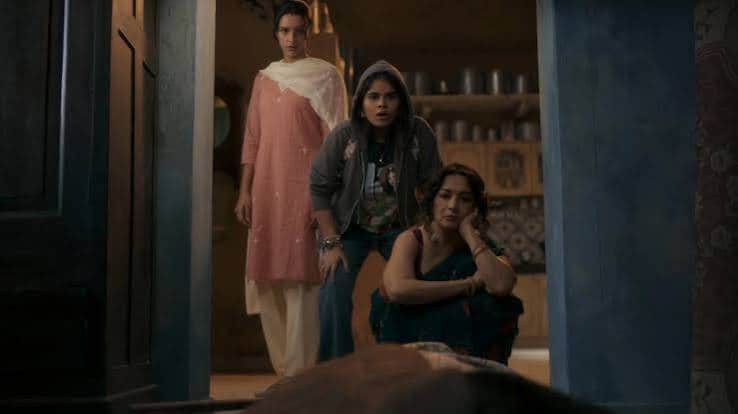
Madhuri Dixit, Dharna Durga, and Tripti Dimri in Maa Behen
As Charitra Gupta lies motionless in her house, a panicked Rekha summons her two daughters - Jaya (Triptii Dimri) and Sushma (Dharna Durga) - for help. The mother claims it was an act of self-defence, but her story - him coming on to her, her pushing her away, his head hitting on the cupboard - is so neat that it feels orchestrated. Further probing only weakens her case. It was Rekha who had called Charitra at night to play cards, it was Rekha who had taken money from the liquor shop, and Charitra knew about it. Sitting with her daughter at the dinner table and wearing a sleeveless blouse, it was Rekha who seemed capable and culpable of murder. And then, Charitra Gupta gains consciousness.
From here, Maa Behen embarks on a wilder ride, with the three women, each with a shadier past than the other, constantly bickering but also helping each other. Jaya, a homemaker, had seduced her husband when the latter had come to see her friend for marriage; Sushma, an influencer, gained popularity after uploading a video of kissing a boy for five minutes. But soon, this turns out to be a smokescreen.
The Tragedy Of The 'Femme Fatale'
With his latest, Triveni not just depicts cautionary women but mimics the gaze that makes them one. The excessive tone is revealed to the conceit and the slant of their story once the women take charge of their past. In a fleeting moment, Rekha shares that it was her husband who wanted to be massaged in full view, implying in the subsequent silence that her objectification was an offshoot of his desire and not the result of her deliberation. Similar subtext arrives with Jaya and Sushma, wherein they both admit that it was the men whose decisions altered their lives.
In any other film, such women would have lurked in the background, and their infamy, at best, would be rebranded as forced autonomy. Maa Behen flips the script in that it inherits and imitates the male gaze, outlines the extent of it, and then ekes out agency from that. All three women take the moral promiscuity attributed to them by the society and reiterate it without subverting. As Charitra Gupta emerges on screen and intimidates them in return for sexual favour, the women, already known for misconduct, sneakily make a video of massaging him. When the man realises and is incensed even more, the women impishly suggest uploading the video. He retreats, and they stand their ground. After all, those who have nothing to begin with also stand to lose nothing.
In his 2025 hit Obsession, American filmmaker Curry Barker also probes the undersides of male gaze to arrive at terrifying results. The psychological horror centres around a man, Baron (Michael Johnston), whose life is upended when his wish of being loved by his crush, Nikki (Inde Navarrette), transfigures into the girl being fatally obsessed with him. The supernatural element in Barker's film stems from the magical twig that Baron breaks and the unsuspecting act wreaks havoc. But Obsession, despite the straightforwardness of the title, unfolds as a potent disclaimer of the male want.
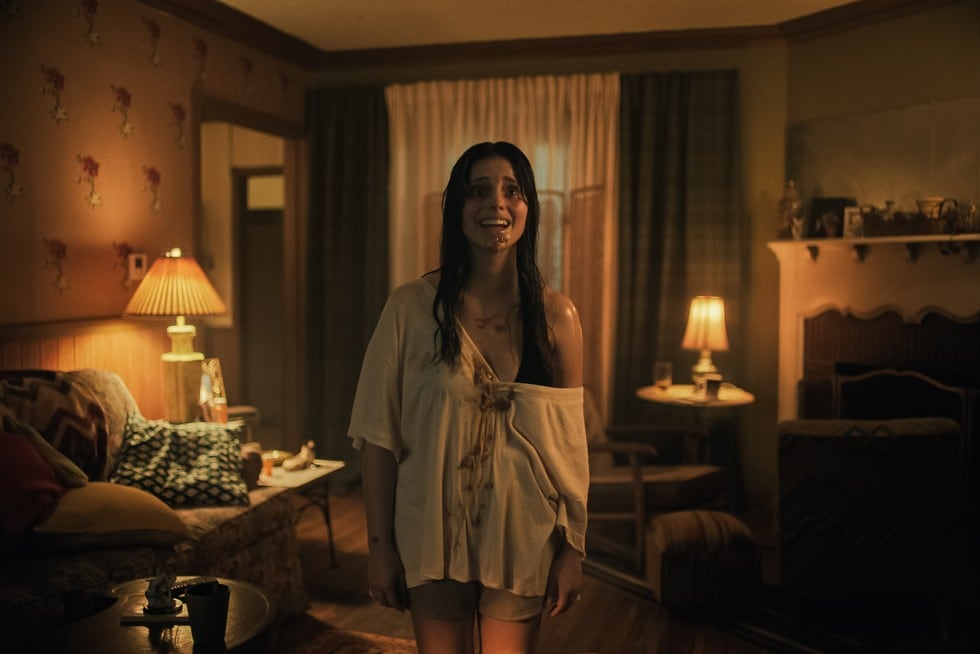
Inde Navarratte as 'Nikki' in Obsession
The bleak world crafted by Barker is soon revealed to be dictated by men and designed as per their needs. The film opens with Baron's impassioned monologue about being in love with Nikki, and yet, the horror surfaces after the very desire is granted. It is a clever ploy that says nothing about the girl's inability to reciprocate. In fact, it says nothing about Nikki at all. The allure of Obsession is its clear-eyed clarity of depicting the exacting nature of love when offered by men. In Barker's capable hands, the deep-seated impulse of a "good guy" like Baron, tellingly nicknamed "Bear" by his friends, translates into a hellish nature of control where the consent and the very existence of Nikki is effaced. The reading here is not that of a lapse of judgement on Baron's part but a flaw of gender on the men's part that regards the selflessness of love through the erasure of self of the other.
The terror, therefore, resides not in a woman being manically obsessed with her partner but in the existence of a world where the wishes of men are granted by other men and women are reduced to a mute pawn in the arrangement.
Much like Triveni, Barker, too, uses male gaze as a filmmaking language. But he stretches it to the extreme, bolsters it with persuasion, and then looks the audience in the face, to ask: how far is too far? Who gains when we inhabit spaces mandated by men and dominated by men? Not women, and not even men.
(Ishita Sengupta is an independent film critic and culture writer from India. Her writing is informed by gender and pop culture and has appeared in The Indian Express, Hyperallergic, New Lines Magazine, etc.)
Disclaimer: These are the personal opinions of the author
-
'School Fees Are Just The Beginning': The Hidden Cost Of Educating Children

Tuition classes, digital devices, transport, uniforms, extracurricular activities, and competitive exam coaching have made education a costly affair.
-
NDTV Probe: CSAM, Sexually Suggestive Content, Gun Culture On Social Media
The probe has uncovered a wider pattern of exploitative and illegal content slipping past moderation, raising questions about the consistency and effectiveness of enforcement.
-
Ice Stupas To Education Reforms: The 'Fast' Evolution Of Sonam Wangchuk
Sonam Wangchuk remains a prominent figure whose activism spans climate change, education reform, democratic rights and environment conservation.
-
Opinion | Pakistan's Iran Problem Isn't Going Anywhere
Despite its glowing successes, and for all its mediation efforts, Pakistan's toughest audience may be in Iran itself
-
Satyagraha, Pyre On River: Tribals' Unique Protest To Save Their Homes
As the Ken-Betwa river-linking project advances, thousands in Madhya Pradesh's Chattarpur say they face displacement, lost livelihoods and inadequate rehabilitation, and are mounting Gandhian-style protests.
-
Opinion | Why Britain Is Finding It So Hard To Deport A Pakistani 'Grooming Gang' Leader
Shabir Ahmed, a UK-Pakistan dual national, lost his British citizenship after his conviction more than two decades ago. Now, Pakistan is refusing to take him back.
-
Beyond Low Cost: Why Foreigners Choose India's Healthcare Over The West
India's medical tourism industry is estimated to be worth $12.32 billion in 2026. It is growing much faster than the country's overall tourism sector.
-
Opinion | Is Saudi Arabia Now Quietly Switching Sides In US-Iran War?
The Saudi presence at the Ayatollah's funeral as well as its refusal to join America's 'Project Freedom' points to a quiet shift away from its ally, the US.
-
Opinion | China Now Has 7 Of The World's 10 Biggest Banks, And That Should Worry India
Seven of the world's ten largest banks are now headquartered in China. Twenty-two Chinese banks figure in the top 100. No Indian bank comes anywhere close.