Opinion | Maa Behen, Obsession, And The Gaze That Eats Itself
Every society has a woman it has already judged. Every man has a story about her. Cinema has long inherited both.

In a certain colony, a woman lives alone. Stories about her, however, are everywhere. She lures men, scans them like QR codes, and some even lie buried in her garden. Widowed early, she has a daughter with her late husband. But in a tryst shrouded in mystery, she birthed another with a man no one knows about. Her tainted character is further infected by the recurring visuals of her waist peeking out from the cotton saris and the sleeveless blouses she continues to wear, and by the place she chooses to work at: an alcohol shop. Therefore, when the self-appointed moral guardian of the neighbourhood is found dead in her house, the implication is clear as day. Rekha, the eternal seductress, has committed the murder.
A premise such as this can largely go two ways. It can either confirm the rumours and craft a narrative of a woman doubling down on her reputation, or it could dispel hearsay and culminate as a tale of a woman killing a moral custodian to vindicate her disrepute. Suresh Triveni's latest film, Maa Behen, playfully smart, does neither. Instead, the outing finds a near-impossible middle ground where the social prejudice is replicated only to be critiqued.
The filmmaking, too, responds through heightened tonality and camp. A male journalist, trained in sensationalisation, is the narrator. He briefs the viewer about the notoriety of Rekha (Madhuri Dixit) as flashbacks of her massaging her husband on the terrace as a newly-wed and men gathering to see splash on the screen. More incriminating images follow: Rekha flirting with the neighbour, Charitra Gupta (Ravi Kishan), the same man who her husband had taken a loan from, and who later was found dead in her house. The walls of her house are scribbled with choice words - "Did you see Rekha's?", "Witch". And then, there are daughters.
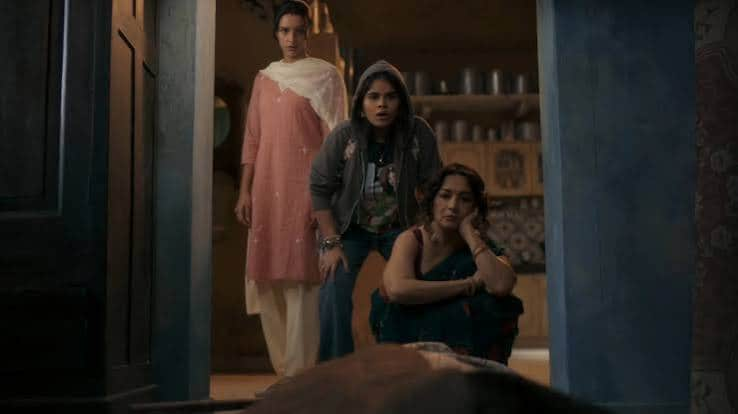
Madhuri Dixit, Dharna Durga, and Tripti Dimri in Maa Behen
As Charitra Gupta lies motionless in her house, a panicked Rekha summons her two daughters - Jaya (Triptii Dimri) and Sushma (Dharna Durga) - for help. The mother claims it was an act of self-defence, but her story - him coming on to her, her pushing her away, his head hitting on the cupboard - is so neat that it feels orchestrated. Further probing only weakens her case. It was Rekha who had called Charitra at night to play cards, it was Rekha who had taken money from the liquor shop, and Charitra knew about it. Sitting with her daughter at the dinner table and wearing a sleeveless blouse, it was Rekha who seemed capable and culpable of murder. And then, Charitra Gupta gains consciousness.
From here, Maa Behen embarks on a wilder ride, with the three women, each with a shadier past than the other, constantly bickering but also helping each other. Jaya, a homemaker, had seduced her husband when the latter had come to see her friend for marriage; Sushma, an influencer, gained popularity after uploading a video of kissing a boy for five minutes. But soon, this turns out to be a smokescreen.
The Tragedy Of The 'Femme Fatale'
With his latest, Triveni not just depicts cautionary women but mimics the gaze that makes them one. The excessive tone is revealed to the conceit and the slant of their story once the women take charge of their past. In a fleeting moment, Rekha shares that it was her husband who wanted to be massaged in full view, implying in the subsequent silence that her objectification was an offshoot of his desire and not the result of her deliberation. Similar subtext arrives with Jaya and Sushma, wherein they both admit that it was the men whose decisions altered their lives.
In any other film, such women would have lurked in the background, and their infamy, at best, would be rebranded as forced autonomy. Maa Behen flips the script in that it inherits and imitates the male gaze, outlines the extent of it, and then ekes out agency from that. All three women take the moral promiscuity attributed to them by the society and reiterate it without subverting. As Charitra Gupta emerges on screen and intimidates them in return for sexual favour, the women, already known for misconduct, sneakily make a video of massaging him. When the man realises and is incensed even more, the women impishly suggest uploading the video. He retreats, and they stand their ground. After all, those who have nothing to begin with also stand to lose nothing.
In his 2025 hit Obsession, American filmmaker Curry Barker also probes the undersides of male gaze to arrive at terrifying results. The psychological horror centres around a man, Baron (Michael Johnston), whose life is upended when his wish of being loved by his crush, Nikki (Inde Navarrette), transfigures into the girl being fatally obsessed with him. The supernatural element in Barker's film stems from the magical twig that Baron breaks and the unsuspecting act wreaks havoc. But Obsession, despite the straightforwardness of the title, unfolds as a potent disclaimer of the male want.

Inde Navarratte as 'Nikki' in Obsession
The bleak world crafted by Barker is soon revealed to be dictated by men and designed as per their needs. The film opens with Baron's impassioned monologue about being in love with Nikki, and yet, the horror surfaces after the very desire is granted. It is a clever ploy that says nothing about the girl's inability to reciprocate. In fact, it says nothing about Nikki at all. The allure of Obsession is its clear-eyed clarity of depicting the exacting nature of love when offered by men. In Barker's capable hands, the deep-seated impulse of a "good guy" like Baron, tellingly nicknamed "Bear" by his friends, translates into a hellish nature of control where the consent and the very existence of Nikki is effaced. The reading here is not that of a lapse of judgement on Baron's part but a flaw of gender on the men's part that regards the selflessness of love through the erasure of self of the other.
The terror, therefore, resides not in a woman being manically obsessed with her partner but in the existence of a world where the wishes of men are granted by other men and women are reduced to a mute pawn in the arrangement.
Much like Triveni, Barker, too, uses male gaze as a filmmaking language. But he stretches it to the extreme, bolsters it with persuasion, and then looks the audience in the face, to ask: how far is too far? Who gains when we inhabit spaces mandated by men and dominated by men? Not women, and not even men.
(Ishita Sengupta is an independent film critic and culture writer from India. Her writing is informed by gender and pop culture and has appeared in The Indian Express, Hyperallergic, New Lines Magazine, etc.)
Disclaimer: These are the personal opinions of the author
-
Opinion | The Last Bet? What Trump's 'Mother Of All Bombs' Could Actually Do To Iran

Can an MOAB deliver a decisive blow to Iran that may force it to surrender immediately, as Japan did after Hiroshima and Nagasaki in World War 2?
-
Hit Songs, Empty Pockets: The Hidden Math Behind India's Viral Music Boom
Over 80,000 brands and five lakh creators in India make branded content. The opportunity is worth around Rs 1,500 crore.
-
Opinion | Great 'Exceptions': How The Oil India Was Attacked For Is The Oil Trump Now Seeks
A law written to punish the buyers of Russian oil was suspended by the US to protect a purchase of Russian oil. India spent fourteen months being lectured for less.
-
Opinion | Louis Vuitton Loot, Torched Cars: France Protests Have An Unlikely Beneficiary
It's an unbelievable moment. Crowds looting the most exclusive stores in Paris, including the famed Luis Vuitton. But what's behind this meltdown?
-
Blog: Kolkata Didn't Learn From 2015. Eleven Years Later, It Proved To Be Fatal
The City of Joy isn't a stranger to crowd control. Be it during Pujo or Christmas at Park Street, Eden Gardens cricket matches, or Derbies between Mohun Bagan and East Bengal. But during Pujo, the entire city is on alert.
-
Opinion | Slurs, Threats, Now A Temple Attack Plot: When Did America Become So Hostile To Indians?
The rising tide of anti-India, anti-Hindu, and racist attacks serves as a stark reminder that economic prosperity does not automatically guarantee social immunity from bigotry.
-
A Step Behind Neha Bora: What Rahul Gandhi's Gesture Says About Congress' Gen-Z Pitch
At INDIA bloc's march to Supreme Court, Rahul Gandhi placed himself a step behind two women, hands resting on their shoulders. One was his sister Priyanka. The one on his right was Neha Bora. Here's what the image means for the protest wave now, and for Rahul's politics in general.
-
Opinion | Imran Khan, And The Perils Of Having An 'Opinion' In Bollywood
The reality of the industry is quite grimy. More often than not, its inhabitants have been fairweather friends, happy to sing the praises of whoever is in a position of authority.
-
Exclusive: India's Food Safety Problem Goes Beyond Just Dirty Kitchens - By Tukaram Mundhe
On World Food Day, Maharashtra's Commissioner of Food Safety explains why instead of taking stopgap measures, the entire supply chain in India needs to be held accountable and made transparent.
-
Opinion | India Has Enough Coal. So Why Are Power Plants Running Short? A 76 Million 'Crunch'
As of October 5, as many as 82 of the 191 thermal plants monitored by the Central Electricity Authority were in the 'critical' category