Opinion | The Jewar Effect: How Noida International Airport Is Reshaping NCR's Real Estate Map
Airports not only generate passenger traffic but also build economic ecosystems. Jewar is now at the beginning of that curve.
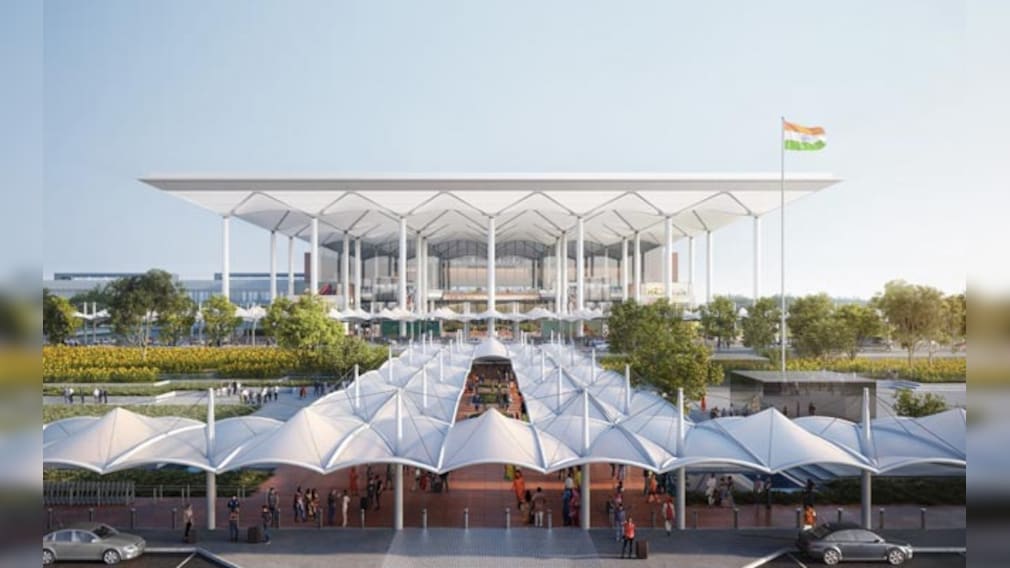
The Noida International Airport at Jewar is not just another addition to the NCR's aviation infrastructure. It marks a pivotal point and is already recalibrating demand across asset classes, reshaping investor sentiment, and redefining the long-term growth trajectory of a corridor that, until recently, was considered peripheral to the region's real estate story.
At CBRE, we have tracked how large-scale infrastructure projects influence markets. The pattern is consistent: airports generate not only passenger traffic but build economic ecosystems. They attract industry, create employment, and progressively draw in every category of real estate demand. Jewar is now at the beginning of that curve.
Built for Scale
At launch, the Phase 1 of the airport is expected to deliver 12 million passengers per annum (MPPA) capacity, one runway, a terminal of approximately 1.1 million sq. ft., and a cargo terminal handling 2.5 lakh metric tonnes annually.
By 2040-50, there is a plan to build a full aerotropolis capable of handling 70-120 MPPA across five to six runways, positioning Jewar to function as a complementary aviation node to IGI Airport, rather than merely a relief valve. That distinction signals long-term institutional confidence in the corridor's economic potential.
Connectivity: The Multiplier
The airport's impact is likely to be amplified by a dense multi-modal connectivity programme. The Jewar-Faridabad Expressway, a 31.42-km, six-lane road linking the airport to the Delhi-Mumbai Expressway, is targeted for completion in 2027. The Palwal-Noida Airport Rail Line, a 31-km connection, is also expected by the same year.
Another rail line, the Ghaziabad-Jewar RRTS, a 72-km Regional Rapid Transit System with 22 stations and a projected travel time of 37-72 minutes from Ghaziabad, is further planned for 2031.
Together, these corridors will extend the airport's effective catchment area significantly and draw passengers, businesses, workers, and investors, across a much wider radius. The Yamuna Expressway Industrial Development Authority (YEIDA) Master Plan 2041 provides the statutory framework within which this development will unfold.
Residential: Demand Already There
The residential story in Greater Noida and the Yamuna Expressway corridor shows that the micro-market did not need the airport's inauguration to validate demand. The demand was already present; the airport has now accelerated supply.
According to our research, the residential launches in Greater Noida increased from ~2,900 units in 2021 to over 15,200 units in 2025, a near five-fold increase over four years. The steepest rise occurred between 2023 and 2024, when launches nearly tripled in a single year. This coincides with the period when construction momentum at Jewar became credible.
The absorption data is equally relevant. The housing sales in the market held strong at over 17,800 units in 2025. In the years prior to that, absorption consistently outpaced new launches. This is not a market experiencing speculative inflation, but where genuine end-user and investor demand has remained structurally ahead of supply, and where developer confidence has now caught up.
Within the corridor, plotted developments are expected to lead the first wave of growth, driven by investor appetite and the relative affordability of land near the airport. Over time, we expect housing to gain more momentum with improving liveability.
Industrial & Logistics: Day 1 Activation
The industrial and logistics segment is fit for early traction. Unlike some other asset classes, it does not need to wait for passenger volumes to build. Day 1 cargo operations, combined with the proximity of planned clusters under the YEIDA framework, provide an immediate demand trigger.
The YEIDA Master Plan designates a dedicated 26-acre logistics and warehousing hub in Sector 8F, anchored by INR 10 billion in committed private investment. Beyond warehousing, the corridor is structured to accommodate a full spectrum of industrial real estate: authority-allotted plots for MSMEs and large-format manufacturing, modern Grade A warehousing, and integrated industrial townships such as the planned Korean and Japanese industrial cities, spanning 365 ha and 395 ha respectively. These combine manufacturing, worker housing, and commercial support infrastructure.
We are also seeing the interest from high-value manufacturing building. An Electronics Manufacturing Cluster in Sector 10 and global healthcare manufacturers exploring the 350-acre Medical Device Park in Sector 28 reinforce the corridor's positioning as a diversified industrial destination rather than a single-use freight hub.
Hospitality & Retail: Near-Term Beneficiaries
Hospitality is among the more immediate real estate beneficiaries of the airport, because demand here is directly tied to passenger volumes and does not require the same density of residential or offices to generate viable occupancy. There is a dedicated hotel plot scheme across Sectors 28 and 29, and a chain has already been selected through a competitive international bidding process to develop a 220-key luxury property within walking distance of the terminal.
Retail is likely to evolve more gradually. The first wave may be driven by roadside convenience retail, catering to highway traffic, support retail within integrated townships, and mixed-use developments. Large-format standalone retail usually follows as residential and employment density builds.
Office: The Long-Term Opportunity
The development of a formal Grade A office park at meaningful scale remains a longer-term opportunity. And it would be contingent on the build-up of population density, the completion of last-mile transit infrastructure, and the emergence of a self-sustaining employment ecosystem.
Today, the primary draw for developers is the relative affordability of commercial land parcels along the Yamuna Expressway and YEIDA corridor compared to established micro-markets such as Noida and Gurugram. This affordability may create an early-mover advantage. We expect individual campuses to emerge first, followed by multi-tenanted buildings as occupier-led demand gains traction.
The Compounding Effect
It would be a mistake to evaluate the Jewar airport's real estate impact only through the lens of its current operational capacity. Infrastructure of this scale may take some time to create value fully. The impact compounds as connectivity improves, employment increases, institutional participation deepens, and consumer confidence grows.
The inauguration of the Jewar Airport marks the beginning of what is, in all likelihood, a multi-decade expansion cycle for this corridor. The NCR has seen airport-proximate development before, but Jewar is different in one important respect: it is arriving with a comprehensive planning framework, a multi-modal connectivity programme, and a level of institutional and government commitment that gives the surrounding real estate market a foundation to scale.
For investors, occupiers, and developers, the relevant question is not whether this corridor will grow - the data already answers that. The more important question is at what point in that growth cycle they choose to participate.
(The author is Chairman & CEO - India, South-East Asia, Middle East & Africa, CBRE)
Disclaimer: These are the personal opinions of the author
-
Why Doesn't Congress Boycott If Polls Are "Fixed"? Answer Lies Beyond Rahul Gandhi's "Distraction" Quip

The starkest demand for a boycott has come from outside the political Opposition, from the Cockroach Janta Party. But does a boycott help? Here's what research, examples, and expert analysis tell us.
-
'Sully' To Gimli, Sioux To Patna: When Pilots Got It Unbelievably Right
Captain Smit Machchhar fought off his co-pilot after being stabbed and opened the cockpit door, saving 174 people.
-
Opinion | Are Saudi Arabia And UAE Reuniting Again After 10 Years?
On Tuesday, the UAE's Vice President, Deputy Prime Minister and Chairman of the Presidential Court, Mansour bin Zayed, met Saudi Crown Prince Mohammed bin Salman.
-
Opinion | 'Lies, Damned Lies, Statistics': On The Controversy Around India's GDP Growth Figures
The debate is less about a single figure than about a decade-long erosion of trust in official statistics.
-
Opinion | Why India Cannot Keep 'Overestimating' Its Value To Washington
Some of India's value to Washington came from the tension between the US and China. That is changing now.
-
Opinion | India Has A 'Lobbying' Problem In Washington, And It Has Come Back To Haunt It
While the EU, Japan, the UK and South Korea secured quick deals, India's efforts were getting drained in prolonged negotiations and the wrong kind of lobbying.
-
India Is Getting Old Before Getting Rich, Will Turn 'Aged' In 16 Years: Moody's
Countries with the steepest fertility declines today will age the fastest in the coming decades. India's drop has been steep.
-
Opinion | Why Does Trump Want To Sell Arms To A US 'Adversary'? Inside His Strange Bargain
Trump's aides maintain that no such offer had been made. But the story points to a larger strategy
-
Opinion | The AI Boom Has Run Into A Big 'Debt' Trap Problem. Inside The 5% Danger Line
For most of the AI buildout's first two years, hyperscalers funded it the easy way: out of operating cash flow. That era is over.
-
Opinion | Iran To Saudi, Pakistan Is Now Fast Running Out Of Sides To Play
Pakistan's long history of playing all parties to its own benefit may have reached the end of its road.