Opinion | Bihar Assault, Hisar Marriage Ban: Who'll Stop The Guardians Of Indian 'Culture'?
Why exactly does the sight of a young couple seeking a bit of alone time somewhere tend to particularly provoke a certain kind of Indian men?

This week, a social panchayat in Hisar in Haryana decided that there would be a ban on love marriage in their village. They also declared that people who defy the ban, together with their families, would face a boycott. Apparently, the decision was taken after a few recent instances of young men and women in the village falling in love and getting married. Those who participated in this outrageous move to stifle the civil liberty of young folks said that it was done to “preserve the social fabric” of the village.
Evidently, the fury against young love not sanctioned by family and society continues unabated. This despite the fact that multiple judgments in the Supreme Court have held all such pronouncements by “khap” gatherings illegal, ruling that they violate Articles 19 and 21 of the Constitution which protect the fundamental rights of individuals, including the right to marry a partner of their choice.
In the Haryana village, a person was quoted as saying, “We consider every girl in the village our own daughter.” In other words, the noxious effort to prohibit love marriages is really all about the community's visceral need to control the lives of girls and to ensure that they conform to the standards of purity and morality laid down by its antiquated social customs. Indeed, nothing enrages patriarchy more than to see women and girls exercise a choice, especially a sexual choice, without its express consent. And it usually hits back by punishing them and their bodies, sometimes with murderous consequences.
Coincidentally, this despicable instinct was on full display in two cases of sexual violence against young girls in Bihar and Delhi that took place around the time when the Haryana village issued its vengeful diktat against love marriage. In Bihar's Jamui, a girl and her male friend, both students of Class X, were returning from their coaching class when they were accosted by a group of men. The girl was groped, lifted and dragged and the boy was beaten up. A video of the incident quickly went viral on social media and sparked a tremendous outcry. In the second incident, a 17-year-old girl was gang-raped in a Delhi park earlier this week by three men who separated her from her male companion, threatened her with a gun and a knife, and took turns at sexually assaulting her.
In both incidents, the assaulters and rapists targeted a young girl who was out with a boy. They seemed to have operated from the belief that the possibility of her being intimately associated with a member of the opposite sex was evidence of her promiscuity, her “bad character”, as it were, and that this automatically gave them the licence to sexually violate her.
This is not to say that women and girls in other situations are not sexually assaulted. They are, and the mind-numbing number of rapes in the country is a testament to that. However, the sight of a young couple seeking a bit of alone time somewhere tends to particularly provoke a certain kind of Indian men - those who are incensed at the idea of a girl making a romantic choice without reference to her family and society. In their twisted, violent little minds, assaulting such a girl probably feels like a double bonanza - they get to slake their own depravity in addition to having the satisfaction of “teaching her a lesson” for daring to be in the company of a male friend.
Interestingly, the video of the Jamui incident appears to have been shot and circulated by one of the assaulters. Did he think that he and his gang would be applauded for what they had done? That they would be praised for upholding morality in public spaces? Garlanded perhaps? After all, politicians in this country are known to have done precisely that to welcome rapists out on bail or those accused of lynching and murder.
A Bihar minister did, in fact, dismiss the Jamui assault as a “chhutput” (insignificant and stray) incident. Though the state government is scrambling to do damage control now, and most of the culprits have been apprehended, the point is that the enabling culture of impunity, the insidious suggestion that society has the right to surveil the private lives of couples, and men have the right to police women's bodies and their morals, continue to embolden would-be aggressors.
And it is not just a dangerously regressive khap pronouncement from the country's hinterland that fuels and sustains such authoritarian sentiments. Witness the provisions of the Uniform Civil Code legislation implemented by states such as Uttarakhand and Madhya Pradesh. They make it mandatory for live-in couples to register themselves with the police, failing which they face imprisonment. It is as if the state is of the view that the status of live-in couples is so dubious, so close to being unlawful, that they need to be watched and tracked at all times.
Love is not a crime. It can manifest in myriad forms - traditional, non-traditional, binary, non-binary, within the bounds of wedlock or without, inter-faith, intra-caste … It can bloom in the young, and it can light up the old. No society or state should arrogate to itself the power to decide what sort of love is kosher and what is not. Let us stop trying to legislate love in the name of custom and tradition and morality. It is a recipe for more hate-filled crimes against women, and no modern, forward-looking society should want to go down that path.
(Shuma Raha writes on gender and culture and is the author most recently of the novel, ‘The Sea Has the Answers')
Disclaimer: These are the personal opinions of the author
-
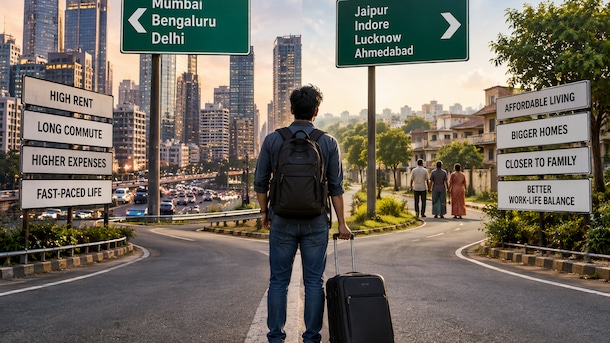
Real Cost Of Moving Out: Low Salary Job In Tier 2 Hometown vs Chasing Big Pay In Metropolitans

The rising cost of urban living is also changing how young couples think about marriage, children and financial independence.
-
Opinion | How Pakistan's Anti-India Obsession Turned Into A $40 Billion Blunder
The country incurred an estimated $40 billion in losses due to trade with India being suspended in 2019, with businesses facing higher sourcing and logistics costs after being forced to import goods from distant markets.
-
BJP Hunts For A Crack. Rahul Gandhi's Allies Could Be His Weak Spot
The government suffers a handicap in the sense that there is little to beat the opponents who have been out of power for long. But this is where the Congress and Rahul Gandhi need to use caution
-
Opinion | A Wounded Trump Could Soon Make The World Pay For His Defeat
The US and the rest of the world should worry more about what Trump might do next to redeem himself.
-
Opinion | Trump's Midterm Rout Eases India's Worries. But It Doesn't End Them
The midterm outcome offers immediate psychological relief for India. But it may not change much when it comes to thorny issues such as tariffs or regulatory frameworks. There, Trump still holds the gavel.
-
Blog | Virat Kohli At 38: The Man Who Gave Cricket His 100%, Every Single Time
From revolutionising fitness standards in Indian cricket to wearing his emotions, spirituality and love for the game with pride, Kohli's legacy extends far beyond runs and records, making him one of the most influential athletes of his generation.
-
Opinion | Classroom Violence: Cinema, Society And The Crisis Of Responsibility
There has been a combined outrage against violent movies such as 'Dhurandhar' and 'Animal', which have been blamed for such widespread behaviour.
-
Opinion | Trump's Midterm Rout Has One More Victim: JD Vance
Vance campaigned as hard as the President, served as the Republican National Committee's finance chair. He watched his home state of Ohio elect a Democratic governor and send a Democrat to the Senate seat he gave up to become Vice President.
-
Opinion | China May Be Turning Pak Into A Military Nightmare For India
Beijing has steadily become Islamabad's principal defence supplier. But the emerging nexus goes beyond weapons