Opinion | India's Oil Reserves: How Long Can They Last As Iran War Continues?
It may be recalled that at the start of the war, India had around 74 days of oil reserves. On May 13, after completion of 74 days, India still had 60 days of oil reserves.
The war in Iran has completed 80 days - 40 days of active conflict and 40 days of a fragile ceasefire, coupled with a double naval blockade in the Strait of Hormuz. A war, launched through pre-emptive strikes by Israel and the US on February 28, should have ended in a few days if things had gone according to plan. But apparently, Iran had other plans, having worked on and prepared for exactly this kind of scenario for over two decades. So, where are we now? Where is the war headed? How is it that the Strait of Hormuz has virtually become the most critical factor in ending the war, an issue that did not exist at the start of the war? And, for us in India, the most crucial question is, how is India securing its national interests in the midst of this conflict, especially energy security?
Indian Dependency on the Strait of Hormuz
India imports almost 88% of its annual crude oil requirements, which amount to 1.8 billion barrels. Broken down to a daily figure, it translates to a daily import of around 5 million barrels of oil per day. Of this, as per figures of FY 2025-26, India imported almost 48% of its total import requirement from the Gulf region, with Iraq (17.8), Saudi Arabia (14.5), the UAE (11.4), along with Kuwait and Qatar, supplying India its crucial needs. During the same period, Russia was the top supplier at 30.5%. On a daily basis, the oil imports from the Gulf region amounted to 2.4 million barrels per day.
It may be of interest to note that till May 2019, Iran accounted for almost 10-12% of India's crude oil imports, which were stopped under American sanctions imposed in President Trump's first term under a 'Maximum Pressure Policy' imposed on it. Also, till 2022, before the onset of the Russia-Ukraine war, Russian imports of oil were barely 1-2%, which have risen to 35-40% at peak levels during the last four years, as India was able to get crude oil from Russia at a heavily discounted price.
In the current war, with Iraq, Kuwait and Qatar completely shut out due to the closure of the Strait of Hormuz, and Saudi Arabia and the UAE able to supply limited amounts of oil, India had a major challenge at hand. As soon as the war in Iran broke out and Iran imposed a blockade in the Strait of Hormuz, India had to quickly look at alternative sources of energy. Consequently, India increased imports from the US, Brazil, Africa and Latin America, expanded the supplier base to nearly 40 countries, and adopted a 'Flexible Procurement Strategy', which meant reliance on more spot purchases than on long-term contracts. Plus, the oil from Venezuela added to the kitty as the US revoked sanctions on the sale of its oil. Another interesting source was Iran, which was permitted to sell crude oil for 30 days in March-April, effectively bringing about 140 million barrels into the global market, some of which was picked up promptly by India, too.
Did these steps suffice to secure India's energy needs? The answer is, yes, partially. Of the daily requirement of 5 million barrels of crude oil, average imports in April were 4.4 million barrels, of which Russia accounted for 1.6 million barrels, Saudi Arabia 668,000 barrels, the UAE 620,000, Oman 100,000 and Venezuela 260,000 barrels. Thus, against a requirement of 5 million barrels daily, there was a shortfall of 0.6 million barrels per day, which was partially set off through the Strategic Petroleum Reserves (SPR) as well as the floating and industry reserves already in India. It may be recalled that at the start of the war, India had around 74 days of oil reserves. On May 13, after completion of 74 days, India still had 60 days of oil reserves, which could be credited mostly to the oil imports discussed above.
There were some apprehensions that the waiver on the purchase of Russian oil would not be renewed after May 16 (when it was due to get over). However, the Indian government made it clear that any purchase of oil from Russia will be based on India's national and commercial interests and not on external sanctions. Also, the US, on May 17, extended the waiver on the purchase of Russian oil for another 30 days. Despite the oil supplies continuing to be ramped up, the deficiencies still exist, which are being made up through the SPR. There is, therefore, a need to examine the status of SPR, a vital component of India's energy security.
India's Strategic Oil Reserves
India has an installed capacity of around 5.33 million metric tonnes (MMT), or 39 million barrels. It is planned to be stored in underground caverns at Visakhapatnam (1.33 MMT), Mangaluru (1.5 MMT) and Padur (2.5 MMT). However, against this target, the actual storage at the start of the war was only 64%, or 24.7 million barrels. Why it was not fully stored has not yet been fully explained by government agencies, but due to this, India started with a deficiency of almost 15 million barrels, or three days of oil imports. This implied that against a planned SPR of 7.8 days (39 million barrels), India had only 5 days (24.7 million barrels). However, with the refinery and pipeline stocks (64-68 days), India could muster up a reserve of 74 days.
There is another structural deficiency in SPR, which, if addressed earlier, could have made the situation better for India. The second phase of SPR envisaged an additional storage capacity of 6.5 MMT or 47.6 million barrels of crude oil in Chandikol (4.0 MMT), and Padur Phase 2 (2.5 MMT) was sanctioned in 2021. Sadly, the projects remained on paper as no land was allotted for the SPR by states, resulting in a loss of 9.5 days of SPR. Adding this up with the deficiency in existing storage, India lost almost 61.9 million barrels of storage, or 12.5 days of reserves, when the war started. Had the phase 1 and 2 of SPR been fully commissioned and filled, India would have had a storage of 17 days (87 million barrels).
The Cost Factor
Another important factor in crude oil imports is the cost, as it has a major impact on India's budget as well as forex reserves. At the start of the Iran war, the price of crude oil was USD 70 per barrel, which has now risen to around USD 110 per barrel. This is an increase of USD 40 a barrel. Against an annual import of 1.8 billion barrels, it adds up to USD 72 billion. Adding the inflated insurance and shipping costs, the added bill threatens to touch USD 80 billion. It could further increase if the war or the stalemate in the Strait of Hormuz continues. To put this in perspective, the Indian Defence budget for FY 2026-27 has been pegged at INR 7.85 lakh crore or USD 86 billion (which currently equals USD 80.5 billion due to the sliding Rupee). Therefore, the increased crude oil import bill threatens to add another defence budget to India's budget, an unsustainable fiscal burden.
Also, every 10% increase in oil price widens India's Current Account Deficit (CAD) by 0.4% of the GDP. With an increase of 60% already in oil prices, CAD could widen by widening by 2.4%. With the Indian government not immediately passing the effect of increased oil prices on to the citizens (up to 14 May), the daily losses with the oil companies amounted to INR 1,000 crore per day, again an unsustainable situation in the long run.
What India Needs To Do Next
The war in Iran and the double blockade of the Strait of Hormuz are taking a heavy toll on the global economy, especially on nations like India, which are heavily import-dependent for energy security. Despite starting at a disadvantage at the start of the war, India was quick off the blocks to secure its energy needs. During the recent visit of PM Modi to the UAE on May 15 , a deal was signed wherein ADNOC (Abu Dhabi National Oil Company) will store up to 30 million barrels of oil in India's SPR while also storing some additional reserves in the UAE itself. However, this storage commitment only helps in filling up the existing and planned storage capacities of SPR in India.
From a future energy security perspective, India will have to significantly enhance its SPR capacities from 17 days to a minimum of 45 days on land, with the possibility of another 10-15 days of SPR on sea on tankers. Incidentally, the International Energy Agency recommends a SPR of 90 days. Plus, India's vulnerabilities in procurement of LPG and LNG, which require a separate examination, too needs to be plugged soon. Also, the drive to diversify sources of imports across geographies needs to be expanded and cemented to insulate Indian energy security needs from conflicts and global shocks. Strategic projects like the Oman-India undersea pipeline may have to be given a relook, too. And most importantly, India will have to stand firm in exercising its strategic autonomy and ensure that no external pressures, like the economic sanctions by the US, prevent it from securing its energy needs from wherever - and however it needs to be sourced.
(The author is a retired Army officer and a senior research consultant at Chintan Research Foundation)
Disclaimer: These are the personal opinions of the author
-
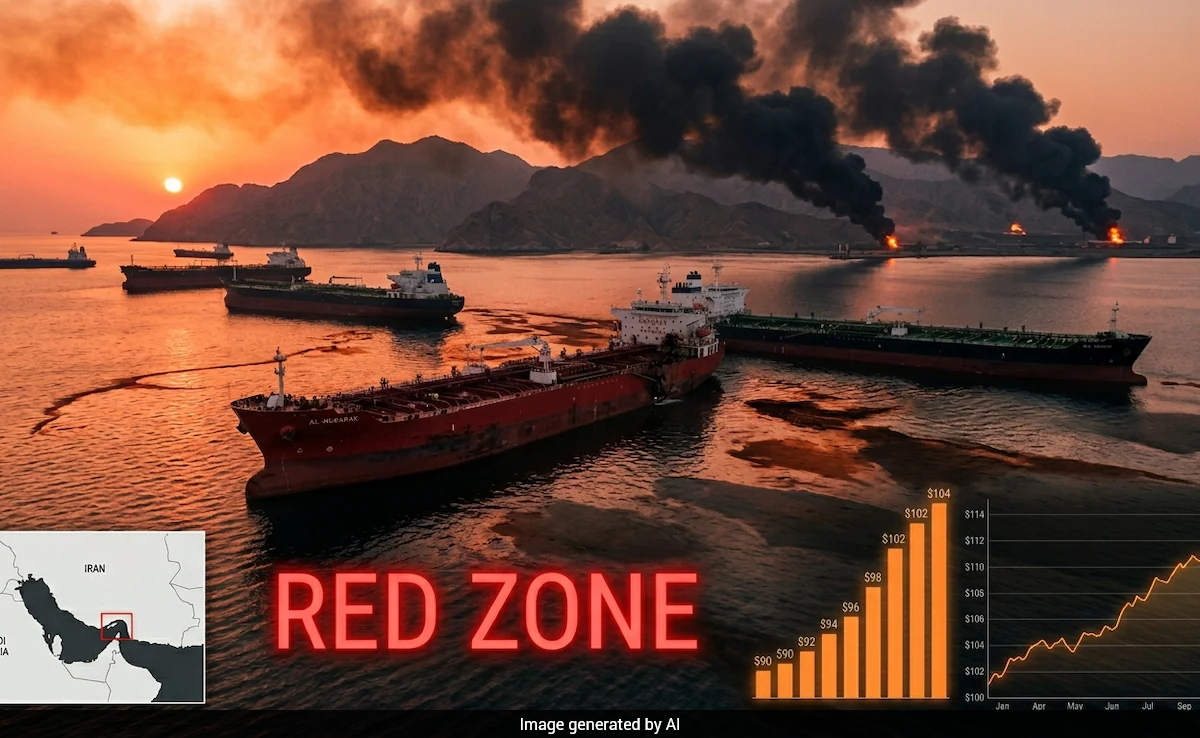
Strait Of Hormuz Shutdown, Oil Supply Crisis Triggers 'Red Zone' Warning

The IEA has already issued warnings about 'the most severe disruption' ever; in April agency chief Fatih Birol told CNBC: "We are facing the biggest energy security threat in history."
-
Opinion: TVK Dismantles Dravidian Stereotypes Without Disturbing Tamil Political Positions
A young Brahmin man, with or without any political background, winning a seat in Tamil Nadu and subsequently becoming a minister, does not fit the established template of Dravidian politics.
-
Opinion | Twisha Sharma And India's Deadly Culture Of 'Adjusting A Little More'
A daughter's desperate cry for help is responded to with "adjust", "compromise", or "save the marriage". Her parents even promise to give more dowry, but refuse to bring her back. Girls are repeatedly sent back into abusive homes till one fine day, they are dead.
-
Opinion | Why India's 'Cockroach' Rebellion Should Terrify The Opposition
The Opposition will make the mistake of thinking that this 'cockroach' moment is about anti-BJP hate. It's not. It's about its own failings.
-
Opinion | Unmarked Vans, 'OMR' Tricks, 'Solver-For-Hires': The Dark Underbelly Of Multi-Crore NEET Scams
Beneath the answer sheets and OMR bubbles, beneath the invigilators and sealed envelopes, lies a system so fragile and so compromised that it has become a multi-crore auction.
-
Opinion | Twisha Sharma And The Case Of The Ever-Innocent Indian Husband
Within 72 hours of Twisha's death, media narrative had run amok: "erratic behaviour", "depression", "drugs". None of it was ever substantiated in a chargesheet. That was never the point.
-
5 Seats, 2 Ministers: Congress' Canny Tamil Nadu Play Snaps 59-Year Drought
The Congress ends its 59-year absence from the Tamil Nadu cabinet after two leaders join Chief Minister Joseph Vijays government. But what led to this moment after the party won just five seats in the April 2026 election?
-
"I Cry In Shower": Meta, LinkedIn Employees Share Fears, Anxiety Amid Layoffs
Life decisions are on hold. Employees say they are unable to plan a future because they don't know if they will still have a salary next quarter.
-
Opinion | Elon Musk Might Just Have Lost The Most Important Case Of His Career
Musk's recent courtroom defeat against OpenAI and Sam Altman will, of course, not damage Tesla or SpaceX. But symbolically, it could become one of the defining moments in the AI industry.
-
Ringside View | How Royal Challengers Bengaluru Transformed Itself Into A Winning Machine
Mo Bobat, RCB's Director of Cricket, helped explain the mindset after the franchise became the first team to qualify for the playoffs this season.