Opinion | How US Midterms Could Give Trump A Very Different 2027
The President isn't on the ballot. But his room to manoeuvre certainly is.
Let's "check in" on the iconic Willard Hotel for a second. This grandiose establishment has hosted many American and foreign dignitaries. The list is exhaustive and impressive. From Abraham Lincoln to Mark Twain and Martin Luther King Jr, as well as visiting dignitaries, like Indian Prime Ministers Narendra Modi and the late Dr. Manmohan Singh, have called the Willard their temporary home.
But one such other frequent visitor inadvertently codified a term. It's an apocryphal story that's often told in Washington, DC. Legend has it that the lobby of this famed hotel was how the words "lobbying" and "lobbyists" came to be. Long before President Donald Trump said, "location, location, location", back in the day, President Ulysses S Grant, the famed Civil War General who victoriously commanded the Union Army, leveraged the short hop from the White House and was often seen in the lobby of this hotel. Word got around of Grant's Willard visits, and people sought to approach him for favours.
Grant, who was miffed with the copious requests, supposedly referred to them as "lobbyists". Some say that's how 'lobbying' and 'lobbyists' got their name. Other linguists and historians disagree and say the word predates Grant.
But the legend tells a bigger story - the Washington story. Everyone wants access to power. And with midterms just a day away, voters decide where that balance of power lies in this cycle.
The midterms don't enjoy the fanfare of presidential elections. Yes, no new President will be elected. Yet, midterms are often seen as the verdict that can break or define a presidency.
The midterms, in some ways, serve as a referendum on the President and his policies, and it shows the mood of the electorate and their perception of where they see the country heading. Ironically, the President's name isn't on the ballot, but the midterms may just be all about him, and votes would be cast vicariously for or against him through several races across all 50 states.
That matters because America's constitutional architecture bifurcates power into the holy trinity of Executive, Legislature, and Judiciary. The White House, as the Executive, advances an agenda and executes the laws; Congress, as the legislative wing, determines how much of that agenda becomes legislation and controls the federal purse strings; the courts interpret the law and enforce constitutional limits.
Winning the presidency makes the person the commander-in-chief. But constitutionally, it is not a license to govern unchecked. So, once in two years, or the halfway mark of the President's four-year term, the midterms determine just who controls Congress.
What's At Stake In The November 2026 Midterms?
Here is the scenario at hand. All 435 seats in the House of Representatives and 35 Senate seats are being contested. These include two special Senate elections - one in the seat vacated by Vice President JD Vance in Ohio, and the other for the seat vacated by Secretary of State Marco Rubio in Florida. Those special elections will determine who serves the remainder of their terms, through January 2029.
Republicans currently hold a majority with 53 Senate seats, against 45 in the Democratic caucus, including two independents - Bernie Sanders of Vermont and Angus King of Maine. Both caucus with the Democrats, bringing the Democratic caucus to 47.
They can afford to lose two, or a net loss of three, and still retain control, since Vice President JD Vance serves as President of the Senate and possesses the constitutional authority to cast a deciding vote when the chamber is evenly divided in a 50-50 split.
So, Democrats need a net gain of four to take back control in the Senate. In the House, Republicans hold 218 seats and the Democrats 214, alongside one independent, who caucuses with the Republicans. There also are two vacancies.
The goal is to get to 218. Thus, Democrats need four more seats than they currently hold, while Republicans must finish at or above that number to secure an outright majority.
What A Win Means For Either Party
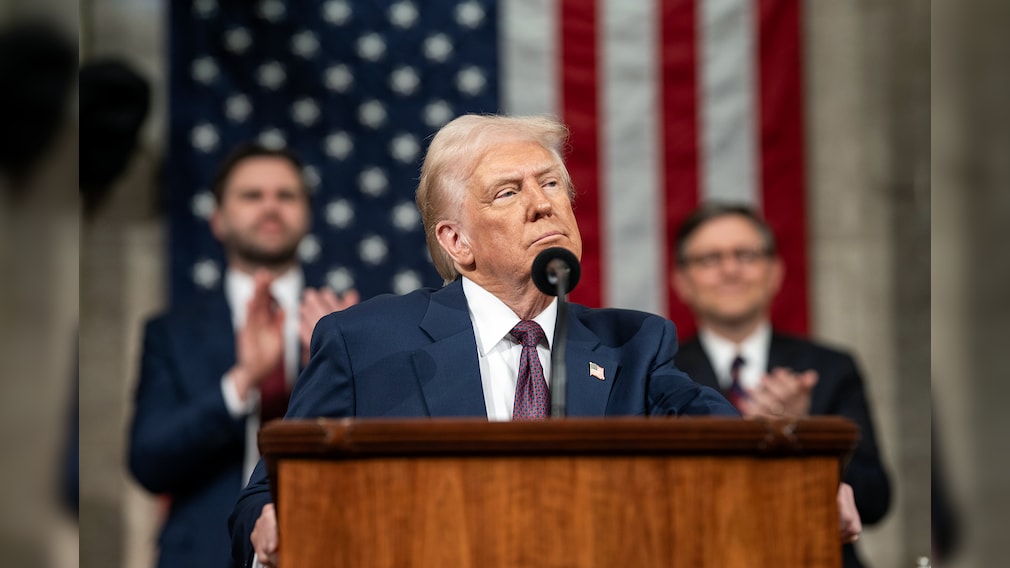
For Republicans, keeping both chambers means a clearer path to delivering President Trump's priorities and advancing his agenda till the end of 2028.
For Democrats, winning either chamber means more power to challenge his policies, and guardrails for some of the policies that they have umbrage with. In a nutshell, Donald Trump will remain President. But should either or both chambers flip, then the terms of his presidency could change as well.
The road to a Senate majority runs through familiar battlegrounds, some tenuous for certain candidates and campaigns.
In Michigan, Democrat Abdul El-Sayed faces Republican Mike Rogers for an open Democratic-held seat, as El-Sayed is vying to be the country's first Muslim Senator. Television debates serve as a barometer of just how heated this battle has been.
In the Peach State of Georgia, Democrat Jon Ossoff must defend his seat against Republican Congressman Mike Collins. Texas offers Democrats the more elusive prize. The Lone Star state has a blue-chip asset in the Republican portfolio, and Democrats are hoping to turn the GoP blue-chip a bit bluer this November. The battle is between millennial James Talarico and the Texas Attorney General Ken Paxton.
But turning the urban "blueberries" of Austin and Houston into a statewide blue victory requires a coalition that has eluded every Democratic Senate candidate since Lloyd Bentsen's victory in 1988. A year before Talarico was born - that's how long it has been since Texas elected a Democrat to the Senate.
In Presidential elections, the rule for Ohio was simple. Win the Buckeye State and win the White House. Ohio, a former presidential bellwether, had backed every White House winner from 1964 to 2016, until the trend broke in 2020, with Joe Biden losing Ohio but winning the Presidency.
Former Senator Sherrod Brown is attempting a Senate comeback against Jon Husted. Like Florida, the Buckeye State has moved from swing territory towards ruby red Republican. Yet, its industrial towns and blue-collar electorate remain a testing ground. For Trump and Vice-President Vance, a fellow Ohioan, it's holding on to the base. For Democrats, it's assuaging the claim that they understand working-class voters.
There is also a familiar Indian-American name in the battle for the state capitals, too.
Republican Vivek Ramaswamy, who ran unsuccessfully for the GOP nomination for President back in 2024, faces Democrat Amy Acton for governor of Ohio. The gubernatorial race won't change the numbers in Congress, but it will decide who runs the state, shaping everything from schools and healthcare to jobs and investment.
And of course, like the famed Beatles song, Vivek Ramaswamy is also getting by with a "little help from his friends". Vice President and fellow Ohioan JD Vance has joined him on the campaign trail, as Ramaswamy faces pushback for a controversial ad featuring Acton's estranged mother speaking against her daughter.
South Carolina offers another test, with Democrat Annie Andrews challenging Darline Graham, the sister of late Senator Lindsey Graham. The veteran senator suddenly passed in office, after having served for over two decades.
Alaska, the 49th state, adds a peculiar twist. America's northern frontier has its own version of the Australian television drama The Sullivans - a situation where two Dan Sullivans are on the same ballot. Democrat Mary Peltola faces incumbent Dan Sullivan on a ballot that also includes Daniel J Sullivan Jr. Allegations surrounding the latter's recruitment, denied by Peltola's campaign, have pulled federal investigators into the contest. President Trump hasn't wasted the opportunity to hit back at Peltola and Democrats, alleging chicanery to obfuscate voters against voting for the Republican Senator.
In a nutshell, different states, different electorates, but similar issues surrounding voters in this election. As the famous credo that Bill Clinton used in his 1992 campaign, "it's the economy, stupid". Voters at the polls have the economy, jobs, inflation, immigration, and, of course, foreign policy on their mind.
The 'Samosa Caucus'
In the House, the contest is district by district. There's the Washington's 'Samosa Caucus', a fun moniker given by outgoing Congressman Raja Krishnamoorthi to describe the Indian-American contingent in the House of Representatives. And he says the six-member caucus is like a samosa, "small but spicy".
But the lineup is changing. Krishnamoorthi's Senate bid ended in the Illinois Democratic primary, while Shri Thanedar lost his House primary in Michigan. Both are serving out their terms.
Ro Khanna and Ami Bera of California, Pramila Jayapal of Washington state, and Suhas Subramanyam of Virginia are seeking another term, while Amish Shah in Arizona and Pia Dandiya in Florida are hoping to join the new season of Samosa Caucus. Some familiar faces, other fresh faces, but all hoping to add the Indian spice to a very American recipe.
The 120th Congress comes into effect on January 3, 2027. It's a domestic race with global implications, as the new Congress will have its own approach pertaining to trade, immigration, and Washington's role on the world stage.
Sure, the President isn't on the ballot. But the President's room to manoeuvre certainly is.
(The author is Consulting Editor, US Desk, NDTV)
Disclaimer: These are the personal opinions of the author
-
Opinion | US Has No 'Election Commission'. Trump Is Testing What That Can Mean

America does not have a central election authority that centrally undertakes these critical functions. Each of the 50 states sets its own election laws.
-
India's New Real Estate Luxury Isn't A Bigger House. It's More Bathrooms
The growing demand for additional bathrooms creates a new challenge: how do developers accommodate them without making the bedrooms smaller?
-
BJP Leader's Singer Wife, A Kabir Bhajan, And Some 'Jantar Mantar': How 15th Century Saint Entered 2026 Row
A video of Sivasri Skandaprasad's singing performance went viral, interpreted as a dig at protests at Delhi's Jantar Mantar. What she's singing is actually attributed to the saint-poet Kabir, and he did not really mean that particular "jantar mantar". He meant something far more profound.
-
Opinion | Sardar Patel, And The Art Of Holding A Nation Together
A true Gandhian, he reminded his countrymen that gaining freedom from foreign rule was merely the first step; true internal Swaraj required much, much more.
-
Opinion | How India Is Making Its Stock Market An Expensive Place To Invest
FPIs sold Rs 1.66 lakh crore of Indian equities in 2025 and a record Rs 3.08 lakh crore in 2026 through October 12. Foreign ownership of the Indian market is at a 15-year low
-
Jail Is No Bar: How Gangsters Call The Shots From Inside Prisons
Jail can become a safe haven from enemies, a recruitment ground for fresh gang members and, in some cases, a command centre for criminal operations
-
From King Edward III To Neha Bora, A 1361 Law Lives On In 'Peace Bonds': NDTV Explains
CJP leaders Abhijeet Dipke, Saurav Das, and Ashutosh Ranka signed peace bonds; two of them even faced jail over an alleged breach, while AISA's Neha Bora questioned such a bond's very logic. Here's what a peace bond is, and what the questions are.
-
Air Force Golf Course Near PM House Closed. How This Land Has Seen Many Turns Of History
The Air Force Sports Complex, which includes the golf course, is the latest property near the Prime Minister's residence set to be taken back this year, as the land is owned by ministries.