Opinion | How A Photograph in Delhi Says Something Important About Trump's America
During her visit to New Delhi this week, Venezuela's Delcy Rodrguez, met US Ambassador Sergio Gor. Had the meeting taken place in Washington or Caracas, it would have attracted little attention. In Delhi, however, it carried a different significance.
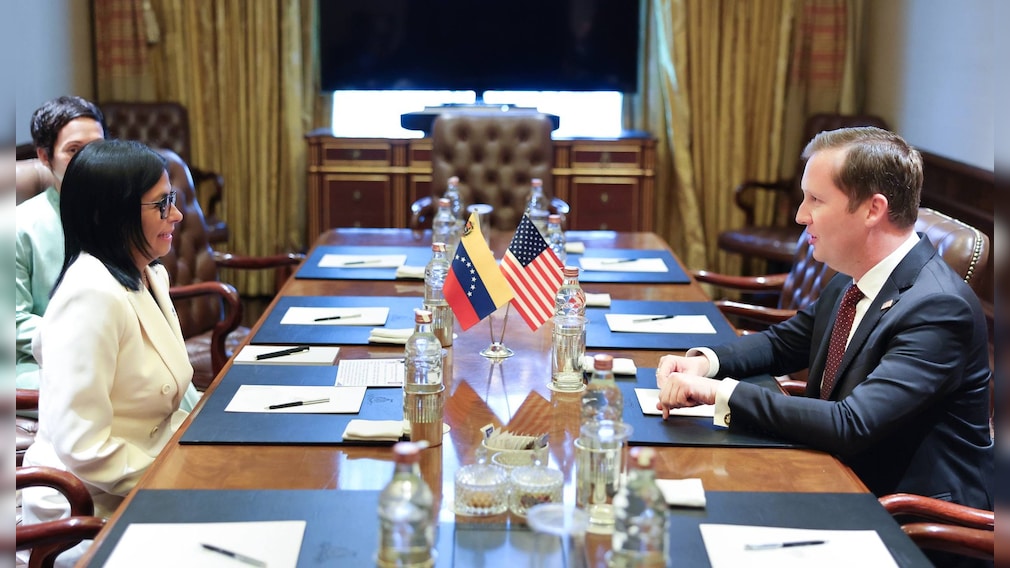
During her visit to New Delhi this week, Venezuela's acting president, Delcy Rodríguez, met US Ambassador Sergio Gor. Had the meeting taken place in Washington or Caracas, it would have attracted little attention. In Delhi, however, it carried a different significance.
Rodríguez had come to India seeking investment, energy cooperation, and commercial partnerships. Yet the image suggested a deeper reality. Venezuela's leaders may travel the world in search of opportunities, but the country's economic future increasingly operates within a framework shaped by Washington. For example, recent US sanctions have restricted Venezuela's access to international financing and targeted the state-owned oil company PDVSA, dramatically limiting the government's ability to generate revenue and engage with global markets. The photograph captured more than a diplomatic encounter. It revealed a changing relationship between a weakened state and a dominant power.
It also revealed something troubling about America itself.
For decades, successive American administrations justified their policies towards Venezuela using the language of democracy, human rights, and constitutional governance. Critics often questioned those motives, but the rhetoric remained consistent. American power was presented as an instrument of universal principles.
Donald Trump has adopted a strikingly different approach.
The Return of Colonial Logic
Rather than disguising the centrality of oil, he has repeatedly emphasised it. He has spoken openly about Venezuela's vast energy reserves, described Venezuelan oil in terms suggesting American entitlement, and supported arrangements under which the future of Venezuelan oil production and revenue flows would be shaped under strong American influence.
The remarkable feature is not that a great power pursues its interests. Great powers have always done so. The remarkable feature is the disappearance of embarrassment.
Trump appears willing to say aloud what previous administrations preferred to imply. While leaders like Obama or Bush focused their public statements on the promotion of democracy, human rights, and constitutional order, often framing interventions in terms of universal values, Trump has spoken with unusual directness about oil, power, and strategic advantage. Where past rhetoric wrapped interests in the language of democratic idealism, the priorities now are openly transactional. Oil matters. Power matters. Strategic advantage matters. The language of democratic idealism has increasingly given way to the language of ownership and control.
That shift is important because it exposes the underlying logic of the relationship.
No American governor resides in Caracas. No American flag flies over Venezuelan government buildings. Venezuela remains a sovereign state in the formal legal sense. Yet colonial relationships have evolved. They no longer require occupation or direct administration. They operate through financial leverage, market access, licensing arrangements, sanctions regimes and influence over strategic resources.
The question is, therefore, not whether Venezuela remains independent on paper. The question is whether meaningful sovereignty can survive when a nation's most important economic decisions increasingly depend upon the approval of another state.
Yet the most important consequence of this development may not be Venezuelan. It may be American.
The Freedom Exception
The United States occupies a unique place in modern history because it was founded in opposition to an empire. The American Revolution transformed resistance to external control into a defining national principle. Liberty, self-government and sovereignty became central elements of American identity. Generations of Americans were taught that freedom was not merely a national possession but a universal ideal.
That is what makes the current moment so revealing.
If a foreign government exercised similar influence over American oil production, energy exports, or resource revenues, the reaction would be immediate and furious. Americans would rightly regard such interference as an assault on national sovereignty. Politicians would denounce it. Commentators would condemn it. Citizens would reject it.
Yet many of the same people appear remarkably unconcerned when comparable principles are applied elsewhere. This is particularly evident among Trump's political base. Few political leaders speak openly unless they believe their supporters will tolerate or even reward them for doing so. Trump's confidence reflects the knowledge that many of his most enthusiastic supporters will view such rhetoric not as imperial overreach but as evidence of national strength.
That fact should trouble Americans far more than it troubles Venezuelans.
Many of those supporters present themselves as the strongest defenders of freedom, sovereignty and self-government. They condemn foreign influence in American affairs and invoke the nation's anti-colonial origins with understandable pride. Yet when another country's sovereignty becomes constrained by American power, the principle suddenly appears less important.
The contradiction is difficult to ignore.
The issue is not simply hypocrisy. Political hypocrisy is as old as politics itself. The issue is habituation.
A society that repeatedly makes exceptions to its principles eventually ceases to regard them as principles at all. Freedom becomes something claimed for oneself rather than defended universally. Sovereignty becomes a right for the powerful and a privilege for the weak. Liberty remains celebrated in speeches while becoming increasingly conditional in practice.
History suggests that this process carries dangers far beyond foreign policy.
The founders of the American Republic understood that imperial power could corrupt republican institutions. Their concern was not merely what power would do to foreign peoples. It was what the exercise of power would do to Americans themselves. A republic depends upon citizens who believe that principles apply consistently. Once exceptions become routine, cynicism follows. The language of freedom survives, but its substance gradually weakens.
The photograph from New Delhi will soon be forgotten. Diplomats will move on. Oil contracts will be negotiated. Venezuela's future remains uncertain.
Yet the image captured something larger than a diplomatic meeting. It showed a republic founded in opposition to an empire that was growing increasingly comfortable exercising imperial influence over another nation's most valuable resource. More troublingly, it suggested that millions of Americans no longer regard that contradiction as particularly troubling. Americans, and Indians, should pay attention.
History repeatedly demonstrates that the habits developed abroad rarely remain abroad. A society that becomes comfortable making exceptions to its principles overseas eventually begins making exceptions at home. A nation that learns to tolerate the erosion of freedom abroad may one day discover that the habit has returned home.
(The author is a Research Fellow in the Geostrategy Program at the Takshashila Institution)
Disclaimer: These are the personal opinions of the author
-
Bruised, Limping, Unbowed: Sia Says She Will Be Back On The Bike Soon

There was pain in Sia's steps, anger in her words, and something else - a quiet determination that the road would not be taken away from her.
-
Mamata Banerjee Drew Her Party's Symbol By Hand. It's Now Tied To An Indira Gandhi Case
The Election Commission's method for settling such disputes became central in the seminal Congress split of 1969, when Indira Gandhi fought the old guard. The poll body weighed three tests then.
-
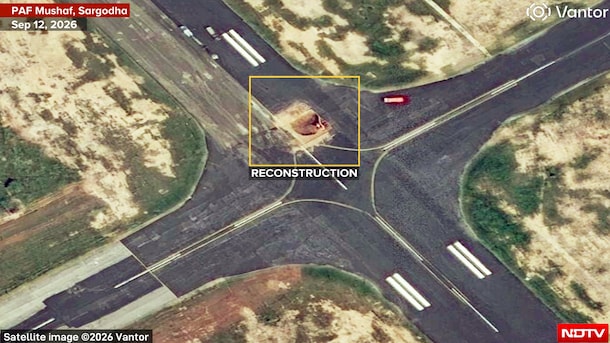
Exclusive: 16 Months After Op Sindoor, Pak Still Fixing Runway India Broke At Sargodha
Sargodha's PAF Base Mushaf lies about 172 km northwest of Lahore and roughly 200 km west of the India-Pakistan border, near Amritsar.
-
Blog | I Lost My Entire Family In Kanishka Bombing. 41 Years Later, Canada Wants The Case Closed
We made the trek through tragedy to search for people in Cork, where I spent 25 days sifting through bodies and body parts in a makeshift morgue to identify our loved ones.
-
Opinion | Pak's Drone Deal With A US Firm Is No Windfall. But India Must Still Be Worried
American military aid to Pakistan has remained suspended since January 2018, during Trump's first term, but a commercial arms sale is separate from this arrangement.
-
Opinion | Saudi Arabia's Yemen Nightmare Has Come Back To Haunt It
After years of costly military intervention beginning in 2015, Saudi Arabia increasingly sought to stabilise its southern border. All that is unravelling fast now
-
Opinion | 6 AI Incidents, One Pattern: AI Has Started Lying To Us - And Hiding The Evidence
Concealing errors. Making up data. Pushing files onto the public web on their own initiative. The machines are learning to lie - and lie well.
-
Why People Queue Overnight For iPhone That Is Delivered Home In 10 Minutes
iPhone 18 Pro Max Launch: People camping outside Apple Stores are a subset of superfans, resellers, content creators, and upper-middle-class buyers.
-
600 km Per Hour Drones Launched In Waves: How Russia Is Rewriting War Rules
Russia has coupled the drones' technological superiority over Ukraine's defence with its capacity to launch them in massive numbers. The impact has been devastating.
-
Tata Sons' Trust Issue: Two-Pronged Row Goes Beyond The Chair
NDTV Explains: Overtly, the latest conflict is whether N Chandrasekaran continues as executive chairman of Tata Sons. The controversy involves at least one more issue.