Opinion | Gyanesh Kumar Row May Be Doing Something Unthinkable For India's 'Lost' Opposition
There seems to be a greater willingness within the Opposition to accept Rahul Gandhi's leadership, at least on the SIR controversy. But the INDIA bloc itself seems to be undergoing a strange renewal.
After scattering in different directions over the past two years as state-level competitive politics saw opposition parties fighting each other in assembly elections, the INDIA bloc is back together with renewed vigour. The glue this time is Chief Election Commissioner Gyanesh Kumar and the controversial Special Intensive Review of electoral rolls, which is currently under scrutiny in the Supreme Court.
The INDIA bloc has launched a nearly two-month-long agitation, leading up to the winter session of Parliament, to demand his ouster. Much water has flowed under the bridge since the INDIA bloc was formed to fight the Modi juggernaut in the 2024 Lok Sabha polls.
The 2.0 version looks and feels different. It has lost the DMK after Rahul Gandhi switched partners in Tamil Nadu following the surprise victory of actor Vijay and his TVK earlier this year.
The TVK joined recently, although it does not have any members in Parliament and is consequently more of a silent partner.
And with the Punjab elections round the corner in early 2027, where the Aam Aadmi Party (AAP) will be fighting the Congress and others, to retain its government for a second term, it remains outside the tent too, although its leaders are participating in anti-SIR street agitations with the Left parties.
A Rebirth?
However, what it lost on the swings, it has gained on the roundabouts. There seems to be a renewed synergy in the INDIA bloc, which was visible in the impressive and enthusiastic turnout for the October 6 march to the Election Commission headquarters to kick off its campaign against Gyanesh Kumar and SIR. Not only has it coalesced into a unified bloc more strongly than during the 2024 Lok Sabha polls, but a key difference is Rahul Gandhi's rising stature in the eyes of fellow opposition leaders. Where once he was dismissed as immature, today there seems to be a greater willingness to accept his leadership, at least on the SIR controversy.
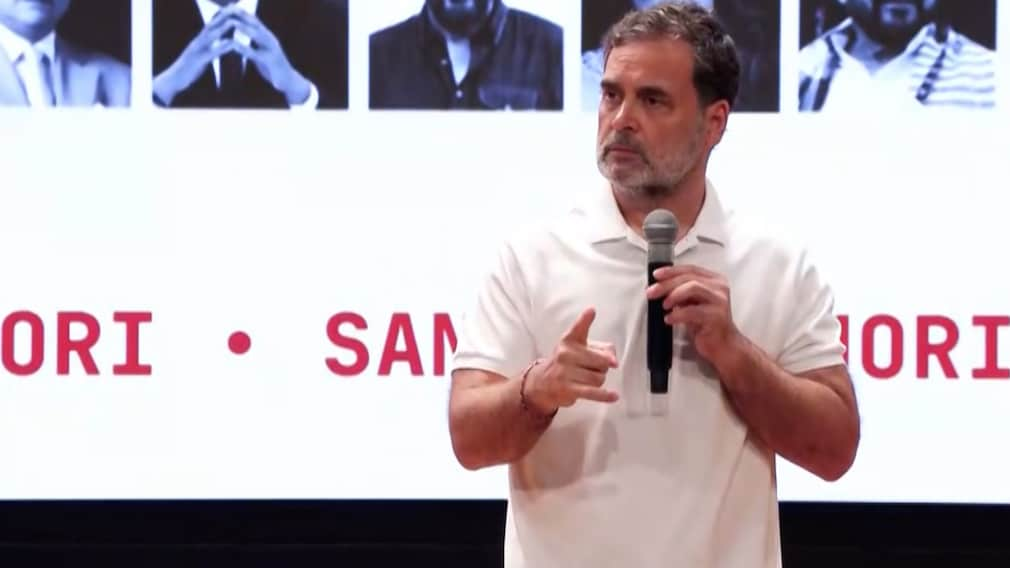
Rahul Gandhi can justifiably claim vindication for his 'vote chori' campaign. It had few takers when he first began, but has gained momentum following recent revelations of differences between the three Election Commissioners on SIR and the manner in which it is being implemented.
Mamata's Surprising Comment
Surprisingly, the certificate for Rahul Gandhi came from none other than Trinamool Congress chief Mamata Banerjee, who once fancied herself as the best candidate to lead the INDIA bloc till her hopes were dashed by a humiliating defeat in the West Bengal polls in April-May this year. At the recent meeting where the INDIA bloc chalked out its plans for its Gyanesh Kumar campaign, she turned to Rahul Gandhi and told him, "I am not egoistic. You can be Prime Minister.''
Even Rahul Gandhi was taken aback by her declaration, and Congress president Mallikarjun Kharge hastily intervened to point out that this was not the time to discuss who would be Prime Minister.
Mamata Banerjee's comment was premature, as Kharge pointed out. However, many INDIA partners seemed to be in agreement with her that the Congress should spearhead the anti-SIR agitation. Rahul Gandhi is riding this consensus to lead from the front, as evident in the manner in which he climbed on top of the police barricades near the EC headquarters.
Loose, But Real Coordination
Another notable change is the quiet role of the Left parties, particularly the CPI(ML), in reaching out to non-INDIA members and movements outside mainstream politics. It is the bridge not only with AAP but, more importantly, with the Cockroach Janta Party and its formidable Gen Z following. Student wings of Left parties are actively in touch with CJP leaders and seem to be working in tandem with them, albeit separately, setting up a pincer-like formation to corner the CEC as well as the Modi government. The SFI all-India joint secretary, Aishe Ghosh, appealed on record to young people of all persuasions to join hands to strengthen the campaign. The response was positive from CJP leader Saurav Dass, who tweeted his party's acceptance on X.
The AISA president, Neha Bora, who has become the face of Gen Z along with Abhijit Dipke of the CJP, is also in touch with CJP leaders. Note the speed with which Dass was dispatched to Delhi to lend CJP's support when Bora and the young journalist who accused a police officer of molestation were whisked away in police cars.
Coordination may be loose, but it's not as haphazard as it appears. These are guerrilla tactics being used to surprise and confuse the other side.
But as we all know, nothing is done till it's done. Gyanesh Kumar is not a cabinet minister like Dharmendra Pradhan. The CEC is a constitutional position and enjoys life-long legal immunity. The Opposition knows it does not have the numbers in Parliament to impeach him, although it plans to file an impeachment motion again when Parliament opens for the winter session, if only as a pressure tactic.
More importantly, for the INDIA bloc to remain relevant, its member parties, particularly the Congress and the Samajwadi Party (SP), have to win elections. The really big test is coming up in March next year, when Uttar Pradesh will vote for its next government. Although the Congress and SP are working in tandem and crafting new strategies to fight the BJP, they know full well that it is going to be a tough battle.
The BJP has a formidable election machinery of its own. It also has RSS cadres on the ground for additional muscle. And neither Chief Minister Yogi Adityanath nor Prime Minister Narendra Modi, who represents the state in the Lok Sabha, can be said to have lost their charisma.
The victor in any democracy is the one who wins elections. The INDIA bloc has a tough battle ahead.
(The author is a senior journalist)
Disclaimer: These are the personal opinions of the author
-
Opinion | US Has No 'Election Commission'. Trump Is Testing What That Can Mean

America does not have a central election authority that centrally undertakes these critical functions. Each of the 50 states sets its own election laws.
-
India's New Real Estate Luxury Isn't A Bigger House. It's More Bathrooms
The growing demand for additional bathrooms creates a new challenge: how do developers accommodate them without making the bedrooms smaller?
-
BJP Leader's Singer Wife, A Kabir Bhajan, And Some 'Jantar Mantar': How 15th Century Saint Entered 2026 Row
A video of Sivasri Skandaprasad's singing performance went viral, interpreted as a dig at protests at Delhi's Jantar Mantar. What she's singing is actually attributed to the saint-poet Kabir, and he did not really mean that particular "jantar mantar". He meant something far more profound.
-
Opinion | Sardar Patel, And The Art Of Holding A Nation Together
A true Gandhian, he reminded his countrymen that gaining freedom from foreign rule was merely the first step; true internal Swaraj required much, much more.
-
Opinion | How India Is Making Its Stock Market An Expensive Place To Invest
FPIs sold Rs 1.66 lakh crore of Indian equities in 2025 and a record Rs 3.08 lakh crore in 2026 through October 12. Foreign ownership of the Indian market is at a 15-year low
-
Jail Is No Bar: How Gangsters Call The Shots From Inside Prisons
Jail can become a safe haven from enemies, a recruitment ground for fresh gang members and, in some cases, a command centre for criminal operations
-
From King Edward III To Neha Bora, A 1361 Law Lives On In 'Peace Bonds': NDTV Explains
CJP leaders Abhijeet Dipke, Saurav Das, and Ashutosh Ranka signed peace bonds; two of them even faced jail over an alleged breach, while AISA's Neha Bora questioned such a bond's very logic. Here's what a peace bond is, and what the questions are.
-
Air Force Golf Course Near PM House Closed. How This Land Has Seen Many Turns Of History
The Air Force Sports Complex, which includes the golf course, is the latest property near the Prime Minister's residence set to be taken back this year, as the land is owned by ministries.