Ringside View | Do Legends Like Messi Get Different Treatment? Football's Uncomfortable Question Refuses To Go Away
History suggests that football's biggest names often find themselves at the centre of decisions that leave rivals wondering whether reputation carries its own invisible advantage.
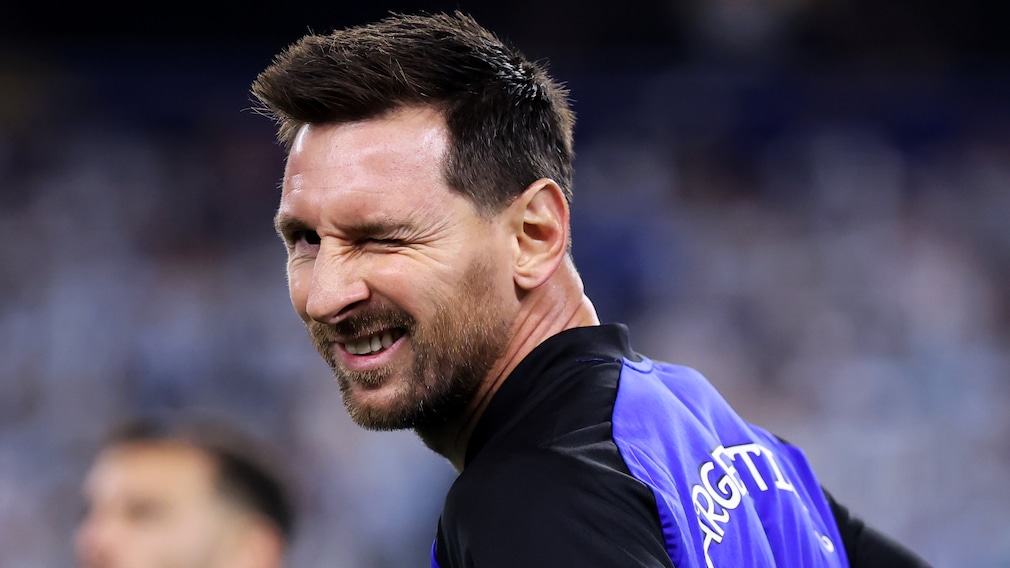
Lionel Messi's Argentina have made their way back in the knockout rounds of the FIFA World Cup. Standing between them and the Round of 16 is Cape Verde, who one of the tournament's biggest surprises. Indian fans will get to witness that contest on Saturday night. But as the football world focuses on the contest itself, around the ring, another debate has once again taken centre stage.Do football's biggest stars play by the same rules as everyone else?
It is an uncomfortable question to ask. This question itself sits somewhere between perception and reality. Referees are expected to be impartial, the Laws of the Game make no distinction between an eight-time Ballon d'Or winner and a first-time international. Yet history suggests that football's biggest names often find themselves at the centre of decisions that leave rivals wondering whether reputation carries its own invisible advantage.
The latest controversy surrounding Argentina happened in their group-stage match against Algeria. Messi escaped without being booked after a studs-up challenge on captain Aissa Mandi. Referee Szymon Marciniak decided to only award a free-kick. The VAR was not called in to decide, no yellow card either.
After scanning through several commentaries of football pundits and referees it seems they are divided on the issue. Some say the moment did not need a yellow/red card because there was no excessive force or intent. Others argue the studs made contact high enough to justify at least a second look. That is a grey area, and debating in the grey often does not have a clear outcome. Those decisions live in football's grey areas. They're neither obvious mistakes nor clear-cut calls. And more often than not, it is the game's biggest names who appear to come away with the benefit of the doubt.
Messi has been here before.
Earlier in this World Cup, Argentina's opener against Austria was clouded by controversy when Alexis Mac Allister seemed to foul Xaver Schlager in the build-up to the opening goal. The referee waved play on, Messi finished the move, and Austria's protests were dismissed. Former Denmark goalkeeper Peter Schmeichel was among those who questioned why the foul had gone unpunished.
As the crescendo to FIFA 2026 builds, thought it was worth doing a quick rewind to Qatar, four years ago.
Messi's deliberate handball against the Netherlands in the quarter-finals somehow escaped a yellow card. Under the laws, it was a cynical act that could easily have been punished. Remember Maradona in 1986 and his infamous hand of God Goal which went past Peter Shilton? Of course there was no VAR back then.
In Qatar Messi, his compatriot, remained free to commit another tactical foul later in the match and receive what became his first caution rather than a second.
And that is not all- Argentina received five penalties during their triumphant 2022 World Cup campaign - the most ever awarded to a team in a single edition of the tournament. Every one of those decisions can be analysed individually, and several were fully justified. Yet collectively they fuelled a narrative that the Universe was working its hand through the referees.
The debate did not begin in this World Cup.
Back in 2007, former Chilean referee Carlos Chandia made a remarkable admission about Messi's Copa América semi-final against Mexico. Messi handled the ball while already on a yellow card, an offence that should have earned him another booking and a suspension for the final. Chandia chose not to show it.
Years later, the referee revealed that he had spared Messi because he wanted to see him in the final-and joked that the Argentine had promised him his shirt after the match.
Whether viewed as an amusing anecdote or a serious lapse in officiating, it remains one of the clearest examples of a referee admitting that the stature of a player influenced a decision on the pitch.
The conversation extends beyond international football.
Chelsea supporters still point to the 2009 Champions League semi-final against Barcelona as one of the competition's most controversial nights. A string of penalty appeals went unanswered as Barcelona survived at Stamford Bridge to reach the final. Years later, the referee acknowledged that he got several key decisions wrong.
The mistakes were never linked to Messi personally. But because he was the face of that Barcelona side, the match has remained part of a broader narrative-that football's biggest stars and biggest clubs often seem to benefit when the game's biggest moments are on the line.
Even in Major League Soccer, controversy has followed Messi. Inter Miami's Leagues Cup run featured a succession of disputed officiating calls. Messi himself has repeatedly escaped serious disciplinary consequences. Make no mistake, some of those confrontations with match officials would almost certainly have drawn harsher punishment for less celebrated players.
None of this proves that there has been a grand conspiracy to favour the top goal scorer at the FIFA World Cup.
There is no evidence that elite referees step onto the pitch intending to favour Argentina or shield Messi. They are among the most experienced officials in football, and every major decision they make is scrutinised from every possible angle.
But referees are human, not machines.
Sending off Lionel Messi in a World Cup knockout match is a very different proposition from dismissing an ordinary defender in a routine league game. The stakes are higher, the pressure is immense, and every call is replayed millions of times around the world.
That does not mean officials consciously protect football's biggest stars. But like anyone making split-second decisions under extraordinary pressure, they are not immune to reputation, occasion or the magnitude of the moment. And when a challenge sits in that grey area between yellow and red, it is fair to ask whether the benefit of the doubt is sometimes given to the player with the biggest name on the pitch.
Imagine an umpire ruling Virat Kohli or Rohit Sharma out, versus a player who has achieved less. We have had much talked-about instances in the world of cricket.
With so much technology available these days, every angle in a football or a cricket match is replayed millions of times. Every decision dominates headlines for days. Every mistake becomes part of history.
Whether it is football or cricket, whether the match officials admit or not, there is immense pressure on them, particularly in matches that involve greats of the game.
The bias is never obvious; it exists in moments, in split seconds. Sometimes they exist in moments where two decisions are both defensible.
A referee, faced with a split-second decision, may instinctively opt for the less severe punishment. Not because of bias or favouritism, but because the cost of getting it wrong when the player is Lionel Messi is enormous.
But that is only one side of the argument.
There is an equally compelling case to be made for Messi.
Few footballers have played under the level of scrutiny he has. Every tackle on him is replayed from half a dozen angles. Every refereeing decision involving him dominates television debates and social media. Incidents that would barely register in an ordinary league match become global talking points simply because Messi is involved.
That level of attention can create its own illusion. Decisions that benefit Messi are magnified, made into reels, circulated on social media, while similar calls involving lesser-known players often go unnoticed. In other words, the perception that he receives special treatment may sometimes be driven as much by the spotlight that follows him as by the decisions themselves.
In the end, perception matters almost as much as reality.
Football runs on trust. Players trust referees. Fans trust that the laws are applied equally, regardless of the name on the back of the shirt. Once that trust begins to erode, every contentious decision becomes another piece of evidence for those who already believe the game isn't being officiated on a level playing field.
That is why the debate refuses to disappear.
As Argentina prepare to face Cape Verde, Messi will once again be at the centre of attention. Every challenge, every whistle and every big refereeing call will be dissected in real time. That is simply the burden of being the biggest name in world football.
The challenge for FIFA isn't to convince everyone that its referees are impartial. No governing body can ever eliminate debate from a sport built on subjective decisions.
Its real task is much simpler. It must ensure that fans never have reason to believe a decision was influenced by the name on a player's shirt rather than by the Laws of the Game.
Because football's greatest players deserve admiration for their talent, not questions about whether they are judged by a different standard.
(Rica Roy is a Sports Editor and Anchor with NDTV)
Disclaimer: These are the personal opinions of the author
-
Opinion | Great 'Exceptions': How The Oil India Was Attacked For Is The Oil Trump Now Seeks

A law written to punish the buyers of Russian oil was suspended by the US to protect a purchase of Russian oil. India spent fourteen months being lectured for less.
-
Opinion | Louis Vuitton Loot, Torched Cars: France Protests Have An Unlikely Beneficiary
It's an unbelievable moment. Crowds looting the most exclusive stores in Paris, including the famed Luis Vuitton. But what's behind this meltdown?
-
Blog: Kolkata Didn't Learn From 2015. Eleven Years Later, It Proved To Be Fatal
The City of Joy isn't a stranger to crowd control. Be it during Pujo or Christmas at Park Street, Eden Gardens cricket matches, or Derbies between Mohun Bagan and East Bengal. But during Pujo, the entire city is on alert.
-
Opinion | Slurs, Threats, Now A Temple Attack Plot: When Did America Become So Hostile To Indians?
The rising tide of anti-India, anti-Hindu, and racist attacks serves as a stark reminder that economic prosperity does not automatically guarantee social immunity from bigotry.
-
A Step Behind Neha Bora: What Rahul Gandhi's Gesture Says About Congress' Gen-Z Pitch
At INDIA bloc's march to Supreme Court, Rahul Gandhi placed himself a step behind two women, hands resting on their shoulders. One was his sister Priyanka. The one on his right was Neha Bora. Here's what the image means for the protest wave now, and for Rahul's politics in general.
-
Opinion | Imran Khan, And The Perils Of Having An 'Opinion' In Bollywood
The reality of the industry is quite grimy. More often than not, its inhabitants have been fairweather friends, happy to sing the praises of whoever is in a position of authority.
-
Exclusive: India's Food Safety Problem Goes Beyond Just Dirty Kitchens - By Tukaram Mundhe
On World Food Day, Maharashtra's Commissioner of Food Safety explains why instead of taking stopgap measures, the entire supply chain in India needs to be held accountable and made transparent.
-
Opinion | India Has Enough Coal. So Why Are Power Plants Running Short? A 76 Million 'Crunch'
As of October 5, as many as 82 of the 191 thermal plants monitored by the Central Electricity Authority were in the 'critical' category
-
Opinion | Starlink, India, And Why Elon Musk Must Know His Billionaire Tantrums Won't Work
India should neither be intimidated by Musk's global influence nor distracted by his theatrics.
-
Blog | 'Baap Da Brat': Kerala Mini Cooper Crash, And Why 'Daddy' Can't Keep Saving You
There are three things you should never underestimate in India: the power of 'jugaad', the elasticity of the law, and the confidence of a 'Baap da Brat' who believes his Papa Posh can fix absolutely anything.