Opinion | Dharmendra: The 'Pehelwan' Who Was A Poet
Dharmendra described himself as a 'mitti ka beta' (son of the soil). But some of his most memorable roles were those of a man of words, a teacher or a poet.
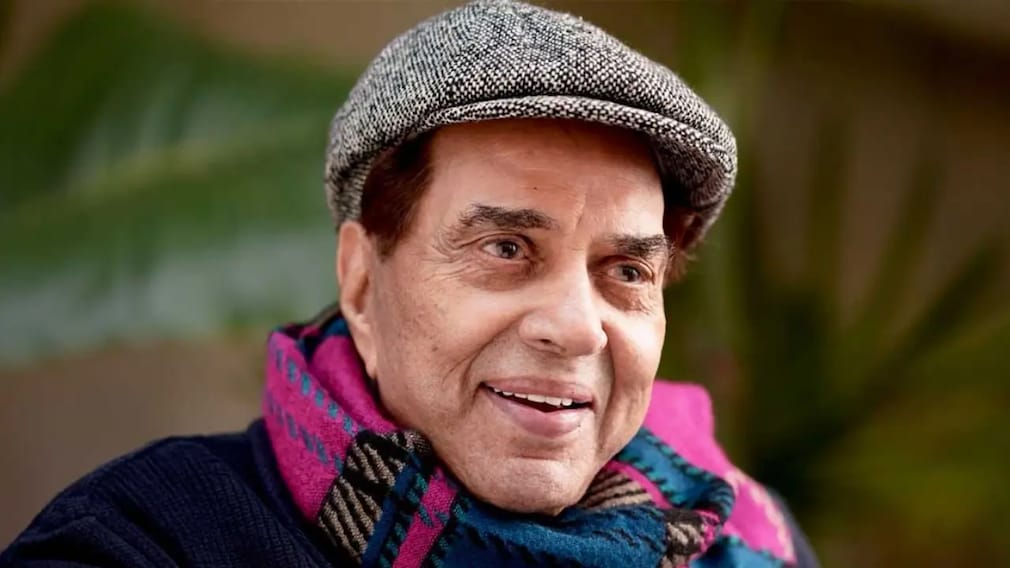
"Rupiya phenk ne se bekaar milte hai, sahityakar nahin (If you throw money, you will get an unemployed person, not a writer)", says Dharmendra to Pran in Pramod Chakravarty's Naya Zamana (1971). Pran plays a wealthy businessman who is woefully short of time and intellect and uses Dharmendra's services to make smart speeches - even going to the extent of stealing his novel to publish it as his own. It was one of several movies in which he, once described by actor Randhir Kapoor as an "uneducated peasant", played a man of learning.
Dharmendra described himself as a 'mitti ka beta' (son of the soil). But some of his most memorable roles were those of a man of words, a teacher or a poet. In Anupama (1966), he played Ashok, a poet, who persuades a shy and lonely Sharmila Tagore to leave her father's cruel home. When he is introduced as a writer of repute on the dining table, someone asks: "Par aap kaam kya karte hain (Yes, but what do you do?)'' Well said, responds Dharmendra with his trademark shy smile, no one can survive by writing alone in our country. It is his words, dedicated to Uma (Tagore) that begin the transformation in her, to the point where she feels emboldened enough to leave her father's home for good.
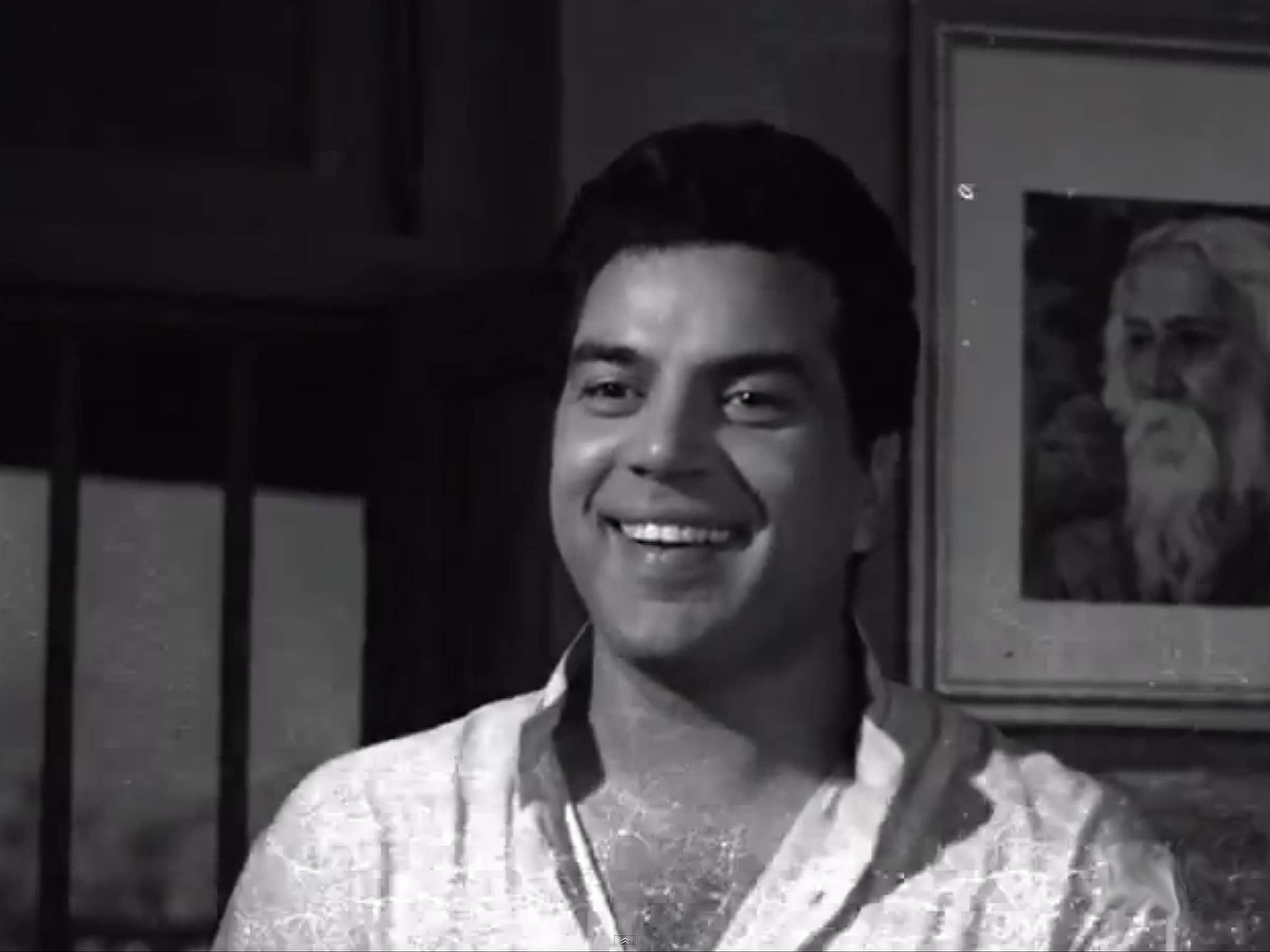
Dharmendra in Anupama (1966)
The truth was that Dharmendra was a closet poet, who, of late, had started declaiming in public. Most recently, a clip from Sriram Raghavan's Ikkis, his forthcoming film, underlines this hidden side to the actor, with a poem on his homecoming featured on him: 'Ajj bhi ji karda hai, pind apne nu jaanwa' (Even now I dream of going home, where the heart belongs). It is one of the urban legends in the Hindi film industry that Dharmendra picked up a lifelong love of poetry from Meena Kumari, with whom he first starred in the iconic Phool Aur Pathhar (1966). He played a criminal, 'Shaka', in it, but off-screen, his gleaming shirtless physicality was acquiring an Urdu polish that would remain a lifelong companion. It is the same vein that Karan Johar touched in Rocky Aur Rani ki Prem Kahanii (2023), where Dharmendra plays a man trapped in a loveless marriage who had a brief dalliance with a poetess, naturally a Bengali named Jamini (when Hindi movies want to portray intellectuals, they turn to Bengal), played by Shabana Azmi.
Man Of Words
The '60s and early '70s were great for Dharmendra's intellectual image. It was often played for laughs as well. Take the charming Dillagi (1978), where he is Professor Swarna Kamal, who teaches an all-girls classroom the poetry of Kalidas. Or Chupke Chupke (1975), where he is Parimal Tripathi, a botany professor pretending to be a Hindi professor, speaking in the kind of Hindi that would embarrass even an old Doordarshan newsreader. His tongue-twisting transalations of everyday English words into Hindi remain a personal favourite, from 'lohpatgamini' for train to 'doorbhash' for the telephone.
Dharmendra was largely seen as the romantic, idealistic hero who supported strong women characters, till Raj Khosla's Mera Gaon Mera Desh (1971) changed the direction of his career, casting him as the angry action hero. As his daughters recount in Khosla's biography, he wanted his hero in peak physical form, and every morning, the villagers of Cheerwa, four kilometres from Udaipur, woke up to "scenes of a strapping Dharmendra riding a horse, playing badminton, or cycling through the dirt roads".
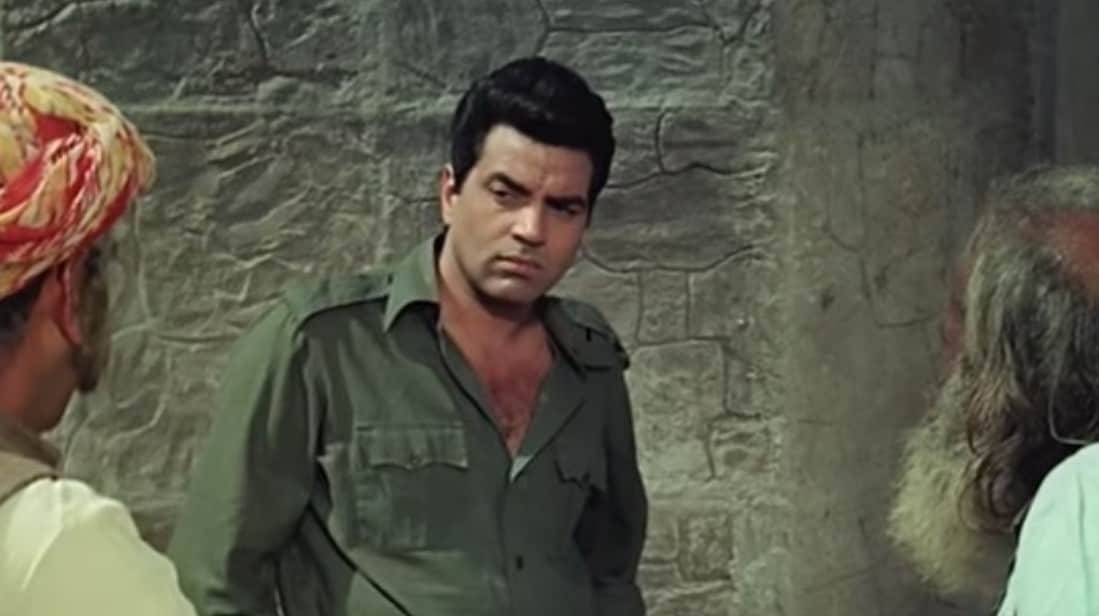
Dharmendra in Mera Gaon Mera Desh (1971)
That visual dominated his career, eclipsing the gentle wordsmith of earlier films, where he was almost the alter ego of his writer-directors. In Gulzar's Kinara (1977), Dharmendra has a cameo as Chandan Arya, a writer who dies in an accident, leaving behind a distraught Arti (Hema Malini). What is the difference between a letter and a poem, he asks Arti playfully, who says that one can be sung, and the other cannot. To this, Dharmendra replies by singing a love letter. In Ek Mahal Ho Sapno Ka (1975), he is a poet who takes to the bottle and worse when the love of his life leaves him, because although his words can give her wings, they cannot actually buy her a plane ticket.
A Romantic, Always
In one of his last impactful roles, Life in a...Metro (2007), Dharmendra plays a man who returns to India to look for the love of his life, carrying with him a diary written in Urdu (the script he was most comfortable in). "Talaash kabhi khatam nahin hoti, waqt khatam ho jata hai (The search never ends, time does)", he says, giving a life lesson to his late love's nieces. When it comes to the heart, one should never listen to the mind.
As did Dharmendra. He was a man of, by and from the heart, a lover refashioned as a fighter, a deeply romantic poet in the body of a pehelwan, a genteel house cat persuaded to be a tiger.
(The author is a journalist)
Disclaimer: These are the personal opinions of the author
-
Blog: Kolkata Didn't Learn From 2015. Eleven Years Later, It Proved To Be Fatal

The City of Joy isn't a stranger to crowd control. Be it during Pujo or Christmas at Park Street, Eden Gardens cricket matches, or Derbies between Mohun Bagan and East Bengal. But during Pujo, the entire city is on alert.
-
Opinion | Slurs, Threats, Now A Temple Attack Plot: When Did America Become So Hostile To Indians?
The rising tide of anti-India, anti-Hindu, and racist attacks serves as a stark reminder that economic prosperity does not automatically guarantee social immunity from bigotry.
-
A Step Behind Neha Bora: What Rahul Gandhi's Gesture Says About Congress' Gen-Z Pitch
At INDIA bloc's march to Supreme Court, Rahul Gandhi placed himself a step behind two women, hands resting on their shoulders. One was his sister Priyanka. The one on his right was Neha Bora. Here's what the image means for the protest wave now, and for Rahul's politics in general.
-
Opinion | Imran Khan, And The Perils Of Having An 'Opinion' In Bollywood
The reality of the industry is quite grimy. More often than not, its inhabitants have been fairweather friends, happy to sing the praises of whoever is in a position of authority.
-
Exclusive: India's Food Safety Problem Goes Beyond Just Dirty Kitchens - By Tukaram Mundhe
On World Food Day, Maharashtra's Commissioner of Food Safety explains why instead of taking stopgap measures, the entire supply chain in India needs to be held accountable and made transparent.
-
Opinion | India Has Enough Coal. So Why Are Power Plants Running Short? A 76 Million 'Crunch'
As of October 5, as many as 82 of the 191 thermal plants monitored by the Central Electricity Authority were in the 'critical' category
-
Opinion | Starlink, India, And Why Elon Musk Must Know His Billionaire Tantrums Won't Work
India should neither be intimidated by Musk's global influence nor distracted by his theatrics.
-
Blog | 'Baap Da Brat': Kerala Mini Cooper Crash, And Why 'Daddy' Can't Keep Saving You
There are three things you should never underestimate in India: the power of 'jugaad', the elasticity of the law, and the confidence of a 'Baap da Brat' who believes his Papa Posh can fix absolutely anything.
-
Opinion | 'Say Our Name': Why A Tiny Island Nation Wants The World To Get Its Name Right
Standing before the UN hall of nations, Naoero President David Adeang asked the world to unlearn its comfortable habits and speak a restored truth.
-
TVS Succession Row Explained: Why Venu Srinivasan's Family Is Divided Over Wealth
TVS Family Dispute: TVS Holdings is a key entity because it owns a controlling stake in TVS Motor Company. It owns 50.26% of TVS Motor.