Opinion | The 'AIPC' Was Once Congress' Boldest Idea. What Happened To It?
Tharoor, to Chakravarti, to Yaskhi now, the fate of a Congress 'experiment' that started in 2017 will tell you a lot
In the Congress, creating an organisation has rarely been the difficult part. What has been challenging has been sustaining its relevance.
The All India Professionals' Congress (AIPC) was one of those rare experiments that, when launched in 2017, appeared to answer a genuine political problem rather than merely accommodate another leader. Rahul Gandhi had correctly identified a constituency that had drifted almost completely outside the Congress ecosystem: doctors, lawyers, entrepreneurs, bankers, academics, technologists, management professionals, and an expanding urban middle class that followed politics intensely but wanted little to do with conventional party structures.
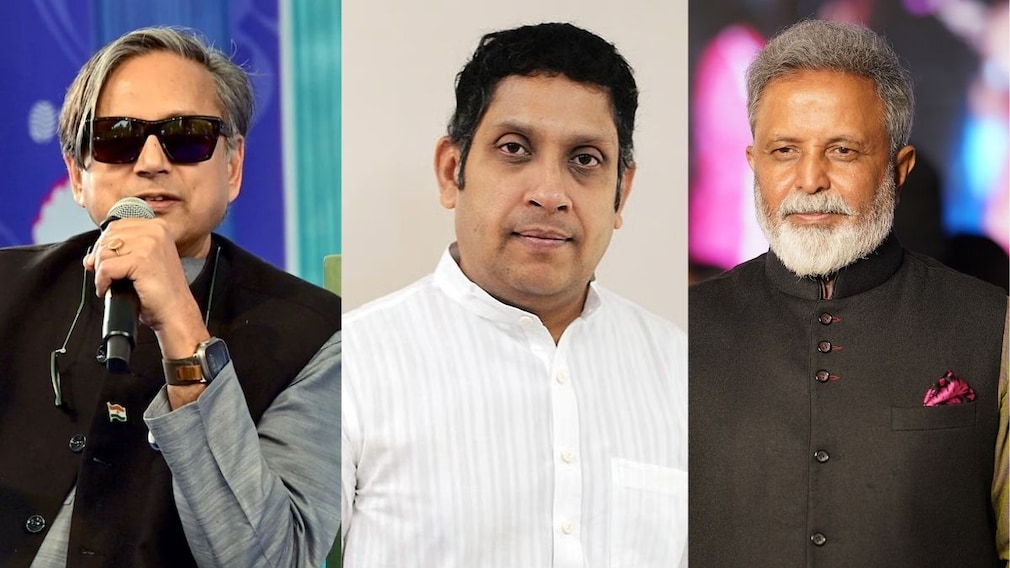
Shashi Tharoor, as the AIPC's founding chairperson, was an obvious choice to lead it. He had the intellectual profile, an independent public following, and, crucially, the ability to make political participation respectable to people who were more comfortable in a boardroom or university seminar than inside a district Congress office.
Nine years later, the wheel has turned again. On September 9, Congress president Mallikarjun Kharge appointed former Nizamabad MP Madhu Goud Yaskhi as the AIPC chairperson, succeeding Praveen Chakravarty, who has moved to the Rajya Sabha. Yaskhi inherits an organisation whose original argument has actually become more compelling with time.
A Bridge Congress Briefly Built
Tharoor understood something about professionals that conventional politicians often do not: most of them were not looking for political careers. They wanted political access without having to become full-time political workers.
The early AIPC, therefore, deliberately behaved differently. Chapters met on weekends, sometimes in hotels and clubs rather than party offices. Professionals could contribute knowledge, policy suggestions, research, or campaign expertise without first mastering the Congress hierarchy. By April 2018, it had established 45 chapters across 20 states. A year later, membership was approaching 8,000. Professionals associated with it were helping the Congress with research, communication, and manifesto-making. In Chhattisgarh, the AIPC teams accompanied the manifesto committee through extensive stakeholder consultations ahead of the 2018 election.There was also an interesting contradiction. The more successful the experiment became, the more Tharoor himself became politically consequential. What began as Rahul's experiment in opening Congress politics to outsiders increasingly carried the imprint of a leader with an independent political constituency.
Tharoor remained the AIPC chairman until November 2023, when Praveen Chakravarty replaced him.
Years Of Invisibility
Chakravarty was hardly an illogical appointment. An investment banker and political economist before entering Congress politics, he had headed the party's data analytics operation and had been closely associated with important policy exercises. On paper, he was precisely the sort of professional the AIPC was intended to attract.
Nor is it accurate to say that absolutely nothing happened during his tenure. The AIPC reorganised its professional domains, ran membership initiatives, sought inputs for party programmes, and took up issues affecting salaried professionals. Its campaign against the withdrawal of indexation benefits after the 2024 Budget was one example. Chakravarty also repeatedly made an argument the Congress badly needed to hear: that social justice alone could not substitute for an appeal to urban aspiration.
After the Haryana defeat in 2024, he argued publicly that the Congress had failed to speak sufficiently to urban voters and should tell young Indians that there was nothing wrong with wanting to become prosperous - that the politics of aspiration and the politics of justice were complementary, not contradictory.
It was an important argument. Yet the AIPC itself never acquired under Chakravarty the political personality it had possessed during its early years. The difference was less between activity and inactivity than between presence and consequence.
Why Madhu Yaskhi Is an Intriguing Choice
This is what makes Madhu Goud Yaskhi's appointment interesting.
Telangana Chief Minister Revanth Reddy described Yaskhi's appointment as "a well-deserved recognition of his long years of service and his ability to connect with people across walks of life". He said, "His experience will help the party deepen its engagement with India's professional community and bring their expertise into nation-building."
Yaskhi is not a political novice dressed up as a professional. Nor is he merely a technocrat parachuted into the Congress system. He has inhabited both worlds.
A lawyer by training, he built a professional career in the United States before returning to India and entering electoral politics. He won Nizamabad for the Congress in 2004 and again in 2009, served two terms in the Lok Sabha, and became a prominent advocate of Telangana statehood. He has held organisational responsibilities within the Congress and understands its internal grammar in a manner many outsiders never do.
That combination may prove useful. The AIPC's problem has always been structural. If it remains too insulated from the Congress, it becomes an agreeable debating society. If it is swallowed entirely by the regular organisation, the very professionals it hopes to attract begin staying away. Yaskhi's task, therefore, is integration without suffocation.
A successful AIPC cannot function in parallel to PCCs, DCCs, and the AICC. Its people must enter manifesto committees, research teams, spokesperson panels, election management structures, and eventually candidate lists. A doctor who spends five years discussing public health inside the AIPC must see some route to influencing the party's health policy. An entrepreneur must be able to alter the Congress' thinking on regulation, taxation, or job creation. A female professional should not merely be invited to a panel on women's empowerment; she should have a credible route into decision-making. Otherwise, membership becomes ornamental.
A Two-Way Street
The larger opportunity is political.
For much of the Narendra Modi era, the BJP has enjoyed a formidable advantage among India's aspirational classes. Entrepreneurship, upward mobility, technology, nationalism, and personal advancement could all be fitted relatively easily into the Modi proposition. The Congress, by contrast, increasingly spoke the language of protection, redistribution, inequality, and grievance.
Those concerns are legitimate. But a party seeking power cannot speak only to what Indians fear losing; it must also speak to what they hope to become.
Professionals today worry about jobs, taxation, arbitrary regulation, the quality of cities, education, healthcare, institutional independence, and opportunities for their children. Many also worry about social polarisation and crony capitalism. But their politics cannot be reduced to victimhood. They want opportunity, mobility, wealth creation, and functioning institutions.
This is where the AIPC can become important - not merely by communicating the Congress's thinking to professionals, but by forcing professional thinking into the Congress.
The test before Yaskhi is consequently larger than restoring Tharoor-era membership figures or organising impressive conclaves. Can the AIPC tell the Congress leadership uncomfortable things? Can it challenge economic formulations that frighten the middle class? Can it reconcile Rahul Gandhi's emphasis on social justice with the ambitions of a young Indian who wants to create a company, buy a home, invest in equities, and become wealthy? Can it persuade the Congress that equality of opportunity need not require an apology for aspiration?
Rahul Gandhi created the AIPC because professionals had become disconnected from politics. The more consequential question in 2026 is whether the Congress itself can stay connected with professionals.
(Rasheed Kidwai is an author, columnist, and conversation curator)
Disclaimer: These are the personal opinions of the author
-
Woman Biker Hit, Air Force Veteran Attacked: The Lawlessness In Gurugram

What gives confidence to some elements in Gurugram to break the law again and again in full public view and on camera?
-
Opinion | When The Feed Braves The Flood
NDTV drops the 24x7 and stakes its next chapter on presence as it inaugurates a new identity
-
The Politics Of Blue: Why Akhilesh Yadav-vs-Mayawati Over A Colour Is Just One Shade Of History
A movie starring Rajinikanth tells us how colours can carry meaning beyond what meets the eye. The latest row over Akhilesh Yadav's party adopting blue, and Mayawati objecting, can be a starting point for understanding the many shades of history.
-
2 Indians Survived 9/11, Then American Justice System Became Their Nightmare
Pulled off a Texas train hours after 9/11, two Indian men were plunged into America's largest terror manhunt.
-
Opinion | Building BRICS In New Delhi
For India as the host nation, chairing the summit tests the core tenet of its modern foreign policy: strategic autonomy.
-
Can India 'Mediate' Between Iran And UAE At BRICS? Gulf Envoy Suggested It Once
At the very start of the Israel-US war on Iran, it was a UAE diplomat who had suggested as much.
-
I Went Looking For A PG In Delhi's Kamla Nagar. Here's What I Found
In every PG visited by NDTV in Delhi's Kamla Nagar, the conversation began with amenities. Nothing in the sales pitch was about how secure the building was.
-
Opinion | How Trump Is Doing More For BRICS Than Its Critics Ever Could
By trying to bully BRICS countries into submission, Trump may be giving the grouping the very relevance he is trying to deny