Analysis | Can Donald Trump Face An 'Arrest Warrant' - Like Netanyahu And Putin?
No one in living memory imagined a moment when the world would seriously debate the possibility of an American president being dragged before a court. Has it come now?
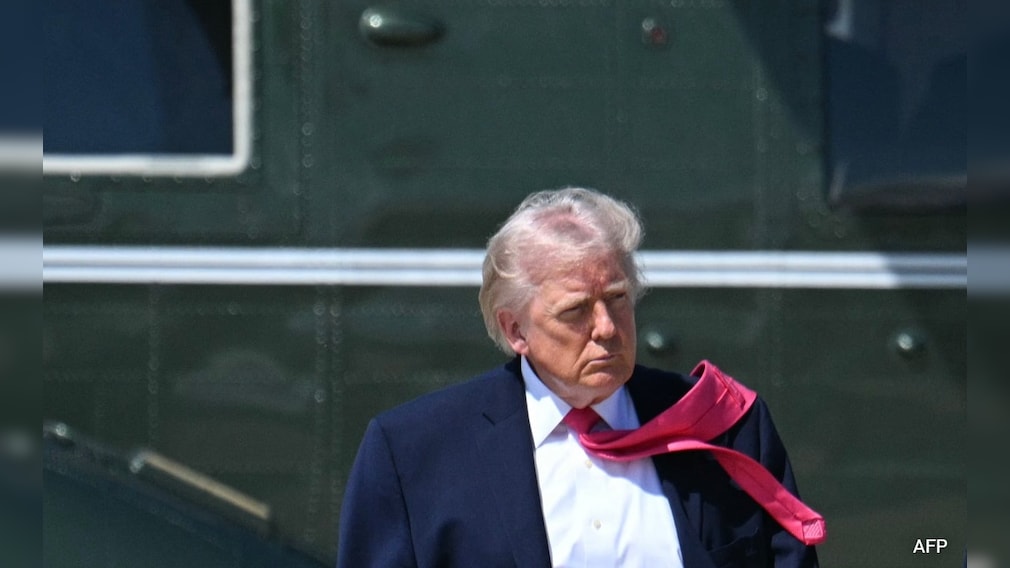
Many in America and across the world are still trying to shake off the shock of President Donald Trump's warning to Iran last week that "a whole civilisation will die" unless Tehran agreed to a deal to end the war and reopen the Strait of Hormuz. Some called him "unhinged", others said he was "unfit for office", and a few even argued that such a statement bordered on the language of a war crime.
No one in living memory imagined a moment when the world would seriously debate the possibility of an American president being dragged before the International Criminal Court. George W. Bush came close to such scrutiny, but the conversation never quite crossed into the mainstream the way it has now.
'Unfit For Office'
Can ICC laws, created to hold leaders accountable for war crimes, ever be applied to a sitting American president? Trump's remarks, which critics say appear to threaten large-scale destruction of infrastructure and the killing of millions of civilians, drew concern from global figures, including UN chief António Guterres and Pope Leo. Some in the US went even further. Former CIA Director John Brennan warned that Trump's rhetoric made him "unfit for office" and argued that the "25th Amendment was written with Donald Trump in mind".
Many are comparing the situation with arrest warrants issued by the ICC against Vladimir Putin and Benjamin Netanyahu. Both leaders come from countries that are not members of the ICC. Yet the court still asserted jurisdiction, arguing that the alleged crimes were linked to territories that fall under its authority. The comparison does not suggest Trump faces an imminent warrant. Rather, it raises a pertinent question: if the legal logic applies to other powerful leaders, could it apply to a US president?
What ICC Really Is
To understand that question, it helps to step back and look at what the ICC actually is. The court was created by the Rome Statute in 2001 to prosecute individuals accused of genocide, war crimes and crimes against humanity. It does not try countries, it tries people. Presidents, Prime Ministers, generals and militia leaders can fall within its scope. The idea behind the court is that for the most serious crimes, no one should be above the law. But we all know that the reality is more complicated. The ICC depends on political cooperation. It has no police force. It relies on countries to arrest suspects.
Trump's rhetoric towards Iran is being examined through this lens. He has spoken about bombing Iran "back into the stone ages" and warned that a "civilisation will die". Critics say such language suggests the intent to destroy an entire civilisation and that in itself amounts to a war crime. Some Democratic lawmakers have described such rhetoric as crossing a dangerous legal threshold.
The 1991 Experience
The ICC has previously charged Russian commanders for attacks on Ukraine's electrical infrastructure. These cases argue that targeting energy systems that sustain civilian life can constitute war crimes when the humanitarian impact is disproportionate. The US itself has wrestled with this issue. During the 1991 Gulf War, the US military struck Iraq's power grid. Subsequent studies documented severe civilian consequences. After that, US military doctrine evolved. In later conflicts, including Kosovo in 1999 and Iraq in 2003, efforts were made to disable rather than permanently destroy infrastructure. Trump's rhetoric, critics argue, suggests a departure from that cautious approach.
The 'Immunity'
The legal debate also intersects with domestic developments in America. In 2024, the US Supreme Court ruled in Trump v. United States that Presidents enjoy broad immunity from criminal prosecution for official acts. This ruling strengthened protections for presidential decisions, including those involving foreign policy and the use of force. Critics say this creates a situation where a president may face little domestic legal risk for actions taken in office. That has shifted attention outward, towards international accountability mechanisms.
Yet the US is not a member of the ICC. It signed the Rome Statute but never ratified it and later withdrew support. The US position is that the court could be used politically against American officials. As a result, the US does not recognise ICC jurisdiction over its citizens. This is the first major obstacle to any case involving a US president. But it is not an absolute barrier. The ICC has two main ways to claim jurisdiction: crimes committed on the territory of a member state and referral by the UN Security Council.
The Security Council route is blocked, as the US holds veto power and could block any referral. The territorial route is more complex. If alleged crimes occur on the territory of a state that is party to the Rome Statute, the ICC may claim jurisdiction even if the accused leader comes from a non-member country. This is the logic used in previous cases. In theory, it could apply to any leader, including a US president, if jurisdictional conditions are met.
Yet, An Arrest Is Unlikely
In practice, however, enforcement would be extremely difficult. The ICC cannot arrest anyone on its own. It depends on member states to detain suspects who enter their territory. A sitting US president would almost certainly be shielded by diplomatic protections, security arrangements and political leverage. So, arrest during office is highly improbable. And what after he leaves office? Even then, it would depend on the member countries where the US president is visiting, and the country is willing to enforce a warrant. Putin's foreign trips are extremely rare, the reason being that he might be arrested if he visited an ICC member country.
There are other potential legal pathways. One is universal jurisdiction, under which national courts can prosecute certain crimes regardless of where they were committed. This concept began with piracy, treating pirates as enemies of all humanity. Today, it can apply to genocide, war crimes and crimes against humanity. But there is a limitation. In a 2002 ruling, the International Court of Justice (ICJ) held that sitting heads of state generally enjoy immunity from prosecution in foreign national courts. That immunity ends once they leave office. The ICJ also noted that international tribunals such as the ICC could still prosecute sitting officials.
Another possibility is that Iran itself could join the ICC and grant retroactive jurisdiction. Ukraine used a similar approach to enable investigations into alleged Russian war crimes. Such a move would be politically sensitive. It could expose Iranian officials to scrutiny as well.
'Self-Protection' Measures
The US has also taken steps to shield its officials. In 2002, Congress passed the American Service-Members' Protection Act, sometimes called the "Hague Invasion Act". The law authorises the US government to use "all means necessary" to free American or allied personnel detained by the ICC. It also allows economic and diplomatic pressure on countries cooperating with the court. More recently, Trump issued an executive order criticising ICC actions against US and Israeli officials and authorising sanctions against court personnel involved in such investigations. These measures reinforce the political obstacles to any case.
In a nutshell, this combination - legal theory on one side, political resistance on the other - defines the debate. On paper, the Rome Statute rejects immunity based on official position. Heads of state are not exempt. In practice, enforcement depends on cooperation. For powerful countries, that cooperation is harder to secure. The law is universal, but its reach is uneven.
Interestingly, as mentioned above, the debate has also spilt into domestic US politics. Some Congress members and former officials have invoked the 25th Amendment, which allows a president to be temporarily removed if deemed unable to discharge duties. Representative Alexandria Ocasio-Cortez described Trump's rhetoric as "clearly grounds for impeachment", reflecting the intensity of criticism among some Democrats. The process would require the Vice-President and a majority of the Cabinet to act, followed by Congressional votes if contested. The amendment has never been used to remove a president permanently.
Trump's Iran rhetoric becomes an interesting case study, as it sits at the intersection of law, power, diplomacy and politics. In theory, international criminal law applies to all individuals, regardless of rank. In practice, enforcement depends heavily on geopolitics. The gap between those two realities is where this debate is now stuck.
(Syed Zubair Ahmed is a London-based senior Indian journalist with three decades of experience with the Western media)
Disclaimer: These are the personal opinions of the author
-
Blog: Kolkata Didn't Learn From 2015. Eleven Years Later, It Proved To Be Fatal

The City of Joy isn't a stranger to crowd control. Be it during Pujo or Christmas at Park Street, Eden Gardens cricket matches, or Derbies between Mohun Bagan and East Bengal. But during Pujo, the entire city is on alert.
-
Opinion | Slurs, Threats, Now A Temple Attack Plot: When Did America Become So Hostile To Indians?
The rising tide of anti-India, anti-Hindu, and racist attacks serves as a stark reminder that economic prosperity does not automatically guarantee social immunity from bigotry.
-
A Step Behind Neha Bora: What Rahul Gandhi's Gesture Says About Congress' Gen-Z Pitch
At INDIA bloc's march to Supreme Court, Rahul Gandhi placed himself a step behind two women, hands resting on their shoulders. One was his sister Priyanka. The one on his right was Neha Bora. Here's what the image means for the protest wave now, and for Rahul's politics in general.
-
Opinion | Imran Khan, And The Perils Of Having An 'Opinion' In Bollywood
The reality of the industry is quite grimy. More often than not, its inhabitants have been fairweather friends, happy to sing the praises of whoever is in a position of authority.
-
Exclusive: India's Food Safety Problem Goes Beyond Just Dirty Kitchens - By Tukaram Mundhe
On World Food Day, Maharashtra's Commissioner of Food Safety explains why instead of taking stopgap measures, the entire supply chain in India needs to be held accountable and made transparent.
-
Opinion | India Has Enough Coal. So Why Are Power Plants Running Short? A 76 Million 'Crunch'
As of October 5, as many as 82 of the 191 thermal plants monitored by the Central Electricity Authority were in the 'critical' category
-
Opinion | Starlink, India, And Why Elon Musk Must Know His Billionaire Tantrums Won't Work
India should neither be intimidated by Musk's global influence nor distracted by his theatrics.
-
Blog | 'Baap Da Brat': Kerala Mini Cooper Crash, And Why 'Daddy' Can't Keep Saving You
There are three things you should never underestimate in India: the power of 'jugaad', the elasticity of the law, and the confidence of a 'Baap da Brat' who believes his Papa Posh can fix absolutely anything.
-
Opinion | 'Say Our Name': Why A Tiny Island Nation Wants The World To Get Its Name Right
Standing before the UN hall of nations, Naoero President David Adeang asked the world to unlearn its comfortable habits and speak a restored truth.
-
TVS Succession Row Explained: Why Venu Srinivasan's Family Is Divided Over Wealth
TVS Family Dispute: TVS Holdings is a key entity because it owns a controlling stake in TVS Motor Company. It owns 50.26% of TVS Motor.