Opinion | Are Saudi Arabia And UAE Reuniting Again After 10 Years?
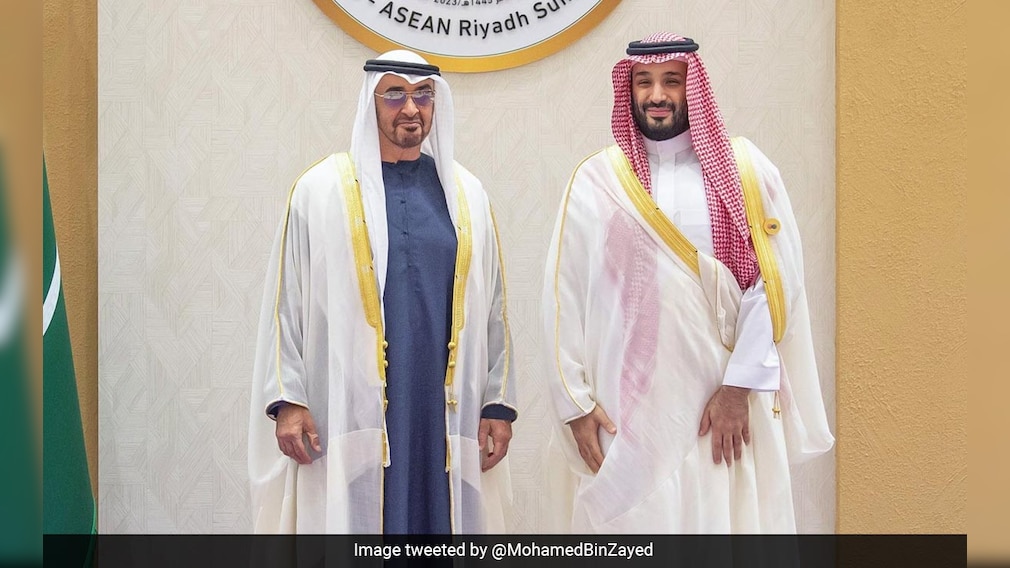
On Tuesday, the UAE's Vice President, Deputy Prime Minister and Chairman of the Presidential Court, Mansour bin Zayed, met Saudi Crown Prince Mohammed bin Salman.
Are we witnessing a rapprochement between the Kingdom of Saudi Arabia (KSA) and the United Arab Emirates (UAE)?
It certainly seems so. On Tuesday, the UAE's Vice President, Deputy Prime Minister and Chairman of the Presidential Court, Mansour bin Zayed, met Saudi Crown Prince Mohammed bin Salman. He was accompanied by a high-level delegation, which included Prince Khalid bin Salman, the Saudi Minister of Defence, Ali Al Shamsi, Secretary General of the Supreme Council for National Security; Ali Al Neyadi, Chairman of the National Emergency, Crisis and Disaster Management Authority and others.
The UAE's main national daily, The National, described the meeting thus: "The visit reflects the deep and enduring partnership between Riyadh and Abu Dhabi, which have maintained close political, economic and security co-operation. High-level exchanges between the two countries are a regular feature of Gulf diplomacy, with senior officials frequently travelling between the two capitals to co-ordinate positions on matters of shared concern."
It would seem as if the two have been best-friends-forever; there was no allusion to the strain that the bilateral relationship had come under due to divergent views on a range of issues, including the one plaguing the Saudis currently the most: Yemen.
Both Saudi Arabia and the UAE had once been partners in Yemen as they intervened to prop up the government of President Abdur Hadi Mansour against the Iran-backed Houthis. Over the years, however, both Gulf powers came to back different factions in Yemen, with the Saudis backing the Yemen government, and the UAE supporting the Southern Transitional Council (STC). Once the UAE felt that the southern regions, including the port of Hodeidah, were secure, it signalled its withdrawal from the war, while the Saudis wanted to secure all of Yemen from the Houthis.
Differences had piled up on other subjects too - on Sudan, on Iran, and even on the economic front, with their competing visions for future prosperity, with the UAE taking the big bold step of exiting from the Saudi-led Organisation of Petroleum Exporting Countries. Another factor has been regarding the normalisation of ties with Israel. While the UAE became the first Israeli partner under the Abraham Accords, the Saudis held back. Now, under the same Houthi threat, Saudi Arabia preferred to turn to Pakistan and not long ago rival Turkey, but not to Israel.
Is that about to change now?
Interestingly, bin Zayed's Saudi visit came almost on the heels of Israeli Prime Minister Benjamin Netanyahu 's visit to Abu Dhabi on Sunday, September 27. While officially it was to discuss bilateral ties, Israeli media announced that officials from other Arab states, including Saudi Arabia were also present at the meeting, which had reportedly also discussed regional escalation and creating a regional defence architecture against "shared threats", with a specific focus on Iran and the Houthis.
Indeed, the Kingdom has seen unprecedented attacks earlier by Iran, which targeted American bases on its territory, and then by Iran-backed Iraqi militias, and now the Yemeni Ansarallah, also majorly backed by Iran. While Iran has inflicted major economic costs on Gulf countries, including on Saudi Arabia, not only through military action but also by closing the Strait of Hormuz, the Houthis have been targeting both Saudi shipping as well as sensitive and strategic infrastructure such as the Petroline oil pipeline. The Saudis are back to facing the same nightmare they had suffered just a decade ago in Yemen, from which they had extricated themselves in 2022 with great difficulty. Now they are back, threatening not just the Kingdom but others, too.
Earlier this year, the Saudis established a multinational maritime defence alliance to "enhance maritime security, protect shared interests in international sea lanes, and prevent their exploitation as a tool of political or economic pressure”, according to Crown Prince Mohammed bin Salman. That did not deter the Houthis. Riyadh then went on to sign the Mecca Pact with Pakistan and Turkey, which was slated to be a major deterrent and was meant to promote regional security and stability. The Houthis soon laid bare the reality of that deterrence. The Saudis next turned to the US, which, while agreeing to intelligence-sharing and coordination, has ruled out any military intervention against the Houthis. The Saudis have also asked China to help rein in the militia group by leveraging their relationship with Iran.
Perhaps it now wants to invoke Gulf solidarity and cooperation. Yesterday, addressing the Kingdom's Shura Council, the Crown Prince said, “The attacks targeting the Gulf Co-operation Council states underscore that Gulf security and stability are indivisible … We are working with our brothers to safeguard Gulf security, pursue strategic co-operation and economic integration, and continue … strengthening joint Gulf action, in order to achieve the GCC's goals and meet the aspirations of its citizens."
Here, the UAE would be an anchor, as the policies of both had earlier converged on a wide range of issues, from reining in the Muslim Brotherhood to modernisation, from Syria to Qatar (remember the blockade?), to Turkey. While the UAE remains deeply sceptical of President Erdogan 's Islamist orientation, the Saudis tried to co-opt it through the Mecca Pact. In fact, President Mohammed bin Zayed was considered to have been a mentor of sorts to Mohammed bin Salman, and there was a time when they had also been mulling joining the Abraham Accords.
Steps have been taken earlier to reach out to each other. For instance, in July, Saudi Arabia's Sheikh Abdulla Al Hamed, chairman of the National Media Authority, wrote on X, "Emirati-Saudi relations are an extension of a shared history and deep-rooted fraternal ties between two brotherly peoples united by a single destiny." Then in August, President Sheikh Mohamed sent a letter to Saudi Arabia's King Salman, inviting him to attend the UN Water Conference in Abu Dhabi in December.
Meanwhile, Saudi Arabia 's Foreign Minister, Prince Faisal bin Farhan, was in the US for talks on regional security and the Iran war. By all accounts, the Saudis are averse to intervening once again in Yemen, or for military action again in the region; what they are seeking, however, is to keep up the economic pressure on Iran, which would, in turn,m weaken its support for its proxies.
While the Gulf Cooperation Council (GCC) was formed as an attempt to forge a unified response to Iran's Islamic revolution of 1979, and frame future policy, it has not been able to forge an adequate unified response to the US-Israel war on Iran, to which they have become collateral damage. Iran has revealed the limitations of a US security architecture for the Gulf countries, and the Houthis have revealed the limitations of Saudi-led security initiatives.
In this context, it is quite logical for the Saudis and the UAE - the two most active GCC members who have tried to proactively shape regional policies - to once again join forces and align themselves towards a common goal. Joint GCC pressure on the US to keep up the economic pressure may work better than individual Saudi or UAE demands. At the same time, if the Saudis do truly feel the need to seek Israeli cooperation in intelligence-sharing or surveillance without joining the Abraham Accords, then the UAE can provide the shield for that. Therefore, what we may be witnessing now may be the beginning of another rapprochement process in the region.
(The author is a senior journalist)
Disclaimer: These are the personal opinions of the author
-
Why Doesn't Congress Boycott If Polls Are "Fixed"? Answer Lies Beyond Rahul Gandhi's "Distraction" Quip

The starkest demand for a boycott has come from outside the political Opposition, from the Cockroach Janta Party. But does a boycott help? Here's what research, examples, and expert analysis tell us.
-
'Sully' To Gimli, Sioux To Patna: When Pilots Got It Unbelievably Right
Captain Smit Machchhar fought off his co-pilot after being stabbed and opened the cockpit door, saving 174 people.
-
Opinion | 'Lies, Damned Lies, Statistics': On The Controversy Around India's GDP Growth Figures
The debate is less about a single figure than about a decade-long erosion of trust in official statistics.
-
Opinion | Why India Cannot Keep 'Overestimating' Its Value To Washington
Some of India's value to Washington came from the tension between the US and China. That is changing now.
-
Opinion | India Has A 'Lobbying' Problem In Washington, And It Has Come Back To Haunt It
While the EU, Japan, the UK and South Korea secured quick deals, India's efforts were getting drained in prolonged negotiations and the wrong kind of lobbying.
-
India Is Getting Old Before Getting Rich, Will Turn 'Aged' In 16 Years: Moody's
Countries with the steepest fertility declines today will age the fastest in the coming decades. India's drop has been steep.
-
Opinion | Why Does Trump Want To Sell Arms To A US 'Adversary'? Inside His Strange Bargain
Trump's aides maintain that no such offer had been made. But the story points to a larger strategy
-
Opinion | The AI Boom Has Run Into A Big 'Debt' Trap Problem. Inside The 5% Danger Line
For most of the AI buildout's first two years, hyperscalers funded it the easy way: out of operating cash flow. That era is over.
-
Opinion | Iran To Saudi, Pakistan Is Now Fast Running Out Of Sides To Play
Pakistan's long history of playing all parties to its own benefit may have reached the end of its road.
-
Gyanesh Kumar Has An Immunity Pin. Why A Petition Says He Can't Use It
The Opposition wants the Chief Election Commissioner prosecuted for alleged manipulation of voter rolls, but a 2023 law stands in the way. A petition in the Supreme Court now says the law has a gap.