After Oil, Gas, Iran's Hormuz Chokehold Raises Fertiliser Red Flag For India
The data suggests India faces a 20-25 per cent exposure to fertiliser supply chain disruptions due to the war and informal blockade on the Hormuz.
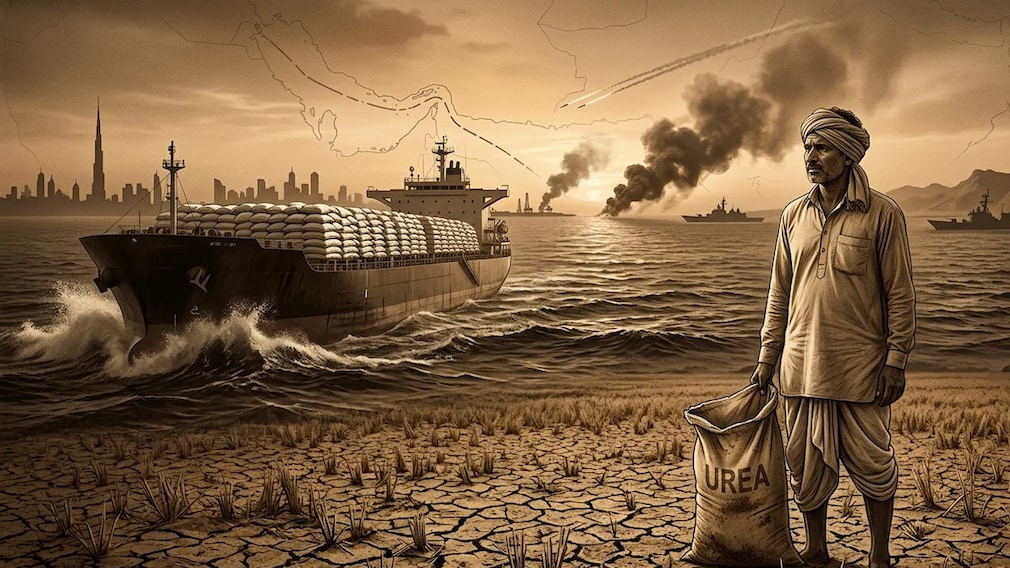
The 12-day (and counting) US-Israel war on Iran reframed battlefield tactics – courtesy a drone-led asymmetric assault by Tehran that has challenged traditional intercept equations.
But short- and long-term impacts on fertiliser supply chains are increasingly critical – and which has flown under the radar so far – particularly since Middle East and Ukraine conflict zones reveal similar vulnerabilities to India's ability to feed an est. 147 crore population. It also impacts jobs and livelihoods in an economy heavily reliant on agriculture.
The energy supply question – crude oil supply unpredictability due to US-Israeli and Iranian strikes on refineries and depots in the Middle East, and shipping constraints as a result of Tehran's unofficial blockade on the Strait of Hormuz – has been well documented so far.
So too has supply volatility impact on India, leading from fears of rationing of petrol and diesel to shortage of LPG cylinders used by over 33 crore households and lakhs of eateries.
Potential dips in crude oil supply via Hormuz are expected to be offset by increased purchases from Russia, and the government has insisted sufficient strategic reserves exist in the interim. The Petroleum Ministry has also directed increased production of LPG cylinders.
But oil and gas are only part of India's exposure in this war.
The fertiliser focus
The data suggests India faces a 20 – 25 per cent exposure to fertiliser supply chain disruptions due to the war and informal blockade on the Hormuz.
This is because, like oil, shipments from the Gulf – from the UAE, Qatar, Saudi Arabia, and Oman – are shipped via the strait.
Given the agriculture sector's importance, this is a not insignificant chink in the armour.
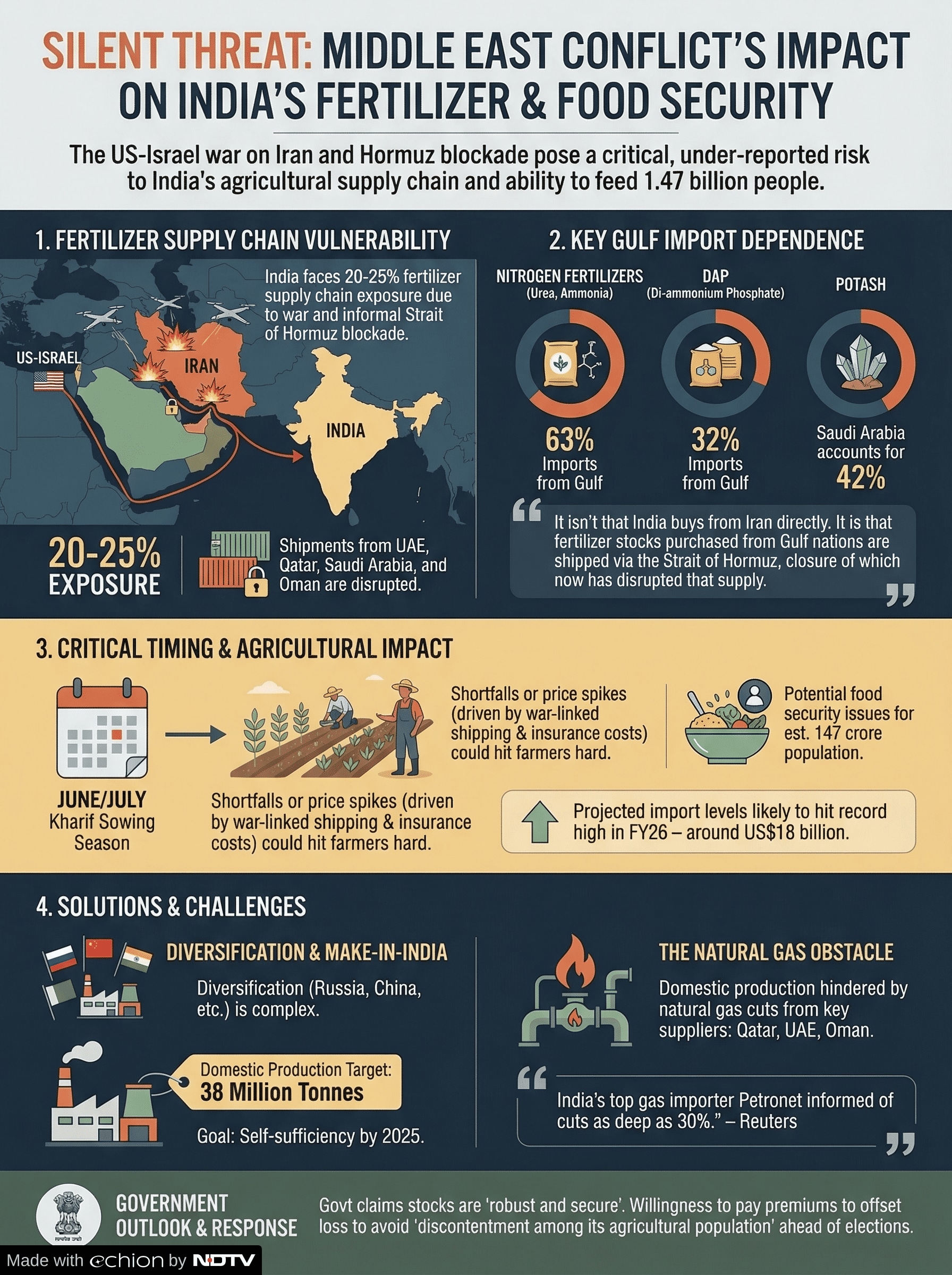
India's potential fertiliser supply chain issues due to the war in Iran.
An estimated 63 per cent of India's nitrogen fertiliser imports, which includes urea and ammonia, and 32 per cent of DAP, or di-ammonium phosphate, comes from these nations.
And Saudia Arabia accounts for an estimated 42 per cent of India's potash imports.
Iran's direct share in this is low; in 2024, for example, India bought urea worth US$231 million from the UAE, Saudi Arabia, and Qatar. Iran supplies were worth only US$2.59 million.
It isn't that India buys from Iran directly. It is that fertiliser stocks purchased from Gulf nations are shipped via the Strait of Hormuz, closure of which now has disrupted that supply.
And though these figures show some volatility – a 21 per cent overall urea import drop in 2023 – the general trend is upward, underlining a potentially significant impact of the war.
Projected import levels are likely to hit a record high in FY26 – around US$18 billion – with urea leading that charge at around 61 per cent because the price is government-controlled.
This is partly due to the two-crop calendar, i.e., the Kharif and Rabi seasons, and with sowing of crops due in June/July for the first, shortfalls or price spikes – driven by war-linked shipping costs, including insurance – could hit farmers hard and lead to food security issues.
The solution?
Diversification is critical but the options are, perhaps, limited.
A pivot back to Ukraine is possible but urea imports were negligible even pre-war.
More practical options are Russia and China, though Delhi's move towards the Gulf nations for urea was to reduce dependence on Beijing. Both will bypass the Hormuz conundrum.
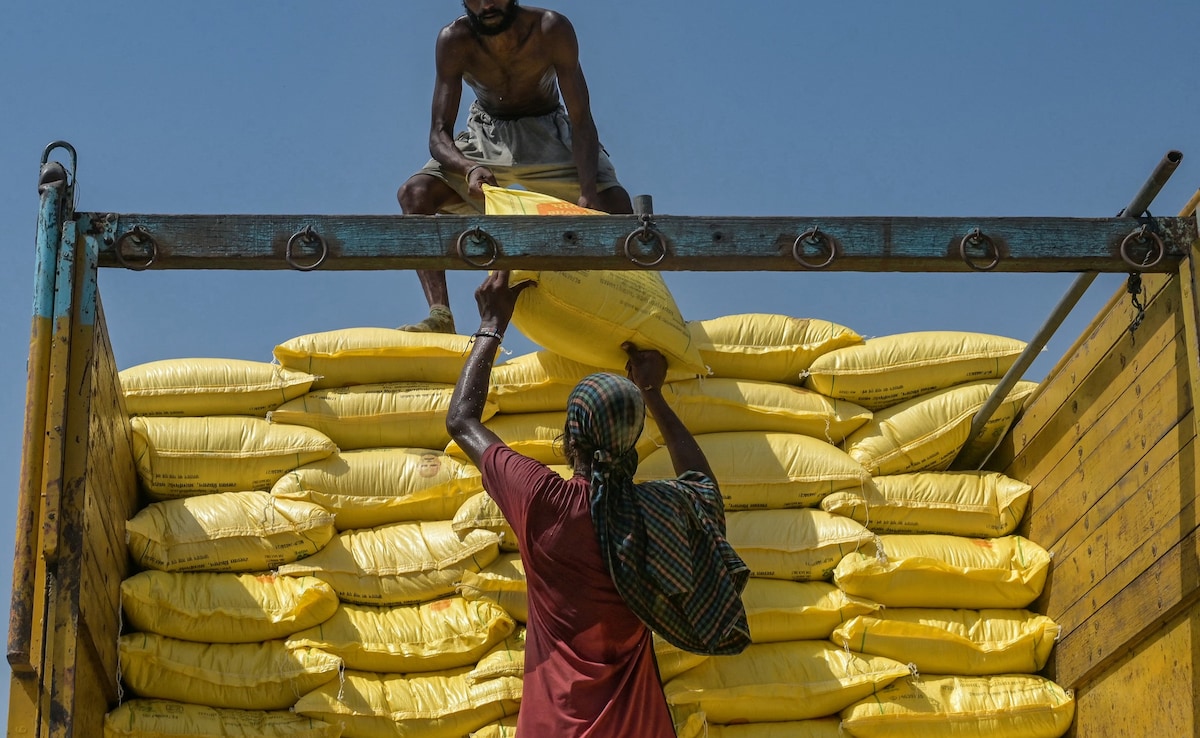
Urea producers trim output as Iran war disrupts LNG flows. Photo: Bloomberg.
India also imports from Nigeria, Uzbekistan, and Indonesia, but these are negligible sellers, each holding a less than five per cent share of the country's urea purchases.
Make-in-India?
Increasing domestic production is a viable alternative, particularly for the long term and as guaranteed risk reduction in times of conflict abroad, a scenario that now seems more plausible than ever. India had set itself a self-sufficiency target of an est. 38 million tonnes.
In fact, urea imports were to have been rolled back by 2025.
However, this presents a different challenge – natural gas – a key ingredient in the manufacture of urea and, unfortunately, India's core suppliers are Qatar, the UAE, and Oman, and all three have reduced supplies in the wake of the war in Iran.
Last week Reuters cited unnamed industry sources as saying India's top gas importer Petronet had informed state-owned marketing companies about cuts as deep as 30 per cent.
The outlook…
… is not all doom and gloom.
The government has said fertiliser stocks are "robust and secure".
On March 6 the Department of Fertilisers said availability of urea and other fertilisers and natural gas would not be affected by the loss of imports from the Middle East. Analysts cited by S&P Global suggested the government would be willing to pay a premium to offset that loss rather than "risk discontentment among its agricultural population" before elections in April/May.
-
Opinion | Manmohan Singh To Bachchans, The Many Mysteries Sonia Gandhi's Memoir Could Solve

She entered politics reluctantly, mastered its power games, chose Prime Ministers, and managed betrayals. Congress's most powerful woman finally tells the world how.
-
Opinion | Why The Congress-Samajwadi 'Merger' Fantasy Could Be Opposition's Biggest Self-Goal
Rahul Gandhi and Akhilesh Yadav do not need to become one another. They need to become better at being themselves, together.
-
Opinion | Mumbai's 'Marathi' Test For Cabbies, And The Art Of Fixing The Wrong Problems
All these years, India's financial capital has worked just fine without a Marathi mandate for its taxiwallahs. Whose problem is the new language rule actually solving now?
-
Opinion | Rs 1.05 Lakh Crore Lost: Inside The Dangerous Rise Of India's Gen Z Stock Traders
Investors under 30 now account for 37.9% of the total investor base in India. But they are also losing money at a much higher rate. Why are they doing it?
-
Opinion | Why A 'Bangladesh' Proposal By Turkish Media Should Worry India
A recent article in Turkish media illustrates how Ankara is turning into a strategic threat for India and its neighbourhood
-
Opinion | 4,800 Indians Removed, 51,000 ICE Arrests: What's Happening In Trump's America?
According to Stop AAPI Hate, Indians are now one of the most targeted groups by ICE, with the highest number of arrests, detentions, and deportations out of all Asian and Pacific Islanders.
-
Opinion | Noakhali To Parliament, What Gandhi, Nehru, Jinnah And Faiz Were Doing On Aug 15, 1947
What was Gandhi doing while Nehru was making his famous midnight speech, and why was Jinnah hosting a lunch as a new nation began fasting? August 15, 1947, looked very different depending on where you stood.
-
Opinion | 79 Years On, India's Enduring Answer To Those Who Had Predicted Its Collapse
Seventy-nine years in the lifespan of an ancient civilisation is a mere heartbeat; yet, in the annals of modern nation-building, it's an audacious triumph.
-
The Coast Pays, Delhi Collects: What The Centre's Mineral Bill Takes From States
India's mineral wealth may lie with the states, but the power to tax it is increasingly travelling north.