Satyagraha, Pyre On River: Tribals' Unique Protest To Save Their Homes
As the Ken-Betwa river-linking project advances, thousands in Madhya Pradesh's Chattarpur say they face displacement, lost livelihoods and inadequate rehabilitation, and are mounting Gandhian-style protests.
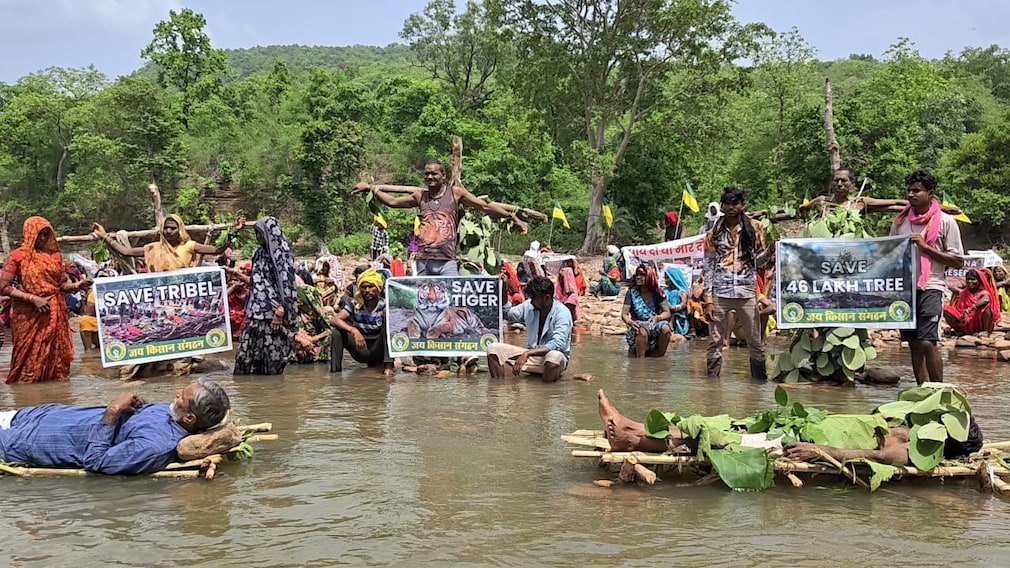
Mahatma Gandhi has returned - in spirit - to Madhya Pradesh's Chhatarpur, where tribal communities are holding protests - from the 'aamran anshan' ('fast unto death') and 'chita andolan' (funeral pyre protest) to the 'mitti' and 'jal' satyagrahas (protests of the soil and water) - to protest the fallout of the Ken-Betwa river-linking project.
The project, they have cried, has cost them homes and livelihoods, and there has been no compensation. They have also argued that promises made in April have been ignored, while they face wrongful police cases and forced evictions.
One set of protesters - gathered under the bridge across the Barana River - built funeral beds on which men lay and floated on the river, warning the state government of their deaths. Another set - also at the Barana site - hung nooses around their necks to signify a 'hanging satyagraha'. And activist-leader Amit Bhatnagar is on an indefinite hunger strike.
The local administration, meanwhile, has insisted assurances have been met. "The state enhanced relief and rehabilitation… now they want more," District Collector Parth Jaiswal said.
This confrontation is happening in Bundelkhand.
To those who know it, it is a vast expanse of land - around 70,000 sq km - in central India that lies between the Indo-Gangetic Plain and the Vindhya Mountains.
Spread across 13 districts divided between Uttar Pradesh and Madhya Pradesh, including Chhatarpur, it is a rocky and rugged land, rising from deep ravines to imposing plateaus and clothed in forests and home to major heritage hotspots, including the world-famous Khajuraho temple complex - a UNESCO World Heritage site - and the Panna National Park.
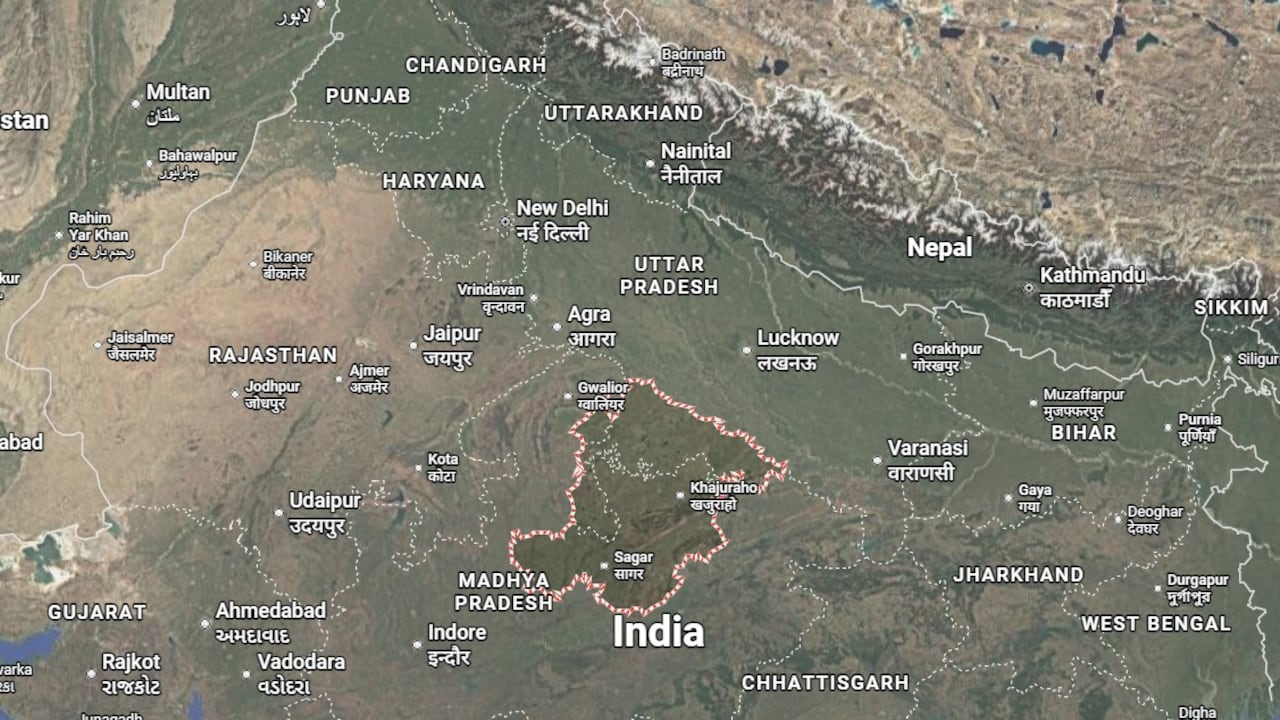
The Bundelkhand region in central India (Photo: Google Maps)
But it is also a semi-arid landscape in which blisteringly hot summers - when temperatures routinely cross 45 degrees Celsius - are paired with inconsistent and often low monsoons.
The searing heat and rocky terrain, which causes what rain does fall to flash flood out of the region rather than replenish underground aquifers, underline the harsh realities of life here, which also include deforestation, fractured agricultural output, and out-migration in search of jobs.
That is why Bundelkhand is often linked to issues like drought and starvation. In this context, the linking of the two biggest water resources - the Ken and Betwa rivers -is a significant initiative for Bundelkhand's development and irrigation needs.
Why the protests
However, as with any large-scale development project - particularly one requiring machine-intensive engineering to actively alter geography - there are concerns over how it might affect the tens of thousands of families who call the area home.
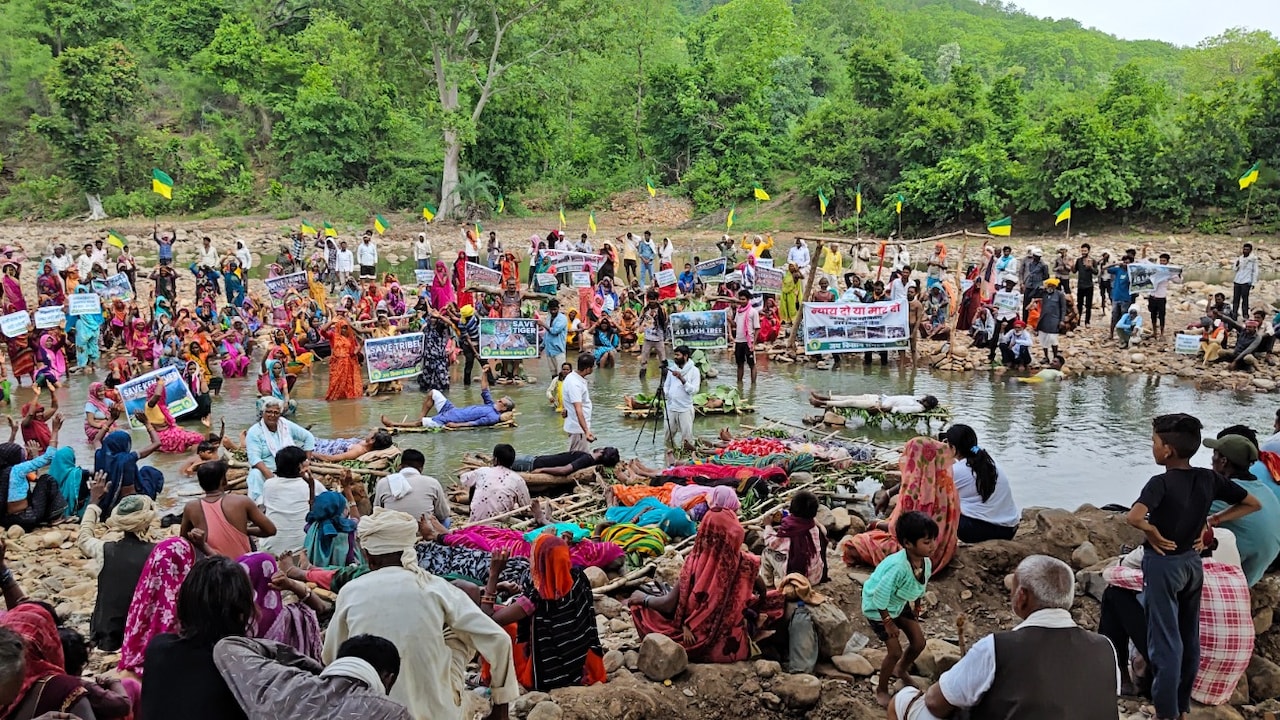
Protesters carry out a 'chita andolan', a funeral pyre protest.
And for nearly two dozen villages in Madhya Pradesh's Chhatarpur district, those concerns are now sitting on their doorsteps.
Over 50,000 people from this region will be impacted, directly or indirectly, by the Ken-Betwa project. Some will be forced from their homes, while others could see their livelihoods - frugal and fragile as they are - wiped out.
The wildlife will suffer too. The Panna forests are home to at least 80 tigers.
Environment and civil society activists working with these families have said the worry is not about the project itself, for no initiative that brings water to Bundelkhand can be ignored. But water at the cost of their economic futures and the environment is a deal that doesn't make sense, particularly when protesters' forest-based livelihoods are under threat.
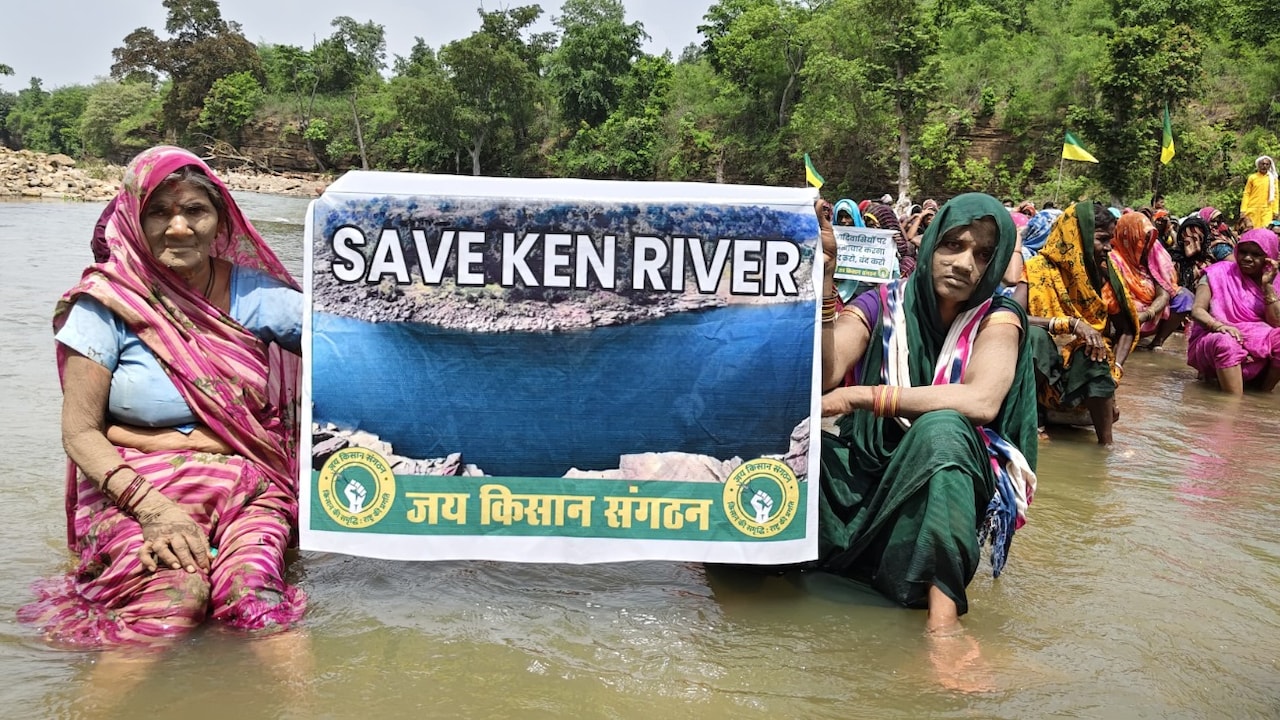
Women from tribal communities protest the KBLP.
Their argument is simple.
If they must leave, then the government must ensure dignified and sustainable rehabilitation, i.e., permanent alternative sources of income and housing, as well as access to basic infrastructure, including that guaranteed under the Constitution.
This includes education and healthcare, drinking water and sanitation, and electricity.
The protesters are steadfast in their demands. "We want to tell the administration… if our demands aren't met this time, we will hang ourselves under this bridge…" one man said.
What is the Ken-Betwa project?
The Ken-Betwa Link Project (KBLP) is India's first major river interlinking initiative. The idea is to transfer water from one river basin – the Ken – to the other via underground pressurised pipes.
The estimated cost of doing so is a staggering Rs 44,605 crore.
But, the government has said, when it is completed the KBLP will irrigate 10.62 lakh hectares of agricultural land, provide drinking water to 62 lakh people, and generate 130 MW of power.
These are not insignificant development milestones.
But for the tens of thousands of men, women, and children who will be affected by this project, necessary though it is, their struggle to survive afterwards must be taken into account. And that struggle will continue, in public till the news cycle ends and away from the spotlight thereafter. But it will continue, as they have made it clear, till the government helps them.
Politics too
Meanwhile, where there are protests and civil society issues at play, politics is too.
Congress MLA Umang Singhar, the Leader of the Opposition in the BJP-ruled state, met some displaced families and protesters and listened to their grievances. He told them their worries would be raised - forcefully - in the next Assembly session and Chief Minister Mohan Yadav's administration would be pushed to ensure rehabilitation and compensation.
The next session begins in three days, i.e., July 20.
Just what the state will do when presented with this issue by the opposition is unclear. Will they acknowledge and answer the people whom they serve, and will displaced families receive rehabilitation and livelihood guarantees? Or will it all just turn into a political squabble, with the lives of the affected people in Chhatarpur district relegated to the backburner?
With inputs from Arvind Kumar Tiwari
-
Hit Songs, Empty Pockets: The Hidden Math Behind India's Viral Music Boom

Over 80,000 brands and five lakh creators in India make branded content. The opportunity is worth around Rs 1,500 crore.
-
Opinion | Great 'Exceptions': How The Oil India Was Attacked For Is The Oil Trump Now Seeks
A law written to punish the buyers of Russian oil was suspended by the US to protect a purchase of Russian oil. India spent fourteen months being lectured for less.
-
Opinion | Louis Vuitton Loot, Torched Cars: France Protests Have An Unlikely Beneficiary
It's an unbelievable moment. Crowds looting the most exclusive stores in Paris, including the famed Luis Vuitton. But what's behind this meltdown?
-
Blog: Kolkata Didn't Learn From 2015. Eleven Years Later, It Proved To Be Fatal
The City of Joy isn't a stranger to crowd control. Be it during Pujo or Christmas at Park Street, Eden Gardens cricket matches, or Derbies between Mohun Bagan and East Bengal. But during Pujo, the entire city is on alert.
-
Opinion | Slurs, Threats, Now A Temple Attack Plot: When Did America Become So Hostile To Indians?
The rising tide of anti-India, anti-Hindu, and racist attacks serves as a stark reminder that economic prosperity does not automatically guarantee social immunity from bigotry.
-
A Step Behind Neha Bora: What Rahul Gandhi's Gesture Says About Congress' Gen-Z Pitch
At INDIA bloc's march to Supreme Court, Rahul Gandhi placed himself a step behind two women, hands resting on their shoulders. One was his sister Priyanka. The one on his right was Neha Bora. Here's what the image means for the protest wave now, and for Rahul's politics in general.
-
Opinion | Imran Khan, And The Perils Of Having An 'Opinion' In Bollywood
The reality of the industry is quite grimy. More often than not, its inhabitants have been fairweather friends, happy to sing the praises of whoever is in a position of authority.
-
Exclusive: India's Food Safety Problem Goes Beyond Just Dirty Kitchens - By Tukaram Mundhe
On World Food Day, Maharashtra's Commissioner of Food Safety explains why instead of taking stopgap measures, the entire supply chain in India needs to be held accountable and made transparent.
-
Opinion | India Has Enough Coal. So Why Are Power Plants Running Short? A 76 Million 'Crunch'
As of October 5, as many as 82 of the 191 thermal plants monitored by the Central Electricity Authority were in the 'critical' category
-
Opinion | Starlink, India, And Why Elon Musk Must Know His Billionaire Tantrums Won't Work
India should neither be intimidated by Musk's global influence nor distracted by his theatrics.