How Parents Walk Tightrope Of Sending Child To Daycare And Ensuring Safety
As dual-income households rise in India and nuclear families become the norm, daycare support is no more a want, but a need.
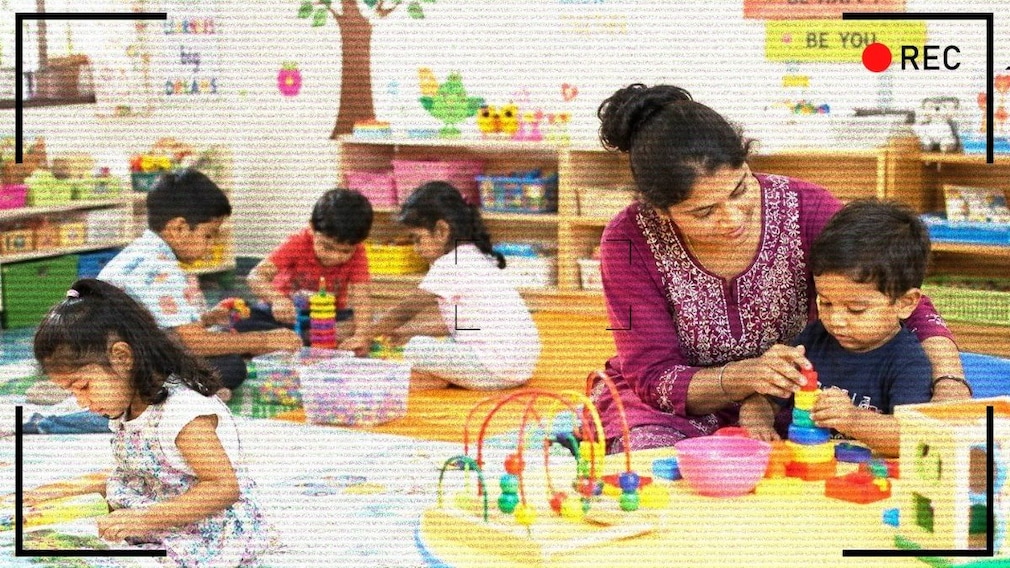
It's 3:30 pm. Six-year-old Abir Singh is walking into a creche in Gurugram, his second home after school hours. Sitting kilometers away from him, his father, Gagandeep Singh, receives a notification on his phone, informing him that his child has checked in to the daycare. He opens the security camera (CCTV) viewer app and watches his son walk into the establishment. Abir puts down his school bag and proceeds to change into casual clothes before lying down for a nap. Gagandeep looks at his son through a five-inch mobile screen. An hour later, Abir goes for a storytelling session at daycare followed by a dance class while Gagandeep watches him have fun with his friends over a cup of coffee. The father and son are reunited around 6:30 in the evening when Gagandeep picks Abir and together they drive back home.
This is their daily routine.
Gagandeep checks the CCTV footage "four to five times" within the span of three hours Abir spends at the creche.
"We don't have any support system, so we need a daycare," says Gagandeep, who has been sending his son to a creche since he was 18 months old.
As dual-income households rise in India and nuclear families become the norm, daycare support is no more a want, but a need.
In 2022, when Debopriya moved from Kolkata to Gurugram, along with her husband and two-year-old daughter, she lost the parental support she had relied on. Faced with a choice between a full-time nanny and daycare, she chose the latter.
"I realised a nanny cannot provide educational benefits to the child. We are full-time working parents, and we cannot engage with the child for eight to nine hours. We wanted professionals looking after our child. Therefore, we opted for a daycare," said Debopriya.
Daycare facilities fill the childcare gap once bridged by grandparents and extended family members. But when cases of abuse at a daycare facility like that in Bengaluru's Capgemini campus -- where children between two and three years of age were made to sit in the drum of a front-loading washing machine and were locked in bathrooms -- are reported, the question of safety takes centre stage.

At a daycare facility in Bengaluru's Capgemini, children between two and three years of age were made to sit in the drum of a front-loading washing machine and were locked in bathrooms.
Parents' Non-Negotiables When Picking A Child Care Facility
All parents NDTV spoke to stressed the need for access to security cameras, or CCTV footage.
"Child's safety is a parent's priority. A big non-negotiable is CCTV access to the parent, especially in today's time when it is hard to trust others," said Varsha Vats, mother of a two-year-old girl, based in Delhi.
Beyond surveillance, Vats highlighted the need for a child-friendly environment. "Everything at the daycare should be childproof; there should be no wide-open gates or windows at the facility; there should be proper ventilation and enough engaging toys which should be cleaned and sanitised frequently."
Vats has been looking for a daycare facility but fears "mistreatment and physical abuse".
For the same reason, Debopriya would check on her daughter, Shanaya, for injuries and bruises every day after she returned from daycare.
"Shanaya is a speech-delayed kid. She was non-vocal when she started going to a creche. To top that, we are native Bengali speakers. The language was new for her. We chose a daycare closer to our house so that it is easier to pick her up in case of emergencies. I visited the facility and spoke to other parents before enrolling my child," said Debopriya.
The first daycare Shanaya went to did not provide the access to CCTV footage but offered daily logs via a mobile application. Debopriya would get updates like "30 minutes nap", "one serving of rice", and photos of her daughter engaging in different activities. This gave her confidence that her child is learning.
Also Read | Bypassed Security, Staged Clip: Capgemini Daycare's Charge Against Ex-Staff
In over four years, Abir has changed four daycares. The first time it was an unexplained injury, the second time it was the distance from his school, and the third time it was the lack of extracurricular activities and healthy food options.
"We didn't want to introduce our child to sugar, but they would give him packaged snacks like biscuits. They refused to make an exception for Abir stating they "cannot give special treatment", so we moved him out of that daycare," said Gagandeep.
For Ramya Alberts, a marketing and communications professional based in Bengaluru and a mother of two daughters, child-to-caregiver ratios matter as much as high standards of hygiene, emergency medical preparedness and transparent communication with parents.
"Cleanliness, qualified staff, positive reviews from other parents and proximity to home or school are additional factors that influence my decision," she added.
Astha Malhotra, a government official and a mother of three -- 15, five and three-and-a-half-year-old -- from Panchkula in Haryana, also checked the mattresses, kitchen and washrooms to ensure the hygiene and well-being of her children.
For Manvi Sharma, mother of two - three-and-a-half-year-old Aarya and a month-old Avyanth - it is important her children are treated like 'family' and not 'clients'. And that is why she chose a 40-year-old daycare which is around 15 km away from her home in Indore but is run by its owner. Healthy food habits and individual attention influenced her decision.
"They provide parents with a weekly lunch menu and ask children to bring one fruit a day. They know my daughter's favourite food and clothes. They made her a diaper-free kid."
Not Just Caregiving, It Is Also About Learning
When Debopriya's daughter joined school, she moved her to a different daycare, one that offered a more structured routine and extracurricular activities.
"I never taught Shanaya days of the week, alphabets or numbers. She learned everything at daycare. A nanny cannot offer such benefits," said Debopriya.
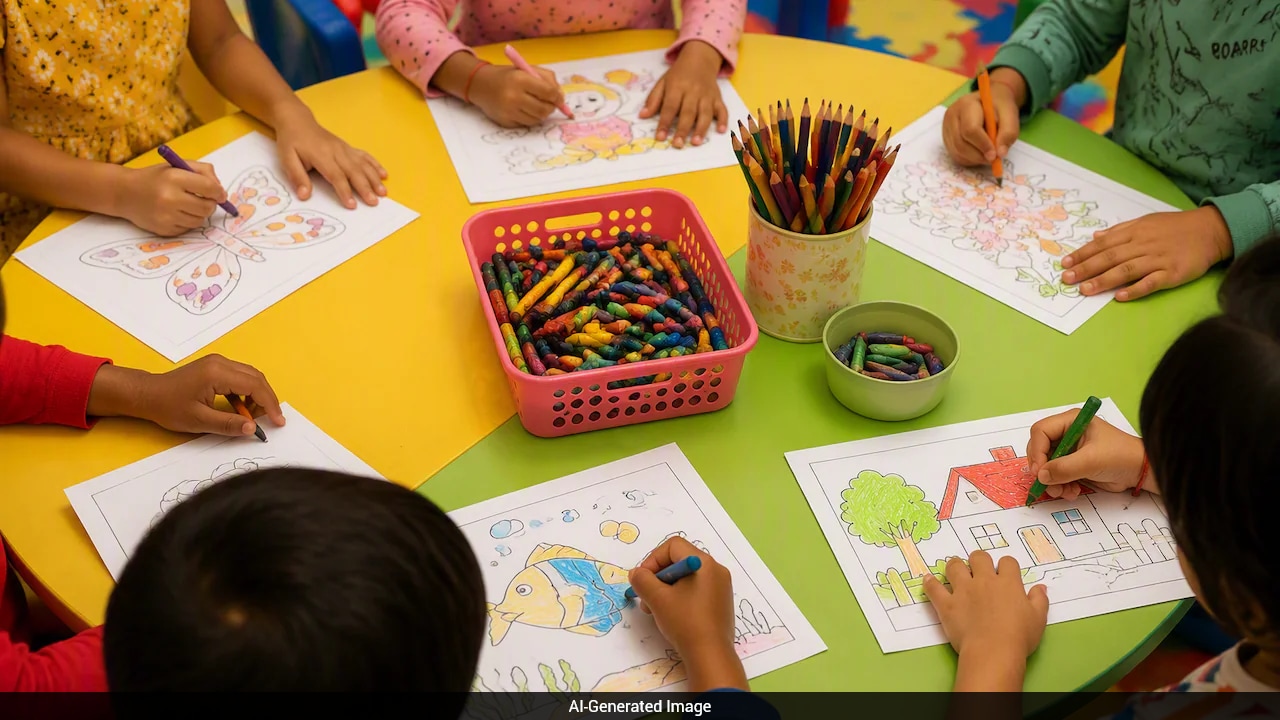
Children practising colouring at a daycare.
After the birth of her second daughter, Astha Malhotra hired a full-time help, but soon realised the child was not learning anything.
"We got CCTV cameras installed in our home and noticed that the help would be occupied watching videos on their phones. Kids need dedicated attention and a place where they could learn. At 18 months, I started sending her to my elder daughter's school since they also offered daycare services. That way she started learning early on instead of sitting idle all day long."
Ramya Alberts believes that engaging children in age-appropriate learning and play rather than simply being supervised aids their growth. For example, a daycare in Bengaluru uses storytelling to build emotional awareness among children.
"After reading a story about a character who feels left out, we ask simple questions like, "How do you think the bunny felt?" or "What would you do if your friend was sad?" These gentle conversations help children recognise emotions, build empathy, and understand that every feeling is valid," said Priyanka Belliappa, founder of Nurtura Preschool and Daycare. "Through songs, visual cues, and everyday interactions, we create a safe environment where children gradually learn to express themselves with confidence."
For Debopriya, sending her daughter to daycare also meant not giving up on her career. "We both get our space. I am not just a mother or a wife. I've been working for 15 years, and I could not give up on my career or lose myself."
But What Happens When The Safety Net Is Breached?
In August 2025, when parents of a 15-month-old girl in Noida noticed marks on the baby's thighs, they thought it was an allergic reaction. However, a medical examination revealed that they were bite marks. Horrified, the parents asked the daycare, where she had been going for the past two weeks, for the CCTV footage and found the attendant hitting the infant in the face and dropping her intentionally.
The attendant who hit the child was a minor. "The authorities must ensure they hire mature people who have the patience to take care of infants," Sandeep, the baby's father, told NDTV.
Incidents like these create trust issues among parents. But what about children who experience abuse?
"When a child is exposed to harassment, neglect, intimidation, or abuse in a daycare setting, the impact can extend beyond the immediate experience," said Dr Abhinit Kumar, Senior Consultant, Psychiatry, ShardaCare-Healthcity.
Dr Kumar suggests noticing changes in behaviour, especially among young children who lack the vocabulary to describe what has happened to them. "Distress may be expressed through changes in behaviour rather than through direct disclosure. Warning signs may include fear of daycare, separation anxiety, disturbed sleep, nightmares, changes in appetite, frequent crying, or regression to behaviours that had previously been outgrown, such as bedwetting or thumb-sucking."
One of the most significant psychological effects of abuse is the disruption of a child's sense of safety and trust, said Dr Kumar, adding that children depend on adults for protection and emotional regulation, and when an adult in a caregiving environment becomes a source of fear or harm, it can affect the child's developing understanding of relationships and safety.
Some children internalise their distress and often don't show it to parents. However, persistent or severe experiences of trauma, according to experts, may be associated with anxiety, depressive symptoms, post-traumatic stress disorder symptoms, emotional dysregulation, low self-esteem, or behavioural difficulties.
To identify abuse and stress in children, Dr Sujatha Thyagarajan, Lead and Head of Department - Pediatric Intensive Care and Pediatric Emergency, Aster Women and Children Hospital in Bengaluru suggests checking for unusual marks, bruises, tenderness, or injuries to private parts.
"Parents should ask children about their day and recognise any new pattern. Reassure children that they are heard and not at fault in case of any untoward incident. If a child is refusing to go to school or daycare, spend some time with them at home and the facility and identify issues," she added.
What The Law Says
The Ministry of Women and Child Development's National Minimum Standards and Protocol for Creches (Operation and Management), released in January 2024, recommends staffing norms (at least one creche supervisor and a helper for handling 20-25 children), CCTV surveillance, first-aid facilities, emergency preparedness and regular inspections.
While the guidelines lay down standards relating to staffing, safety, infrastructure and monitoring, it is important to remember that these are guiding principles rather than a legally enforceable rulebook with uniform penalties for non-compliance.
Kumar Nilendu, General Manager, Programs - Child Rights and You - CRY (West) believes India could benefit from a National Childcare Regulatory Framework "that establishes common minimum, non-negotiable standards across the country while allowing states the flexibility to strengthen and contextualise these standards based on their specific needs and capacities".
Such a framework should regulate quality standards for childcare services; all types of creches and daycare centres (government, private or employer-run); financing and budgeting; and institutional mechanisms responsible for registration, supervision, monitoring, inspection, quality assurance, grievance redressal and accountability.
"At present, a significant share of the financial responsibility rests with states or employers. However, states differ considerably in their fiscal capacities, whereas every child is entitled to the same standards of safety, care and development. Therefore, a National Childcare Regulatory Framework should ensure that every state is enabled to implement and enforce a common minimum standard of quality, safety and child protection across all creches," he added.
What can parents do to ensure the safety of their children? Uma Mahadevan, Additional Chief Secretary and Development Commissioner, Government of Karnataka recommends checking for the daycare's registration certificate and accreditation and visiting the facility to understand the kind of approach attendants adopt toward children.
For daycare institutes, Mahadevan suggests regular safety audits for creches like schools and hospitals, monitoring of quality of facilities and the capacities of caregivers.
When asked about three reforms that would most improve childcare safety and quality in India over the next five years, Mahadevan said, "A programme to support organisations or women groups wanting to start creches; strong training for creche workers, along with a supervisory and managerial career growth model built in; localised and contextualised curriculum framework of early childhood activities like music, play-based learning, routine healthcare and nutrition. These things should be introduced along with quality benchmarks."
Mahadevan, who has worked with the Department of Women and Child Development, emphasised standardising the curriculum framework without templatising it to the extent that it cannot be contextualised. "For example, a creche in an urban slum, where children speak different languages, cannot have activities being carried out in one language. No child should feel alienated."
The Parenting Paradox
Parents place an incredible amount of trust in daycare service providers. And the reassurance, according to Priyanka Belliappa, comes through transparency, consistency, and genuine care.
"When parents see that their child is happy, comfortable, and excited to come back each day, that's the strongest reassurance we can give," she added.
But fear, doubt, and guilt remain.
Everything, however, comes down to safety. And it is these cases of abuse that scare Varsha and take away the courage to leave her child with anyone other than family.
"It's s not just about choosing careers or parenting. In other countries, even at-home mothers have an option to send their children to daycare because of assured safety. In India, even in necessary scenarios, parents can't rely on a system that is safe enough for their children," she concluded.
-
Opinion | The AI Boom Has Run Into A Big 'Debt' Trap Problem. Inside The 5% Danger Line

For most of the AI buildout's first two years, hyperscalers funded it the easy way: out of operating cash flow. That era is over.
-
Opinion | Iran To Saudi, Pakistan Is Now Fast Running Out Of Sides To Play
Pakistan's long history of playing all parties to its own benefit may have reached the end of its road.
-
Gyanesh Kumar Has An Immunity Pin. Why A Petition Says He Can't Use It
The Opposition wants the Chief Election Commissioner prosecuted for alleged manipulation of voter rolls, but a 2023 law stands in the way. A petition in the Supreme Court now says the law has a gap.
-
Opinion | Is The World Staring At A Big Stock Market Crash - And Recession? 5 Uneasy Signs
On Wednesday, the US bond market recorded its worst day since Trump's "Liberation Day" tariffs rattled markets in April 2025. The 30-year US Treasury yield topped 5.43%, putting it on track for its highest close since 2004.
-
Form 6 For New Voters: When A Small Change Triggered A Big Row
In July 2026, the online version of Form 6 on the ECI's ECINet portal was modified to include a new declaration.
-
Opinion | Saudi Arabia's China Turn Has Begun - After Learning Much The Hard Way
Leaning on China just makes sense for the Saudis right now. The question is, can its other great 'ally' stomach it?
-
Opinion | Bihar Assault, Hisar Marriage Ban: Who'll Stop The Guardians Of Indian 'Culture'?
Why exactly does the sight of a young couple seeking a bit of alone time somewhere tend to particularly provoke a certain kind of Indian men?
-
Opinion | The Trump-Xi Summit, And India's Many Worries Of Its Own
Washington and Beijing may have chosen coexistence over confrontation. For India, that could be both a relief and a warning.
-
Opinion | China Claims It Has Cut Troops At The Indian Border. But The Math Doesn't Add Up
The reduction likely has more to do with the deployment along the LAC than the total strength active in the region