Indian Family Wipeout Over iPhone: The Dangerous Lure Of Consumer Tech Debt
Young buyers walk into physical retail stores, hand over basic identity documents and walk out with a consumer electronic device that costs more than their entire family's monthly take-home income

One case is not enough to pass judgement on a complex thing. And one death linked to monthly payments on an iPhone is definitely not enough to say it's the surest way to get caught in a debt trap.
But the view changes when there is more than one case of human tragedy over debt after an expensive purchase like an iPhone. From time to time the media reports stories about people dying due to self-harm over financial disputes and demands linked to expensive gadget purchase. Most of these cases involved young people, or the age group known as Gen-Z. See these cases, for example.
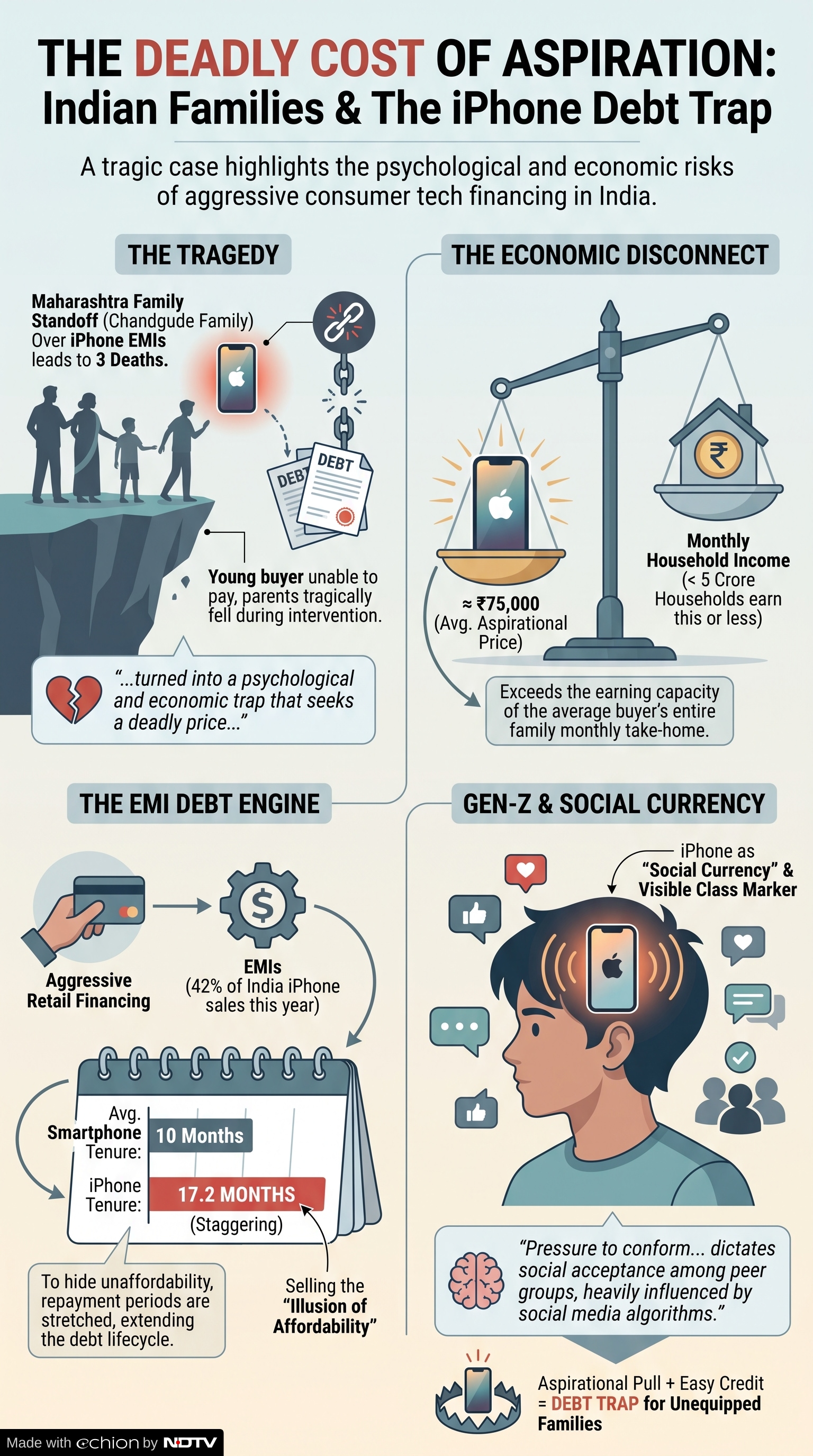
The latest case involved three deaths: Kunal Chandgude, 19, and his parents who fell off a cliff in Maharashtra while in a family standoff over paying EMIs for an iPhone.
In India, macroeconomic consumption surveys and wealth distribution data show less than five crore households have a monthly family income of Rs 75,000. Assuming that the average price of this 'aspirational' phone is Rs 75,000, most households run the risk of falling into a debt trap.
The question of whether the iPhone is pushing lakhs of families to debt needs a serious look. At least 42 per cent of iPhones sold in India this year will be on EMIs, independent market research firm Counterpoint Research said in a report.
The wipeout of an entire family in Maharashtra showed the aspiration to own a premium smartphone, fuelled by aggressive retail financing, has turned into a psychological and economic trap that seeks a deadly price from families unequipped to handle modern consumer tech debt.

Chandgude bought an iPhone on EMI but found himself unable to make the payments. After an argument with his parents over his demand for money to pay the latest instalment, he ran out of his house and made his way to the edge of a hill, leading to a three-hour standoff that ended in tragedy.
His father, Murlidhar, 48, who spent a lifetime working as a driver to support the family, lost balance and fell off the cliff while making a final attempt to physically grab his son. His mother, Sangeeta, jumped after them in shock and despair on seeing what had just happened.
What can be a more extreme result of an aspiration that is possibly pushing lakhs of Indian families into a debt trap?
Independent market research shows that buying high-end smartphones on borrowed money has become common. This tendency has moved from the cities to smaller towns and villages.
Consumers are moving away from cash and one-time payments amid steadily rising device prices. The smartphone industry has encouraged this after realising that the only way to maintain growth in a price-sensitive market is to sell the illusion of affordability through monthly instalments.
Data shows that tier-2 markets are now the single most financing-driven segment for smartphone purchases, outpacing major cities, a study this month by Counterpoint Research said.
To hide the unaffordability of these premium devices, the retail market kept stretching out repayment periods by keeping the monthly cash outflow seemingly manageable and extending the lifecycle of the debt.
Today, the average smartphone financing tenure in physical retail stores has reached 10 months. But for Apple's iPhones, the aspirational pull is so strong that the average financed tenure stretches to a staggering 17.2 months, the market research firm said.
It would not be wrong to assume that monthly instalment and economic reality shows a disconnect between what Indians earn and what they consume. If the average price of an iPhone is conservatively estimated at Rs 75,000, it exceeds the earning capacity of the average buyer, considering the total household income of the same amount.
But millions of these premium devices are sold every quarter.
Young buyers walk into physical retail stores, hand over basic identity documents and walk out with a consumer electronic device that costs more than their entire family's monthly take-home income.
For a father like Murlidhar, working long hours as a driver, financing a phone of that magnitude would need sacrificing basic household stability, delaying essential medical care or compromising on nutrition.
And for Gen-Z consumers, an iPhone serves as an important piece of social currency and an intensely visible class marker. Independent consumer behaviour analysts and youth psychologists have highlighted that the pressure to conform is more suffocating in smaller cities as the device dictates social acceptance among peer groups, heavily influenced by social media algorithms that equate self-worth with material possession.
It's a lot easier to buy on EMIs these days, thanks to the growth of non-banking financial companies (NBFCs) and point-of-sale financing. The traditional way of taking loans that often took time is no longer applicable for such purchases. There is no bank visit, no demands for hard collateral and no strict assessments of a household's holistic financial health. Algorithms approve paperless loans in under three minutes based on a PAN card and an OTP.
Retailers get higher margins on premium devices, so they push EMI schemes aggressively. On the other end of this bargain are the consumers - which includes Gen-Z - who enjoy the instant gratification of unboxing a high-end product, while the invisible financial burden is quietly transferred to the parents.
This intense psychological burden may explain the fatalism seen on Khavda Hill in Maharashtra. Did Chandgude see the end of his social existence when faced with the possibility of not being able to pay the EMI?
The collateral damage of a consumerist obsession has nowhere else to fall but on working class parents who have spent their lives earning and saving whatever little they could to move up to the middle class. Then, all of a sudden, they are pushed into a hyper-consumerist debt cycle they do not understand and forced to subsidise their children's social currency, taking on high-interest loans to maintain the peace at home.
-
The Real Story Of France's Unrest Is Getting Lost In A Storm Of Online Lies

A man cosplaying Napoleon on the streets, looting at luxury fashion stores like Dior, France is currently confronting one of its most serious episodes of civil unrest in years.
-
Opinion | The Last Bet? What Trump's 'Mother Of All Bombs' Could Actually Do To Iran
Can an MOAB deliver a decisive blow to Iran that may force it to surrender immediately, as Japan did after Hiroshima and Nagasaki in World War 2?
-
Hit Songs, Empty Pockets: The Hidden Math Behind India's Viral Music Boom
Over 80,000 brands and five lakh creators in India make branded content. The opportunity is worth around Rs 1,500 crore.
-
Opinion | Great 'Exceptions': How The Oil India Was Attacked For Is The Oil Trump Now Seeks
A law written to punish the buyers of Russian oil was suspended by the US to protect a purchase of Russian oil. India spent fourteen months being lectured for less.
-
Opinion | Louis Vuitton Loot, Torched Cars: France Protests Have An Unlikely Beneficiary
It's an unbelievable moment. Crowds looting the most exclusive stores in Paris, including the famed Luis Vuitton. But what's behind this meltdown?
-
Blog: Kolkata Didn't Learn From 2015. Eleven Years Later, It Proved To Be Fatal
The City of Joy isn't a stranger to crowd control. Be it during Pujo or Christmas at Park Street, Eden Gardens cricket matches, or Derbies between Mohun Bagan and East Bengal. But during Pujo, the entire city is on alert.
-
Opinion | Slurs, Threats, Now A Temple Attack Plot: When Did America Become So Hostile To Indians?
The rising tide of anti-India, anti-Hindu, and racist attacks serves as a stark reminder that economic prosperity does not automatically guarantee social immunity from bigotry.
-
A Step Behind Neha Bora: What Rahul Gandhi's Gesture Says About Congress' Gen-Z Pitch
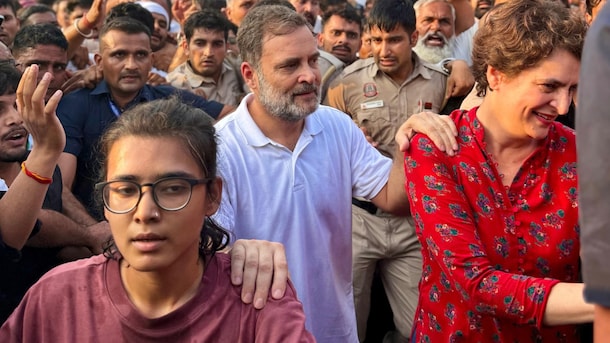
At INDIA bloc's march to Supreme Court, Rahul Gandhi placed himself a step behind two women, hands resting on their shoulders. One was his sister Priyanka. The one on his right was Neha Bora. Here's what the image means for the protest wave now, and for Rahul's politics in general.
-
Opinion | Imran Khan, And The Perils Of Having An 'Opinion' In Bollywood
The reality of the industry is quite grimy. More often than not, its inhabitants have been fairweather friends, happy to sing the praises of whoever is in a position of authority.
-
Exclusive: India's Food Safety Problem Goes Beyond Just Dirty Kitchens - By Tukaram Mundhe
On World Food Day, Maharashtra's Commissioner of Food Safety explains why instead of taking stopgap measures, the entire supply chain in India needs to be held accountable and made transparent.