Explained: India-Pak Sir Creek Border Dispute And Its Strategic Importance
On Thursday Defence Minister Rajnath Singh said attempts to illegally occupy more of India, i.e., its half of Sir Creek, will be met with a response that will change "history and geography".
Military tension between India and Pakistan - never far from the surface and explosive when it does break cover, as Operation Sindoor showed in May - may have expanded to a new theatre this week after Islamabad was warned against territorial aggression in Gujarat's Sir Creek.
On Thursday Defence Minister Rajnath Singh said attempts to illegally occupy more of India, i.e., its half of Sir Creek, will be met with a response that will change "history and geography".
Singh said India remains open to a peaceful resolution of the border dispute in Gujarat (and other areas) but "Pakistan's intentions are flawed and unclear". The recent expansion of military infrastructure -bunkers and radars, as well as forward bases capable of launching attack drones or infantry operations - in adjacent areas reveal that country's intentions, he said.
READ | India's Big Warning To Pak Against Aggression In Gujarat's Sir Creek
Increased Pak military footprint anywhere on the border raises eyebrows but, after Op Sindoor and the first India-Pak armed conflict since 1971, it is a matter of some concern and urgency.
So what is Sir Creek?
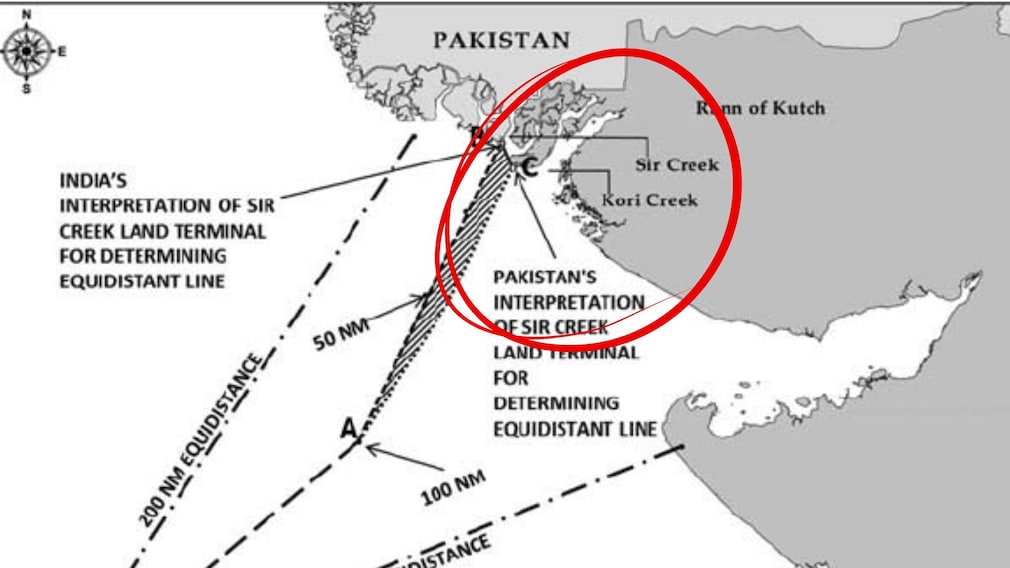
It is a narrow strip of water, less than 100km long, in the tidal estuary between Gujarat's Rann of Kutch and Pakistan. Control is disputed over interpretations of maritime boundary lines.
The creek is the official westernmost border between India and Pakistan.
The origin of the dispute dates back decades to pre-independence India (as do so many of the India-Pak conflicts) when the region was ruled by the Maharaja of Kutch and there were conflicting territorial claims from differing interpretations of colonial-era maps and agreements.
Today the dispute is this - India claims half of Sir Creek and, therefore, the marshlands that border Pakistan's Keti Bunder Wildlife Sanctuary, while Pak cites one of those colonial-era deals and insists the boundary lies east of the creek, giving it access to the heartland of Gujarat.
The document Pak cites is the 1914 resolution signed by the Rao of Kutch and the Sindh government, which says the eastern bank of the creek is the boundary line.
India, however, relies on a 1925 map that points to the mid-channel of the creek. India has also pointed to the internationally-accepted Thalweg principal that says the border between two nations that share a navigable waterway is the line of the deepest part of the main channel.
Pak, though, says the doctrine doesn't apply as Sir Creek is not navigable.
Why is Sir Creek important?
Control of the Sir Creek not only influences (and effectively settles) the India-Pak maritime boundary issue, but also gives the side in charge a significant strategic boost.
India maintaining a military presence on its side, for example, acts as a deterrent as it offers direct maritime access to the Karachi Port, a trading hub and No 1 target in a war. Singh made that point when he said 'Pak should remember, one route to Karachi passes through Sir Creek'.
For Pakistan, increased access to the Sir Creek region allows, theoretically, a pincer movement on India; i.e., in the event of another armed conflict, simultaneous attacks in Pak-occupied Kashmir or the Rajasthan and Punjab border and in Sir Creek could stretch Indian forces.
Control also supports the Pak Navy in positioning its warships along the coastline, thereby enhancing its security and influence over maritime routes near the Gujarat coast.
Prize isn't just military
Sir Creek is one of Asia's largest fishing grounds and supports the livelihoods of thousands of people. The border dispute frequently segues into the arrest of fishermen and women, from both nations, who stray across the border. It also impacts access to potential undersea oil and gas reserves, important in the light of Pak's deal with the US to develop "massive" oil resources.
Exploration of these reserves have stalled due to the border dispute.
The potential economic benefit, however, is immense, particularly as Indian balances the cost-effective import of Russian oil against the fury of the US for 'fuelling the war in Ukraine'.
The terrorism red flag
India's concerns for Sir Creek aren't just related to the Pak military.
In September 2019 abandoned boats were found in the area after intel about Pak special forces soldiers trying to infiltrate the country and carry out a terror attack in Gujarat.
RECAP | Terror Alert For South India Based On Boats Found In Gujarat's Sir Creek
This was days after then-Navy Chief Admiral Karambir Singh cited other intel reports to claim Pakistan-based terror group Jaish-e-Mohammed is training members for underwater attacks.
A red alert was issued, not just for Gujarat, but also down the southern coast all the way to Kerala, underlining the strategic importance of Sir Creek.
NDTV is now available on WhatsApp channels. Click on the link to get all the latest updates from NDTV on your chat.
-
IRGC's New Boss Is No Ordinary Man. Meet Ahmad Vahidi, Iran's Ultimate Survivor

He has survived purges, sanctions, assassinations, secret deals, and Iran's most consequential wars. The IRGC's new chief, formally appointed by Khamenei this month, knows the regime - and its enemies - like few others do.
-
Analysis | BJP's Mother Of All Resets: An Overhaul To Fix Its Perception Problem
The battle this time is to regain credibility as BJP has entered a phase which is going to be the launch pad for a national face after a political force called Narendra Modi.
-
Opinion | Why Is India Cooler As The World Burns? A Heatwave 'Mystery'
Europe, which is warming at more than twice the global average, is now bracing for even worse climate impacts. But something strange and unexpected is happening in India, keeping it cooler.
-
Tukaram Mundhe: The IAS Officer Restaurants Fear Most In Maharashtra
As FDA commissioner, Tukaram Mundhe has his eyes on Maharashtra's plate. Food adulterators, storied restaurants and clubs, dark stores of quick commerce platforms, school and government canteens, surrogate advertisers of banned products - no one is out of bounds.
-
3 Minutes, 6 Stanzas, Century-Old Debate: The Many Turns In Vande Mataram's Journey
PM Narendra Modi launched a year-long commemoration of the song's 150th anniversary on November 7, 2025. In December, both Houses held special discussions on it, during which the 1937 Congress decision was scrutinised.
-
Opinion | Sajjan Kumar, Congress, And How To Keep Messing Up An 'Apology'
A sitting Congress MP has termed Sajjan Kumar's death an "irreparable loss", calling him a man whose bond with the people of Delhi was "an example". This was a tribute, delivered in full sentences, to a convicted killer of Sikhs.
-
Explained: Why Tamil Nadu Dropped Second Airport Near Chennai
While the government stands firm with the protesting residents, Chief Minister Vijay assured that Chennai's aviation needs will not be ignored. The state will soon announce a detailed plan for a new airport at an alternative site, he said.
-
Opinion | A 'Snub' Gone Too Far? The Story Of Bangladesh PM's Stalled India Visit
The abrupt cancellation of Prime Minister Tarique Rahman's scheduled visit to New Delhi this month raises many questions.
-
Inside Pak's New Law That Has One Man Written All Over It: Asim Munir
With a new act, Munir has truly reached the apex. At least most politicians in Pakistan will hope so.
-
Behind Sugar Shock: Not Ethanol, But Over-Estimation Led To 16% Price Rise
In November 2025, the government allowed sugar mills to export 15 lakh tonnes. Now, India has allowed 10 lakh tonnes of raw sugar to enter duty-free.