Dharmendra Pradhan Resigns: Gen Z's 'Online Habits' Became Protest Strengths
CJP Protests: The movement's most effective tool was not a manifesto. It was Gen Z's instinct to document, joke, post and share with Instagram as its amplifier.
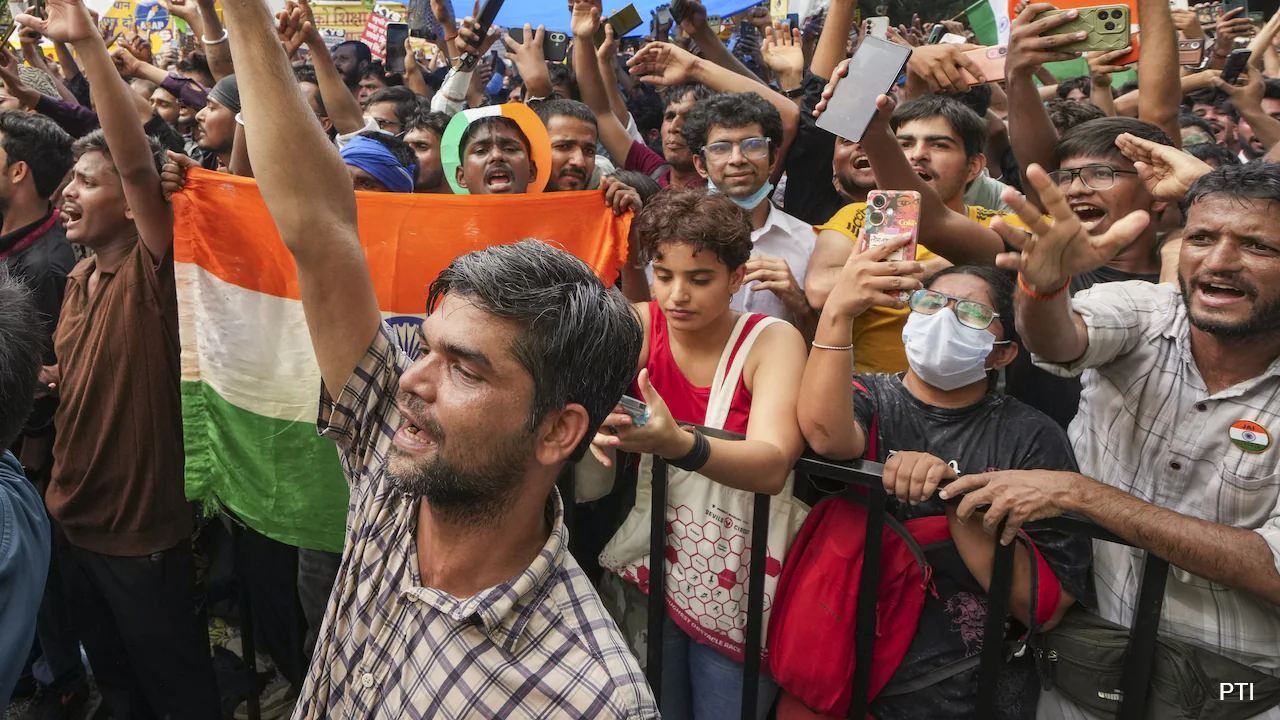
"We are Gen Z, we can do it," 21-year-old Alice, a UPSC aspirant, said at Delhi's Jantar Mantar with the flat certainty of someone stating a fact rather than making a prediction. She was talking about Dharmendra Pradhan's resignation - the primary demand of thousands of young protesters across India spearheaded by Abhijeet Dipke's Cockroach Janta Party or CJP. Just hours earlier, government sources had indicated that the Education Minister's exit was not on the cards and that it would be the "easiest decision to make".
Less than a day later, she was proved right. Dharmendra Pradhan - only the second Union Minister to quit in Prime Minister Narendra Modi's tenure - resigned and crowds of protesters - many dressed as cockroaches, Batman, Superman, Mahatma Gandhi, and all of them armed with a phone and an Instagram account, erupted in joy.
Alice belongs to a generation routinely dismissed as distracted, entitled and perpetually online. During the CJP protests, however, many of those very habits became advantages. Constant phone use became documentation. Meme fluency became mobilisation. Short-form videos became recruitment. And Instagram became as important to the movement as the protest site itself.
The movement's most effective tool was not a manifesto. It was Gen Z's instinct to document, joke, post and share with Instagram as its amplifier.
"What's in my bag for the Jantar Mantar protest." GRWM for a police crackdown. Pre-protest workout routines captioned "Delhi Police ki laathi khaane jaa raha hoon (going to go get lathi-charged by the Delhi Police)". One protester filmed himself being chased by police, narrating it half-amused, like commentary on someone else's chase scene - turning fear of crackdown into content.
Even detention became content. Videos showed protesters cracking jokes inside police buses, singing, filming selfies with fellow detainees or turning the experience into a vlog, often with captions that mixed humour with defiance.
Collectively, these videos lowered the psychological barrier to joining the protests. Jantar Mantar began appearing on feeds less like an intimidating site of confrontation and more like a place people simply showed up to.
The site itself resisted the visual grammar of protest-as-suffering. Volunteers fanned strangers through the humidity. There was free ice cream, chai, food delivered from cities across the country, medical aid, legal aid - elements perfect to travel on a feed as easily as any meme.
"There are no set roles for us here," said a volunteer, too busy to give his name. "We fill in wherever we see a gap. All of us are self-motivated. Many of us have nothing to do with CJP, there are many students who just want to help." For a movement that insisted from day one that it was about the cause and not about who led it, that was itself the point.
As the protests intensified, so did their online life. Support surged after the July 20 march to Parliament turned violent, with protesters accusing the police of using excessive force.
Alongside emotional first-person accounts from victims and witnesses, feeds filled with something closer to a field manual: advice on dealing with tear gas, protective goggles to cut exposure to smoke and irritants, one student's tip on lining jeans with thermocol sheets at the hip and back to soften a baton's blow. The crowdsourced advice gave the crowd a sense of togetherness.
"It feels like all of us are in this together. I will keep coming here even if it takes months," Alice said, smiling, offering me chai within moments of our eyes meeting at a protest where everyone was a stranger to me.
The protests showed that public demonstrations weren't limited to the streets. They continued online, where millions who never set foot at Jantar Mantar still participated in shaping the narrative - a generation that grew up documenting itself, using that same instinct to its own advantage. Constant phone use, reflexive filming, fluency in memes and short-form video, the habit of recording everyday life, all of it became infrastructure: for documentation, for mobilisation, for narrative-building faster than any newsroom could match.
"People say we take a lot of pictures - this is why we take a lot of pictures, so that we have proof," Rhiya Ahir told NDTV, recalling one of the defining images of the protests - the moment she stood in front of a police van packed with detained protesters in Mumbai.
The government, in its own way, acknowledged the power of social media virality with PM Modi advising his Cabinet colleagues to engage with the youth on Instagram through Reels and interactive sessions - just hours after he posted a message on the social media platform listing planned government measures to stem paper leaks.
For a generation routinely accused of being glued to its screens, the CJP protests told a more complicated story. Smartphones became cameras, notebooks, evidence lockers and megaphones. Habits often dismissed as vanity or distraction helped create an unprecedented real-time archive, one recorded not just by television crews and photojournalists, but by thousands of young people documenting events as they unfolded.
-
Opinion | Building BRICS In New Delhi

For India as the host nation, chairing the summit tests the core tenet of its modern foreign policy: strategic autonomy.
-
Can India 'Mediate' Between Iran And UAE At BRICS? Gulf Envoy Suggested It Once
At the very start of the Israel-US war on Iran, it was a UAE diplomat who had suggested as much.
-
Opinion | When The Feed Braves The Flood
NDTV drops the 24x7 and stakes its next chapter on presence as it inaugurates a new identity
-
I Went Looking For A PG In Delhi's Kamla Nagar. Here's What I Found
In every PG visited by NDTV in Delhi's Kamla Nagar, the conversation began with amenities. Nothing in the sales pitch was about how secure the building was.
-
Opinion | How Trump Is Doing More For BRICS Than Its Critics Ever Could
By trying to bully BRICS countries into submission, Trump may be giving the grouping the very relevance he is trying to deny
-
Opinion | BRICS Has Grown Up. Now It Must Behave Like An Adult
The India-China accommodation will be a key driver of the grouping, but a 'non-Western' agenda will work well only if it focuses on ending global conflict as much as on stabilising the global economy
-
Opinion | 9/11, And The Price Of Fighting Terror For A Quarter Century
Twenty-five years later, 9/11 is more than just a lived memory for those who witnessed it in real time, as I did as a UN official
-
Opinion | US Can Threaten, Not Dictate: What India's Iran Message Really Means
If India's Bishkek message was a signal to the US, then Pezeshkian's arrival in New Delhi for BRICS will be a defining note: that India's strategic autonomy is not up for debate