3 Minutes, 6 Stanzas, Century-Old Debate: The Many Turns In Vande Mataram's Journey
PM Narendra Modi launched a year-long commemoration of the song's 150th anniversary on November 7, 2025. In December, both Houses held special discussions on it, during which the 1937 Congress decision was scrutinised.
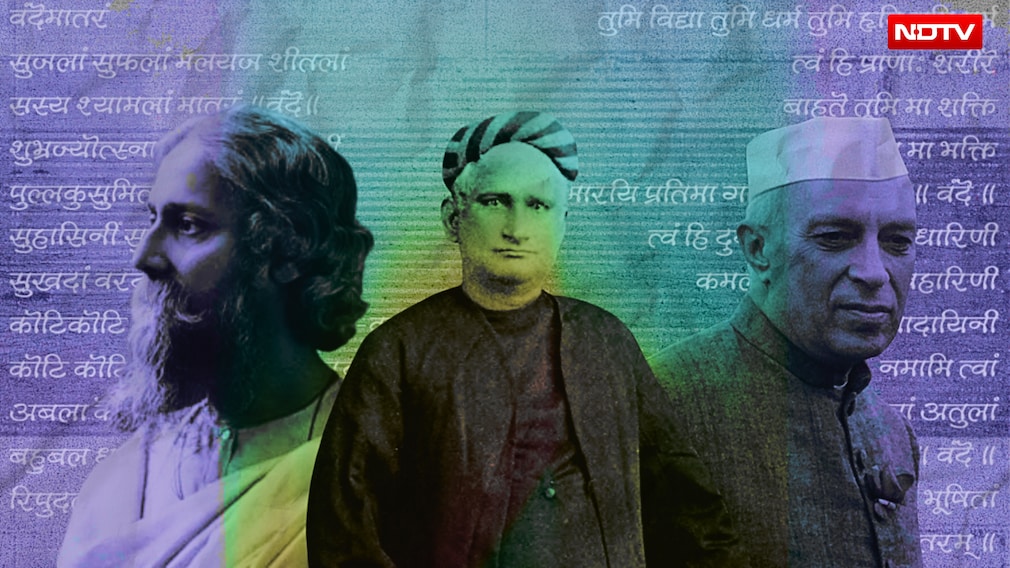
When the Congress decided this month that only the first two stanzas of Vande Mataram would be sung at party events, it was not making a new decision. It was reaffirming one taken 89 years ago, in the last week of October 1937. But the controversy over which parts of it are secular or inclusive enough, and which stanzas should not be sung, has travelled even longer, both in time and space.
The latest row came after the BJP-led central government's moves to "give due respect" to the National Song. Parliament in July amended the Prevention of Insults to National Honour Act, extending to Vande Mataram the statutory protection the National Anthem, Jana Gana Mana, had so far. Preventing or disrupting the singing of Vande Mataram is now a criminal offence punishable with up to three years in jail.
That singing means the full song (six stanzas) as per a separate notification. But the debate over the 3-minute-10-second version has lasted decades, and continues.
What The Stanzas Say
Written by Bankim Chandra Chattopadhyay (or Chatterjee) in 1875 in Sanskritised Bengali, and first published in the journal 'Bangadarshan' as part of a serialised novel, the poem acquired much of its contentiousness after it was incorporated into the book form of the novel, 'Anandamath', in 1882.
This novel is set against the 18th-century Sanyasi Rebellion against the British and local Muslim-led administrations. It has been praised as a rousing retelling of a revolutionary moment in history, but also critiqued for having fictionalised some parts to allegedly disparage certain communities.
In Aurobindo Ghose's English translation of all six stanzas, published in 1909 as 'Mother, I Bow to Thee', the first two describe a fertile land cooled by southern winds, its nights "rejoicing in moonlight".
The third is where it turns to more pointed imagery, speaking of millions of throats and the sharpness of swords. This one closes on the mother driving away the armies of her foes. The fourth speaks of "thy image we raise in every temple", deploying Hindu imagery. The fifth names her as Durga with 10 weapons of war, as Kamala (or Lakshmi) at play in the lotuses, and as Vani (or Saraswati), the goddess of learning. The sixth follows in the same vein.
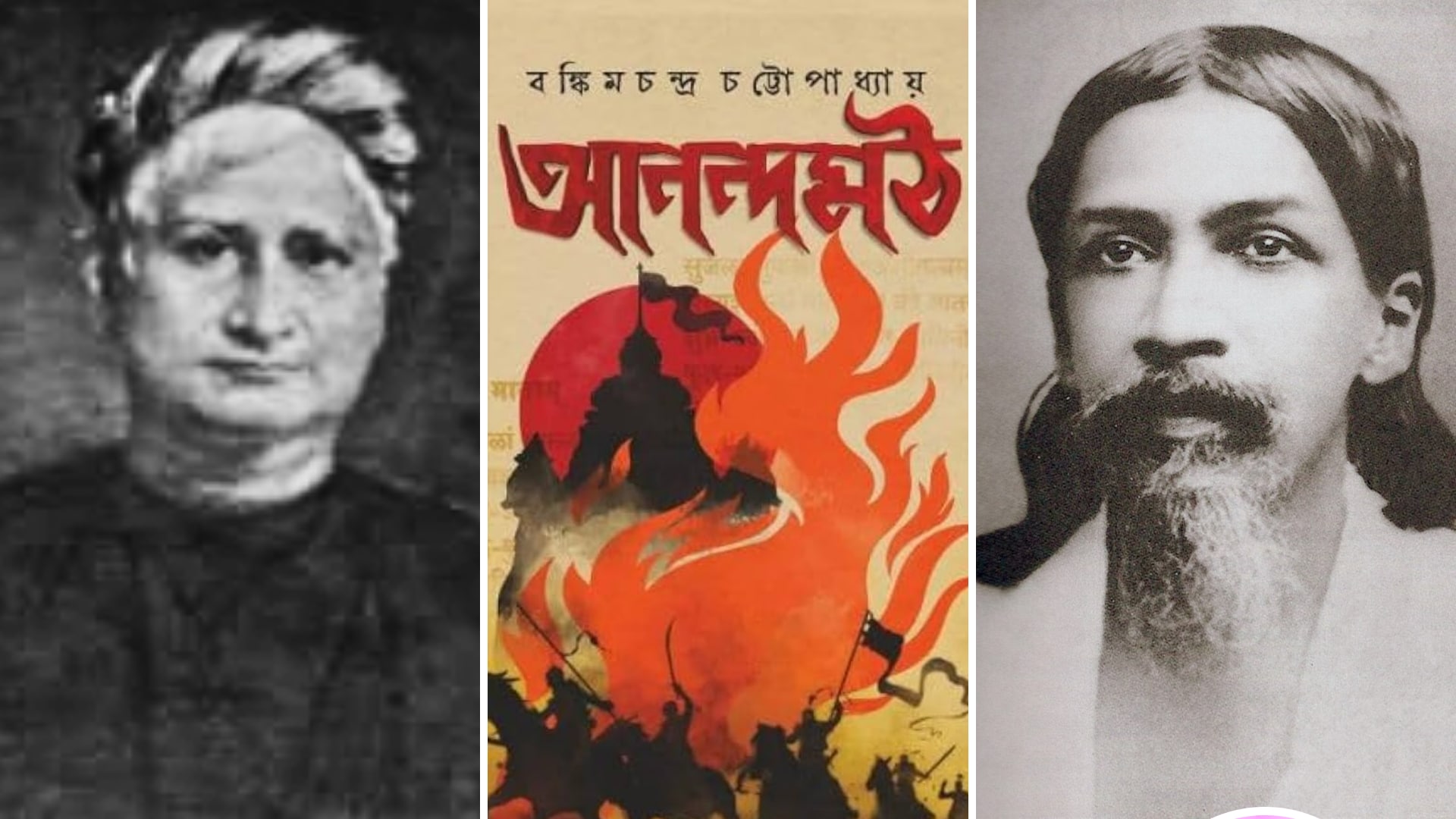
Bankim Chandra Chattopadhyay's novel Anandamath contains Vande Mataram, which was famously translated into English by Aurobindo Ghose. (Images: PIB, Amazon, Wiki Commons)
Move beyond Bengal
Poet-scholar Rabindranath Tagore set Vande Mataram (also called 'Bande Mataram' as per Bangla phonetics) to music, and sang it at the Congress session in Calcutta in 1896. At the party's Bengal provincial conference at Barisal in 1906, held under the presidentship of A Rasul during an agitation against the partition of Bengal, police lathi-charged delegates and tore 'Bande Mataram' badges. The Congress recorded this as a pivotal moment in its resolution three decades later, noting that some "were beaten so severely as they cried 'Bande Mataram' that they fell down senseless".
The song soon moved far beyond Bengal. At the International Socialist Congress in Stuttgart in 1907, Bhikaiji Cama unfurled a flag of Indian independence with the words 'Vande Mataram' across its middle band. Soon, multiple journals took the words as a masthead. Its two-word title became a slogan.
The Congress later noted this as the period in which the poem/song stopped being Bengali alone. The party's 1937 resolution acknowledged that the number 70 million (7 crore) in the poem had long been replaced by 30 crore, the population of all of India at the time: "[The larger number] crept in at a later stage when the song came to have a national significance." The population reference made no religious distinction, it said.
Why, then, was a choice made on the stanzas?
At the Congress session at Kakinada (now Andhra Pradesh) in 1923, the singer Pandit Vishnu Digambar Paluskar rose to render the song. Maulana Mohammad Ali Jauhar, presiding over the session, objected. No final decision was made, and singing it or not, curtailed or in full, remained discretionary.
The year 1937 then became key in Vande Mataram's journey.
What Happened Through 1937
Muhammad Ali Jinnah had left the Congress and was presiding over the Muslim League's annual session at Lucknow, where, listing his grievances against the Congress, he said on October 15, 1937, "Hindi is to be the national language of all India, and the Bande Matram is to be the national song, and is to be forced upon all." He made a broader charge in that speech, that "the majority community have clearly shown their hand: that Hindustan is for the Hindus".
This speech has been described, including by some BJP leaders recently, as a campaign by Jinnah that the Congress pandered to.
What is known is this: The same week that Jinnah spoke at Lucknow, Subhas Chandra Bose wrote to Jawaharlal Nehru, the then president of the Congress, suggesting he consult Tagore. Nehru's reply is available in his archives.
Nehru wrote back from Allahabad on October 20, 1937, agreeing to speak to Tagore, and told Bose he had obtained an English translation of 'Anandamath' to understand the background of the song. "It does seem that this background is likely to irritate the Muslims," he wrote.
He continued, "There is no doubt that the present outcry against Bande Mataram is to a large extent a manufactured one by the communalists. At the same time there does seem some substance in it... Whatever we do cannot be to pander to communalists' feelings but to meet real grievances where they exist."
The Congress recently circulated Tagore's response, pointedly during the December 2025 parliamentary debate on Vande Mataram.
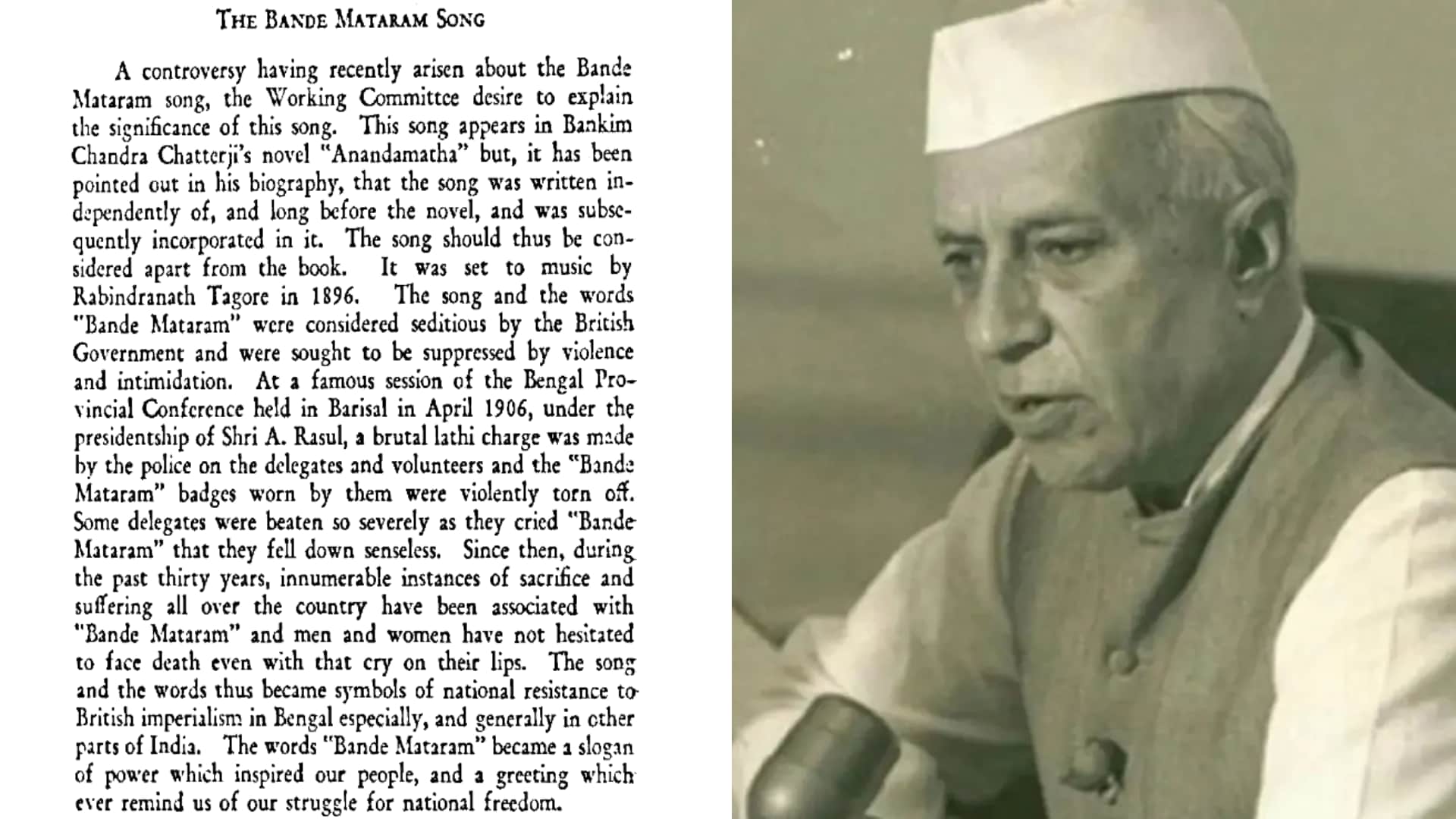
Nehru was president of the Congress when a key decision on Vande Mataram ('Bande Mataram', part of the CWC statement pictured here) was made in 1937. (Image: AICC)
Writing to Nehru, Tagore said, "To me the spirit of tenderness and devotion expressed in its first portion, the emphasis it gave to the beautiful and beneficent aspects of our motherland made a special appeal..." But he "found no difficulty" in dissociating this part from the rest of the poem and other portions of the book.
The poem's core, he said, was a hymn to the Hindu goddess Durga. Noting that he had been raised in his father's monotheistic ideals, he said some parts could "wound Muslim sensibilities". Muslim scholars have long argued that the song's imagery of 'Mother India' as a goddess violates the basic Islamic tenet of strict monotheism, which forbids followers from worshipping anyone other than Allah and from idol worship.
Tagore's way out: "Bande Mataram" as a song of the freedom movement had already come to consist of only the first two stanzas, and there was no need to carry the rest with it each time.
Nehru had also written to Urdu writer Ali Sardar Jafri before Jinnah's speech, on September 1, 1937: "I think that the whole song and all the words in it are thoroughly harmless and nobody can take exception to their meaning... But I also think that the song is not suitable as a national anthem. It contains too many difficult words which people do not understand and the ideas it contains are also out of keeping with modern notions of nationalism and progress."
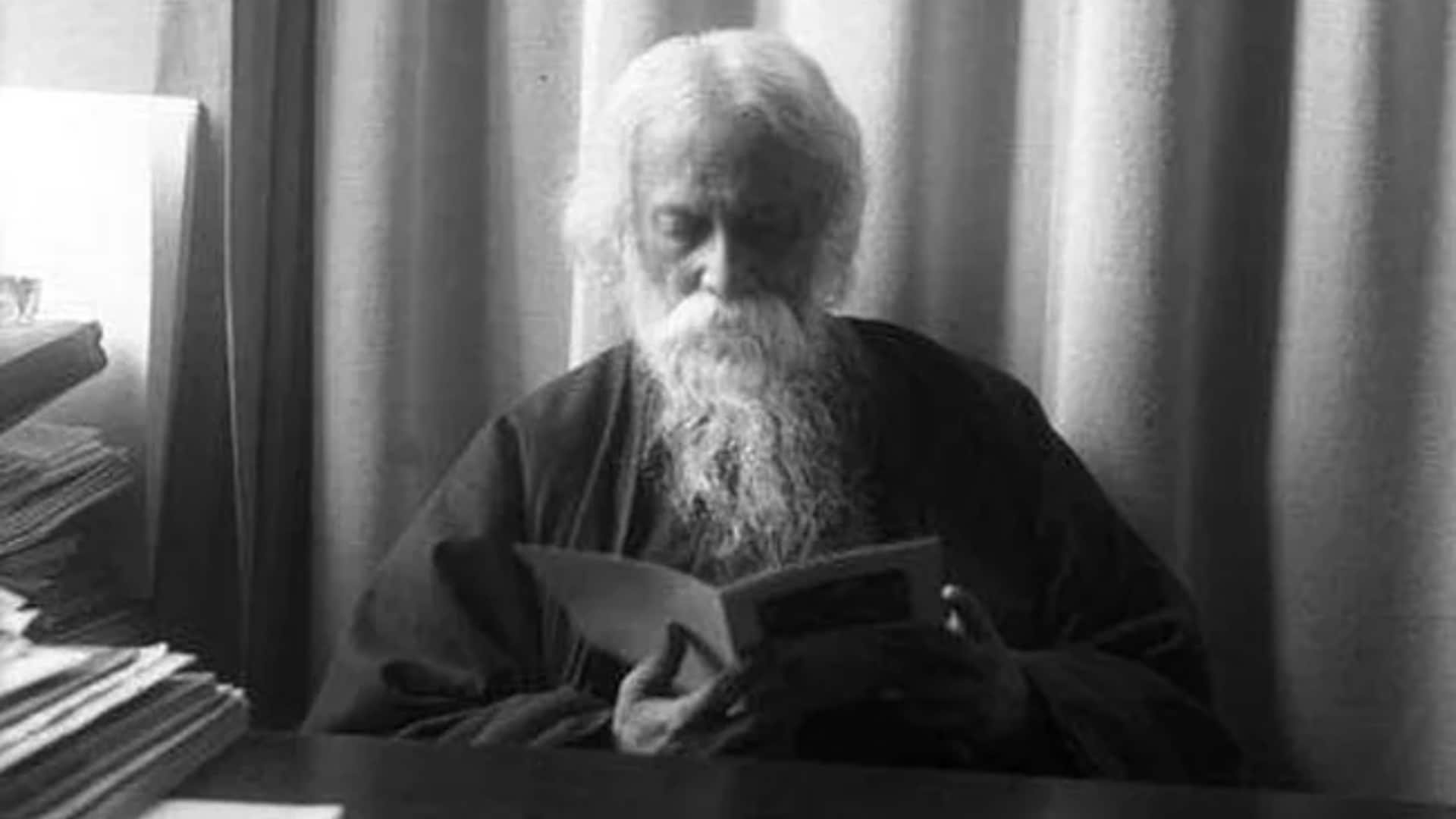
Rabindranath Tagore held the view that the first two stanzas were enough. (Image posted on X by @NobelPrize)
A Decision That Echoes
The CWC, the main decision-making body of the party, met in Calcutta (now Kolkata) from October 26 to November 1, 1937, with a session of the wider All India Congress Committee running concurrently (October 29-31). That's where the party resolved that only the first two stanzas be sung. A statement by the CWC defended the song, before qualifying the decision on the stanzas.
In the opening stanzas, the committee saw no ambiguity. These described the motherland's beauty in tender language, and "there was absolutely nothing in them to which objection could be taken from the religious or any other point of view". "[The song] was never sung as a challenge to any group or community in India," it noted.
The other stanzas "are little known and hardly ever sung", and "contain certain allusions and a religious ideology which may not be in keeping with the ideology of other religious groups in India".
A key line was: "The Committee recognise(s) the validity of the objection raised by Muslim friends to certain parts of the song."
It nevertheless held that "the modern evolution of the use of the song as part of National life is of infinitely greater importance than its setting in a historical novel", and recommended the first two stanzas at national gatherings. This was passed unanimously. Rajendra Prasad and Vallabhbhai Patel were present, as were Mahatma Gandhi, Jawaharlal Nehru, Subhas Chandra Bose, Maulana Abul Kalam Azad, JB Kripalani and Govind Ballabh Pant, among others.
The CWC clarified: "At no time, however, was this song, or any other song, formally adopted by the Congress as the National Anthem of India."
That status went to Jana Gana Mana later, with Vande Mataram becoming the National Song with "equal" respect, as per the Constituent Assembly.
Mahatma Gandhi held the view, in 1939, that "no matter what its source was and how and when it was composed", Vande Mataram "has become a most powerful battle-cry among Hindus and Mussalmans of Bengal during the partition days". He called it "an anti-imperialist cry" and said, "It had never occurred to me that it was a Hindu song or meant only for Hindus."
He supported the two-stanza compromise, though, and right after Independence, on August 23, 1947, asserted that the song was now a slogan that "should never be a chant to insult or offend the Muslims".
As Settled at Independence
On August 14, 1947, at the ceremony marking the transfer of power from the British Raj to the Indian Dominion, Sucheta Kripalani sang the first verse of Vande Mataram as the opening item. Twelve days later, HV Kamath rose in the Constituent Assembly to complain that members had entered the chamber only after the song had finished.
The Constituent Assembly debated whether Vande Mataram or Jana Gana Mana should be the anthem; Nehru favoured the latter, arguing also that it lent itself better to orchestras and military bands abroad.
On January 24, 1950, Rajendra Prasad, as Constituent Assembly President, announced the settlement. Jana Gana Mana, written by Tagore, would be the National Anthem. This is also a curtailed version -- the first of five verses of 'Bharoto Bhagyo Bidhata', a religious hymn originally composed for the monotheistic Brahma Samaj.
Vande Mataram, "which has played a historic part in the struggle for Indian freedom, shall be honoured equally with Jana Gana Mana and shall have equal status with it". The morning of August 15, 1947, Omkarnath Thakur, on an invitation from Vallabhbhai Patel, performed the complete version on All India Radio. When Parliament passed the Prevention of Insults to National Honour Act in 1971 to protect the Anthem and the Flag, the National Song was left outside it.
Delhi Debates, 150 Years On
Prime Minister Narendra Modi launched a year-long commemoration of the song's 150th anniversary on November 7, 2025. In December, both Houses held special discussions on it, during which the 1937 Congress decision was scrutinised.
PM Modi and Home Minister Amit Shah characterised the "partitioning" of the song as the foundation of the Partition of India into two nations, India and Pakistan, in 1947. The Congress, in arguments put forth by Priyanka Gandhi Vadra and others, said the choice of stanzas had been settled by freedom fighters in their wisdom.
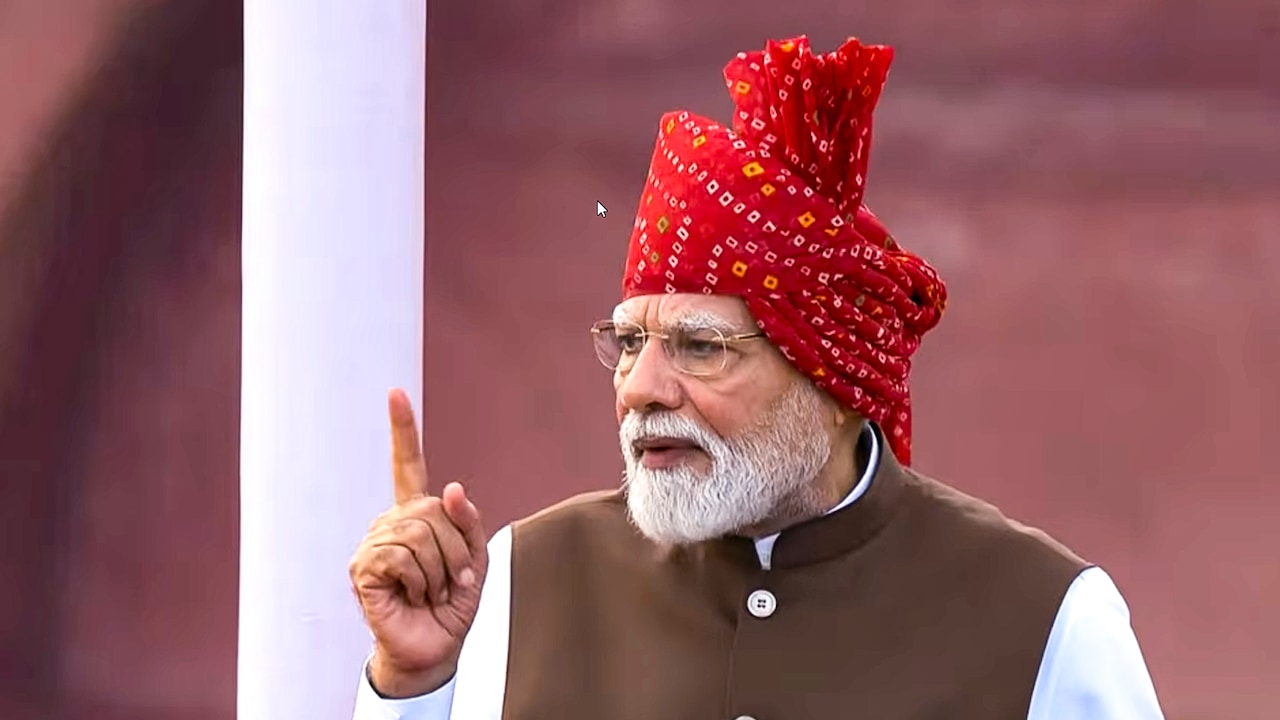
PM Narendra Modi delivering his Independence Day speech on August 15, 2026.
The Centre moved forward with all six stanzas and, at the start of this year, the Home Ministry notified protocols directing that the entire song be sung at official functions, before Jana Gana Mana. In July, the relevant law was amended, too, to provide for jail term if anyone obstructs such singing.
Read | Analysis: War For Votes Over Vande Mataram
On August 15, 2026, all six stanzas, for the first time, were sung from the Red Fort. At the Congress headquarters the same morning, footage of Sonia Gandhi speaking to party chief Mallikarjun Kharge during the rendition set off the latest row. Four days later, the Congress Working Committee met and reiterated its position taken in Calcutta in 1937.
-
Indian Family Wipeout Over iPhone: The Dangerous Lure Of Consumer Tech Debt

Young buyers walk into physical retail stores, hand over basic identity documents and walk out with a consumer electronic device that costs more than their entire family's monthly take-home income
-
China Outspends India In Space, But New Delhi Holds The Trust Card
The US remains the undisputed leader in the global space race. But it's realistic for India to aim for the third place, says Bellatrix Aerospace COO.
-
It's About The Provenance: Head Of Strategy Koreel Lahiri Decodes One Identity Of NDTV
We at NDTV consciously recognise the fact that the same consumer inhabits several screens during the course of a day.
-
Opinion | India's UPI Miracle Has Created A Difficult, Rs 20,000-Crore Question
UPI's whole magic was the Rs 30 payment it charged nothing for. But how long can it stay free?
-
Opinion | Manmohan Singh, Bachchans, And Other Secrets Of 10 Janpath: The Sonia Gandhi Story
She entered politics reluctantly, mastered its power games, chose Prime Ministers, and managed betrayals. Congress's most powerful woman finally tells the world how.
-
Opinion | Why The Congress-Samajwadi 'Merger' Fantasy Could Be Opposition's Biggest Self-Goal
Rahul Gandhi and Akhilesh Yadav do not need to become one another. They need to become better at being themselves, together.
-
Opinion | Mumbai's 'Marathi' Test For Cabbies, And The Art Of Fixing The Wrong Problems
All these years, India's financial capital has worked just fine without a Marathi mandate for its taxiwallahs. Whose problem is the new language rule actually solving now?
-
Opinion | Rs 1.05 Lakh Crore Lost: Inside The Dangerous Rise Of India's Gen Z Stock Traders
Investors under 30 now account for 37.9% of the total investor base in India. But they are also losing money at a much higher rate. Why are they doing it?
-
Opinion | Why A 'Bangladesh' Proposal By Turkish Media Should Worry India
A recent article in Turkish media illustrates how Ankara is turning into a strategic threat for India and its neighbourhood