What Mirzapur The Movie Gets Right That Bollywood's Superstar Films Often Get Wrong
Mirzapur: The Movie doesn't have a conventional Bollywood 'superstar' whose name alone can command an opening, and yet, the theatres are filling up
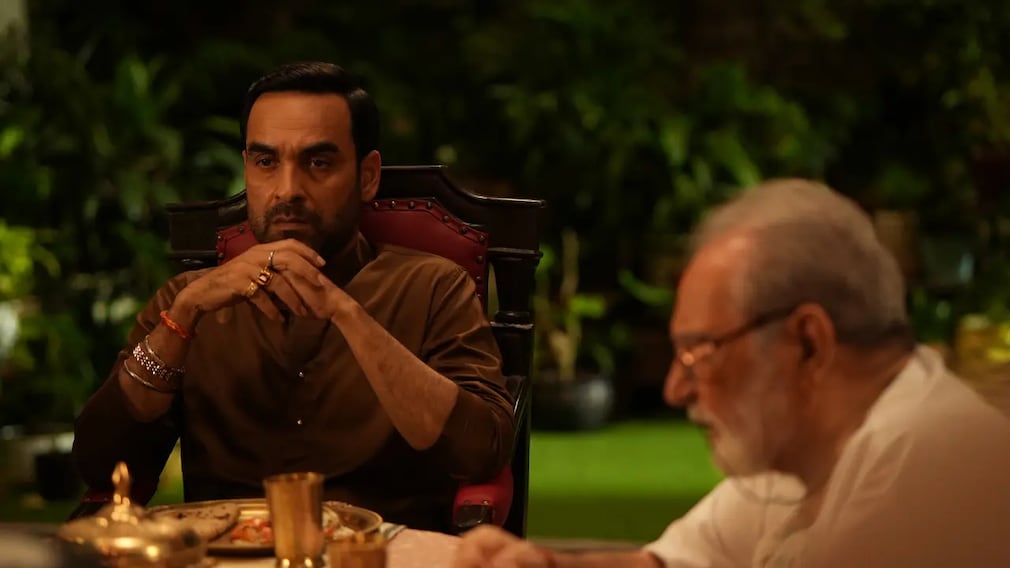
Last Tuesday, on a working day, in the middle of the afternoon, I watched Mirzapur: The Movie at a multiplex in Delhi NCR.
It was a full house.
At a time when theatres are struggling to fill seats even on weekends, that is worth paying attention to. For a three-hour-plus film, it felt less like a Delhi NCR multiplex and more like a small-town single-screen theatre with whistles, claps and hoots greeting every punchline.
What makes it more interesting is that Mirzapur: The Movie doesn't have a conventional Bollywood 'superstar' whose name alone can command an opening. And yet, the theatres are filling up.
The film has definitely flipped a few of Bollywood's old box-office rules. From its opening day to the point where its collections are expected to cross Rs 300 crore, it has done something Bollywood did not quite see coming. Shifting a gritty, couch-viewing streaming universe to the big screen was a massive gamble, but its roaring success has surprised everyone.
Mirzapur isn't the first Hindi series to make the jump to cinema. Khichdi: The Movie tried it back in 2010, with modest success. But Mirzapur has taken the experiment to an entirely different level.
More than a successful film, it could be a turning point in how India consumes entertainment.
What Really Connected With Mirzapur The Movie?
Indian OTT has had no shortage of hits. Every few weeks, a new series seems to be "No. 1 in 100 countries." And then, just as quickly, it disappears from public memory.
The real achievement is not getting people to watch but getting them to remember.
Very few Hindi shows have managed that. Panchayat turned the rhythms of small-town life into mainstream pop culture. Gullak made the ordinary feel wonderfully entertaining. But when it comes to Hindi crime dramas, no recent show has created a more durable cultural footprint than Mirzapur. It took the language of the hinterland - its crime, swagger, humour, violence and characters and made it work everywhere, from metropolitans to Tier-3 towns.
I also believe that the real secret of Mirzapur is not its plot. It is its people.
Think about the characters. Guddu Pandit. Munna Bhaiya. Kaleen Bhaiya. Beena Tripathi. Bauji. Madhuri. Vasudha Pandit. Golu. Even characters with far less screen time have a way of sticking around in your head. That is the hallmark of a truly successful fictional universe: you remember the characters even when you don't remember which episode or season they appeared in.
And Mirzapur has an unusually large supply of them.
Each character has a distinct personality, voice, ambition and, often, a line or mannerism that becomes instantly identifiable. Munna's reckless entitlement. Guddu's transformation from an impulsive young man into a ruthless operator. Kaleen Bhaiya's controlled menace. Beena's quiet calculation. Bauji's old-world cruelty. The women, too, are not merely there to decorate the men's story. Beena, Golu and Madhuri have their own agendas, strategies and arcs. Even characters who barely occupy the centre of the narrative can leave a mark.
It is tempting to compare that quality with something like Sholay, where even supporting characters became part of the country's collective memory. I wouldn't make that comparison too literally. The eras, formats and cultural contexts are completely different. But on one very specific parameter- the sheer number of characters with recall value - Mirzapur is unusual.
Even the smallest characters have recall value. Remember the infamous '*%#$* waale chacha'. Maqbool, the bodyguard. Or Penchar in the movie. These aren't characters who had enormous screen time, just one crazy moment to make an impression.
Perhaps that was where Mirzapur had an advantage that most new films simply don't.
You don't need to introduce these people or a five-minute backstory explaining who Guddu or Munna Bhaiya is. You don't need to establish Kaleen Bhaiya's power. The audience already knows. They have spent years with these characters. They know their histories, their rivalries, their betrayals and their catchphrases. They know who hates whom. They know who is likely to pull the trigger, and who is likely to smile before doing it.
That familiarity is incredibly valuable in a theatrical environment. Most films spend the first act asking audiences to invest in their characters. Mirzapur The Movie walked into the theatre with that investment already made. The theatre was simply the new meeting place. And the film rewarded that loyalty with a well-made masala entertainer that delivered more than fans had expected.
What Makes Mirzapur A Breakthrough
Mirzapur: The Movie has boldly broken multiple Bollywood traditions at once. For starters, it opened at around Rs 25 crore on day one, without any conventional superstar leading the film. In this case, the franchise became the star.
The film has also reversed the traditional Bollywood film journey. Historically, the entertainment pipeline flowed strictly in one direction: theatrical films would eventually find a secondary life on streaming platforms. Here, the journey went the other way. A show built over several seasons on OTT created enough fandom to reverse-engineer a massive theatrical event.
Mirzapur has always had a strong connect with smaller towns and the Hindi heartland. But its theatrical success goes well beyond Tier-2 and Tier-3 markets. It has also pulled audiences into multiplexes in the metros, cutting across the usual urban-mass divide.
Perhaps the biggest achievement is that it converted streaming fandom into paying theatre audiences. Watching a series at home is easy. Paying for a ticket to watch its continuation is a different commitment. Mirzapur managed to make that transition almost seamlessly.
The Success Has Big Implications For Both OTT And Cinema
Mirzapur could change how OTT and Bollywood think about franchises. Soon, OTT's biggest shows could become their biggest theatrical franchises.
Industry insiders confirm that streaming platforms are already scouting their top web series for theatrical potential. The partnership between Amazon MGM Studios and Excel Entertainment offers a blueprint for a true hybrid model. Streaming giants realise they can co-own theatrical revenue streams, creating a hybrid model where the same IP works across both platforms.
Most importantly, it has the potential to rewrite the rules of Bollywood's traditional star system. When a fictional universe and its characters already carry massive cultural weight, the IP becomes the star. For studios, this drastically lowers risk: why spend years launching an unproven character or wait for a superstar when an OTT show already has millions emotionally hooked?
You can expect the rise of a new force in Indian entertainment: the streaming universe franchise, which has the one thing every producer wants: an audience already waiting.
The irony isn't lost on the industry. A quarter-century ago, Farhan Akhtar and Ritesh Sidhwani's Excel Entertainment redefined slick, urban Bollywood with Dil Chahta Hai. Today, the same team has taken one of India's rawest, most unapologetically mass OTT worlds and brought it to the big screen with remarkable success.
-
Opinion | Building BRICS In New Delhi

For India as the host nation, chairing the summit tests the core tenet of its modern foreign policy: strategic autonomy.
-
Can India 'Mediate' Between Iran And UAE At BRICS? Gulf Envoy Suggested It Once
At the very start of the Israel-US war on Iran, it was a UAE diplomat who had suggested as much.
-
Opinion | When The Feed Braves The Flood
NDTV drops the 24x7 and stakes its next chapter on presence as it inaugurates a new identity
-
I Went Looking For A PG In Delhi's Kamla Nagar. Here's What I Found
In every PG visited by NDTV in Delhi's Kamla Nagar, the conversation began with amenities. Nothing in the sales pitch was about how secure the building was.
-
Opinion | How Trump Is Doing More For BRICS Than Its Critics Ever Could
By trying to bully BRICS countries into submission, Trump may be giving the grouping the very relevance he is trying to deny
-
Opinion | BRICS Has Grown Up. Now It Must Behave Like An Adult
The India-China accommodation will be a key driver of the grouping, but a 'non-Western' agenda will work well only if it focuses on ending global conflict as much as on stabilising the global economy
-
Opinion | 9/11, And The Price Of Fighting Terror For A Quarter Century
Twenty-five years later, 9/11 is more than just a lived memory for those who witnessed it in real time, as I did as a UN official
-
Opinion | US Can Threaten, Not Dictate: What India's Iran Message Really Means
If India's Bishkek message was a signal to the US, then Pezeshkian's arrival in New Delhi for BRICS will be a defining note: that India's strategic autonomy is not up for debate