The Vvaan, Ye Prem Mol Liya To Maatrubhumi: Why Bollywood Is Finally Warming Up To Bihar
For decades, the film industry sold Punjabi weddings, bhangra and Karwa Chauth to the rest of the country. Now they have to discover not just Chhath, but the wider culture and stories of this region
For more than fifty years now, Bollywood has quietly indulged in a sort of soft geographic apartheid. In the Hindi films of the fifties and sixties, romance and celebration belonged to Lucknow's tehzeeb and old-world charm. Post-nineties, Bollywood's music and weddings packed their bags for the mustard fields, and popular festivals depicting 'Indian culture' were mostly set in Punjab.
Quirky stories from West and South Delhi got plenty of screen time too. Plenty of blood, crime, and chaos were mostly reserved for the 1990s Mumbai underworld movies. Even as Bollywood discovered the culture and quirks of 'small town India' over the past two decades, its cameras stopped at Benaras, Bareilly, and Kanpur.
Through all this, Bihar, a state of over 130 million people, an ancient homeland of philosophy and culture, and a permanent nerve centre of Indian politics, was conveniently ignored in commercial Bollywood. Bihar was real, yet its everyday culture barely showed up on the big screen.
Streaming platforms eventually started telling the stories from the state, but big-ticket Bollywood largely stayed away. It was a classist blind spot designed to comfort upper-middle-class, urban moviegoers who were used to seeing Bihar in one condescending way: as a poor, backward supplier of cheap labour whose everyday life wasn't aesthetic enough for big Bollywood banners.
Yet suddenly, what we are seeing is a very convenient change of heart in Bollywood.
"Ek Bihari Sau Pe Bhaari"
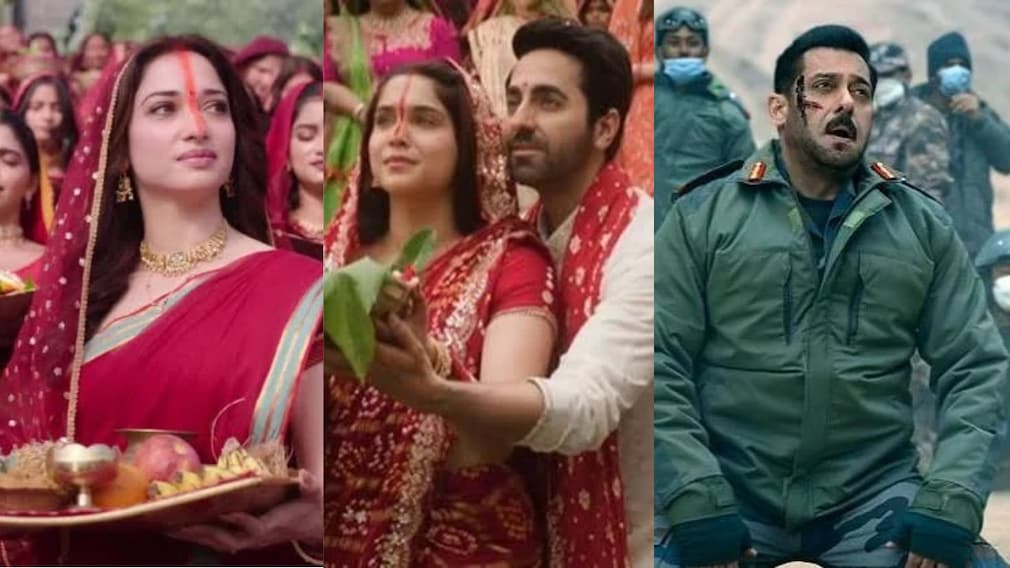
Superstar Salman Khan is playing a Bihar Regiment officer in his forever 'upcoming' Matrubhumi, turning the old regional boast "Ek Bihari sau pe bhaari" into his main trailer punchline. Meanwhile, Bihar's biggest cultural export, Chhath Puja, has officially moved from the riverbanks to the multiplexes. Sidharth Malhotra and Tamannaah Bhatia's The Vvan featured a lavish Chhath song that had little do with the film's actual plot.
Now, Rajshri Productions, Bollywood's ultimate barometer of safe, mainstream family values & culture, has cast Punjabi boy Ayushmann Khurrana as a Bihari lead in Yeh Prem Mol Liya, complete with its own grand Chhath set piece. As Ayushmann Khurrana told NDTV, "Prem's family is from Bihar... Of course, there's Chhath Puja."
Bollywood has clearly found a new festival to milk. It seems like Chhath is the new Karwa Chauth. And thekua is coming for makke di roti.
To appreciate this change of heart, you have to rewind the tape on how Hindi cinema treated Bihar for decades.
When The Great Shailendra Tried (And Failed!)
The earliest real taste of Bihar's soil in mainstream Hindi cinema came from poet-lyricist Shailendra's passion project, Teesri Kasam (1966). Headlined by huge stars like Raj Kapoor and Waheeda Rehman and partly shot in Araria, the film bombed on release. Today it's rightly hailed as a classic, and few films have ever captured Bihar's people and folk traditions with such honesty. Even the songs, from Chalat Musafir and Paan Khaaye Saiyan Hamaar to Sajan Re Jhooth Mat Bolo, sounded unmistakably like the region's own folk music rather than a studio imitation.
Even after Bhojpuri cinema took off in 1963 with Ganga Maiyya Tohe Piyari Chadhaibo (backed by mainstream Hindi cinema talent including Nazir Hussain and Lata Mangeshkar), Bombay's big banners and stars remained far more infatuated with Mumbai, Kashmir, and Lucknow.
The Accent Without The Address
Even superstar Dilip Kumar's blockbuster Gunga Jumna (1961), for all its Bhojpuri-Awadhi cadence and massive popularity in Bihar, safely parked its story in a fictional Awadh town instead.
Ironically, when Rajshri Productions was staring at financial ruin in the early1980s, it was the sleeper hit Nadiya Ke Paar (1982) that bailed them out. Set in Jaunpur, eastern Uttar Pradesh, the film is often casually labelled a 'Bhojpuri film' because of its Awadhi-Bhojpuri dialect and songs. It ran for months across North India's single screens, turning its blockbuster soundtrack into a permanent staple at weddings and Holi celebrations across UP and Bihar even today.
But even after that success, Bollywood treated it as a one-off rural fluke. Meanwhile, Bhojpuri cinema built a huge audience of its own, only to be dismissed by city critics and multiplex crowds as cheap and lowbrow.
For years, whenever Bollywood wanted stories of feudal violence or rustic romance, their characters often spoke idioms and slang native to areas of Bihar, yet title cards and scripts neatly rebranded them as towns of Eastern U.P. or vague fictional heartland zones. To Bollywood, 'pan-Indian' meant catering to the Delhi-Punjab belt and urban metros.
Guns, Goons And Bihar
The real irony was that Bihar was already supplying Mumbai with its sharpest talent. Shatrughan Sinha brought the swagger and became a huge star in Hindi cinema. Later, Manoj Bajpayee and Pankaj Tripathi changed the way Hindi cinema looked at acting. Films like Shool and Prakash Jha's mainstream political dramas Gangaajal (2003) & Apaharan (2005) did put Bihar on screen, but mostly through the familiar lens of crooked politics and jungle raj.
It was Anurag Kashyap's Gangs of Wasseypur (2012), set in Dhanbad (undivided Bihar for much of the film's timeline), that made the heartland look cool, stylish, and cinematic. Its local music, earthy language and unapologetic profanity had a swagger of their own.
But Wasseypur came with the same catch as Prakash Jha's earlier films. By setting a template that dozens of crime movies and streaming shows followed (Maharani, Khakee, Jamtara), it locked in Bihar's image as a land of gangsters, guns, and mafias. It meant that Bollywood was finally willing to enter Bihar, provided the trip came with a body count. The state's everyday warmth, family life and festivals, celebrated so freely in the Hindi films set in Punjab, would have to wait.
Bollywood did attempt a mainstream Bihar biopic with Vikas Bahl's Super 30 (2019), with Hrithik Roshan playing mathematician Anand Kumar. On paper, it was gutsy casting: a Greek-god superstar ditching his abs, hiring a dialect coach, and stepping far outside his comfort zone. The film made money, too. Still, Roshan took plenty of flak for his shaky accent and heavy brownface makeup to 'look like a Bihari'. Worse, throughout promotions, he kept thanking his coach for teaching him the 'Bihari accent', blissfully unaware that Bihar speaks distinct languages like Bhojpuri, Magahi, and Maithili, not one single, catch-all 'Bihari accent'.
Why Is Bollywood Warming Up To Bihar Now?
Put simply, the audience has changed.
Over the last three decades, migration from Bihar and Eastern UP has quietly reshaped India's major cities. Second-and third-generation Biharis now sit in corporate boardrooms, run major newsrooms, and power the bureaucracy. More importantly for Bollywood, they buy multiplex tickets. Naturally, they want to see their lives, festivals and culture on screen. And Bollywood, in turn, sees a lucrative new audience and a market it no longer can afford to ignore.
Their clout is visible on the streets every autumn. Once a quiet ritual performed on distant riverbanks, Chhath Puja has exploded into a massive public spectacle across the Yamuna banks in Delhi and the seafronts of Mumbai. It carries real cultural and political weight. How long could Bollywood keep pretending this audience does not exist? You cannot ignore one of India's largest internal diaspora forever.
Don't mistake this sudden affection for a cultural awakening. It is cold business. Politicians spotted this new vote bank years ago. Mumbai's filmmakers are just late to the party.
For decades, the film industry sold Punjabi weddings, bhangra and Karwa Chauth to the rest of the country. Now they have to discover not just Chhath, but the wider culture and stories of this region. As I said, they would have to believe that thekua can be as cinematic as makke di roti.
Treating Bihar solely as a gag or a gangland is getting old. If Yeh Prem Mol Liya hits the jackpot, expect Bollywood to suddenly realise that Mithila, Magadh, and Bhojpur have plenty of other stories to sell.
-
The Hidden 'Water Cost' Of Agriculture: Comparing India With Major Economies

Traditional flood irrigation, which remains common across Indian farms, is a major reason. It has a water-use efficiency of just 35-40 per cent.
-
Blog | DPS MMS To Instagram: The Cost Of Irresponsible Men
On International Men's Day, it is worth having a conversation that isn't always comfortable for men.
-
Real-Life Mirzapur? Story Of UP's Tiwari Haata That Akhilesh Yadav Visited
The Samajwadi Party chief's pit stop at the Tiwari Haata in Gorakhpur carried considerable political significance ahead of the UP elections
-
The Name Is Bond. Emo Bond. Robert Pattinson Inherits 007 With Feelings
The internet has already given the new James Bond a nickname. It is a joke, but it touches on the oldest question for the "cool" spy franchise: How much is he allowed to feel?
-
Buying Property For Investment? 6 Factors To Check Beyond Price
For anyone buying property as an investment, the real question is not simply how much the property costs. It is how much money it can generate.
-
Is Buying Home In A Small Town Smarter Than In A Metro? Here's The Math
According to Knight Frank's H1 2026 Affordability Index, the EMI-to-income ratio stood at 69% in Mumbai and 67% in the National Capital Region.
-
Samajwadi Seat Talks: The UP-Size Gap Between Congress' Rhetoric and Reality
UP Election 2027: Seat-sharing negotiations are rarely easy. More so when they involve a regional force determined to guard its turf and a national party desperate to regain lost ground.
-
Cyber Outages: The Attack That Has No Name
Banks, flights and the world's office mail failed four times in five days, each time without an attacker. The world spends $247 billion a year on locks
-
Buy A Plot Or Flat? What Homebuyers In Tier-2 Cities Should Consider
Plots may offer greater flexibility, but apartments remain a more straightforward route to homeownership for many buyers.