Your CTC Is Dead. Your Company Is Calculating You In Tokens Now
AI is turning years of human skill into tokens that companies can price against salaries. As the cost of machine intelligence falls, the real question is no longer whether AI can do your job, but whether HR will decide it can do enough of it for less.
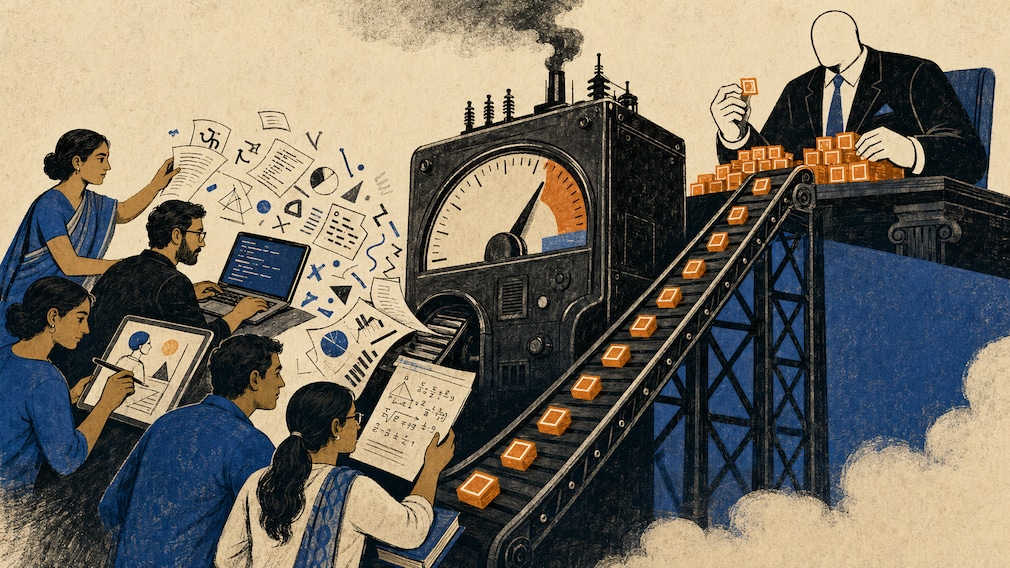
AI has found a way to do something capitalism could never quite manage before: separate skill from the skilled, break it into tokens and sell it by the meter.
There is a line doing the rounds on Reddit: “The underlying purpose of AI is to allow wealth to access skill while removing from the skilled the ability to access wealth.”
It sounds like dystopian exaggeration. Then you realise that every sentence an AI writes, every line of code it generates and every document it analyses is already counted and billed in tokens. A writer's instinct, a coder's logic, a lawyer's drafting and an artist's imagination are being converted into cheap, reproducible units of machine work.
The human spent years acquiring the skill. The model absorbed its patterns, while the platform acquired the ability to reproduce parts of the work whenever a customer was willing to pay. Capital no longer always needs to hire the person. Increasingly, it can simply pay for the tokens.
That is the real AI revolution hiding behind the friendly chatbot. Human expertise is not merely being automated. It is being tokenised, priced and rented back to the economy by companies that control the infrastructure on which this new form of work runs.
So perhaps “Will AI replace humans?” was never the right question. The more disturbing one is: Who owns the meter on human skill?
Skills, Now Priced Per Token
Behind the reassuring language of copilots and assistants, AI has a brutally simple economic grammar. Every action a model performs, including reading, writing, coding, analysing, reasoning or generating an image, consumes tokens. These are small pieces of data processed by the system, and each of them can be counted and priced.
Deloitte calls the token “the fundamental unit of AI work”. Its 2026 analysis argues that the economics of AI increasingly revolve around tokens rather than software licences, processors or server capacity. For companies, the critical calculation is fast becoming how efficiently tokens can be converted into revenue, productivity or lower costs.
That may sound like a technical change, but it is also a redefinition of labour.
A company once hired a content team, a software unit or a group of junior analysts. It paid salaries in exchange for time and expertise. Now, parts of the same work can be summoned through an application programming interface and charged according to consumption. The company no longer needs to employ every person whose skill contributed to the output. It can rent a machine-generated approximation whenever required.
A copywriter's instincts become text generation, a programmer's experience becomes code completion, a lawyer's drafting becomes document automation and an illustrator's eye becomes image generation. The work does not vanish, but the relationship between the work and the worker begins to fray.
AI Does Not Need To Replace You
The debate around AI and employment is usually framed in absolute terms. Will AI replace journalists? Will programmers disappear? Are lawyers, designers and accountants next?
That is not how the disruption needs to happen.
AI does not have to eliminate an entire profession to alter its economics. It only needs to absorb enough of the routine work to reduce the number of people required. It can produce the junior lawyer's first draft, the journalist's basic report, the developer's boilerplate code and the designer's initial concepts. Companies may still retain experienced humans to supervise, correct and approve the output, but they may require far fewer people beneath them.
This matters because most professions have an apprenticeship structure. The apparently mundane tasks most vulnerable to automation are often how people acquire judgement. Junior lawyers learn by preparing drafts. Reporters learn by covering routine stories. Developers improve by writing ordinary code before they are trusted with critical systems.
If those tasks disappear, companies may save money today while quietly dismantling the process that creates tomorrow's experts. We could end up demanding human judgement in important moments after removing many of the opportunities through which that judgement was developed.
Nor does a model have to become better than the finest human in a profession. It only has to make a large amount of competent work abundant and inexpensive. Scarcity once protected the economic value of expertise. AI weakens that scarcity by reproducing fragments of skill at enormous scale. The individual may remain just as capable as before, even as the market price of parts of that capability falls.
The Person With The Tokens Gets The Workers
This is where the Reddit line becomes difficult to dismiss.
“Wealth accessing skill” is no longer simply a metaphor. Capital buys computing power, computing power produces tokens, and tokens activate models capable of performing tasks that once required trained people.
A sufficiently well-funded company can summon writing, coding, analysis, design and customer support whenever it needs them. It can increase output without increasing employment at the same rate. Unlike human workers, AI systems require no recruitment cycle, leave, insurance or promotion. They can also be expanded or switched off as demand changes.
Deloitte is already advising finance chiefs to treat token expenditure with the seriousness traditionally applied to strategic investment. Businesses are being encouraged to monitor consumption, impose budgets, set usage alerts and charge AI costs back to individual departments. The language is revealing because it treats cognitive output as a metered corporate resource.
The resulting hierarchy is not difficult to see. Chipmakers control a crucial physical layer, cloud companies provide the infrastructure, AI firms control the models and large enterprises hold the budgets required to deploy them at scale. The worker may receive access to a chatbot, but access to the interface is not the same as ownership of the system.
Everyone Has AI, But Not Everyone Has Power
The strongest defence of AI is that these tools are available to almost everyone. A student, freelancer or small business can now gain access to capabilities that once belonged only to large organisations.
That is true and important. It is also incomplete.
A person using a free chatbot with strict limits and a multinational deploying customised agents across its operations may both be described as having access to AI. Economically, however, they possess very different things. One has assistance; the other has infrastructure.
Deloitte's 2026 State of AI report found that worker access to approved AI tools had increased by 50% in a year. Yet only 25% of organisations surveyed had moved at least 40% of their AI experiments into production. The interface has spread much faster than the ability to turn AI into a functioning industrial system.
The global divide is equally instructive. Microsoft's AI Economy Institute found that generative AI adoption continued to rise in 2025, but growth in the Global North was nearly twice as fast as in the Global South.
The existence of a widely available chatbot does not erase differences in computing power, proprietary data, specialised chips, model quality or token budgets. Serious economic advantage will belong to those able to combine these resources at scale. A freelancer may use AI to work faster; a global corporation can use it to redesign entire departments.
Cheap Tokens Carry A Human Cost
Falling token prices are usually presented as an uncomplicated victory. Cheaper AI should encourage innovation, widen access and reduce operating costs.
It will also change the calculation behind many salaries.
As the cost of machine-generated work falls, businesses have a stronger incentive to automate tasks that were previously performed by people. Employees do not suddenly become less intelligent or less hardworking. Their problem is that parts of what they do can now be reproduced at a price against which no salary can easily compete.
Previous technologies produced similar disruptions. The printing press displaced scribes, calculators replaced human calculators and industrial machinery reduced the economic power of many artisans. AI, however, is moving across several cognitive professions at once. The same underlying technology can produce language, images, software and analysis, while a programmable meter records the cost of every operation.
The machine age automated large parts of physical labour. The token economy is beginning to apply the same logic to thought.
Productivity For Whom?
There is, of course, a more optimistic case. AI can make individual workers dramatically more capable. It can give small firms access to expertise they could never previously afford, create new markets and generate professions that do not yet exist.
PwC's 2026 Global AI Jobs Barometer found stronger productivity growth at companies most exposed to AI. It also reported that wages and headcount were rising faster in some AI-exposed industries than in those with less exposure. Technology does not create only losers, and predictions of total job extinction have rarely aged well.
But overall productivity growth does not settle the question of ownership.
A company can become more productive while employing fewer people. An economy can grow while workers lose bargaining power. Wages can rise for a smaller group of AI-augmented specialists even as the entry routes into those jobs narrow.
If one employee equipped with AI can perform the work previously done by ten, who receives the benefit? The worker is unlikely to be paid ten times as much. The working week is unlikely to be reduced by 90%. The nine people no longer required are unlikely to receive a share of the savings.
In most cases, the productivity gain will appear on the company's balance sheet. That does not make AI inherently malign. It does, however, expose the limits of describing productivity as though its rewards are automatically shared.
Whoever Owns The Meter Owns The Future
The AI debate has focused heavily on capability. Can machines reason? Can they become creative? Can they outperform humans? Will they eventually reach artificial general intelligence?
These questions matter, but they can distract from the economic transformation already taking place. We do not need to wait for superintelligence to see that power is shifting.
Human abilities are being translated into machine-readable patterns and activated through tokens sold by companies controlling the underlying infrastructure. Much of the knowledge came from generations of writers, artists, programmers, researchers and other professionals. The financial returns, however, are likely to flow disproportionately to those who own the models, computing capacity and distribution.
The meter will help determine which skills retain their value, which jobs survive and which companies or countries dominate the next layer of economic production. That is why the argument cannot remain limited to whether AI is good or bad, or whether it will replace particular professions.
The more honest question is who will own the systems through which human knowledge is packaged, priced and sold.
Because if expertise can be converted into tokens, control over those tokens means control over far more than a technology. It means control over the tollbooth standing between human intelligence and the wealth it creates.
Views expressed are personal
-
Opinion | Gen Z Can Topple A Minister. Why Can't They Enter Parliament?

India's Gen Z can vote at 18, graduate soon afterwards, and even hold bureaucratic positions after 21. What they still can't do is contest elections before they turn 25.
-
Exclusive: Satellites Show At Least 11 Chinese Stealth Jets Facing India. New Delhi's Answer Is Years Away
What makes the deployment of the J-20 significant are its stealth characteristics which enable it to dominate contested airspace
-
'A Breaking Point': An Open Letter To Nandan Nilekani On How To Fix India's Exams
Congress MP Shashi Tharoor offers a radical blueprint to the man leading the Centre's exam reforms task force.
-
Opinion | Trump's Nuclear 'Gift' To Saudi Arabia Could Haunt Middle East For Years
Trump just signed a '123' deal with the Kingdom. For the Saudis, this could be a big win. But for the region, it can quickly become a source of uncontrolled chaos.
-
An Evening At Student-Led Protest That Pushed Education Minister To Resign: In Pics
We spent the day at Jantar Mantar, located in the heart of New Delhi's Connaught Place area, where the youth-led movement was born and grew into a national call for accountability.
-
Opinion | One Resignation, 3 Headaches: The Bigger Politics Behind Dharmendra Pradhan's Exit
The minister's exit revives an old Congress-era tradition and hands the BJP a very contemporary problem to solve on the road to Uttar Pradesh.
-
Dharmendra Pradhan Resigns: Gen Z's 'Online Habits' Became Protest Strengths
CJP Protests: The movement's most effective tool was not a manifesto. It was Gen Z's instinct to document, joke, post and share with Instagram as its amplifier.
-
Tear Gas Containers And Hope For A Better Future: The Duality Of Protest
The government today assured CJP that police cases filed against students would be withdrawn and no action would be taken against them in future.
-
Opinion | 7 Big Problems That Have Turned NEET Into A Trauma Machine For 22 Lakh Students
For every paper leak that makes headlines, there are seven deeper failures of NEET that decide who gets to become a doctor and who gets trapped in the system for years.