How Law Enforcement Is Using AI To Solve Crimes
Police agencies are increasingly turning to artificial intelligence to sift through mountains of evidence, identify suspects and speed up criminal investigations.
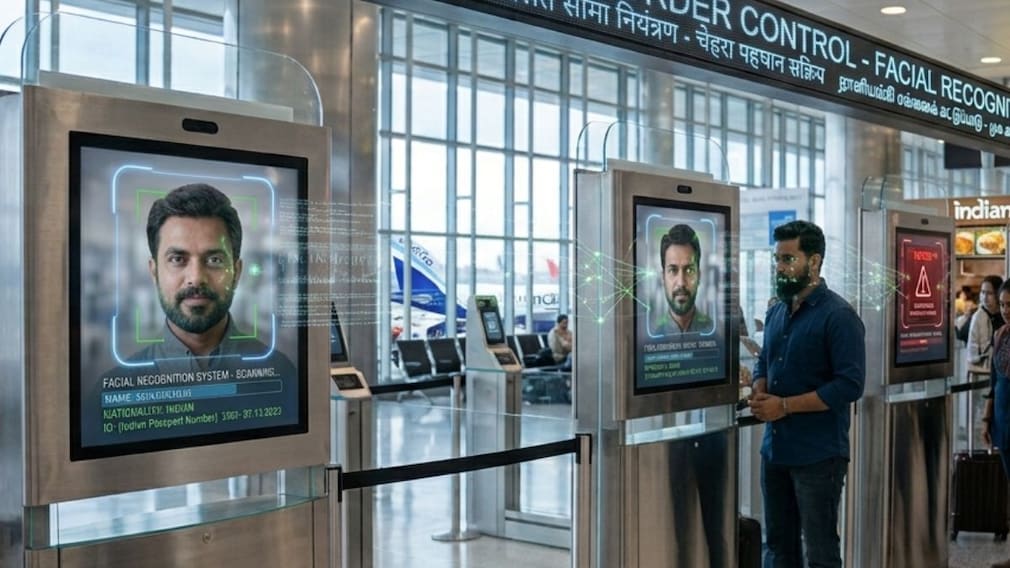
AI has gone far beyond just generating text or images. Increasingly, it is helping law enforcement agencies investigate crimes, analyse evidence, identify suspects and even predict criminal activity.
From scanning millions of digital records in minutes to enhancing blurry CCTV footage and mapping criminal networks, AI is becoming an important investigative tool for police and security agencies across the world.
Recently, digital forensics company Exterro told Axios that the FBI used its platform during the frantic 48 hours between the attempted assassination of US President Donald Trump at the White House Correspondents' Dinner and criminal charges being filed against suspect Cole Tomas Allen.
Like most companies that work with law enforcement agencies, Exterro operates under strict non-disclosure agreements (NDAs), meaning it could not reveal exactly how the FBI used its software. However, company executives told Axios that investigators typically use the platform to sift through massive volumes of digital evidence-including messages from seized devices, social media accounts and other online trails linked to a case.
Exterro is one of several companies globally-including in India-that now provide AI-powered investigative tools to police forces, intelligence agencies and the armed forces.
An Explosion Of Digital Evidence
According to Amsterdam-based Sensity AI, one of the biggest reasons law enforcement is adopting AI is the sheer volume of digital evidence investigators must process today.
Sensity works with law enforcement agencies and forensic laboratories across several Indian states as well as internationally.
"So once upon a time, investigations would have been carried out by forensic specialists, which is still true," Sensity Threat Researcher James Middleton told NDTV.
"But because of the volume of evidence that now needs to be analysed, investigations have increasingly become part of routine policing. More police officers-not just forensic experts-are now carrying out digital investigations."
He said AI-powered tools are designed to simplify complex forensic workflows.
"These aren't forensically trained people, so they need access to tools that are intuitive and very easy to use. You don't have to spend years learning them like forensic analysts do."
Narrowing The Leads
Indian cybersecurity and AI company Innefu Labs supplies investigative platforms to several state police forces, paramilitary organisations and central security agencies, including Delhi Police, Chandigarh Police, Gujarat Police, the BSF and the CRPF.
Tarun Wig, co-founder of the Delhi-based company, explained how AI can dramatically reduce the amount of manual investigation required.
"We have a population of 2 crore people and a police force of around 1,04,000. There is no way 1,04,000 personnel can monitor 2 crore people."
"AI helps narrow the field of suspects from 2 crore people to around six or seven lakh repeat offenders, allowing investigators to focus their attention where it matters most."
Beyond identifying potential suspects, AI systems can also guide investigators through standard operating procedures, reminding officers to complete required investigative steps, organise evidence and prepare charge sheets that are more likely to withstand scrutiny in court.
Innefu also develops revenue intelligence systems. According to Wig, its AI tools have helped identify fraudulent GST claims worth nearly Rs 5,700 crore.
AI Is Already Being Used Across India
Several Indian law enforcement agencies have already integrated AI into their investigative workflows. Delhi Police use Automated Facial Recognition Systems (AFRS) and AI-enabled smart glasses to identify suspects in crowded public spaces.
AI algorithms are also being used to reconstruct faces from unidentified human remains and age-progress photographs of absconding suspects. One such reconstruction reportedly helped Kerala Police solve a 19-year-old cold case.
State police departments are also deploying specialised AI assistants. Uttar Pradesh Police's Crime GPT helps officers quickly retrieve gang profiles, search criminal records and match voice samples. Maharashtra Police use MahaCrimeOS AI-developed in collaboration with Microsoft-to accelerate cybercrime investigations.
Meanwhile, the National Investigation Agency (NIA) has deployed an AI-powered Organised Crime Network Database (OCND), which maps relationships between criminals using information collected from multiple state databases.
Investigators are also increasingly relying on AI-enhanced video forensics platforms such as AMPED FIVE to improve poor-quality CCTV footage, detect deepfakes and assist with facial recognition.
The Challenges
While AI can dramatically speed up investigations, experts have also raised concerns about privacy, surveillance and algorithmic bias.
Civil liberties groups have repeatedly warned that facial recognition systems can produce false matches, particularly if the underlying datasets are inaccurate or biased. Privacy advocates have also questioned how long investigative data should be retained and whether sufficient safeguards exist to prevent misuse.
As AI becomes more deeply integrated into policing, governments around the world are increasingly being challenged to balance faster investigations with transparency, accountability and the protection of individual rights.
-
Opinion | The Post-War Middle East May Already Be Splitting Into Two New 'Camps'

We may see a closer Qatar-Oman-Iran trilateral partnership emerging in the coming days, while another grouping already in the making is of Saudi Arabia, Pakistan and Egypt.
-
Opinion | 330 Million: Why The Biggest Number In India's AI Boom Is The Most Useless One
India has the largest crowd of AI users. But that number could be a vanity, pleasant to report in the morning and slow to pay by evening. Because who wants to pay for AI yet?
-
How Delhi Built Its Most Beloved Hubs On A Fire Trap
Delhi fire: Since 2019, 543 people have lost their lives in the city due to fire tragedies. Tracing back to 2016, the figure rises to more than 800, according to Delhi government data. In the first half of 2026 alone, 65 deaths in fire accidents have been reported.
-
FIFA Let Politics Win Over Football, Iran Paid The Price For Political Hypocrisy
Football's governing body has long sold itself as apolitical - like the IOC - an organisation above borders, above diplomacy, above conflict. But this World Cup has challenged that idea and changed perceptions about FIFA.
-
Opinion | India's Solar Dreams Have A Big China Problem
The entire edifice of Indian solar, the panels, the parks, the rooftop schemes, the 500 GW of non-fossil capacity promised by 2030, rests, at its base, on a single supply line that runs across a contested border.
-
An Indian Explosives Company Faces Questions From A War Half A World Away
An explosives manufacturer from India suddenly found itself named alongside Sudanese military-linked companies, Egyptian suppliers and international recruitment networks accused of prolonging a civil war that has devastated an entire nation.
-
Opinion | For The Great Passport Debate, A 'Common-Sense' Cure - By Shashi Tharoor
There is a gap between legal theory and the practical realities of a passport. But an easy fix can resolve this manufactured crisis.
-
"There's Nothing We Can Do": Inside Lives Of Delhi's Pavement Dwellers
A 10-year-old girl sleeping with her family on a pavement was allegedly kidnapped, raped and murdered in Delhi.
-
Exclusive: A Massacre In Waiting, And A World That Chooses Silence
In Sudan, Rapid Support Forces (RSF) militants are closing in on the strategic city of El Obeid. Experts and rights groups have warned of a "genocide-like" event, similar to what unfolded in El Fasher.