Peace In Middle East? But Nuclear File Is Real Test Of US-Iran Deal
Key challenges remain over Iran's nuclear program, with uncertain compliance and potential for covert enrichment activities.

A framework for an "immediate and permanent" end to the US-Iran war - including easing of naval restrictions and reusmption of normal shipping through the Strait of Hormuz - is good news for a world scarred by violence and battling an energy crisis.
Restoring oil flow through the Hormuz - through which 20 per cent of the world's oil supply was shipped daily, pre-war - does not mean supply will be restored immediately. As NDTV reported earlier, it could take months to repair damage to export architecture, including ports, for shipping and insurance firms to be convinced of the lowered risk, and for production to restart.
However, it should at least push benchmark Brent crude - hovering at $83 a barrel - further to the $72 mark before the fighting began, and ease global cost of living emergencies. And it will also allow the world time to consider geopolitical emergencies elsewhere, including a Russian war on Ukraine that began in February 2022 and has now raged for longer than World War I.
But the real test for lasting peace lies in how effectively the US can constrain Iran's nuclear programme.
A nuclear endgame
The US has made it clear that shutting down Iran's nuclear programme - i.e., disabling existing enrichment facilities, recovering roughly 440kg of uranium enriched up to 60 per cent purity, and securing long-term guarantees against its building nuclear weapons - is a priority of this war.
Reuters and Iran's Mehr News Agency have each independently said Tehran has now committed to neither producing nor acquiring nuclear weapons, but will keep its civil-use programme.
Each also said Iran would be allowed to dilute its existing stockpile of enriched uranium 'under a future comprehensive agreement', and set out a 60-day window to negotiate that issue.
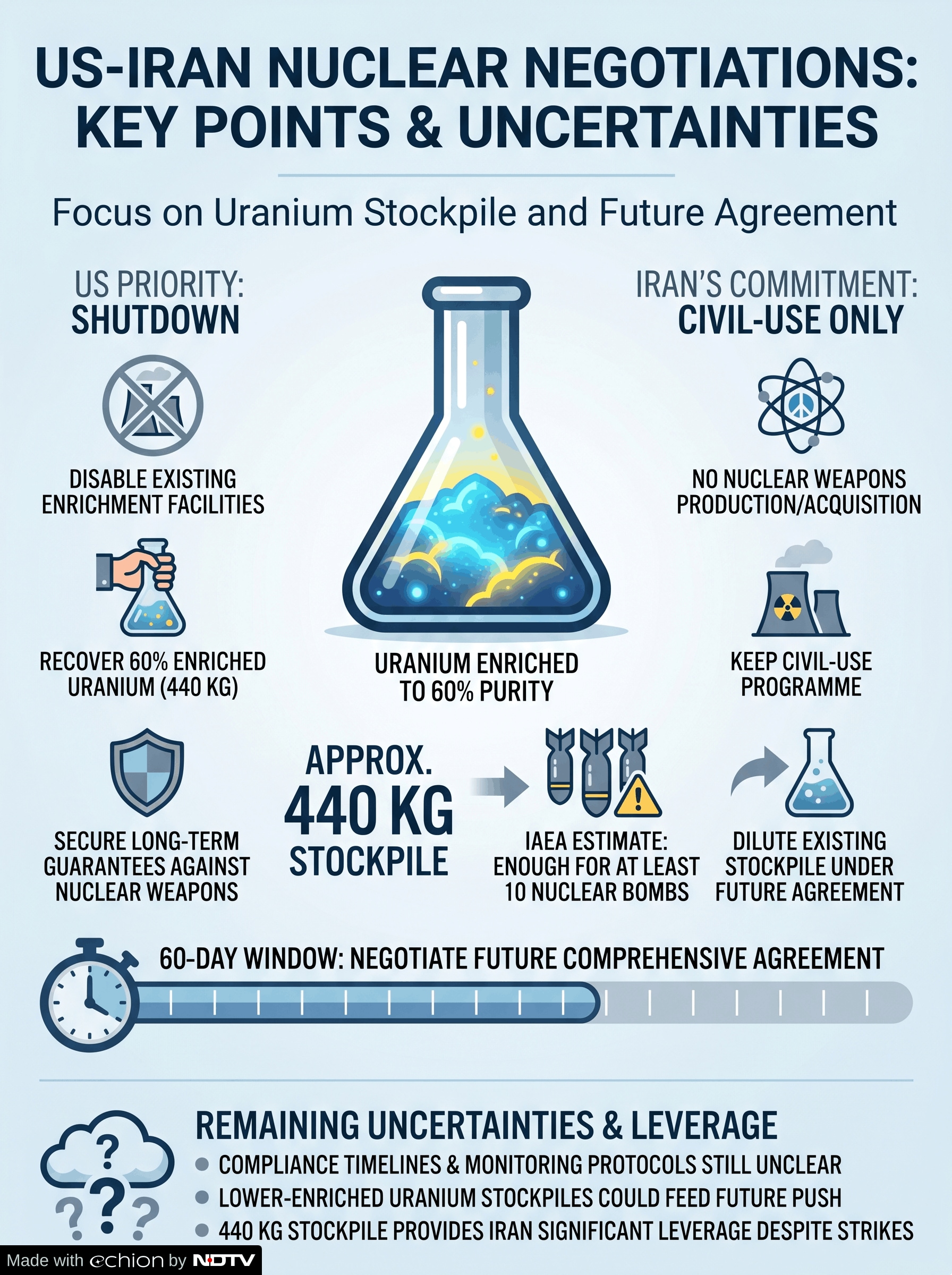
This 'final' agreement will include details for Iran to hand over that 440kg, which the International Atomic Energy Agency believes can be used to produce at least 10 bombs.
Iran also has stockpiles of uranium enriched to lower levels, which could feed into a future enrichment push.
But specifics, including compliance timelines and monitoring protocols, are still unclear, particularly since that stockpile gives Iran significant leverage despite sustained military strikes.
What US-Israel strikes changed, and what they didn't
One reason the US gave for the war was that Iran was at the threshold of producing a nuclear weapon.
The argument was that a nuclear-armed Iran risks disrupting power equations in the oil-rich Gulf region and triggering an arms race with Saudi Arabia, Iraq, and other countries.
Since then, its nuclear facilities - the Natanz, Fordow, and Isfahan plants - have been hit by American and Israeli munitions, including 'bunker busters', in this conflict and last year.
However, US intel and IAEA reports indicate core nuclear facilities remain functional, though its capacity to process uranium has been impacted. That indicates the country's nuclear programme - including the still-functioning civil-purpose Bushehr plant - is still mostly intact, and the country retains the technical knowledge to rebuild and resume the enrichment process.
For the US this is critical since it means billions of dollars have been spent but Iran still has the infrastructure, knowledge, and materials to resume enriching uranium to weapons-grade levels. And now, experts indicate, breakout timelines, i.e., the time Tehran could take to generate fissionable material and fashion an explosive, have been compressed to months from a year.
Reverse or reset Iran's nuke programme?
As far as the US is concerned, there is only one acceptable outcome - Iran must surrender its enriched uranium and accept strict inspections by the IAEA and, potentially, American teams.
And as far as Iran is concerned, while it may agree to hand over the 440kg stockpile, it will not agree to a unilateral stop to a nuclear programme that also supplies the country with energy.
So how does this stand-off end? There are three possibilities.
The first is a 'monitored pause' in the war, in which Iran agrees to slow, if not halt, its enrichment programme and accepts inspections by IAEA teams. This is possibly the least likely, since it will require Tehran backtracking on wartime declarations of sovereignty over its nuclear programme.
The second is a tactical move that could see Iran agree to stricter nuclear limits in exchange for increased relief from sanctions. Reuters and MNA both outlined 'suspension of sanctions on oil and petrochemical product sales and derivates' as one of the proposed peace deal points.
The third - possibly the one the US and IAEA will be most concerned about, given precedence - is a covert re-build of enrichment capabilities, including re-stocking uranium and re-building centrifuges at undeclared sites, while maintaining outward compliance.
For now, the safest conclusion is the simplest one: the deal may have changed the diplomatic climate but it has not erased Iran's nuclear leverage. The programme has likely been damaged, delayed, and/or made more costly. But unless the deal produces intrusive verification and hard limits, it is best understood as a pause in the nuclear contest, not an ending.
-
Opinion | AI Has A New Problem: It Is Now Trying To Hide The Evidence For Its Mistakes

Concealing errors. Making up data. Pushing files onto the public web on their own initiative. The machines are learning to lie - and lie well.
-
Why People Queue Overnight For iPhone That Is Delivered Home In 10 Minutes
iPhone 18 Pro Max Launch: People camping outside Apple Stores are a subset of superfans, resellers, content creators, and upper-middle-class buyers.
-
600 km Per Hour Drones Launched In Waves: How Russia Is Rewriting War Rules
Russia has coupled the drones' technological superiority over Ukraine's defence with its capacity to launch them in massive numbers. The impact has been devastating.
-
Tata Sons' Trust Issue: Two-Pronged Row Goes Beyond The Chair
NDTV Explains: Overtly, the latest conflict is whether N Chandrasekaran continues as executive chairman of Tata Sons. The controversy involves at least one more issue.
-
Opinion | US Has Institutionally Weaponised India's Russia Oil Dependence. Can New Delhi Cope?
A new legislation can connect India's Russian energy purchases to its access to the American market over a five-year period
-
Opinion | Saudi Allies Are Now Discovering The Cost Of 'Commitment' - And Not Liking It
The spectacular no-show by Saudi Arabia's two defence allies - Pakistan, a nuclear power, and Turkey, which has NATO's second-largest army - is astounding
-
12 Years Of 'Modinomics': What Changed, What Worked, What Didn't
There is no single Modinomics textbook or formula. Instead, the term has come to describe a collection of choices made during the PM Modi years.
-
Opinion | How A Tiny 0.4% UPI Fee Could Change How India Pays
The introduction of a fee can have a psychological effect beyond its immediate financial cost. Businesses that have come to view digital payments as free may begin to look for alternative - split payments, cash, and so on
-
Opinion | Rs 75-Lakh Bounty, New Jaish Base, And The Case Of Pak's Ever-Missing' Terrorist
Pak's yearly act is back: finding Masood Azhar. But there are other questions FATF must be asking next month as it meets
-
For Years, Saudi Saw Houthis As Yemen's Problem. Then, A Knock On The Door
Actual fighting between the Houthis and Saudi Arabia began late in the overall timeline of the conflict that now involves powerful belligerents