Trump Pushes Middle East Reset, Pak Faces Saudi, Abraham Accords Dilemma
Pakistan faces a dilemma over the Abraham Accords, needing to recognise Israel for economic gains but opposing it without Palestinian statehood.
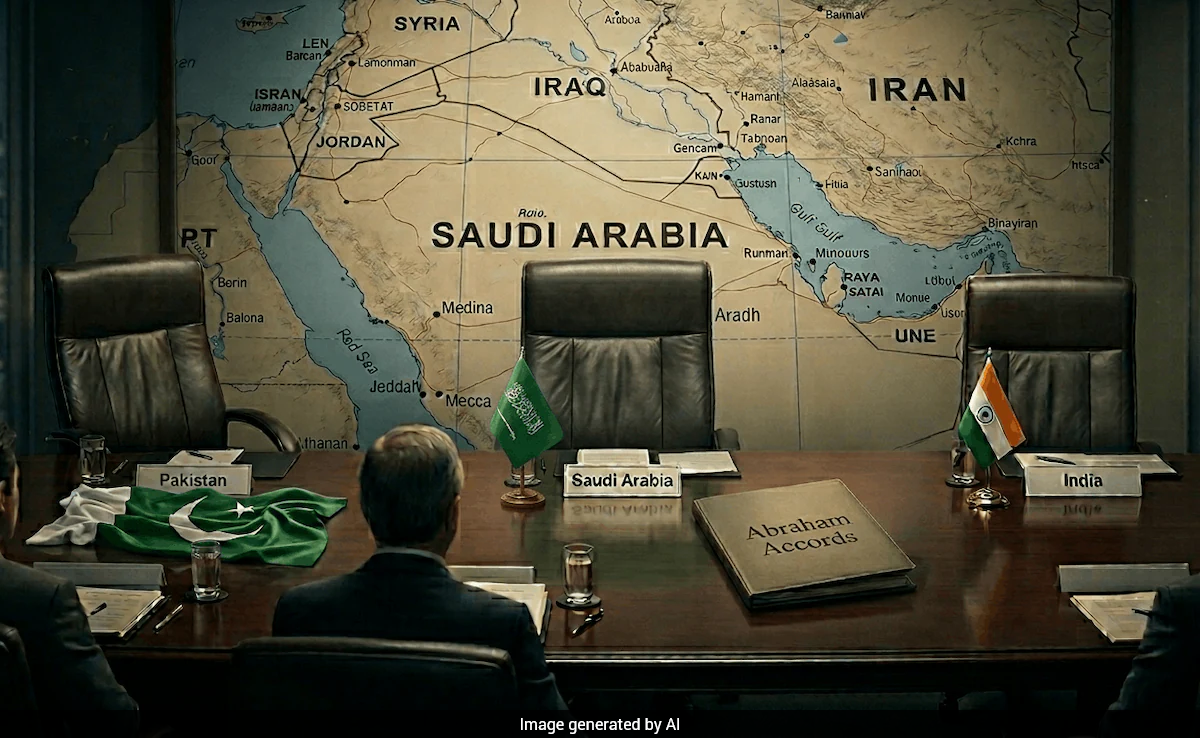
A rock and a hard place.
An uncomfortable position to be in, but that is where Pakistan found itself this week after Donald Trump pulled the Abraham Accords off the Oval Office high shelf and pitched them as the means to secure an Iran war exit ramp and execute a 'regional redesign'.
An end to the war would be good news for a world struggling with the energy crisis due to the Strait of Hormuz closure. It would also be good news for Pakistan, which sees itself as a 'key player' in the peace process and will claim partial credit for helping stop the fighting.
But the payoff is complicated.
Trump has chosen to push the Accords - authored in his first term - as the political and diplomatic cornerstone of regional peace. And that means Pakistan, if it wants a seat at that table, must recognise Israel without a 'just resolution' of the Palestine issue. Or it must forgo economic and strategic gains from the Accords to preserve political and ideological doctrines.
The old position
Pakistan's stance on the Accords has been consistent - it will not sign the agreement without concrete steps for the creation of a viable Palestinian state with East Jerusalem as its capital.
Pak Defence Minister Khwaja Asif underlined that point on May 26 when he said: "... I don't think we should join any accord that clashes with our fundamental ideologies... we have a very clear stance that it (failure to establish a Palestinian state with pre-1967 borders) is not acceptable."
That position reflects Pakistan's self-image as a 'champion of the Islamic world' and is fuelled by a domestic ecosystem that includes religious parties and sections of the military, both of whom have political clout and have been conditioned by decades of anti-Israel rhetoric.
That leaves the current Pakistan government - led by Prime Minister Shehbaz Sharif - with little, if any, room to pivot on the Israel and Accords question, or even a backdoor into the Accords.
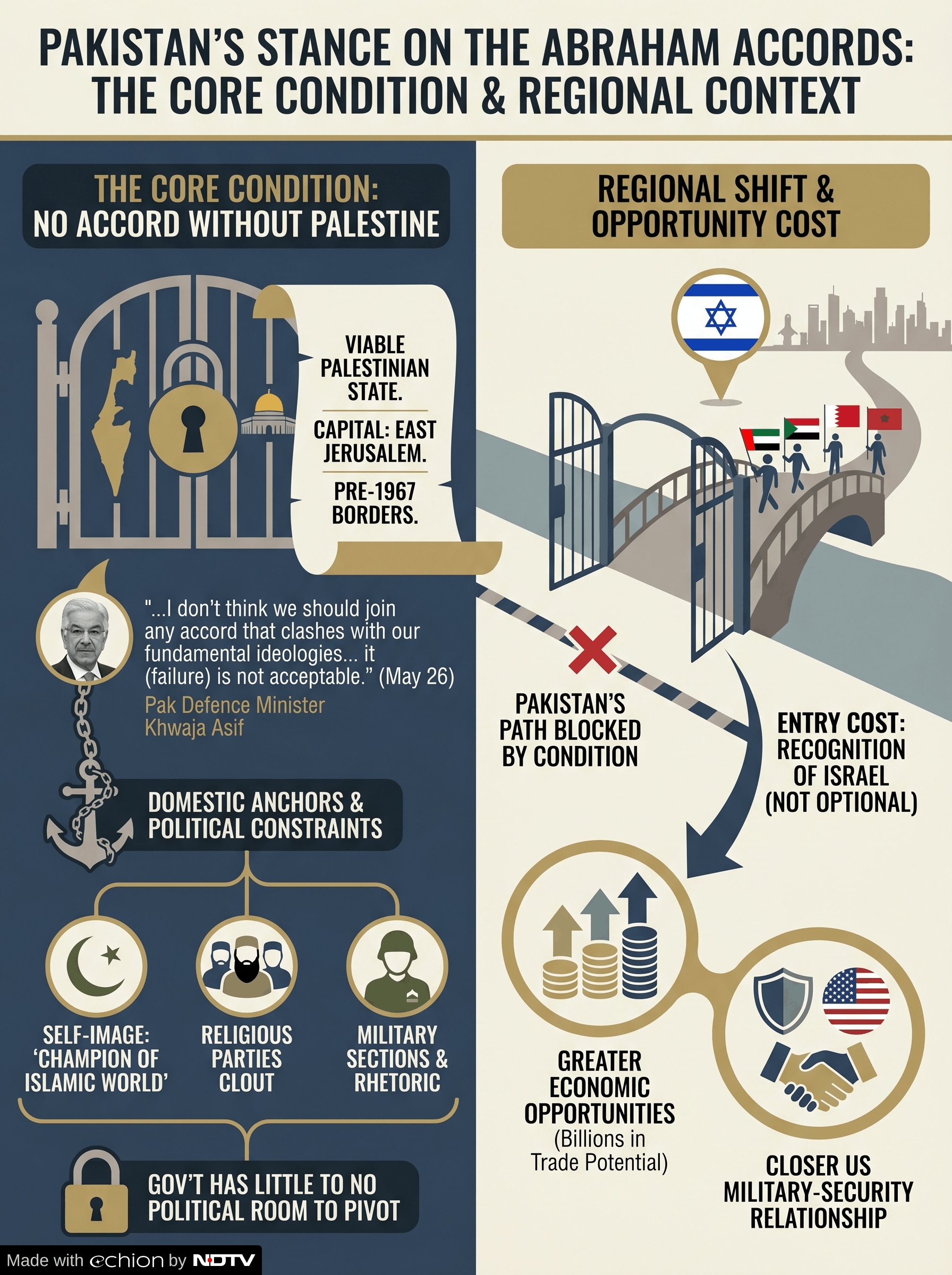
Even if there is room, or a backdoor, it is being eaten into as Sunni Arab states in the Middle East and beyond recalibrate positions on Israel, potentially lining up to join the United Arab Emirates, Bahrain, Sudan, and Morocco in recognising Tel Aviv and pocketing a host of benefits.
These include greater economic opportunities - the potential to jumpstart bilateral trade by billions of dollars - and a closer military-security relationship with the United States.
And the entry cost - recognition of Israel - is not optional.
Saudi Arabia, the 'swing factor'
Riyadh sits at the intersection of two significant political circles of power - Arab legitimacy as the custodian of Islam's holiest sites, and strategic weight from being the largest Gulf economy.
Like Islamabad, Riyadh has also said normalisation of ties with Israel can only begin after 'a clear path to a Palestinian state' is established. And so how it responds to Trump's call could not only reshape Middle East geopolitics, but also force Islamabad down a path it does not want to go.
If Saudi Arabia recognises Israel, then Pakistan, for all its ideological objections, will be hard-pressed to ignore the direction without risking diplomatic and economic isolation.
That means for Trump, Riyadh is the ace up his sleeve.
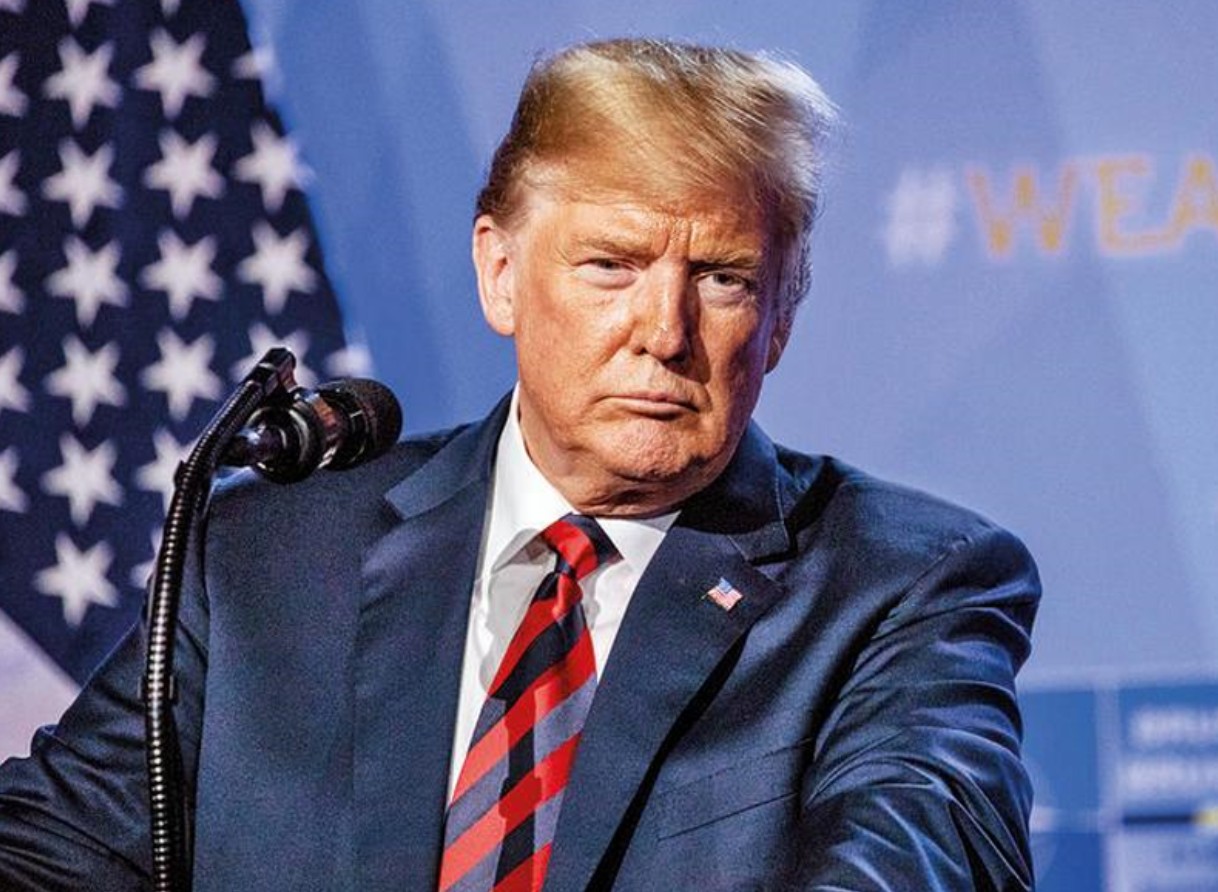
Trump has pushed Abraham Accords 2.0 as an Iran war solution (File)
That said, the mutual defence pact the two countries signed in September 2025 could influence how this plays out, since the deal potentially weakens Trump's 'join or be excluded' diktat.
The US has advertised joining the Accords as a 'precondition' to being part of a (not-yet agreed) peace deal with Iran and, indirectly, an American-Israeli security umbrella.
But the Saudi-Pak deal gives Riyadh access to an alternate arrangement - which includes China by extension - that could make it less reliant on US-Israel guarantees. Of course, this assumes Pak-China military cover can stand up to the US-Israeli option, which experts believe is unlikely.
The presence of an option, however, is enough to give Saudi Arabia some room to resist US pressure to join the Accords. And the longer Riyadh holds out, the more that pressure eases.
For Pakistan, this is golden because it weakens the idea of a united Sunni Arab bloc.
India inside the tent
Meanwhile, for India, it swings the other way. Delhi is already inside the tent, so to speak. It already has close ties with both Israel and key Gulf nations, such as the UAE, Qatar, Bahrain, and Jordan. So it is not being asked to choose.
But Delhi has invested heavily in its relationship with Riyadh and would obviously like that relationship to grow.
That means a Saudi-US-Israel bloc will alter the balance of power in a region that remains critical for India's oil, gas, and fertiliser needs, even though diversification is underway. The risks are not immediate but do represent a possible gradual attrition of a space the government has carefully built and cultivated, both for its energy and trade opportunities.
Ultimately, a Saudi Arabia that declines to join the Accords disrupts the US' plan for a Middle East political, security, and trade architecture that positions Israel at the centre and pushes back the prospect of normalisation without Palestinian statehood.
But a Saudi Arabia that does leaves Pakistan in a fix. Recognise Israel and potentially face domestic backlash, or don't recognise it and Islamabad drops into an 'exclusion zone'.
-
BJP Leader's Singer Wife, A Kabir Bhajan, And Some 'Jantar Mantar': How 15th Century Saint Entered 2026 Row

A video of Sivasri Skandaprasad's singing performance went viral, interpreted as a dig at protests at Delhi's Jantar Mantar. What she's singing is actually attributed to the saint-poet Kabir, and he did not really mean that particular "jantar mantar". He meant something far more profound.
-
Opinion | Sardar Patel, And The Art Of Holding A Nation Together
A true Gandhian, he reminded his countrymen that gaining freedom from foreign rule was merely the first step; true internal Swaraj required much, much more.
-
Opinion | How India Is Making Its Stock Market An Expensive Place To Invest
FPIs sold Rs 1.66 lakh crore of Indian equities in 2025 and a record Rs 3.08 lakh crore in 2026 through October 12. Foreign ownership of the Indian market is at a 15-year low
-
Jail Is No Bar: How Gangsters Call The Shots From Inside Prisons
Jail can become a safe haven from enemies, a recruitment ground for fresh gang members and, in some cases, a command centre for criminal operations
-
From King Edward III To Neha Bora, A 1361 Law Lives On In 'Peace Bonds': NDTV Explains
CJP leaders Abhijeet Dipke, Saurav Das, and Ashutosh Ranka signed peace bonds; two of them even faced jail over an alleged breach, while AISA's Neha Bora questioned such a bond's very logic. Here's what a peace bond is, and what the questions are.
-
Air Force Golf Course Near PM House Closed. How This Land Has Seen Many Turns Of History
The Air Force Sports Complex, which includes the golf course, is the latest property near the Prime Minister's residence set to be taken back this year, as the land is owned by ministries.
-
Opinion | How A Poland 'Experiment' Could Change India's Defence Industry
Europe is spending billions on arms in a historic rearmament drive. Indian firms can cash in. But there's a catch
-
Opinion | The Muslim World Is Seeing An Unexpected 'Experiment' - In Kazakhstan
The country has a long history of using mediation to mitigate conflict; now, it has added another, much-wanted dimension to it.