US' $240 Million Drone Over Cuba That's Strangling China's Oil Supply
From Venezuela to Hormuz to Malacca, the US has made three moves to strangle China's oil. Now a $240M drone over Cuba signals move four — and Trump wants the island. The chessboard is almost complete.
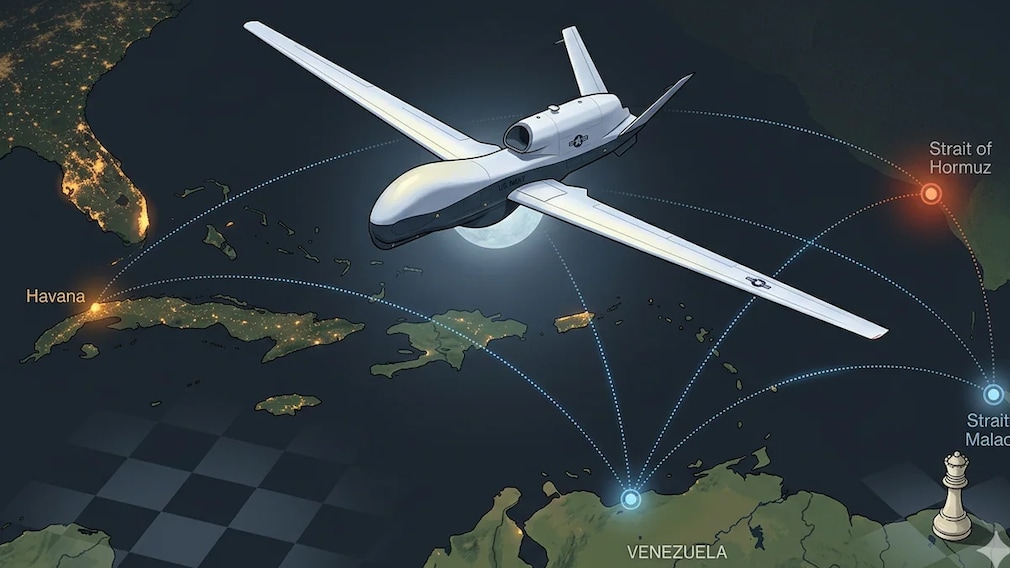
Somewhere above the deep, dark Caribbean Sea, at altitudes commercial jets cannot reach, a winged beast - as large as a Boeing 737 - drew lazy patterns in the night sky. It didn't have weapons. It didn't need any. It was the weapon.
The US Navy's MQ-4C Triton surveillance drone - callsign BLKCAT6 - is a US$240 million machine that can stay airborne for over 24 hours and has a 55,000+ feet operational ceiling. And it conducted extensive reconnaissance off Cuba this week.
Open-source flight tracking data caught it loitering off Havana Wednesday evening. Hours earlier it was monitoring the nearly 200 km-wide strait between Cuba and Jamaica - a key shipping route linking the Panama Canal to the Atlantic Ocean.
The Jamaica Channel, they call it, and it seems the US just made its fourth move on an oil-slicked chessboard linking Cuba, Venezuela, Iran, the Strait of Malacca… and China.
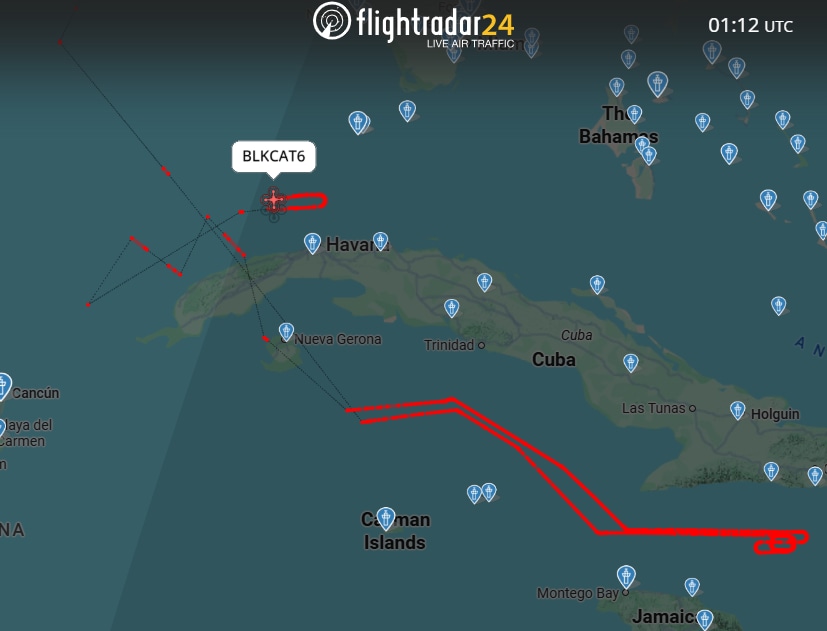
The drone flight map over Cuba. Image posted on X by @Osinttechnical
'China chokepoint calculus'
First, and this is important. Allowing a recon drone's flight path to appear on an open-source network was not an accident. It was a deliberate move, a 'we're watching' message to Beijing.
Second, given the MQ-4C's orbit, it likely also tracked the Windward Passage and Yucatan Channel. These, combined with the Jamaica Channel, are major Caribbean shipping routes.
But their value is not in volume of crude.
Venezuela-China oil shipments have dried up since the US seized the latter's 303+ billion barrels in January. Special forces kidnapped President Nicolas Maduro and installed his deputy, Delcy Rodriguez, who opened them to Washington.
Beijing pivoted to Russia; Jan-Feb 2026 imports from Moscow rose to 40.9 per cent YoY.
The US' second move - queen to Iran and Tehran's Hormuz blockade - plugged between 40 and 45 per cent of China's daily crude demand, though flow has stuttered rather than stopped. With the Israel-Lebanon ceasefire now in effect that flow could increase, but US warships in the GUlf of Oman will still likely play gatekeeper, particularly for China-flagged vessels.
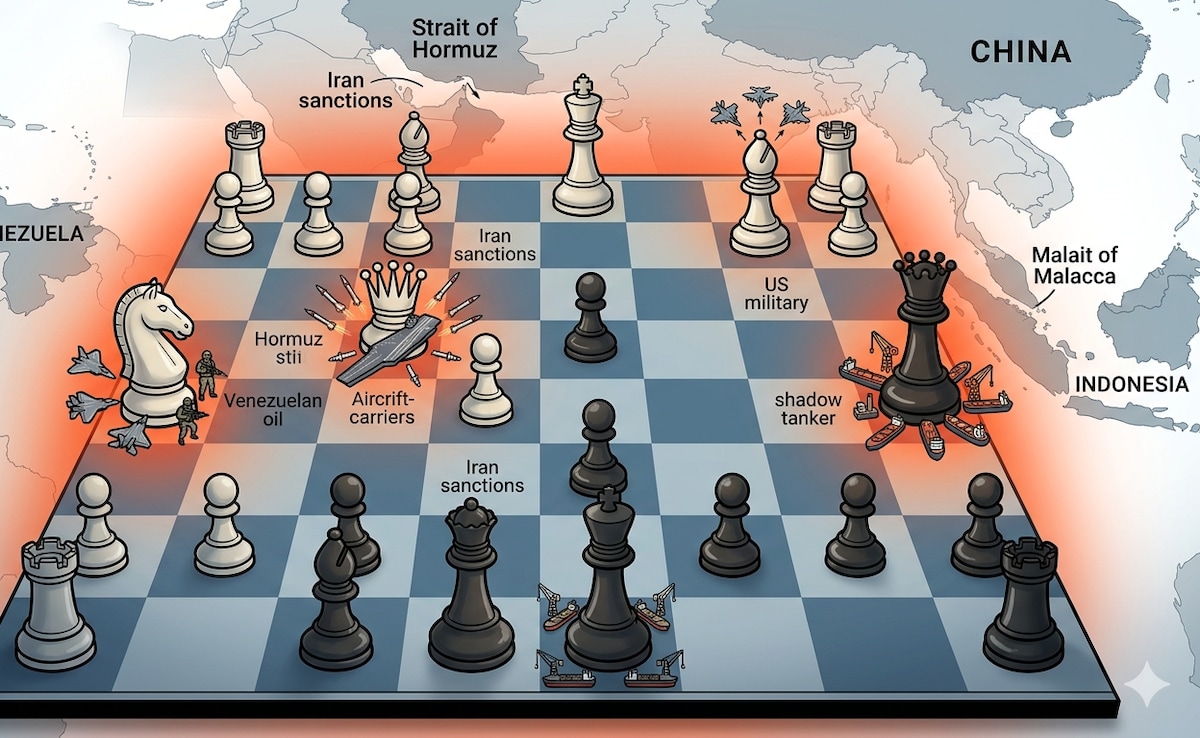
The Venezuela, Iran, Malacca Strait chessboard. Image generated by AI
And the third - bishop to Indonesia, to secure Malacca surveillance - means the US can tighten pressure on China's eastern flank, a route that supplies 80 per cent of its seaborne crude flows.
That underscored Beijing's 'Malacca dilemma' fears.
Move 1, 2, 3: Noose Tightens
Taken together, Venezuela, Iran, and Malacca emphasise what experts have been hinting at since early-2026 - the US is building coercive architecture around China's oil supply.
Malacca Gambit: How China Oil-Choke Strategy Could Backfire On Trump
Beijing has significant reserves, among the largest in the world, a large and diverse list of crude suppliers, and a network of pipelines running through Russia, Central Asia, and Pakistan.
But in a chokepoint scenario these buy time not immunity, though with the latter China could fashion escape routes, either by identifying alternate sources or via diplomatic or economic counterpressure. And its strong message of support to Cuba - reeling under an energy blockade after the US cut off Venezuela supply - offers an insight into what Beijing is planning.
"China expresses its deep concern and opposition to the US' actions on Cuba," its foreign ministry said back in January.
After that China began running fuel to the island.
US knight to Cuba, to control Caribbean sector
Cuba is the US' fourth move. The value of the Caribbean passages is strategic.
Control over the Caribbean means the US can deter Chinese presence and 'shadow tankers' and also extend surveillance and military coverage off its southern coast, specifically Florida.
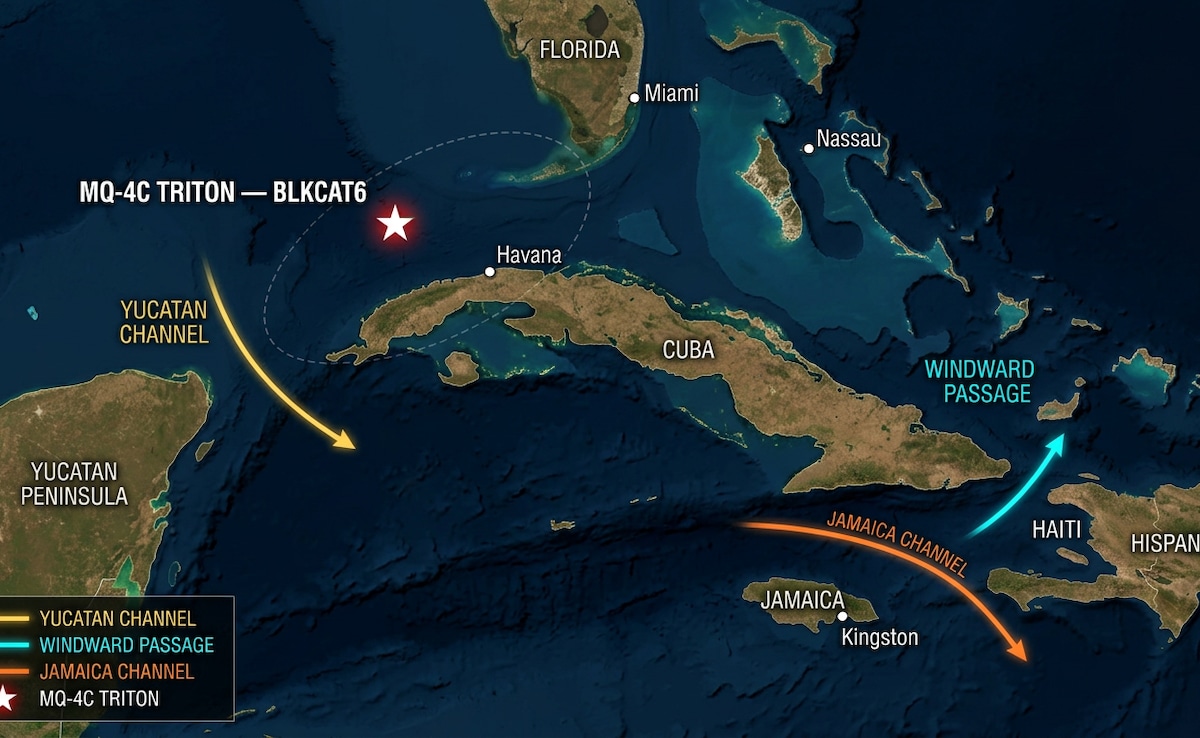
The Caribbean region and the three shipping channels. Image generated by AI
It will also eliminate Chinese local electronic counterintelligence posts, like the one in Bejucal, a small town roughly 30km inland from Havana, and which the MQ-4C was likely also tracking.
The strategic upgrade is significant. A drone can watch but a base offers a military threat to all Chinese ships in the area.
"I could do anything I want with it," Donald Trump said in March. He almost has it. His blockade has Cuba on its knees, except for China, for now. And that suggests a flip of the likely MQ-4C tasking - 'shadow tankers', yes, but carrying fuel to Cuba.
-
Opinion | How A Tiny 0.4% UPI Fee Could Change How India Pays

The introduction of a fee can have a psychological effect beyond its immediate financial cost. Businesses that have come to view digital payments as free may begin to look for alternative - split payments, cash, and so on
-
Opinion | Rs 75-Lakh Bounty, New Jaish Base, And The Case Of Pak's Ever-Missing' Terrorist
Pak's yearly act is back: finding Masood Azhar. But there are other questions FATF must be asking next month as it meets
-
For Years, Saudi Saw Houthis As Yemen's Problem. Then, A Knock On The Door
Actual fighting between the Houthis and Saudi Arabia began late in the overall timeline of the conflict that now involves powerful belligerents
-
Lal Topi, Blue T-Shirt: Akhilesh Yadav's 'PDA' For Blue Has A Coded Message
The message is clear: the Samajwadi Party wants to talk to voters beyond its traditional Yadav-Muslim support base, particularly to Dalits.
-
The Day 600 Men Lay Siege To Islam's Holiest Site And How They Were Gassed Out
Nearly 47 years ago, on November 20, 1979, the Grand Mosque itself was seized by an armed group in one of the most extraordinary episodes in modern Saudi history.
-
New UPI Charges: If Digital Payments Save Money, Why Charge For Them Now?
UPI Payments Free For Years: The government has subsidised UPI adoption for years. Official figures show thousands of crores in payouts over years.
-
Opinion | Sydney Sweeney And The Obsession With Asking Sportswomen To 'Take The Clothes Off'
There is a world of difference between an athlete choosing to be sexy and an advertiser deciding that sex is the most interesting thing about her
-
Opinion | The 'AIPC' Was Once Congress' Boldest Idea. What Happened To It?
Tharoor, to Chakravarti, to Yaskhi now, the fate of a Congress 'experiment' that started in 2017 will tell you a lot
-
Woman Biker Hit, Air Force Veteran Attacked: The Lawlessness In Gurugram
What gives confidence to some elements in Gurugram to break the law again and again in full public view and on camera?