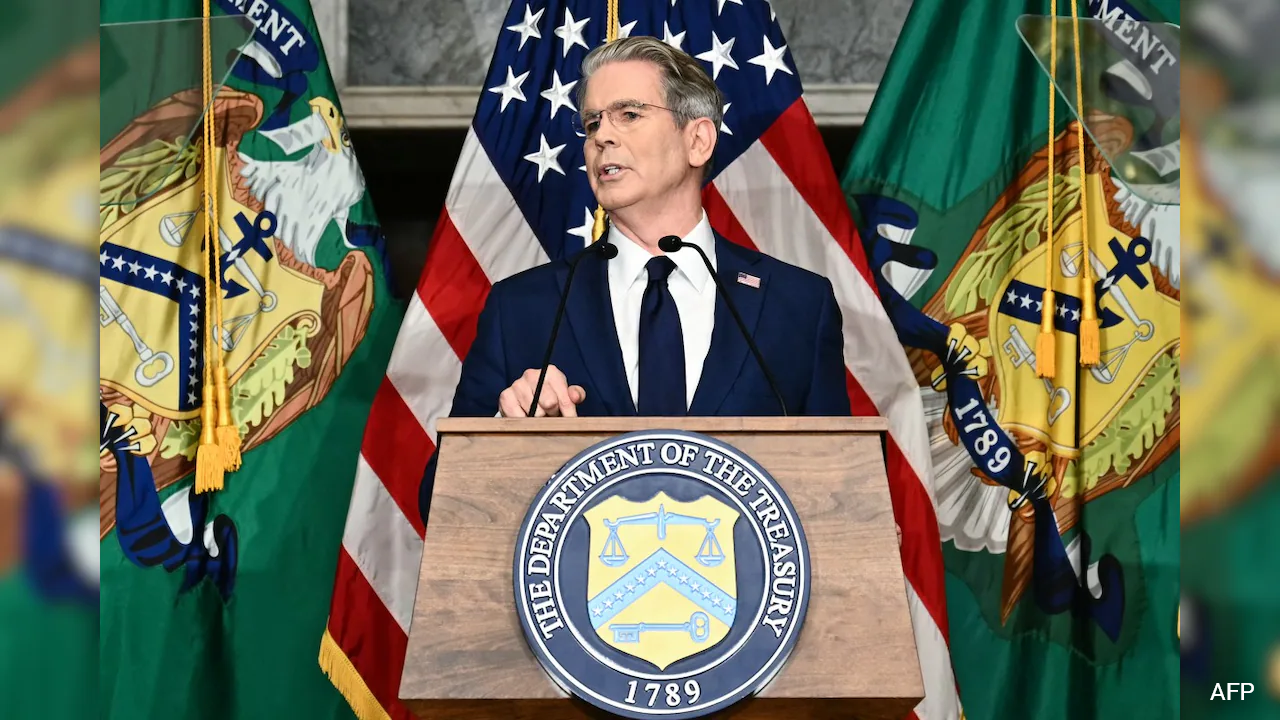
US Treasury Secretary Scott Bessent on Monday laid out plans for the "economic asphyxiation" of Iran, expanding Washington's secondary sanctions threats and warning of dire consequences for countries that do not join the campaign.
The announcement comes almost six months into a war on Iran that has ground to a stalemate, with stalled peace talks and Tehran blocking most traffic through the crucial Strait of Hormuz.
Bessent earlier said the United States was declaring an "economic D-Day" on Iran, but his announcement named no specific countries beyond Iran and gave no timelines.
"Around the globe, our objective is to sever every economic lifeline that sustains this tyrannical regime until Tehran stands alone," Bessent told journalists.
"We are going to hold everyone accountable, and this is economic asphyxiation of this regime."
He added that countries not joining US sanctions would "share in the isolation" of Iran, and noted that President Donald Trump was making phone calls to world leaders with requests to stop interactions with Tehran.
The Treasury Department said expanded secondary sanctions would target Iran's digital assets, technology, gold, aviation and shipping sectors.
It also issued new sanctions against 60 individuals, companies and vessels that allegedly aid Iran in oil revenue generation, weapons procurement and cyber operations.
The sanctions hit entities around the world, including in the United Arab Emirates, Hong Kong, China, Singapore and in Europe.
Bessent vowed that any entity "that facilitates money laundering on behalf of Iran will be removed from the US dollar system."
Iran had been dismissive of the threat of additional sanctions, and on Monday its economy minister predicted "another defeat" for Washington.
"We've been waiting for these plans for a long time, and the government is and was ready and has a two-year plan to manage these events," said Ali Madanizadeh.
Decades of sanctions
Iran has weathered decades of crushing international sanctions, and before the war it continued to export millions of barrels of oil, mostly to China, and to evade sanctions through complex international financial networks.
Asked on Monday if Chinese banks would be targeted by the new sanctions, Bessent said "no one is above the reach of US sanctions."
Ali Vaez of the International Crisis Group said Washington was seeking to impose maximum economic pressure through various levers, but that Iran "has faced all of these before."
"While there is little doubt in Washington's ability to impose substantial pain, Tehran believes that it has a high threshold for absorbing it, as well as the potential to respond to financial pressure with military counterpressure," he said.
The US naval blockade of Iran has seen its oil exports via the Strait of Hormuz fall from two million barrels a day pre-war to just 0.4 million by mid-August, according to maritime tracker Kpler.
Speaking to reporters on Monday, US Defense Secretary Pete Hegseth said that the pivot to applying economic pressure did not mean that military strikes were off the table.
"Economic pressure, we know, hurts them the most right now," he said. "But by no means are we foreclosing using kinetic strikes anywhere in the Strait of Hormuz or around Iran."
For ordinary Iranians, the standoff is likely to bring only more economic pain after years of rampant inflation, which in December and January fueled massive anti-government protests.
Sarah Hassanbeigi, a 32-year-old pharmacist in Tehran, said: "I don't think people can really take this much longer."
Pakistani delegation
Last week, Iranian President Masoud Pezeshkian, considered a relative moderate, said Tehran should "bring the war to an end now as we are in a position of power."
That followed Supreme Leader Mojtaba Khamenei's appointment of hardliners to key security positions.
On Monday, Pakistan's army chief Asim Munir -- a key mediator in the conflict -- visited Iran and met separately with Iran's president, chief negotiator and the head of its highest national security body.
The meetings took place after Trump spoke last week with Munir, a US source familiar with the matter told AFP earlier on Monday.
Islamabad was a leading mediator in talks that helped secure an April ceasefire that later fell apart. It is also a major trading partner of Iran, possibly opening it up to the threat of the new sanctions.
Oman's foreign minister was due in Iran on Tuesday, as Muscat and Tehran seek a deal on regulating passage through Hormuz.
(Except for the headline, this story has not been edited by NDTV staff and is published from a syndicated feed.)
Track Latest News Live on NDTV.com and get news updates from India and around the world


