600 km Per Hour Drones Launched In Waves: How Russia Is Rewriting War Rules
Russia has coupled the drones' technological superiority over Ukraine's defence with its capacity to launch them in massive numbers. The impact has been devastating.
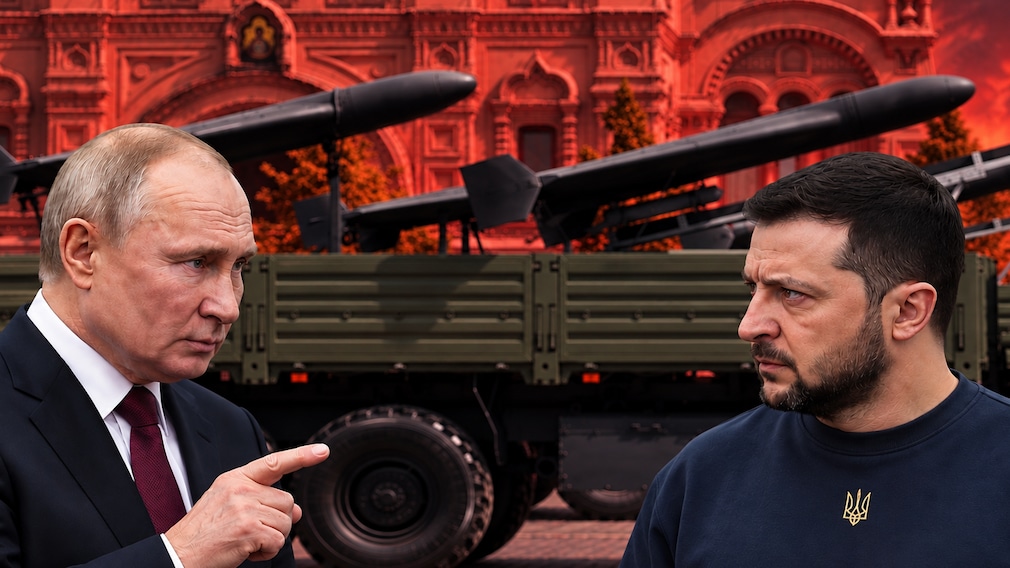
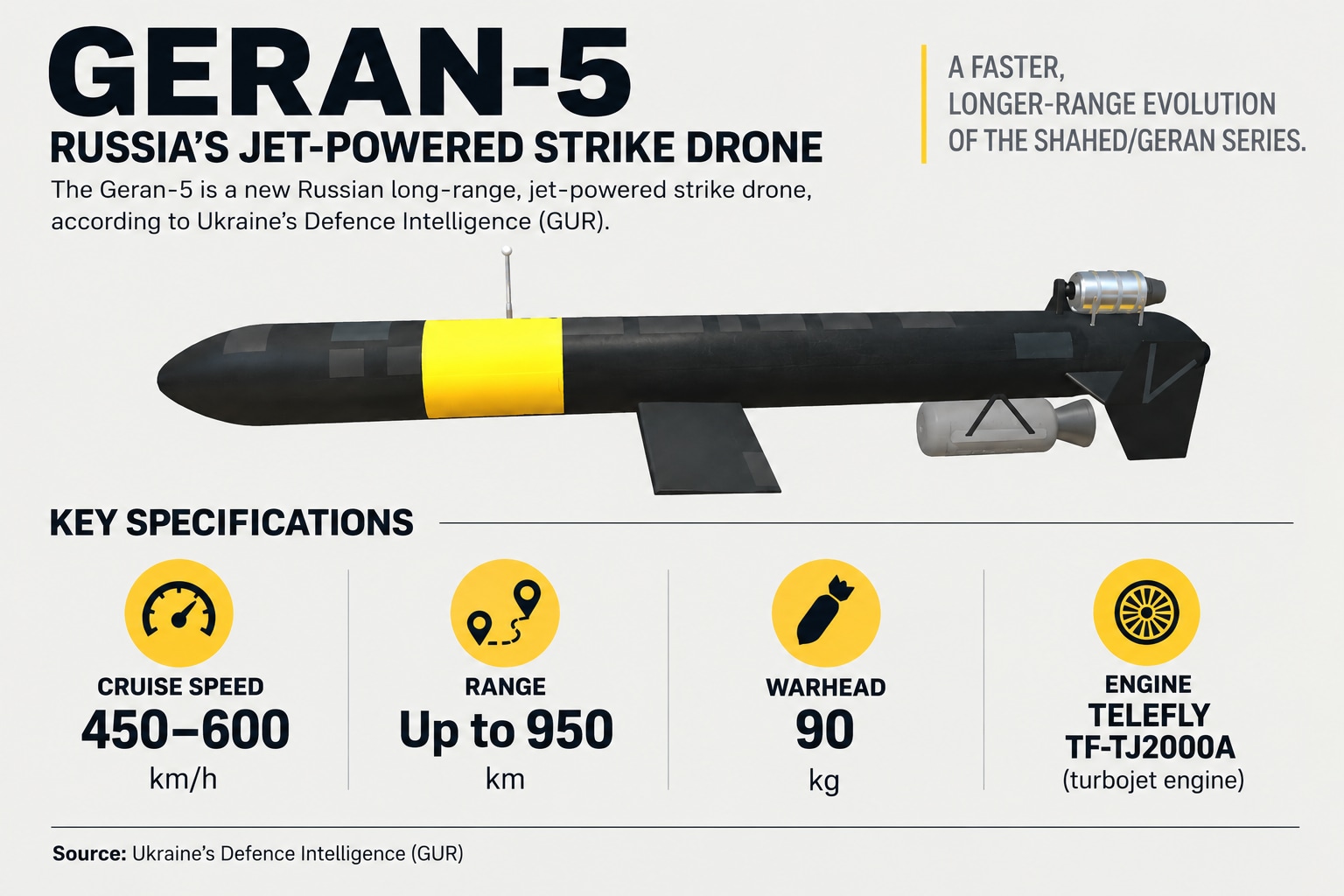
Top Speed: 600 kilometres per hour. Operational ceiling: 6,000 metres. Weapon class: Drone. Specialty: Blurring the line between drones and cruise missiles. Objective: Overwhelm Ukrainian air defence, sap its arsenal of interceptor missiles, and dent its resolve. But no technical specifications provide a better testimonial to the effectiveness of Russia's Geran-5 drones than the candid admission made by Maksym Zhorin, Deputy Commander of Ukraine's 3rd Army Corps: "We don't know what to do about them."
Over the past five years, Russia has devised new weapons and strategies. Ukraine, supported financially and with weapons by its Western allies, has played catch-up, innovating on the fly and finding elegant solutions to Moscow's inventiveness.
So, when Russia started swarm attacks using Iranian-designed Shahed-class drones in 2022, Kyiv swiftly responded with mobile anti-drone groups armed with machine guns and short-range interceptor rockets. They proved highly effective, achieving over a 90 per cent kill rate and frustrating the Russians. Moscow was then forced to change its tactics -- and it did so with such effectiveness that Ukrainian leaders now shy away from flaunting interception rates.
Several factors make the Geran-5 deadly effective. They are jet-powered, making them fast. They are impervious to machine gun fire because they fly too high. They terrorise civilians as they often strike before people can scamper to safety. Ukraine's only defence currently is shooting them down with missiles, which are far too expensive and far too few, partly because its main weapon supplier United States itself is tied up in a protracted war in the Middle East.
"The Geran family is Russia's domestic production line of the Iranian Shahed-136, manufactured at scale at the Alabuga special economic zone. The jet-powered variants - Geran-3, and now Geran-4 and Geran-5 - replace the original piston engine and propeller with compact turbojets, largely Chinese-sourced commercial engines. The result is a step change in performance: cruise speeds of 300-400 km/hour with dashes to 500 km/hour for the Geran-4, and up to roughly 600 km/hour for the Geran-5, at altitudes up to 5,000–6,000 metres, with ranges from 450 km to over 950 km depending on the variant," says Kateryna Bondar, Senior Fellow, Center for Strategic & International Studies.
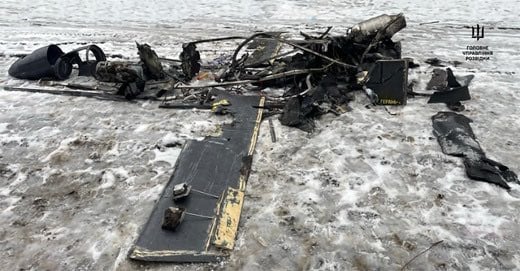
The wreckage of Geran-5 in Ukraine.
Photo Credit: Ukraine's Defense Intelligence (GUR)
She said Ukraine's counter-drone infrastructure was optimised against propeller-driven drones, not the jet-powered machines.
"Mobile fire groups with heavy machine guns, gun trucks, and FPV interceptor drones costing $1,400-3,000 closed the cost-exchange gap against that target, at one point accounting for the majority of Shahed kills. The jet-powered Gerans defeat this layer through speed and altitude," she added.
The analyst said Ukrainian interceptors max out at 250–300 km/hour, and they cannot shoot down a target moving at 600 km/hour.
"Newer variants add onboard electronic warfare that disrupts interceptor video links in the terminal phase. The compressed timeline is equally important: detection, identification, decision, and launch must all occur in a fraction of the time available against the older drones, forcing Ukraine back onto scarce and expensive surface-to-air missiles," she said.
Yuriy Cherevashenko, a deputy commander of Ukraine's air force, elaborated on another insidious aspect of the drones that makes them deadly.
"The main danger of these drones is that they're guided: meaning they can change their flight route and altitude, through an operator's command," he told Reuters.
Russia's Broad Strategy Behind Geran-5 Swarm Attacks
Russia has coupled the drones' technological superiority over Ukraine's defence with its capacity to launch them in massive numbers. Moscow launched around 450 jet-powered drones in June. The number rose to 2,850 in August. In many of these attacks, around 70 per cent of the drones used were jet-powered.
"Without volume, none of these tactics work," said Bondar.
"It is the foundation of the entire campaign. Russia's reported production has reached roughly 3,000 jet-powered airframes per month, with jet variants now comprising half to two-thirds of some nightly strike packages. Scale converts an individually mediocre weapon into a strategically effective one, because what matters to the defender is not the interception rate but the absolute number of leakers: a 90 per cent interception rate against 800 drones still means 80 impacts. Mass also enables tactical flexibility: decoys, multi-axis routing, altitude variation, and deliberate sequencing designed to map and exhaust Ukrainian defences," she added.
With the sustained campaign, Russia has made its intentions perfectly clear. It wants to hurt the morale of the Ukrainian military and the beleaguered nation's people. The security expert describes this strategy as "attrition of the defence itself".
"Each wave forces Ukraine to expend interceptors, missiles, crew endurance, and repair capacity. Round-the-clock raids deny recovery windows for the energy grid and keep air defence crews and the population under continuous alert. The targeting logic - power generation, gas infrastructure, defence production, logistics - aims at Ukraine's capacity to sustain the war and at civilian morale simultaneously," she said.
The strategy is not solely aimed at terrorising the masses. It is a deliberate cost-imposition strategy that treats Ukrainian air defence stockpiles, Western replenishment budgets, and societal resilience as the true targets, she added.
James Patton Rogers, drone expert and lecturer in the Department of War Studies at King's College, London, says the Geran-5 is an important step in the evolution of one-way attack drones.
"By replacing the original Iranian-designed Shahed piston engine with a small jet engine, Russia has produced a drone that is faster, harder to shoot down and still much cheaper than a cruise missile. That combination of speed and relatively low cost is what makes them powerful. They allow Russia to carry out sustained long-range attacks without relying exclusively on expensive missiles, keeping those for the most heavily defended or strategically important targets," he added.
Ukraine's Options
The Ukrainian response to the Russian onslaught is slow. Ukrainian forces found wreckage of jet-powered drones, which resemble ballistic missiles with wings, as early as January this year. The nation's Directorate of Intelligence and Defence (GUR) published details of the drones' use by Russia.
Nearly nine months have passed, and Kyiv still has not been able to develop a cost-effective solution to the problem.
Ukraine's military had invited a large group of producers to test a new generation of interceptors in July. Things, however, did not go according to plan.
Many of the interceptor drones proved difficult to control at speeds sometimes exceeding 400 kilometres per hour, and many crashed into nearby fields and forests, Reuters reported, quoting sources.
Russian terror on Ukraine and Kyiv continues - Russia launches drones at Kyiv all the time during the day, so the air raid alerts are almost constant.
— Anton Gerashchenko (@Gerashchenko_en) September 3, 2026
Russia has increased the number of Geran-5 drones that are launched at Kyiv. They are closer to a cruise missile than to a drone… https://t.co/yLr9Xp4Zsn pic.twitter.com/35A5XRWLBt
Ukrainian defenders believe they will soon develop interceptors fast enough to shoot down the drones. However, Russian engineers are attempting to preempt Kyiv's strategy by deploying and refining onboard systems that detect approaching objects and automatically accelerate, the news agency reported.
"For Ukraine, the biggest challenge now is speed. Ukrainian air defences became highly effective against the earlier Gerans using electronic warfare, drone interceptors, gunnery teams, and short-range missile systems as part of a layered defence. The jet-powered versions give defenders much less time to detect, track and engage, especially when they are launched in large numbers," said Rogers.
Kyiv is exploring several options, including cheap guided missiles and feeding the attacking drones false GPS data. Another strategy they are considering is making the slower interceptors collide head-on with the Gerans instead of chasing them.
"No single system will restore the previous equilibrium. The answer is a layered, cost-conscious architecture rebuilt against the new target. The most urgent layer is a jet-powered interceptor class. Ukraine has begun fielding systems reportedly capable of 600 km/h - paired with denser sensing and automated cueing so that engagement decisions happen at machine speed," said Bondar.
Russia's escalation with jet-powered “shaheds” is gradually becoming increasingly terrorist in nature. Throughout the day, the Russians have been deliberately targeting gas stations in Kyiv. Today alone, and from these strikes alone, two people have been killed. My condolences to… pic.twitter.com/VYBKrAiRS3
— Volodymyr Zelenskyy / Володимир Зеленський (@ZelenskyyUa) September 11, 2026
She said Ukraine should also attempt to disrupt Geran drone production to counteract Russia.
"The second layer is left-of-launch: deep strikes against Alabuga, engine and component supply chains, and launch sites, an area where Ukraine's own long-range drone campaign mirrors Russia's. Third, electronic warfare and hardening buy time and reduce leakage damage. Finally, the interceptor problem must be industrialised with Western partners - the requirement is thousands of affordable high-speed effectors per month, not a handful of exquisite ones. The race is iterative, and the side that adapts faster wins each cycle," she said.
Lessons For The World
The Ukraine-Russia war and Moscow's drone strategy will force other militaries globally to find affordable ways to shoot down drone swarms.
"The lesson for future air defence is that counter efforts won't just be about building better interceptors; it will also be about finding affordable ways to defeat large numbers of incoming drones, and focusing on supply chain denial and long-range strikes on military-industrial targets, but even then, the drone will always get through—a fact and threat that needs to be recognised by all nations," said Rogers.
Bondar concurs. She described Geran-5 as effectively a "low-cost" cruise missile that can perpetually alter military outlooks on air defence.
"The Geran-5, at 600 km/h with nearly 1,000 km of range, is functionally a low-cost cruise missile built with drone economics - a category that could be called the mass-producible deep-strike munition. Its significance is that deep strike, historically a scarce capability rationed by missile inventories and delivered by expensive aircraft, becomes a commodity. Every fixed asset within a thousand kilometres of a launch point - airfields, depots, refineries, headquarters - sits under continual threat, and the defender must spend far more per engagement than the attacker spends per shot. That inversion of strike economics, not any individual platform, is what changes warfare, it dissolves the sanctuary of the rear and makes air defence a problem of industrial capacity rather than technological superiority," she said.
Will these drones make using missiles economically irrational, especially regarding the cost-to-reward ratio? She replied in the negative.
"Not irrational, but increasingly niche. Ballistic and cruise missiles retain decisive advantages against hardened, defended, and time-sensitive targets, and Russia continues to use them for exactly those missions. What has changed is the division of labour: drones have taken over the mass-strike role, absorbing interceptors and exhausting defences, while missiles are reserved for targets that justify their cost and are frequently sequenced behind drone waves that have already saturated the radar picture. The economic logic does not eliminate the missile, it repositions the missile as a scarce precision instrument inside a strike package whose volume is supplied by drones," she concluded.
-
Mamata Banerjee Drew Her Party's Symbol By Hand. It's Now Tied To An Indira Gandhi Case

The Election Commission's method for settling such disputes became central in the seminal Congress split of 1969, when Indira Gandhi fought the old guard. The poll body weighed three tests then.
-
Exclusive: 16 Months After Op Sindoor, Pak Still Fixing Runway India Broke At Sargodha
Sargodha's PAF Base Mushaf lies about 172 km northwest of Lahore and roughly 200 km west of the India-Pakistan border, near Amritsar.
-
Blog | I Lost My Entire Family In Kanishka Bombing. 41 Years Later, Canada Wants The Case Closed
We made the trek through tragedy to search for people in Cork, where I spent 25 days sifting through bodies and body parts in a makeshift morgue to identify our loved ones.
-
Opinion | Pak's Drone Deal With A US Firm Is No Windfall. But India Must Still Be Worried
American military aid to Pakistan has remained suspended since January 2018, during Trump's first term, but a commercial arms sale is separate from this arrangement.
-
Opinion | Saudi Arabia's Yemen Nightmare Has Come Back To Haunt It
After years of costly military intervention beginning in 2015, Saudi Arabia increasingly sought to stabilise its southern border. All that is unravelling fast now
-
Opinion | 6 AI Incidents, One Pattern: AI Has Started Lying To Us - And Hiding The Evidence
Concealing errors. Making up data. Pushing files onto the public web on their own initiative. The machines are learning to lie - and lie well.
-
Why People Queue Overnight For iPhone That Is Delivered Home In 10 Minutes
iPhone 18 Pro Max Launch: People camping outside Apple Stores are a subset of superfans, resellers, content creators, and upper-middle-class buyers.
-
Tata Sons' Trust Issue: Two-Pronged Row Goes Beyond The Chair
NDTV Explains: Overtly, the latest conflict is whether N Chandrasekaran continues as executive chairman of Tata Sons. The controversy involves at least one more issue.
-
Opinion | US Has Institutionally Weaponised India's Russia Oil Dependence. Can New Delhi Cope?
A new legislation can connect India's Russian energy purchases to its access to the American market over a five-year period
-
Opinion | Saudi Allies Are Now Discovering The Cost Of 'Commitment' - And Not Liking It
The spectacular no-show by Saudi Arabia's two defence allies - Pakistan, a nuclear power, and Turkey, which has NATO's second-largest army - is astounding