Opinion | Lunch, Now A State Award: What's With The Growing Pakistan-US Lovefest?
After years of being ignored publicly by recent American administrations, the turnaround in established policy is baffling. What gives?
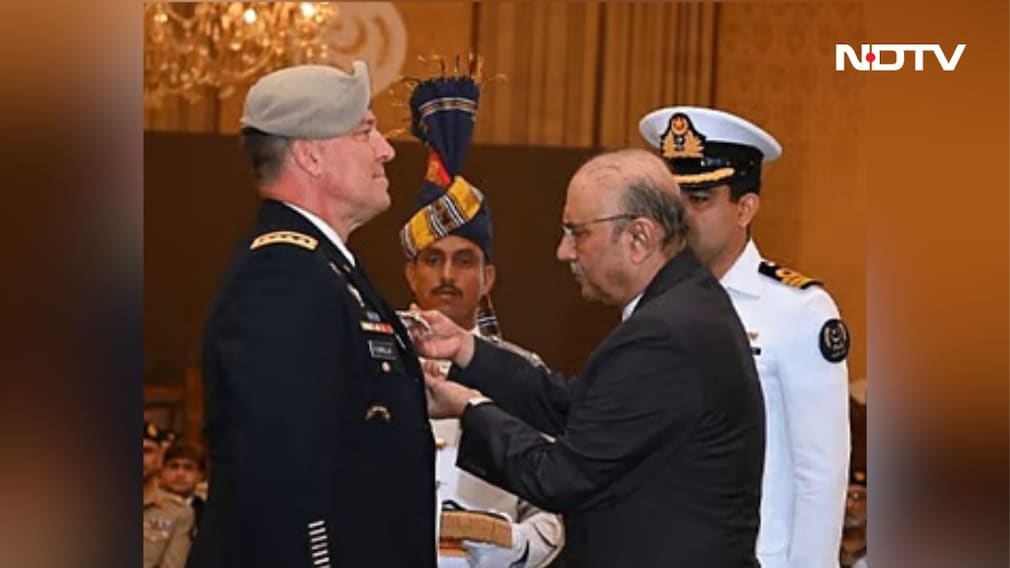
In terms of sheer turnaround in established policy, it beats description. Recently, the Pakistani Foreign Minister was in Washington, shaking hands with the US Secretary of State Marco Rubio, even as American delegations arrived in strength in Pakistan after years of being ignored by previous American administrations. Even heavier for the Pakistanis was the bestowing of Pakistan's highest military honour on General 'Mike' Kurilla. It's enough to make one wonder what the Field Marshal is up to.
Pakistan Brings Out the Champagne
The Foreign Ministry is, of course, portraying the whole saga as a success of no mean order. At one level, that is entirely justified. The Biden administration never invited even the Prime Minister of Pakistan, let alone meet any of their officials. Now there is the highly unprecedented lunch of a sitting Army Chief with the US President and his cringeworthy batting for a Nobel Peace Prize for Trump. Despite the US then bombing a 'brotherly' Muslim country next door - Iran - the Pakistani administration continued to bend over backwards to thank Trump for his 'pro-active role' for peace in the region.
And now comes the final, almost comical gesture: the award of the highest military honour for US CENTCOM commander General 'Mike' Kurilla. The sight of a US General representing the most powerful democracy in the world standing at attention in front of a powerless President Zardari is even more cringeworthy. As Kurilla well knows, it is Field Marshal Munir who is in charge, together with Inter-Services Intelligence (ISI) Chief Lt Gen Asim Malik as National Security Advisor. Earlier, Kurilla had praised Pakistan to the skies for its 'cooperation' in fighting terrorism - this after it handed over one lone terrorist allegedly responsible for a bombing of US troops as they left Afghanistan. This gesture apparently made up for the decades when it facilitated al Qaeda's top leadership on its territory and thereby was directly responsible for some 3,000 dead troops, over 20,000 wounded, not including 26 Central Intelligence Agency (CIA) personnel. Now, Pakistan is a 'phenomenal partner'. It's enough to make one gag.
Pakistan's Premature Ululations
Now comes the bitter truth. The read-out of the meeting between Dar and Rubio is terse and to the point, and sheds light on that mysterious lunch. It expresses 'appreciation' for Pakistan's 'constructive role in mediating conversations with Iran'.
That's interesting. As of last week, Pakistan-based Jaish ul Adl had claimed an attack across the border on a packed courthouse. Again, on July 28, Pakistan suspended road travel between the two countries. But here's something to note: not too long ago, Iran's General Mohsen Rezae had claimed that Pakistan had said that if Israel launched nuclear weapons at Iran, Islamabad would nuke Israel. In short, this is Pakistan at its usual game, playing all sides, one against the other. The US read-out also mentions counterterrorism operations against Islamic State-Khorasan; that means there's a US hand in Afghanistan, which has been resisting Pakistani pressures for quite a while. So, here, too, Pakistan gets its pound of flesh, not to mention possible funds for all of this, at the upcoming US-Pakistan Counterterrorism Dialogue in August. If the US doesn't get this, it needs to look up its files.
The Minerals Hook
There's another 'hook' to reel in the US. Rubio mentions "exploring prospects for enhancing collaboration in the critical minerals and mining sectors". Earlier, a senior State Department official had travelled to Pakistan - again, in April - to "advance U.S. interests in the critical minerals sector at the Pakistan Minerals Investment Forum". Naturally, he met with the Army chief, as did a US Congressional delegation, which included the co-chairs of the Pakistan Caucus, Congressmen Jack Bergman and Tom Suozzi. The irony inherent in this was the Pakistani interior minister's statement that his country "stood as a wall between terrorism and the rest of the world".
Meanwhile, it seems that Balochistan has the largest copper and gold resources in the world, according to the CEO of America's Barrick Mining Corporation, which is exploiting the Reko Diq mines. Balochistan reportedly has $6 to $8 trillion worth of untapped mineral wealth, including vital rare earth elements like dysprosium, terbium, and yttrium. The fact that the Baloch are being harried and killed by the hundreds doesn't seem to bother Washington at all.
The problem? China is also heavily invested in the same region of Chagai with not just its Saindak mine, but also a host of power projects, not to mention the Gwadar port. Beijing is not going to take such an ingress lightly, especially since its workers continue to be attacked in the province. Recently, the newly minted Field Marshal Munir was summoned to Beijing, where the declaration of 'iron brothers', etc, aside, it was rumoured that China was deeply unhappy with Rawalpindi's inability to protect its citizens.
Crypto Capital
There's more. Just after Operation Sindoor ended, a newly appointed Pakistani head for Crypto and Blockchain, Bilal Saqib, was touring the US, where he addressed an elite audience that included the Vice President JD Vance and Eric Trump and Donald Trump Jr, at the Bitcoin Vegas 2025 in Las Vegas. There, Saqib sold Pakistan as one of the largest freelance markets with 40 million cryptowallets. With a Minister of State rank and an Order of the British Empire under his belt, Saqib is 'sellable' abroad, especially as he also thanked Trump for his 'peacemaking' skills.
None of this crypto talk, however, was backed by Pakistani law, as the State Bank of Pakistan pointed out. It was not until July that an ordinance was promulgated by the President to establish a regulatory authority for the purpose. But Pakistan's regulations are a mess, and the need to push through an ordinance rather than a Parliament-based legislation is being questioned by critics and likened to the Army-controlled Strategic Facilitation Council (SFC), which is completely opaque in its dealings. Pakistan already had a crypto holding of about $10 billion, even before it was legalised, and ranked third in the Global Crypto Adoption Index in 2020-2021.
Consider that all this activity actually began in April, when the Texas-based logistics firm Fr8Technologies offered to help Pakistan in setting up blockchain products and crypto advice. The firm is linked to World Liberty Financial (WLC), which is owned by members of Trump's family. Since then, given the clear US interest in using Pakistan as a base for its crypto ambitions, other massive names like Binance have weighed in. Irony is that, knowing cryptocurrencies are much in use by terrorists and the criminal underground - as the Financial Action Task Force points out - the US deliberately chose a country that has loose financial oversight (at best) and is entirely army-controlled, to push in billions in potential investment. Nice.
Pakistan Has Overestimated Itself - Again
In sum, what is notable is that America's 'interests' in Pakistan - none of which may have anything to do with India - have preceded the Pahalgam attack. Even so, amid the choppy regional dynamics, there is one constant: Pakistan, as always, seems to have bitten off more than it can chew. To keep Iran, the US and China all happy at once - even as its debts to Beijing in just the power sector touch PKR 423 billion - may be too much even for its inventive powers. Something has to give.
Delhi's reason for worry is that the new Cold War has almost arrived in the West, even as it creates strong uncertainties towards the East. But every change has opportunities.
(Tara Kartha was with the National Security Council Secretariat)
Disclaimer: These are the personal opinions of the author
-
Mayawati's Tough Love: Nephew Akash Anand Benched Again. What It Means For BSP

Akash Anand, the 31-year-old foreign-educated nephew of BSP boss Mayawati, finds himself out of favour, for at least the third time in three years, with the latest turn coming in Lucknow on September 3.
-
Blog | Why You Should Care Whether Schrodinger's Cat Is Dead Or Alive
Imagine going on a romantic Alpine getaway and returning with the equation that runs the modern world. The only snag: nobody can quite agree on what it says about reality.
-
Promote, Punish, Repeat: Decoding Mayawati's Akash Anand Puzzle
The development in the BSP is unprecedented. Never before has any Indian party elevated a family member and dumped him or her unceremoniously thrice within a span of three years.
-
Opinion | Nepal Needs $5 Billion To Rebuild. World's Climate Fund Doesn't Have Even 10% Of It
The fund caps support at USD 20 million per project; Nepal needs two hundred times that. And the board is not scheduled to sit until December.
-
Opinion | The Rise Of Indians In US Is Making Some Americans Very, Very Angry
A new report released yesterday shows how Indians are now among the biggest targets of racist attacks in America.
-
Opinion | China, Pak, A Stalled India Visit: How Signals From Bangladesh Are Getting Louder
A fighter jet deal with China, interest in Pakistan's military bloc, and a 'stalled' visit to India - all in a month. Bangladesh's drift is getting harder to ignore.
-
Opinion | Indus Treaty, Hague, And Pakistan's Endless Search For Leverage Over India
If the IWT survived all the trials in the past, it is because India's threshold of tolerance had been unusually high. But Pakistan must know that it can't arm-twist India through international pressure.
-
Opinion | Nepal's 'Climate Compensation' Pitch Is Valid, But Its Demand From India Isn't
Nepal's vulnerability gives it a claim on multilateral climate finance. It does not follow that India bears responsibility for this.
-
Opinion | India Wants A 6th-Generation Fighter. But A Lot Could Go Wrong
India might just be building too many fighter jets to focus on any one of them well. A recalculcation is needed.
-
Reporter's Diary | Worse Than War: An Aerial View Of Nepal's Trishuli River Valley Tragedy
In many ways, reporting on natural disasters is far more harrowing than covering modern war