The Making Of Anand: Rajesh Khanna's Last Days As Superstar Before 'Lambu' Amitabh Bachchan's Rise
The legendary film director Frank Capra once said that tragedy is not when the actor cries, but when the audience cries. And how the audience cried for Anand
Hrishikesh Mukherjee never had to look far for stories. While other filmmakers chased formulaic drama or grand spectacles, he preferred to focus on the human heart.
To him, the ordinary struggles and quiet relationships of everyday people were the purest form of cinema. In his films, he found profound philosophy in ordinary moments.
On his death anniversary, as we look back at a legacy that drew career-defining performances from Amitabh (Abhimaan), Dharmendra (Satyakam), and Rajesh Khanna (Namak Haraam), we return to his absolute crown jewel: Anand.
More than a box-office triumph, Anand was a deeply personal emotional purging. By pairing the unstoppable superstar Rajesh Khanna with a script brimming with raw humanity, Mukherjee created a timeless masterpiece that taught generations how to truly live by showing us how to gracefully face death.
The Genesis Of A Masterpiece
Cinema often finds its path through unexpected turns. The character of Anand, a terminally ill man who chooses to spread joy because his time is short, was modelled heavily after the vibrant personality of Mukherjee's dearest friend, Raj Kapoor.
Initially, Mukherjee approached Shashi Kapoor and even the iconic Kishore Kumar for the part. When that fell through due to misunderstandings, the role landed on the shoulders of Rajesh Khanna, who was then swept up in the absolute frenzy of unprecedented stardom. Hearing the narration, Khanna loved it so much that he signed on at a lower market price just to work with the master filmmaker.
Shooting Anand was a race against time. Being the disciplined filmmaker that he was, Hrishikesh wanted to finish Anand very quickly. In 1970, Khanna had monopolised the theatres with a succession of hits, working round the clock like a machine and turning hysterical under the weight of his own success. He later admitted he didn't even know how to say "no."
One day Hrishikesh Mukherjee caught him in a reflective mood on his sets and asked, 'When was it last that you saw the sun rise, Kaka?'
Rajesh Khanna replied that he didn't remember.
Mukherjee again asked, 'And when was it last that you saw the sun set?'
Rajesh could only smile as the answer was evident. It was this rare, straight-talking wisdom that allowed Mukherjee to handle the reigning superstar's late arrivals and frantic schedules. He was one of the few directors who could get away with reprimanding the superstar over his starry tantrums.
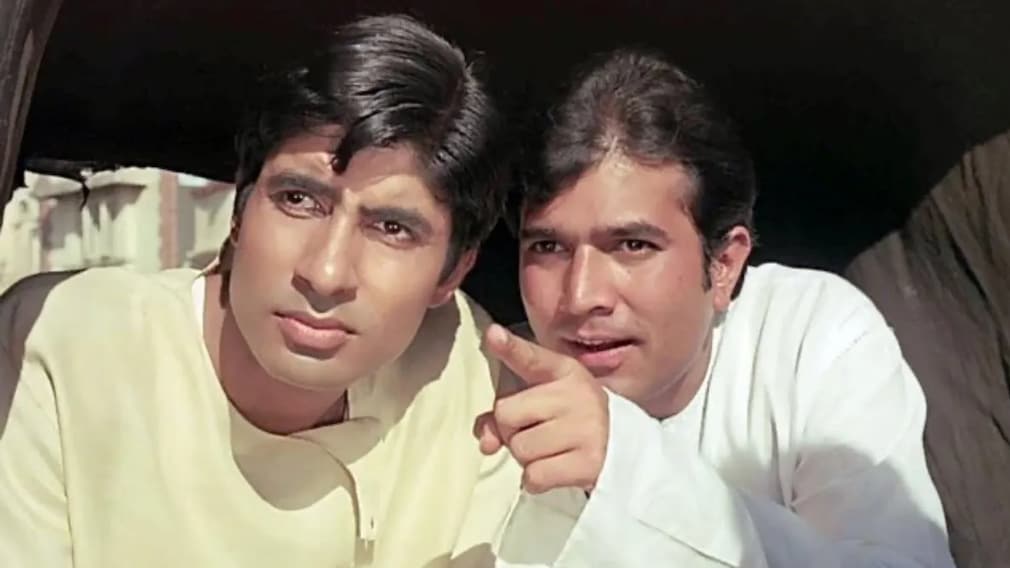
Amid this whirlwind, a young, tall, and lanky Amitabh Bachchan, who had made his debut the previous year, was signed to play Dr Bhaskar Banerjee. Bachchan would go on to work in several films with Mukherjee, delivering fabulous performances in each. Amitabh Bachchan, in later interviews, said that his celebrity status really started when he signed Anand with the superstar. He later recalled, 'I was being cast opposite him in Anand. This was like a miracle, God's own blessing and one that gave me "reverse respect". The moment that anyone came to know that I was working with Rajesh Khanna, my importance grew. And I gloated in its wake.'
Most of the shooting of Anand was done at Mohan Studio in Bombay. Hrishikesh Mukherjee actually shot the film in just a month's time. Rajesh Khanna was so busy shooting for so many films that he didn't have much of a clue as to what was happening on the sets of Anand. Actress Seema Deo, who played an important role in the film, recalled, 'He couldn't remember the lyrics of any song, so there would be a prompter sitting on the sets to tell him the lyrics; he would listen to each line and then lip-sync it, but no one realised this.'
It is difficult to believe that he was working round the clock, running from one shooting to another, while enacting his most memorable character Anand on screen. During the shoot, Hrishikesh Mukherjee would get angry at Rajesh's habitual late arrivals, but he would wait for the shoot to be over to express his anger. Actor Ramesh Deo recalls that Hrishi-da didn't want the scene to be affected: 'Rajesh used to enact the scene so well, that after the scene, Hrishi-da used to say, "Tumne itna aacha kam kiya hai, tumhe sau gunah maaf."' [You have done such good work that all your sins are forgiven.
The Beginning Of The Epic Rivalry
While researching my book on Rajesh Khanna, journalist Sudhir Gadgil recalled a fascinating episode he was witness to from the day of Anand's press screening. Rajesh Khanna was very excited about Anand. He wanted to show the film to the press and get good reviews.
A special show of Anand was organised in the Excelsior theatre near VT in Bombay, for the media. After the film got over, film journalist Devyani Chaubal came running to Sudhir and asked him to skip the food and go to the car parked outside. Chaubal knew Khanna since his early days of struggle. When Sudhir reached downstairs, he realised it was Rajesh Khanna's car. A few minutes later, Devyani sneaked out of the theatre with Rajesh Khanna and came straight to the car. Once inside, Rajesh Khanna inquired if she liked the film. Devyani looked at him for a few moments and said, 'Don't ever work with that lambu [tall fellow] again. Woh teri chutti kar dega [He will finish your career].'
It was clear that 'lambu' was a reference to Amitabh Bachchan. Rajesh Khanna was surprised at her reaction. He laughed and casually asked, 'Kya hua, us lambu mei aisa kya hai?' [What happened? What is so special about that tall guy?]
To this, Devyani answered, 'Have you noticed his eyes? Did you hear his voice? I am telling you, do not work with him again.' Apparently, Rajesh laughed and did not take her seriously, although Devyani tried her best to persuade him.
The Unforgettable Climax Scene
The film's ending had initially made the distributors apprehensive. They feared that audiences would be alienated by the tragic death of the lively Anand, and some even proposed a more commercial twist in which divine intervention would miraculously save him. But Mukherjee firmly believed that if Anand didn't die, the film would lose its entire philosophical premise.
The tragedy of the ending lay not simply in Anand's death, but in the sudden, raw vulnerability of his final moments. The man who had taught everyone around him how to embrace life was, at the very end, reduced to desperately pleading for a few more breaths. That devastating reversal gave the ending its emotional and philosophical power.
Hrishikesh Mukherjee informed his writer Gulzar to open the film in such a way that the audience knows in the first scene itself that Anand (played by the reigning superstar Rajesh Khanna) is dead. He did not want the audience to be in a state of suspense till the end and keep guessing whether Anand will survive or not. By doing that, Hrishikesh Mukherjee wanted to concentrate on the essence of the film: how Anand wants to live life to the fullest and make the best of the time he has.
And yet, the impact of the death scene was nothing short of phenomenal. It became an unforgettable cinematic moment. An epic climax that remains inseparable from the legacy of Anand. Even today, no discussion of the film feels complete without revisiting those final, devastating moments.
Towards the last scene of the film, all prayers and medicines have been exhausted to save Anand. The end is near. Anand, writhing in pain, finally shows signs of fear.
In a moment of extreme helplessness, Dr Bhaskar Banerjee rushes out to buy some homoeopathic medicine that he has heard about. By the time he comes back with the medicine in hand, Anand has passed away. Filled with extreme frustration and remorse, Dr Banerjee starts shouting at the dead body, 'Talk to me!' At that precise moment, a recorded message by Anand starts playing, 'Babumoshai... zindagi aur maut uparwale ke haath mein hai... usse na aap badal sakte hain, na main. Hum sab to rangmanch ki kathputliyan hain, jinki dor uparwale ki ungliyon mein bandhi hai. Kab, kaun, kaise uthega, koi nahin jaanta . . .'
Amitabh Bachchan, in his impeccable baritone, speaks the immortal line summarising the character, 'Anand mara nahi . . . Anand marte nahi.' [Anand did not die . . . a thought like Anand doesn't die.] And so, by the end, Anand did not remain a character any more. Anand becomes a philosophy of life.
In the past, director Hrishikesh Mukherjee had been an ace editor, editing films of the likes of Bimal Roy. Anand is a classic example of great editing mastered over time. The way he used the pre-recorded dialogue in the climax ensured the film and Rajesh Khanna's inclusion in Hindi cinema's roll of honour. The memorable dialogues were written by Gulzar; the elegiac poem 'Maut Tu Ek Kavita Hai . . .', narrated so poignantly by Amitabh Bachchan to explain the spirit of Anand,
The legendary film director Frank Capra once said that tragedy is not when the actor cries, but when the audience cries. And how the audiences cried for Anand!
That raw, collective heartbreak was the ultimate magic of Hrishikesh Mukherjee, a visionary who not only made movies but left behind a philosophy for life. Decades later, as the screen fades, his eternal mantra still guides us through the noise:
"Zindagi badi honi chahiye Babu Moshaye, lambi nahi!"
-
Why Nepal Is So Vulnerable: Glacial Lakes, And A Himalaya That Moves Constantly

The August 26 inland tsunami was not an accident of weather. It sat at the intersection of processes that make Nepal one of the most hazard-exposed countries.
-
IRGC's New Boss Is No Ordinary Man. Meet Ahmad Vahidi, Iran's Ultimate Survivor
He has survived purges, sanctions, assassinations, secret deals, and Iran's most consequential wars. The IRGC's new chief, formally appointed by Khamenei this month, knows the regime - and its enemies - like few others do.
-
Analysis | BJP's Mother Of All Resets: An Overhaul To Fix Its Perception Problem
The battle this time is to regain credibility as BJP has entered a phase which is going to be the launch pad for a national face after a political force called Narendra Modi.
-
Opinion | Why Is India Cooler As The World Burns? A Heatwave 'Mystery'
Europe, which is warming at more than twice the global average, is now bracing for even worse climate impacts. But something strange and unexpected is happening in India, keeping it cooler.
-
Tukaram Mundhe: The IAS Officer Restaurants Fear Most In Maharashtra
As FDA commissioner, Tukaram Mundhe has his eyes on Maharashtra's plate. Food adulterators, storied restaurants and clubs, dark stores of quick commerce platforms, school and government canteens, surrogate advertisers of banned products - no one is out of bounds.
-
3 Minutes, 6 Stanzas, Century-Old Debate: The Many Turns In Vande Mataram's Journey
PM Narendra Modi launched a year-long commemoration of the song's 150th anniversary on November 7, 2025. In December, both Houses held special discussions on it, during which the 1937 Congress decision was scrutinised.
-
Opinion | Sajjan Kumar, Congress, And How To Keep Messing Up An 'Apology'
A sitting Congress MP has termed Sajjan Kumar's death an "irreparable loss", calling him a man whose bond with the people of Delhi was "an example". This was a tribute, delivered in full sentences, to a convicted killer of Sikhs.
-
Explained: Why Tamil Nadu Dropped Second Airport Near Chennai
While the government stands firm with the protesting residents, Chief Minister Vijay assured that Chennai's aviation needs will not be ignored. The state will soon announce a detailed plan for a new airport at an alternative site, he said.
-
Opinion | A 'Snub' Gone Too Far? The Story Of Bangladesh PM's Stalled India Visit
The abrupt cancellation of Prime Minister Tarique Rahman's scheduled visit to New Delhi this month raises many questions.
-
Inside Pak's New Law That Has One Man Written All Over It: Asim Munir
With a new act, Munir has truly reached the apex. At least most politicians in Pakistan will hope so.