Opinion | How EVs Are Getting Smarter, Faster, And More Efficient
Tata Motors' Anand Kulkarni explains how smarter technology is reshaping the EV ownership experience.
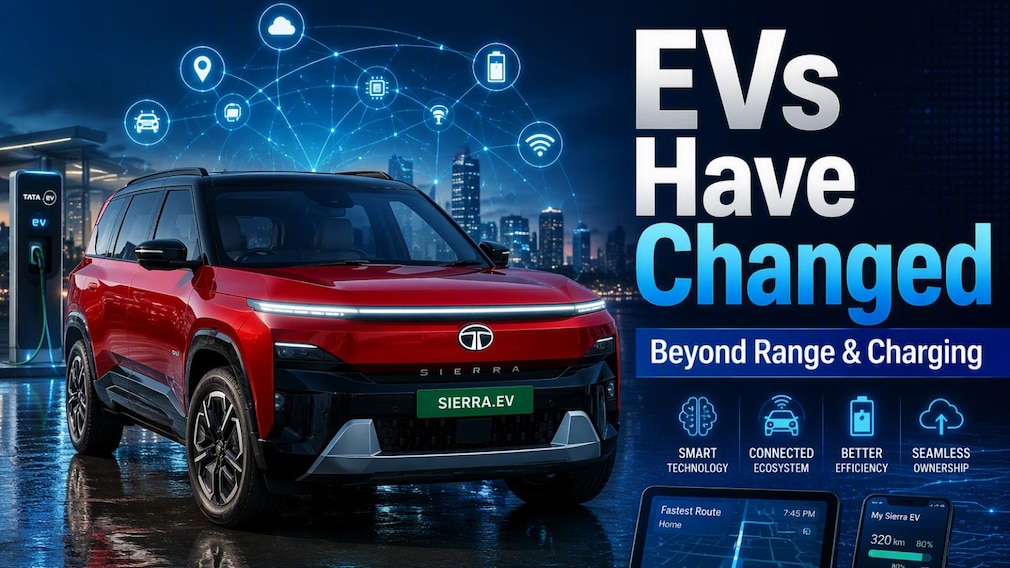
India's electric vehicle story has evolved significantly over the last few years. Not too long ago, the conversation was centered around range. Prospective customers wanted to know how far an EV could travel on a single charge and whether the existing charging infrastructure was ready to support wider adoption. But today, the conversation has broadened considerably. EV adopters are increasingly focused on how electrification fits into everyday life, how intuitive it feels to drive, and the value it delivers beyond the powertrain.
This shift in expectations is shaping the next phase of EV development.
Smarter Than Before
One of the biggest changes in modern EVs is the role technology plays behind the scenes. The real value of technology lies in helping customers get more from their vehicles while making the ownership experience more seamless. Much like smartphones have evolved from mere communication devices into intelligent assistants, EVs have become more adaptive to the needs of their users.
Many of the upgrades, which benefit customers are not noticeable right away. Innovations like advanced battery management, intelligent navigation, and connected ecosystems are enabling vehicles to be more responsive to real-world driving conditions.
Connected services enable the vehicle capabilities well beyond the driving experience. Features enabling customers to remotely monitor vehicle status, optimise charging schedules, and receive software updates over time are becoming part and parcel of everyday EV ownership.
The New Charging Mindset
One of the clearest signs of how far the EV industry has progressed is that charging is no longer the first thing intenders talk about.
Charging is now becoming a natural part of using an EV everyday - a clear endorsement of how the infrastructure has expanded and speeds have improved. The sentiment is now shifting from "Where will I charge?" to "When is it most convenient for me to charge?" - a clear signal of increasing ease of use and confidence in electric mobility.
Getting More From Every Charge
Range will always matter but there is a larger story behind that number. Today's EVs are getting increasingly better at using energy efficiently. Improved battery packaging and upgrades to regenerative braking are helping enhance real-world usability without necessarily needing larger battery packs. This means the consumer now experiences more flexibility and better usability in a wide range of driving conditions, clearly making electric mobility a more practical option for everyday driving.
Looking Ahead
The evolution of electric mobility is no longer defined by a single metric. The most successful EVs of the future will combine intelligent technology, efficient engineering and everyday practicality. They will anticipate customer needs, simplify ownership and continue improving long after purchase.
Electric mobility is increasingly being defined not by what it replaces, but by the new possibilities it creates. As technology, infrastructure and customer expectations continue to evolve, the ownership experience will become more seamless, capable and intuitive than ever before.
(Mr. Anand Kulkarni is Chief Product Officer and HV Engineering, Tata Motors Passenger Electric Vehicles & Tata Passenger Electric Mobility)
-
Tata Sons' Trust Issue: Two-Pronged Row Goes Beyond The Chair

NDTV Explains: Overtly, the latest conflict is whether N Chandrasekaran continues as executive chairman of Tata Sons. The controversy involves at least one more issue.
-
Opinion | US Has Institutionally Weaponised India's Russia Oil Dependence. Can New Delhi Cope?
A new legislation can connect India's Russian energy purchases to its access to the American market over a five-year period
-
Opinion | Saudi Allies Are Now Discovering The Cost Of 'Commitment' - And Not Liking It
The spectacular no-show by Saudi Arabia's two defence allies - Pakistan, a nuclear power, and Turkey, which has NATO's second-largest army - is astounding
-
12 Years Of 'Modinomics': What Changed, What Worked, What Didn't
There is no single Modinomics textbook or formula. Instead, the term has come to describe a collection of choices made during the PM Modi years.
-
Opinion | How A Tiny 0.4% UPI Fee Could Change How India Pays
The introduction of a fee can have a psychological effect beyond its immediate financial cost. Businesses that have come to view digital payments as free may begin to look for alternative - split payments, cash, and so on
-
Opinion | Rs 75-Lakh Bounty, New Jaish Base, And The Case Of Pak's Ever-Missing' Terrorist
Pak's yearly act is back: finding Masood Azhar. But there are other questions FATF must be asking next month as it meets
-
For Years, Saudi Saw Houthis As Yemen's Problem. Then, A Knock On The Door
Actual fighting between the Houthis and Saudi Arabia began late in the overall timeline of the conflict that now involves powerful belligerents
-
Lal Topi, Blue T-Shirt: Akhilesh Yadav's 'PDA' For Blue Has A Coded Message
The message is clear: the Samajwadi Party wants to talk to voters beyond its traditional Yadav-Muslim support base, particularly to Dalits.
-
The Day 600 Men Lay Siege To Islam's Holiest Site And How They Were Gassed Out
Nearly 47 years ago, on November 20, 1979, the Grand Mosque itself was seized by an armed group in one of the most extraordinary episodes in modern Saudi history.
-
New UPI Charges: If Digital Payments Save Money, Why Charge For Them Now?
UPI Payments Free For Years: The government has subsidised UPI adoption for years. Official figures show thousands of crores in payouts over years.