After Meeting Donald Trump, France's Macron Reveals The Endgame In Ukraine
Ukraine War Ceasefire Deal: The war in Ukraine completed 3 years on February 24. Thousands of Ukrainian citizens have died and over 6 million live as refugees abroad.

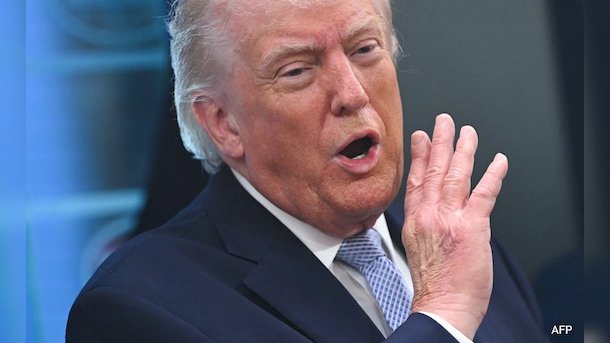
After an hours-long meeting with Donald Trump in Washington DC, French President Emmanuel Macron laid down the endgame in Ukraine, suggesting that a peace deal or ceasefire agreement is highly likely in a matter of weeks. He also spoke in detail about his meeting with President Trump and what the outcomes will be.
President Macron was representing all of Europe at today's meeting with President Trump, since Europe shares a common concern over its security. Mr Macron had held a meeting with top leaders of the European Union in Paris last week while Russia and the United States were holding a meeting over Ukraine in Saudi Arabia.
European leaders who huddled up in Paris voiced their concern - that a US-Russia direct deal on Ukraine will ignore Europe's concerns on security. They echoed the same sentiment - that talks on the Ukraine war cannot happen without Ukraine and Europe.
THE ENDGAME SEQUENCE
Donald Trump has said that the three-year-long Ukraine war will end within weeks, and President Macron shared his optimism. Calling the arrival of President Trump to negotiations on Ukraine as a "game-changer", the French President said "he (Trump) knows how to re-engage with Russia with the full deterrence capacity of the US".
Mr Macron however cautioned the US President not to rush into a deal with Moscow. "In 2014, we had a peace deal with Russia. I can tell you from personal experience, since I was one of the two members along with German representative to follow up on the ceasefire. Russia grossly violated every single time - and none of us reacted collectively. So, the issue is of trust and credibility - how to ensure Russia does not do this again," he said in an interview to Fox News.
He went on to say that "For me the sequence of the ceasefire agreement should be as follows - First, there should be a negotiation between the US and Russia and then the US and Ukraine. President Trump has announced today that he is willing to have a short-term meeting with Ukraine's President Zelensky - this is super important."
"A truce could actually happen in the weeks to come," he said, adding that "Truce has to be achieved on land, in the air, and at sea, and infrastructure (installed in Ukraine) - and Russia must respect it. If it doesn't, it will be clear that Moscow is not serious about a peace deal" and Ukraine's sovereignty.
On Fox News:pic.twitter.com/1dBUFDEOYW
— Emmanuel Macron (@EmmanuelMacron) February 25, 2025
"During this period of time - when the truce is in place, we negotiate - on security guarantees (by Moscow), on land and territories (to reclaim or surrender), and it will be the responsibility of the Ukrainian President (to safeguard Kyiv's interest)," President Macron said.
"For the United States," he said, Washington "will secure a deal on rare earth and other critical minerals". Confirming that France and the rest of Europe will be fine with this, Mr Macron explained that such a mineral deal for Washington "is important, because this would be the best way to guarantee that the US is also committed" and not back out of Ukraine's safety and sovereignty.
And on the back of these set of manoeuvres, with all parties invested in maintaining Ukraine's sovereignty, we will finally have a peace deal, he explained.
KEY STEPS AFTER THE CEASEFIRE
"But how can one guarantee that Russia will not violate this treaty in future," the French President questioned before giving the answer himself. "There is no consensus for NATO, or having Ukraine join NATO, but if we (European NATO members) leave Ukraine alone, like we did in the past," there is a risk for another invasion by Russia, he explained.
"So, as a follow-up to the ceasefire, we need to see which type of security guarantee we need going forward. One can be to increase the capacity of Ukraine to maintain a very strong army (on the Russian front). The second option will be for France and the UK to work together on a proposal that the two nations will send combined troops to Ukraine - not to go to the frontline, not to go on confrontation, but to be stationed at locations agreed upon by the treaty that all parties approve of. The aim will be just to maintain a troops presence in Ukraine to keep a check on Russia's credibility. Of course, this will be with the backing of the US," he said.
On Europe's responsibility and the sharing of costs, which President Trump has said is "absent", President Macron said "We (Europe) are ready to take our fair share of the burden, since it is in Europe. I have already spoken with around 30 European leaders, and a lot of them are ready to be a part of such a defence structure. But Europe wants a guarantee and solidarity from the US that if there is a violation by Russia, and if Ukraine or Europe is attacked, then the US will back us."
"I discussed this with President Trump this morning and he very clearly announced it. If we have this guarantee and solidarity from the US, then I think we have a deal," he said.
The war in Ukraine completed 3 years on February 24. Thousands of Ukrainian citizens have died and over 6 million live as refugees abroad. Military losses have been catastrophic, although they remain closely guarded secrets. The estimated cost to rebuild Ukraine's economy after Russia's invasion has risen to $524 billion, nearly three times its expected 2024 economic output.
-
Hit Songs, Empty Pockets: The Hidden Math Behind India's Viral Music Boom

Over 80,000 brands and five lakh creators in India make branded content. The opportunity is worth around Rs 1,500 crore.
-
Opinion | Great 'Exceptions': How The Oil India Was Attacked For Is The Oil Trump Now Seeks
A law written to punish the buyers of Russian oil was suspended by the US to protect a purchase of Russian oil. India spent fourteen months being lectured for less.
-
Opinion | Louis Vuitton Loot, Torched Cars: France Protests Have An Unlikely Beneficiary
It's an unbelievable moment. Crowds looting the most exclusive stores in Paris, including the famed Luis Vuitton. But what's behind this meltdown?
-
Blog: Kolkata Didn't Learn From 2015. Eleven Years Later, It Proved To Be Fatal
The City of Joy isn't a stranger to crowd control. Be it during Pujo or Christmas at Park Street, Eden Gardens cricket matches, or Derbies between Mohun Bagan and East Bengal. But during Pujo, the entire city is on alert.
-
Opinion | Slurs, Threats, Now A Temple Attack Plot: When Did America Become So Hostile To Indians?
The rising tide of anti-India, anti-Hindu, and racist attacks serves as a stark reminder that economic prosperity does not automatically guarantee social immunity from bigotry.
-
A Step Behind Neha Bora: What Rahul Gandhi's Gesture Says About Congress' Gen-Z Pitch
At INDIA bloc's march to Supreme Court, Rahul Gandhi placed himself a step behind two women, hands resting on their shoulders. One was his sister Priyanka. The one on his right was Neha Bora. Here's what the image means for the protest wave now, and for Rahul's politics in general.
-
Opinion | Imran Khan, And The Perils Of Having An 'Opinion' In Bollywood
The reality of the industry is quite grimy. More often than not, its inhabitants have been fairweather friends, happy to sing the praises of whoever is in a position of authority.
-
Exclusive: India's Food Safety Problem Goes Beyond Just Dirty Kitchens - By Tukaram Mundhe
On World Food Day, Maharashtra's Commissioner of Food Safety explains why instead of taking stopgap measures, the entire supply chain in India needs to be held accountable and made transparent.
-
Opinion | India Has Enough Coal. So Why Are Power Plants Running Short? A 76 Million 'Crunch'
As of October 5, as many as 82 of the 191 thermal plants monitored by the Central Electricity Authority were in the 'critical' category
-
Opinion | Starlink, India, And Why Elon Musk Must Know His Billionaire Tantrums Won't Work
India should neither be intimidated by Musk's global influence nor distracted by his theatrics.