Celebrities Are Shattering The Biological Clock: Here's What They Aren't Telling You
 Instagram
"The biological clock is ticking." For decades, the number 35 hung over women's heads like a silent alarm. Turning 30 typically triggered a quiet panic to settle down, freeze time, or compromise on life goals before an invisible door slammed shut. As a result, every woman knows the sound of the imaginary clock ticking inside her body. Today, however, the clock is being publicly disassembled in real time. Look at any red carpet or Instagram feed today, and the biggest flex isn't bouncing back after giving birth, it's announcing a pregnancy in their 40s. From Anne Hathaway and Hilary Swank to Katrina Kaif and Kareena Kapoor Khan, stars across Hollywood and Bollywood are rewriting the rules of motherhood.
This major shift highlights that the best time to build a family isn't dictated by a calendar, but by readiness. But what's the missing piece of the puzzle here? Is the biological clock a myth? Are celebrities telling us the whole story, or are everyday women being unintentionally misled?
Well, the answer isn't simple.
Undoubtedly, eliminating the fear around the biological clock is a massive win. It allows women to focus on their careers, education, financial independence and personal goals without feeling like they are running out of time. Many women deeply aspire to embrace motherhood, just not in their 20s or early 30s. However, the declining egg quality and quantity often force women to make hurried decisions, stop everything else and focus on getting pregnant exactly when they are not physically, mentally or financially ready.
Several celebrities have played a significant role in demystifying the timeline surrounding fertility. Stars like Priyanka Chopra, Mona Singh and Ekta Kapoor have shared their experiences of freezing their eggs in their 30s. Long before this became mainstream in India, filmmaker Farah Khan normalised IVF after welcoming triplets at 43.
But the biological clock isn't a myth. Human biology is still the same.
For the unversed, the biological clock refers to the natural, age-related decline in a woman's ability to conceive. In medical terms, a biological clock refers to ovarian ageing.
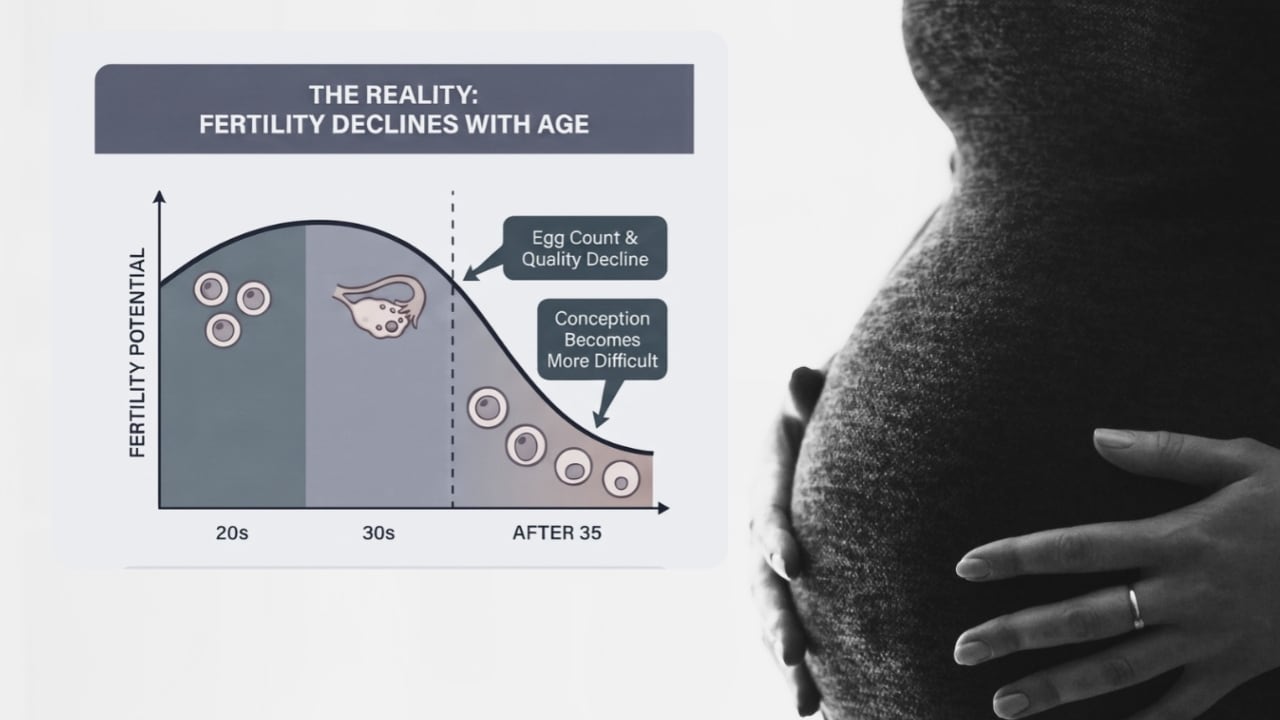
Women are born with all the eggs they will ever have. Unlike men, who continually produce new sperm, a woman's supply of eggs decreases steadily from birth until menopause. Only about 12% of a woman's pre-birth egg reserve remains by age 30.
As eggs age, they are more prone to defects during cell division. This leads to higher rates of chromosomal abnormalities, which not only makes fertilisation harder but also increases the risk of miscarriage.
According to the American College of Obstetricians and Gynaecologists (ACOG), female fertility peaks in the late teens to late 20s and begins a gradual decline around age 30. The decline speeds up in the mid-30s, and getting pregnant naturally becomes unlikely by age 45.
"The biological clock remains an important factor, regardless of how frequently we see celebrities embracing motherhood in their late 30s and 40s. A woman's egg count and egg quality decline with age, particularly after 35, making conception more difficult. Celebrity pregnancies can help normalise later motherhood, but they should not create the impression that age-related fertility concerns no longer exist," says Dr. Niti Kautish, Director - Obstetrics & Gynaecology at Fortis Hospital, Faridabad.
"This trend has motivated a large number of women to focus on education, work, financial independence and other personal goals before starting a family. That said, it is important to remember that pregnancy announcements from celebrities don't always show the whole picture," highlights Dr. Kanika Agarwal, Director & Unit Head - Obstetrics & Gynaecology, Max Super Speciality Hospital, Noida.
Dr. Agarwal also emphasised that reproductive health varies greatly from one person to another, thus, age and fertility issues must be taken into account when deciding on the timing of motherhood.
You don't know the whole story: The science behind delayed pregnancies
If female fertility drops sharply after 35, how are celebrities getting pregnant and delivering babies in their mid-40s?
The answer lies in the quiet revolution of reproductive medicine. From egg freezing in one's early 30s to advanced IVF and genetic embryo screening, modern science allows women to press pause on biology in ways previous generations never could.
- Egg freezing: When a woman freezes her eggs at 31 and uses them at 44, her body carries the pregnancy, but the embryos carry the genetic profile of a 31-year-old.
- IVF and genetic screening: Advanced In Vitro Fertilisation paired with Preimplantation Genetic Testing (PGT-A) allows doctors to screen embryos for chromosomal health before implantation, dramatically improving success rates for older mothers.
- Donor eggs and surrogacy: For women welcoming children in their late forties or fifties, like supermodel Naomi Campbell, donor eggs or gestational surrogacy are frequently the silent pillars.
Both the doctors highlight that the circumstances behind celebrity pregnancies are not always publicly known, including whether fertility treatments were involved.
"Such announcements can set up unrealistic expectations among women undergoing fertility treatments, as it may lead them to believe that there is a higher likelihood of naturally conceiving in their mid-to-late 40s. As a result, consultations become delayed, and women seeking information or assistance face a lot of disappointment when they discover that getting pregnant at their age comes with various complications," adds Dr. Agarwal.
So is pregnancy after 40 a big NO?
No! Pregnancy after 40 is possible. "But it requires more careful planning and monitoring. Compared to younger women, there may be a higher risk of miscarriage, chromosomal abnormalities, gestational diabetes, high blood pressure and preterm birth," says Dr. Kautish.
However, she also clarified that "age alone does not determine the outcome, and many women have healthy pregnancies with appropriate medical care."
When it comes to natural conception, the chances decline considerably with age. "At 40, the probability of conceiving in a single menstrual cycle is around 10% or lower. At 42, the chances are significantly lower, while natural conception at 45 is unlikely, though not impossible," states Dr. Kautish.
Additionally, "the precise likelihood can differ from woman to woman based on the ovarian reserve and fertility health," mentions Dr. Agarwal.
Does late pregnancy affect a woman in the long run?
Advanced maternal age, which typically refers to women aged 35 and older, requires careful medical supervision due to the increased risk of potential complications related to this age group. Among other factors, women aged 35 and older are more likely to develop gestational diabetes, hypertension, preeclampsia, placental abnormalities and undergo a Caesarean section. Some of the pregnancy-related conditions such as gestational diabetes and hypertension may also increase the risk of developing type 2 diabetes and heart disease in the future.
"Nevertheless, this does not imply that adverse outcomes will occur. Preconception counselling, examination of the patient's medical history, regular progress checks, proper nutrition, and postpartum follow-up help to prevent probable complications," adds Dr. Agarwal.
Every body is different
Not every woman hits menopause right after the age of 45 years. Genetics, current health status, pre-existing health conditions and overall well-being play a crucial role in determining the actual timing of the breakdown of the biological clock.
Fertility specialists recommend that women in their late 20s or early 30s ask their gynaecologists for two simple baseline checks: an AMH (Anti-Mullerian Hormone) blood test to estimate their remaining egg reserve, and an Antral Follicle Count (AFC) ultrasound. Having concrete data replaces guesswork with informed confidence.
Dr. Kautish shares a powerful message saying, "Women should make reproductive decisions based on their health, fertility assessment and personal circumstances rather than celebrity announcements or any other external factor."
"If pregnancy is being considered after 35, consulting a gynaecologist early is important. After 40, fertility evaluation should not be delayed. The aim is not to create fear around age, but to help women make informed decisions with realistic expectations," she adds.
\r\n
\r\n
Disclaimer: This content including advice provides generic information only. It is in no way a substitute for a qualified medical opinion. Always consult a specialist or your own doctor for more information. NDTV does not claim responsibility for this information.